CABAHS members share photos from their gardens.
Members, please send in photos of your garden or a particular plant or flower in your garden, to be included here.
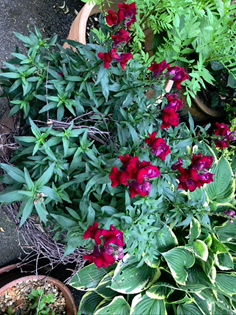
Supporting plants in a timely manner has been one of members’ New Year’s resolutions on more than one occasion. I remember one reading: to support plants before they fall over!
But how to do it in a way that is both attractive and unobtrusive? In addition to which, you have to find the right materials. I have long been an admirer of the ‘birch halos’ used by Sarah Raven and at Great Dixter, for example, but had never attempted to create one.
This year I managed to find myself a pile of birch twigs and, inspired by the clear instructions in Arthur Parkinson’s book The Flower Yard, I had a go.
As you can see from the Antirrhinums, although not quite on the same level of skill, my efforts are doing the job and don’t look too bad!
I wonder what other attractive supports members have found for themselves?
CABAHS member Jean R thinks her garden is out of control! She says:
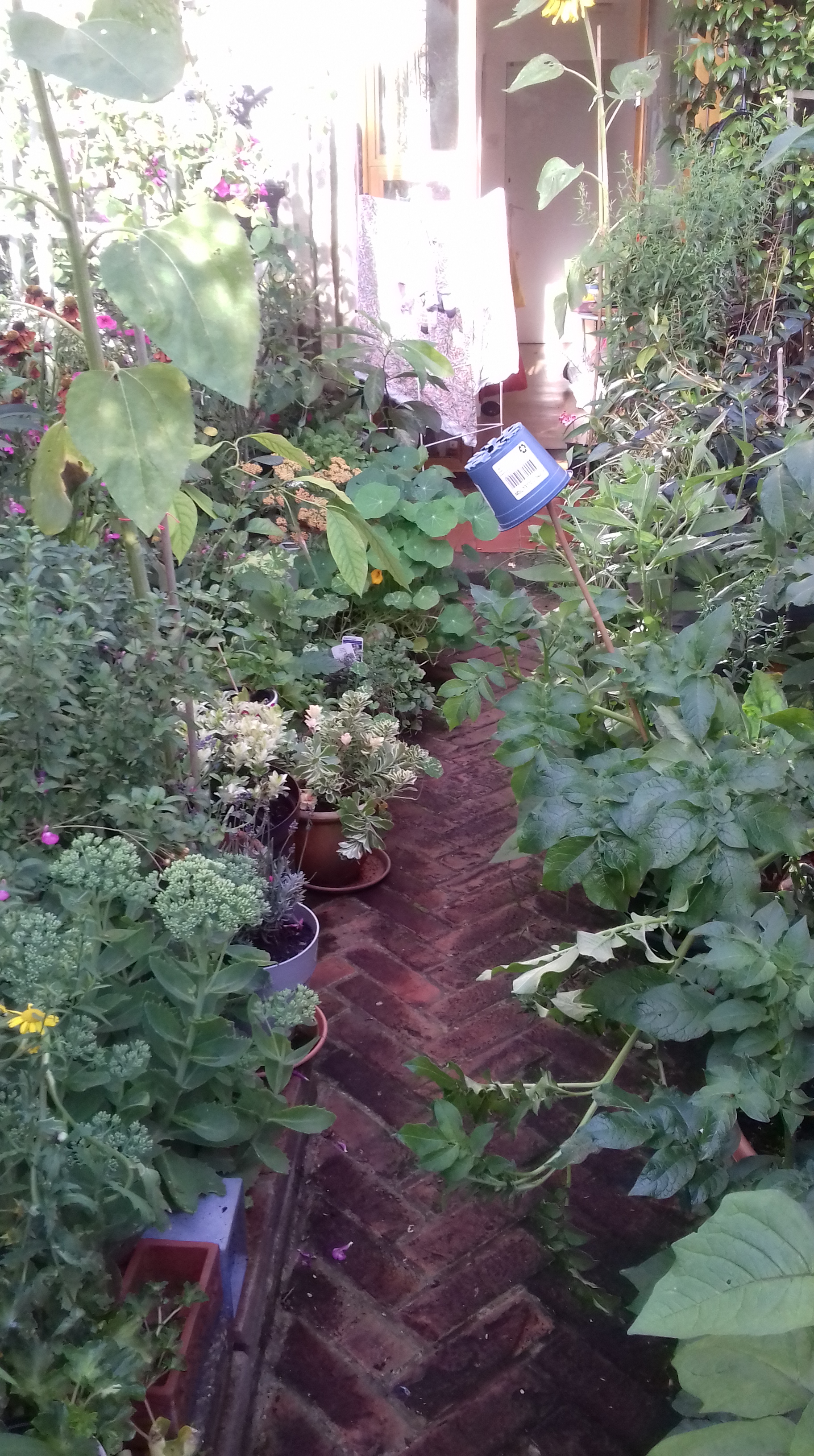
I’m a true amateur gardener and have watched aghast as nasturtiums, chinese lanterns and the leaf cutting bee have almost destroyed all my carefully laid out spring plans! In fact I love those bees, but do they really need so much leaf to line their nests? I also love nasturtiums and Chinese lanterns, but how dare they spread so prolifically!
Then to cap it all, intrepid visitors searching for my garden path find that only a sideways crab-like advance is possible to reach my front door! You can spot my front garden in Vanbrugh Park if you are passing by…….
Jean’s front garden path (somewhere in there)
Evidence of Jean’s leaf cutting bees!
An unusual shrub in Kathy’s garden – this is Sphaeralcea (Globe Mallow) Newleaze Coral. A real toughie, it loves this dry sunny weather.
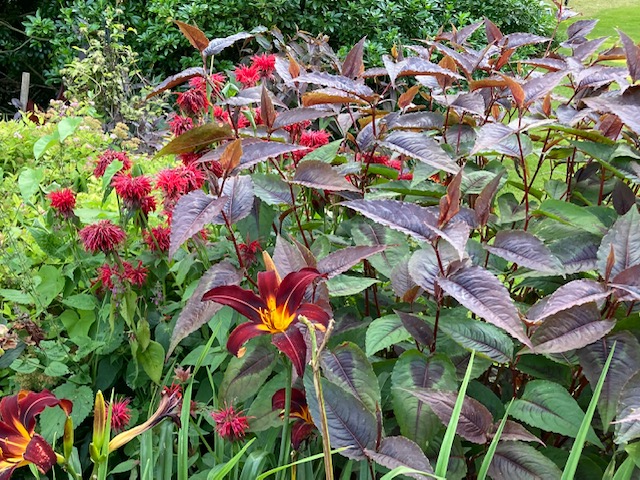
This is Angela’s pretty Monarda (bee balm), the photo doesn’t really show it but Angela says it is now 5 feet tall!
Rambling Rosie looking great in Carolyn’s garden. Love the name, really suits it!
A selection of photos of Ruth & Matthew’s beautiful garden ‘The Gatehouse’. CABAHS members attended a lovely open evening, wandering around their garden recently, with donations in aid of the Hospice.
The Gatehouse bordersRoses (red one is WB Yeats) grown in a bed in the shape of a Tudor Rose
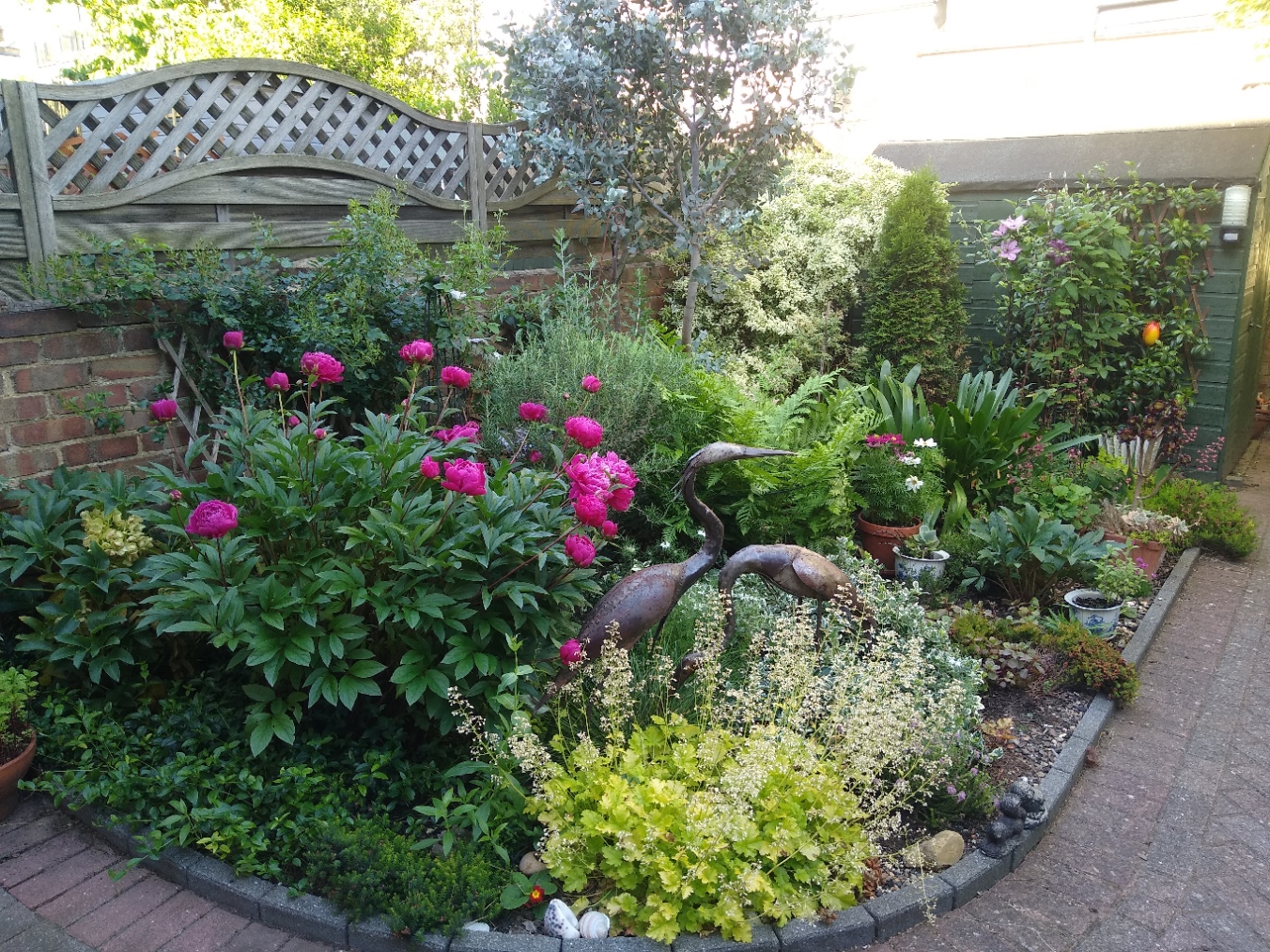
Here is Carolyn’s lovely peony before it was battered by the recent rain storms! And a picture of her lovely clematis Hagley’s Hybrid.
This is our Treasurer Ron’s lovely rose “Tender Loving Care”. Must ask him for some cuttings!
Wonderful Echium towers in Mike’s garden in Eltham, which he opened to raise funds for the Hospice Open Gardens scheme.
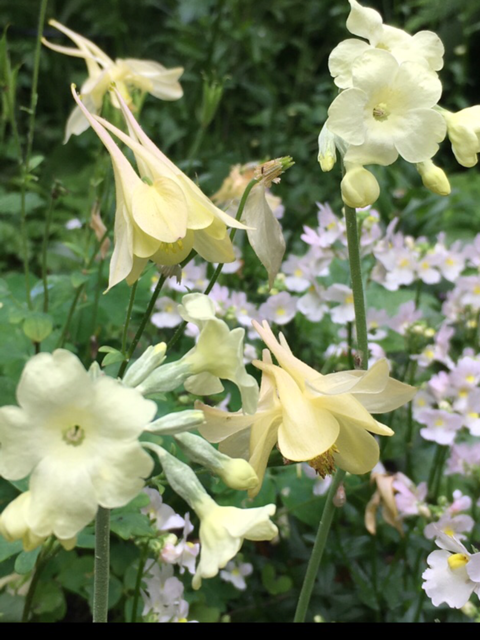
Member Sharon has sent these two pictures in. She says: “My favourite flower in the garden at present is a cream, fragrant Primula Alpicola. The scent is divine! It grows next to Aquilegias and Nemesia Wisley Vanilla. The best part about this little primula is that I bought it at the CABAHS plant sale in the Old Pond Garden held last summer 2020. Does anyone recognise this as a plant they brought in for sale? Thank you, I am very grateful.”
Here is Jillian’s favourite rose “Rhapsody in Blue” looking wonderful this June.
Libertia is doing its thing in Kathy’s front garden. Idea copied from a lovely dry garden at Winchelsea’s NGS open gardens a few years ago. This year the spiky leaves took a real hit from the cold Spring winds, and look sadly brown, but lots of nice new green ones are coming up from the base.
Hosta heaven and lots of spring colour in Vija’s garden. For slug control, she recommends the Gardeners World recipe for garlic spray (see Here we go gathering slugs in May).
Here is Annie’s colourful Spring garden view.
This is a little frog in Annie’s garden – she raised frogs from tadpoles in a bucket in 2019, so this might be a returning one!
On Sunday I picked 22 slugs off my small hostas (just to reassure readers, I don’t do this regularly – I do have other things to do!). With the advent of damper weather they are really starting to show themselves. For those who love growing hostas, slugs and snails are probably the biggest pests and even the giants like Sum and Substance and Big Daddy are not always immune to their predations. Growing in a coarse medium, or using environmentally friendly slug pellets, doesn’t necessarily solve the problem because slugs are smarter than you think. If necessary they will abseil down a neighbouring plant to get at the leaves of your hosta, so anything at ground level will not always stop them.
Preparatory products have been, rightly, removed from the market as they have proved toxic. A garlic wash has long been recommended as an alternative and I have used this myself in the past.
When I recently bought some new hostas (those of you who know my garden might wonder why I need any more, but I justified the purchase on the basis that one was a replacement for Dancing Mouse and the other was a gift) the recipe for a garlic wash was included with the plants, which I thought I would share with you. Please see below.
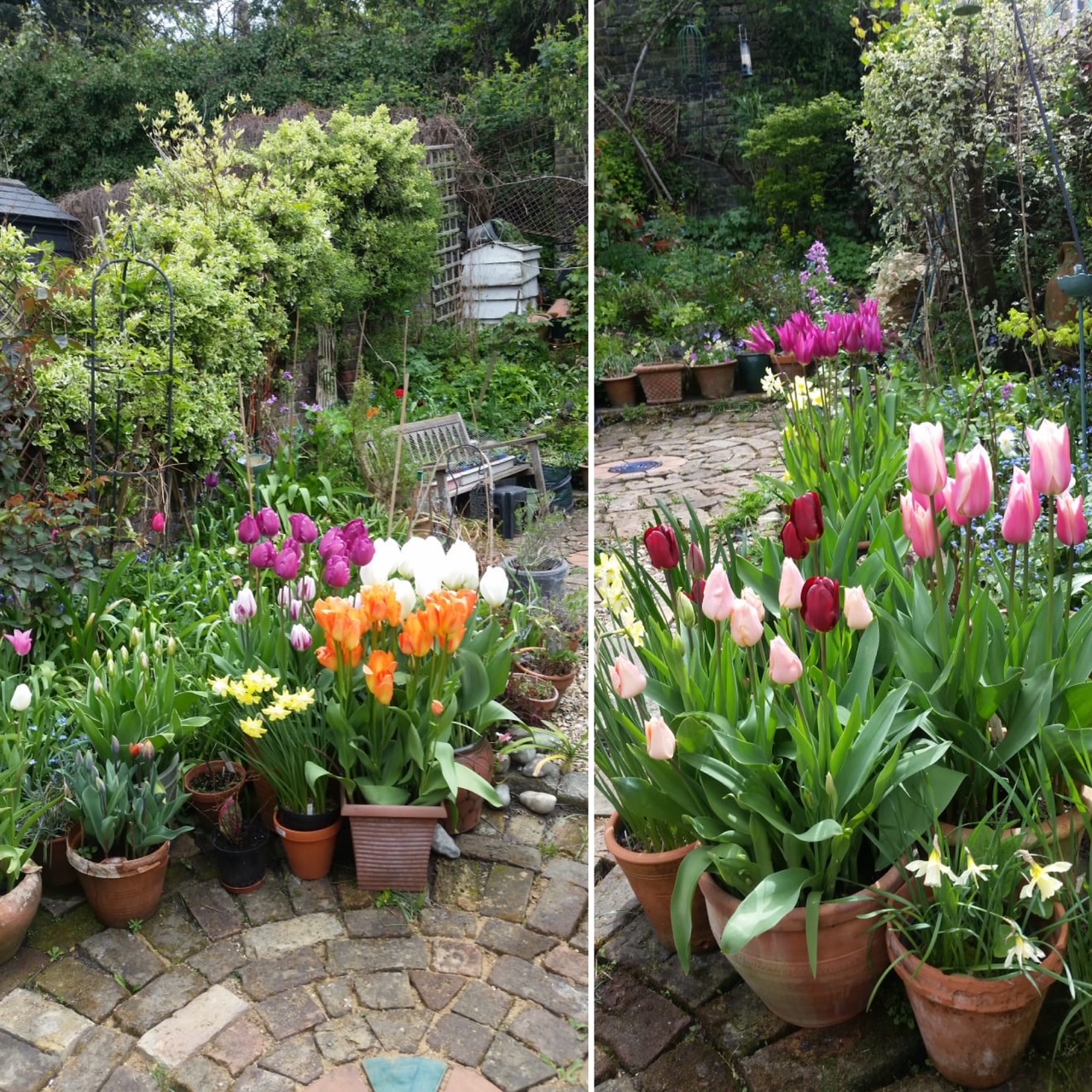
Here is Pat’s Spring garden, the squirrels have left her some tulips then!
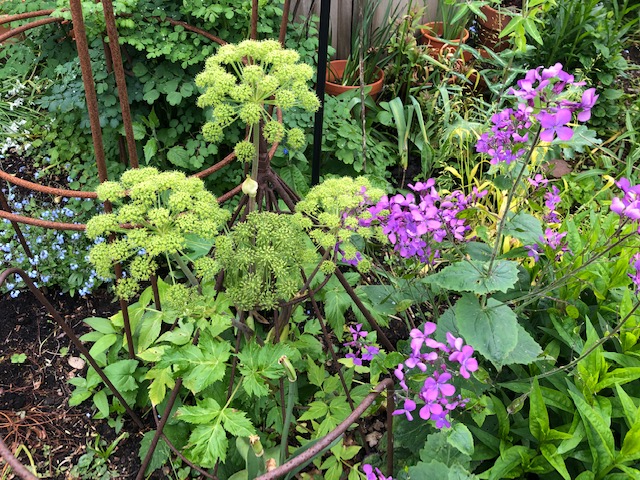
This is a selection of colourful plants from Elizabeth’s garden:
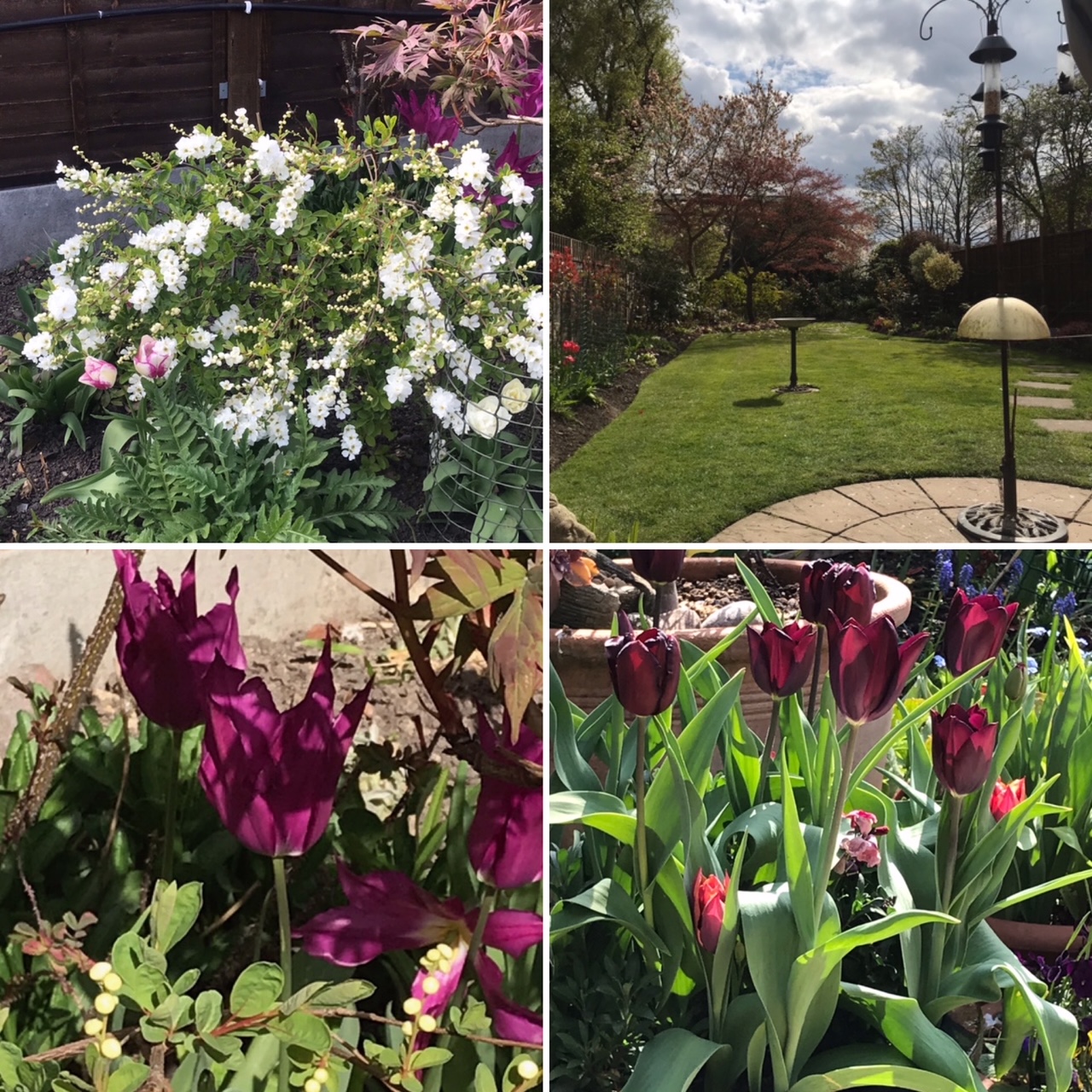
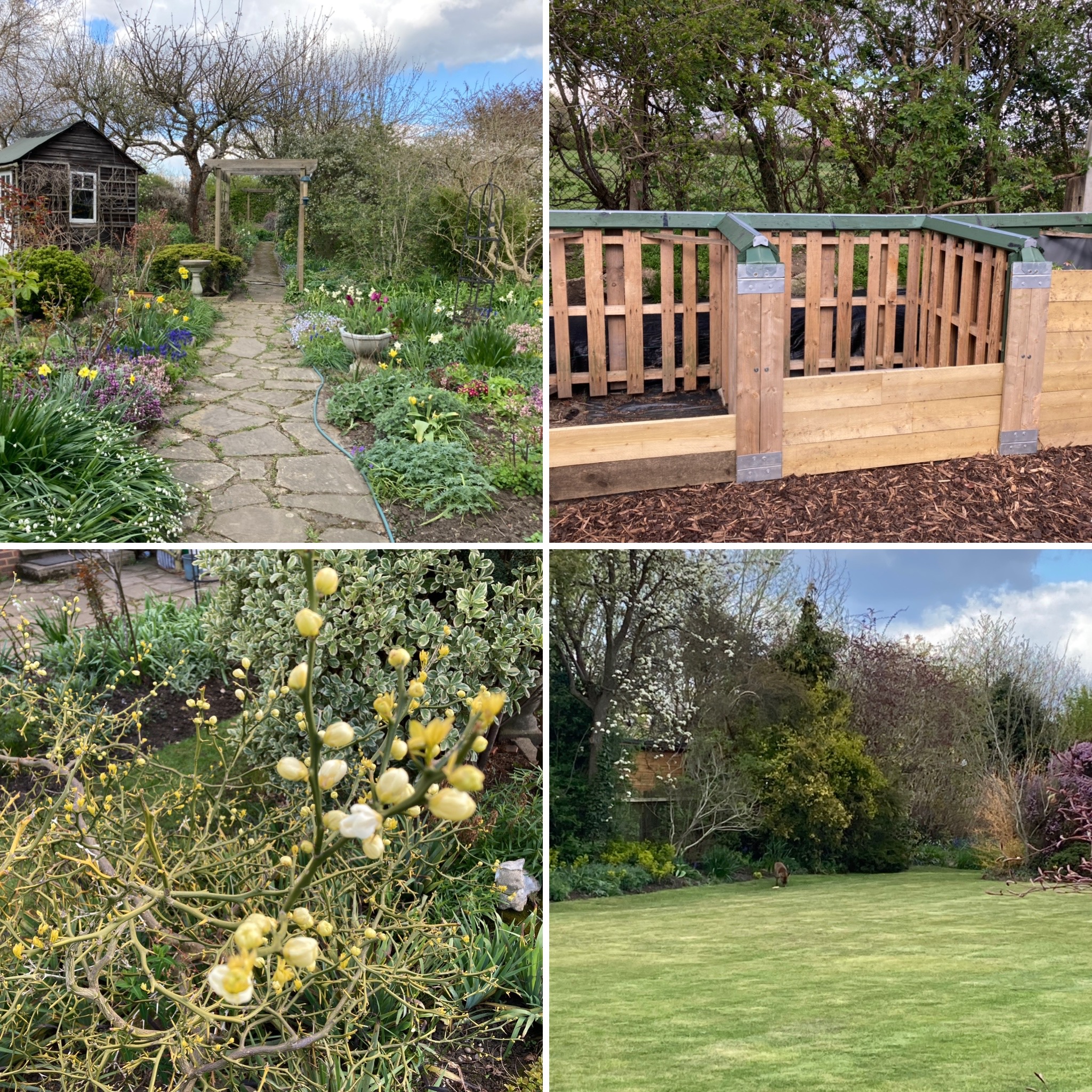
Here is Jillian’s garden in the Spring sunshine. She has some new compost bins to die for! The unusual shrub (bottom left) is a bitter orange or Ponceris trifoliata, it has vicious thorns but beautiful flowers.
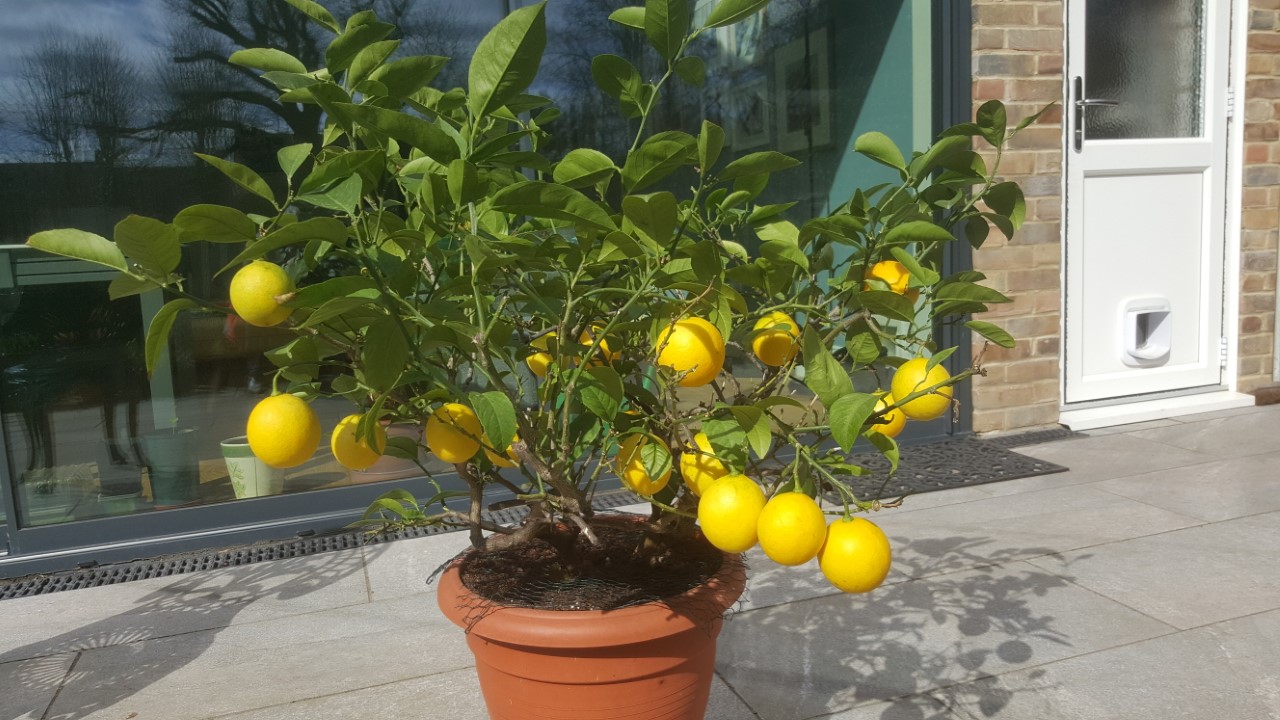
Hugh has sent in the picture below – he says: This is a “Meyer Lemon” and it is probably 30 years old now. There are 18 lemons on the tree this year which is enough for 36 gin and tonics! The fruit are delicious and the blossom in spring is really very fragrant.
Meyers lemons are not frost hardy so I bring it indoors every winter but this year it has become a bit confused and seems to have ripened over Christmas. As we do not have a conservatory in our new house it has spent the winter in our bike store cupboard. This is not heated but seems to obtain some warmth from the house and it only has obscured glass in the doors.
Sometimes the fruit take over a year before they are ready and often the tree is in flower again before I have picked all the fruit from the previous season.
Every year is different and it has looked like dying a couple of times but this year has truly been a record year. I can well recommend it!
Look who has been visiting in Sharon’s garden in Shooters Hill? She says she is so pleased she left part of her garden for the wildlife, and this is her reward! He’s been hibernating in a leaf pile and came out to enjoy the sunshine today. He has been scrubbing around in Sharon’s garden and then wandering through the beech hedge into her neighbours. Oh the advantages of a Wildlife corridor, we should all make one!
Shown below is Angela’s beautiful Clivia in full bloom. Angela says this one is a division from her main plant, and is one of her favourite indoor plants as it needs so little care and attention.
I have had a worrying time recently, and have bored my husband half to death with my constant observations along the lines of “I wonder if one has arrived yet?” and “Perhaps today is the day”.
As we are awaiting the appearance of our first grandchild, you might think that’s the reason for my anxiety? Well of course that’s very important, but in fact the problem has been that for the first time in 30 years, the toads have not arrived in our pond.
I have been pondering (ha! pond-ering) whether it is the new fence that has stopped them or whether I have been too tidy in the shrubbery and whether I should not have got rid of the overgrown irises at the pond edges. To try to make amends, I have crawled along the new fence and created nice deep tunnels underneath (to the interest of my two terriers and the annoyance of my husband, who has no engineering knowledge and thinks this will weaken his expensive fence).
My neighbours on the other side have known me for a long time, so they have already assured me they will put any lost toads they find through the hole by our shed so they can find their way home.
Toads can travel up to 2 km to come back to the pond they grew up in to spawn, so imagine how many fences and what obstacles we humans put in their way on that journey? They live about 10-12 years, so in theory you should get more coming back each year. I am afraid my little band has been dwindling in recent years, and I worry that the new fence may just make them give up and change their permanent address to a pond down the road.
Luckily, I am able to tell you that today there has been movement in the pond! It’s not heaving, like Monty’s pond on Gardeners World, but there are definitely a few happy toads in there, making their “chirrup” noises and sounding pleased (relieved?) to be home. No spawn yet, but I expect a happy ending to this story, any day now.
Two years ago my daughter bought me a houseplant which she had seen in a shop, but which she had not got a name for. It also didn’t look like anything I had seen before. Despite its rather delicate appearance, through the heat of summer 2020 it did extremely well in a south facing room, even much better than I had expected, but I was still no closer to identifying it.
Then, recently, while trawling through some photos of houseplants, I came across one of my plant! It is called Asparagus falcatus. Described thus: ‘Often known by the name, Sicklethorn, Asparagus falcatus is a variety of asparagus fern. It is a robust creeper, which is covered with thorns. The roots of this plant form swollen tubers that resemble sweet potatoes. This South African plant climbs rapidly by means of the sharp spines on its stems and is often used in that country as an impenetrable barrier.
Having finally identified the plant, the name now puzzled me. It looks nothing like asparagus and I wondered how it had acquired the designation.
And now, in March, I find a shoot has come up from the compost. It is brown and quite thin and whippy, with what look like small thorns the length of the stem, but which are not in fact spiky at all. What’s more, the tip looks very much like asparagus!
So there I have it: Asparagus falcatus is named for this tender stem which looks like an asparagus spear and which has ‘thorns’ along its length – ‘falcatus’ means sickle shaped or hooked.