CABAHS members share photos from their gardens.
Members, please send in photos of your garden or a particular plant or flower in your garden, to be included here.
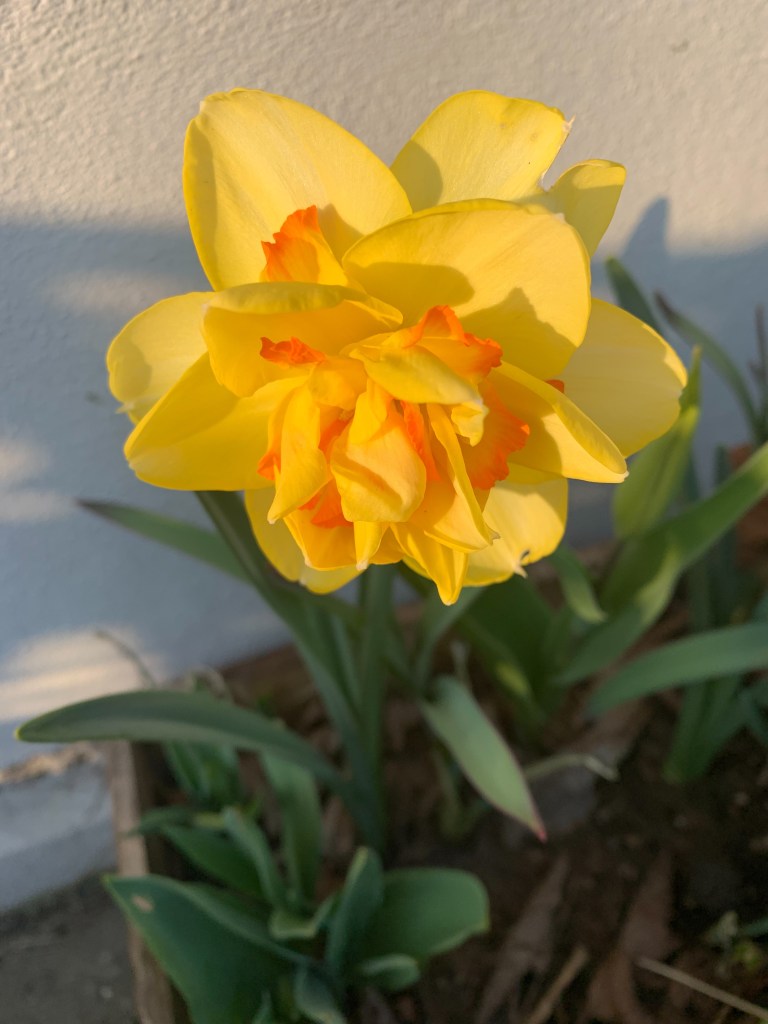
We’re always pleased to receive reports from our members’ gardens, particularly when accompanied by photos. This month Annie H wanted us to share her delight with the Rose Cottage ‘Garden Party’ tulips in her front garden.
Nicolas shared this photo with us showing his Daphne bholua in February.
I know we have had posts on euphorbias already, but these plants are such a delight in the month of April that I am adding yet more. The little Euphorbia Chameleon, below, self -seeds happily, but in such a delicate and restrained way that it is welcome everywhere I find it. In addition to this, it politely dies back and allows summer flowering plants to take over.
The Euphorbia below (amygdaloides purpurea) is a stunning contrast with the lime green flower head and the stems which are an intense dark red. It has seeded itself in the gravel path and I’m not entirely sure where it comes from.
In Euphorbia, flowers occur in a head, called the cyathium. Each male or female flower in the cyathium head has only its essential sexual part, in males the stamen and in females the pistil. The flowers do not have sepals, petals or nectar to attract pollinators, although other nonflower parts of the plant have an appearance and nectar glands with similar roles. Euphorbias are the only plants known to have this kind of flower head. It should also be noted that, when the stems are cut, they exude a thick white substance which is extremely irritating to skin.
And, of course, there is the magnificent Euphorbia Mellifera (Honey Spurge) which rightfully deserves its common name and is a delight to be near at this time of year when the scent fills the air. Every garden should have one – it keeps its shape well or can be cut back. Mine originally came from the garden of Jillian Smith, CABAHS ex-Chair, who many remember fondly. Jillian, if you are reading this – thank you!
Anna has sent a picture of her blue garden, which she plants in late winter every year before the Eucomis take over in the summer. The Polyanthus flower clusters are going over but more buds are coming up, including hyacinths and Welsh poppy seedlings. What a striking effect!
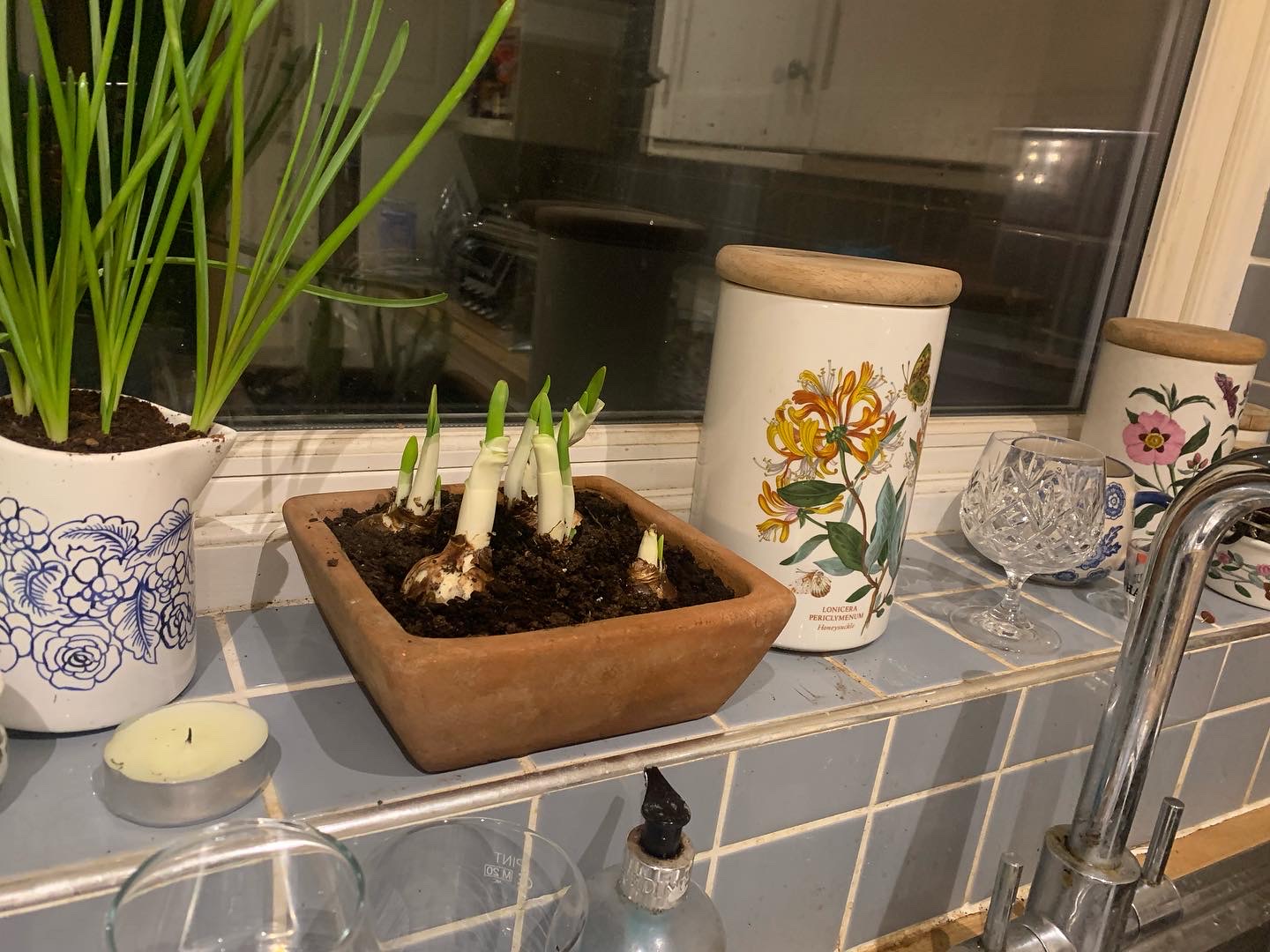
And Sue has a succession of bulbs appearing in her pots as her ‘lasagne’ style planting develops through spring.
Spurred by Kathy’s post on Euphorbia in the Old Pond Garden I have taken this photo of E. myrsinites which sits outside my back door all year round. As Kathy points out, Euphorbia are a large and adaptable genus and at this time of year are a real treat. I have found they do particularly well in my gardening conditions and now have several varieties.
In my front garden (such as it is) Euphorbia characias s. wulfenii is usefully seeding itself in a way which looks like I have planted it deliberately, but is actually nothing to do with me at all.
On the latest RHS gardening update I have just read that, according to Sally Nex, the more plants you grow the more carbon your garden can store away, which is therefore another way of helping to create a more sustainable environment.
This suits my gardening philosophy just fine!
I am so often tempted at plant fairs to buy another addition for my garden, but often without any clear idea of where the plant will go. (And how wonderful to be able to buy plants at the Chelsea Flower Show this year!) Now the idea of packing yet more in makes me feel positively heroic!
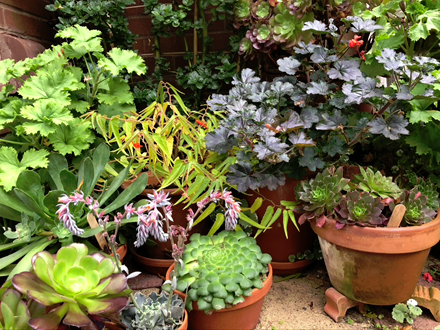
An example of the ‘always room for one more’ school of gardening outside the back door.
Clockwise from top left: lady’s mantle, cucamelon, Virginia creeper, ornamental grape vine and dogwood, chillies, Japanese blood grass – or – Alchemilla mollis, Melothria scabra (cucamelon), Parthenocissus quinquefolia, Vitis vinifera ‘Purpurea’ and Cornus alba ‘Sibirica’, Capsicum annuum ‘Cayenne’ (chilli), Imperata cylindrica
Late in 2020 Ali H set herself a challenge: to take one photo a day in her garden for a year, and post it on Instagram. Her purpose was mainly to notice and appreciate how the plants develop and change, also to have a record of what is there and when (she’s always surprised to look back and see the bulbs in flower, or a covering of snow!). She tried not to set too many other conditions as she knew she wouldn’t get round to doing it otherwise – so they don’t have to be ‘good’ photos, they don’t have to be plants in flower, they don’t have to be anything other than a photo of a plant in her garden – including fruit and vegetable crops. She likes individual plants and looking at things close up, so that’s what they tend to be – but occasionally there’s a view or a combination. Here are a few photos from September (above) and October (below). Ali’s not sure what 2022’s challenge will be. She might just carry on!
Clockwise from top left: dogwood, cabbage palm, myrtle, oak-leaved hydrangea, Persicaria, maidenhair fern – or –Cornus alba ‘Sibirica’, Cordyline australis, Myrtus communis, Hydrangea quercifolia ‘Burgundy’, Persicaria microcephala ‘Red Dragon’, Adiantum venustum
Kathy A’s Japanese anemones (probably variety “Serenade”) are the tallest they have ever been this year. Even the usual white ones, Honorine Jobert, are phenomenally tall. Is it the rain? Have other members experienced this?
Since my recent spinal surgery I have been frustratingly incapacitated. However who would not be cheered-up and consoled by a view like mine? From a prone position on my living room sofa I look out, through a huge glass sliding door, onto a beautiful panorama of colourful flowers. I had worked so hard in spring to prepare the garden knowing that my operation would put me out of action for a while.
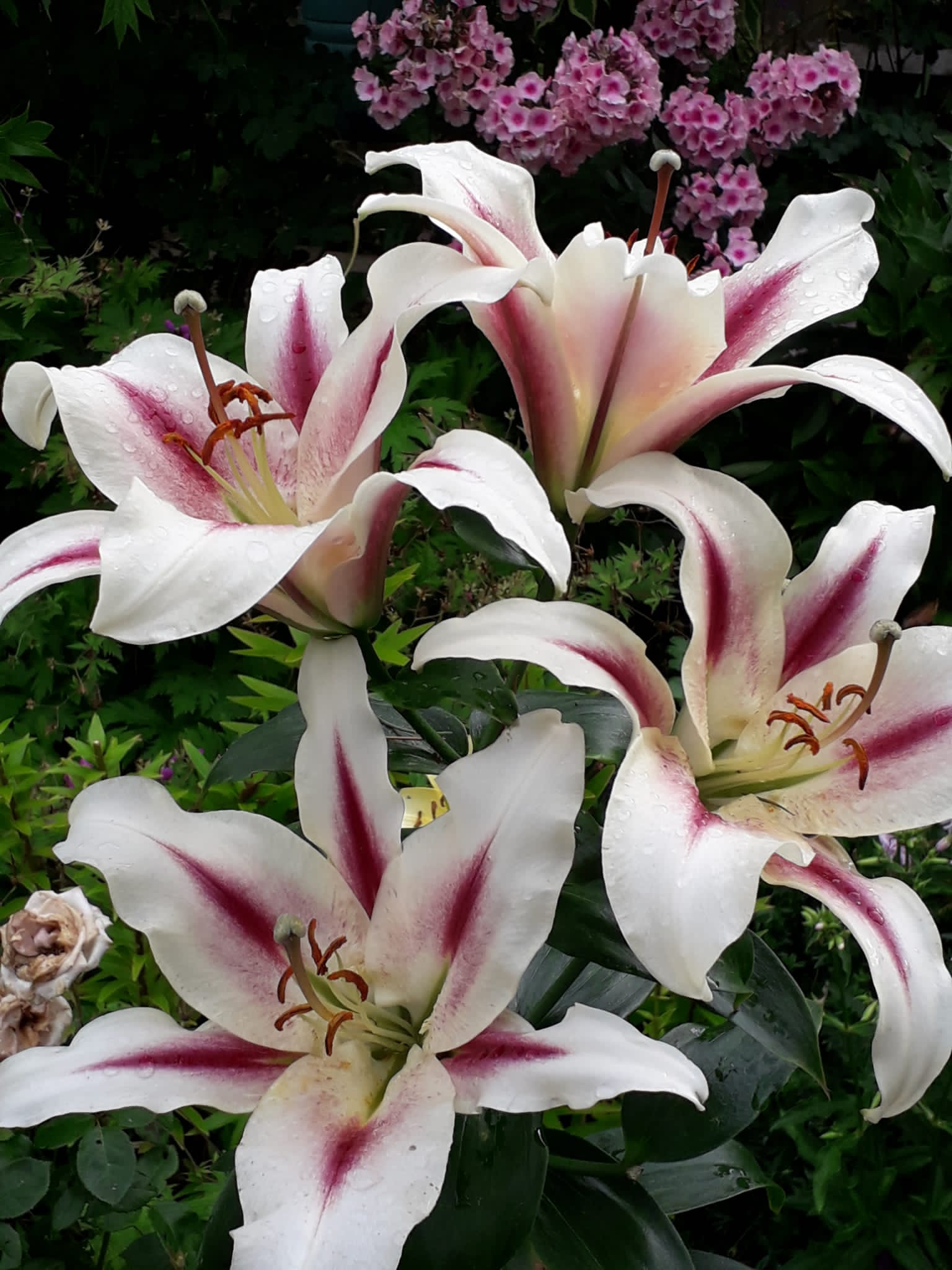
Looking from the sofa my eyes encounter the patio first, which is packed with pots of pelargoniums, lilies, geraniums, dahlias, fuchsias and a huge hanging basket overflowing with lemon -scented begonias. As I write I lament the denuding of our lemon tree outside the window, which bore 18 ripe, juicy lemons in early summer. I can’t complain, however, as my husband and I have enjoyed the fruits of its bounty in the form of 36 gin and tonics on many warm summers evenings!!
Soft grey patio pavers slope down from the patio onto a small lawn, it’s curved edges lined, on every side, with colourful flower beds. Although I have been cursing the snails, which have been devouring most of the annuals that I grew in the spring, they have at least left abundant golden rudbeckia and fluffy blue ageratum which tumble merrily onto the lawn.
It’s a real delight to take a morning stroll (or hobble) around the borders to discover what has come into flower each new day. I have been thrilled with my new Alstroemeria ‘Indian Summer ‘ that are in full bloom right now. Hugh and I were so impressed when we spotted them growing on Wisley’s trial beds, that I came home to order them that very evening.
Beyond the alstroemeria, Geranium ‘Rozanne’ never fails to impress with masses of rich blue flowers from June to October. They create an excellent foil for Rudbeckia and blue spires of Perovskia beyond. I’m so proud to have grown 6 different colours of Phlox this year. My latest addition, called Phlox ‘Blue Paradise’ is an incredible purplish blue. It’s just wonderful!
Towering flame orange Tithonia (Mexican Sunflowers), Cosmos ‘Purity’, Helianthus ‘Lemon Queen’ and evening primrose all add excitement and height at the back of the borders. Fortunately each bed is so jam-packed that there is not much room for weeds!
The only problem is… it’s snail & slug heaven! I have been shocked to find that this year’s snails must be a super-breed with jaws strong enough to eat through the hairy tough stems of sunflowers( all of them!!)
A tantalising glimpse of a brick-paved area and vegetable patch can be seen through an arch beyond the lawn. Today Hugh re-potted his banana tree and it can now be seen waving it’s huge leaves behind the bird bath in the middle of the brick circle. I can just about glimpse the scarlet flowers on the runner bean canes in our miniature veg plot on the far side of the brick circle, reminding me to ask Hugh to keep picking the veg for dinner each day. The enormous cucumbers (‘Swing’ F1) have been a real surprise this year. I grew them up a vertical support for them just before going into hospital and so many have grown in a few weeks just from one plant in one pot!
Well, I could carry on like this for ever. I haven’t even mentioned my new shade border with 4 newly purchased, remarkable clematis. (the best has turned out to be one called ‘Pernille’) My enthusiasm for my garden never wanes! Unfortunately the same cannot be said of my stamina which is being curtailed by too many painkillers currently.
Although I could not join you all in Charlton House garden for the first real live meeting since Covid struck, I will be thinking of you all and hoping that the evening goes well.
Recovery from my op can take months but I am determined to bounce back in record time so wish me luck. Anyway how could I fail to recover quickly when I can see the biggest incentive outside my window?