August 2022: Gardeners Question Time

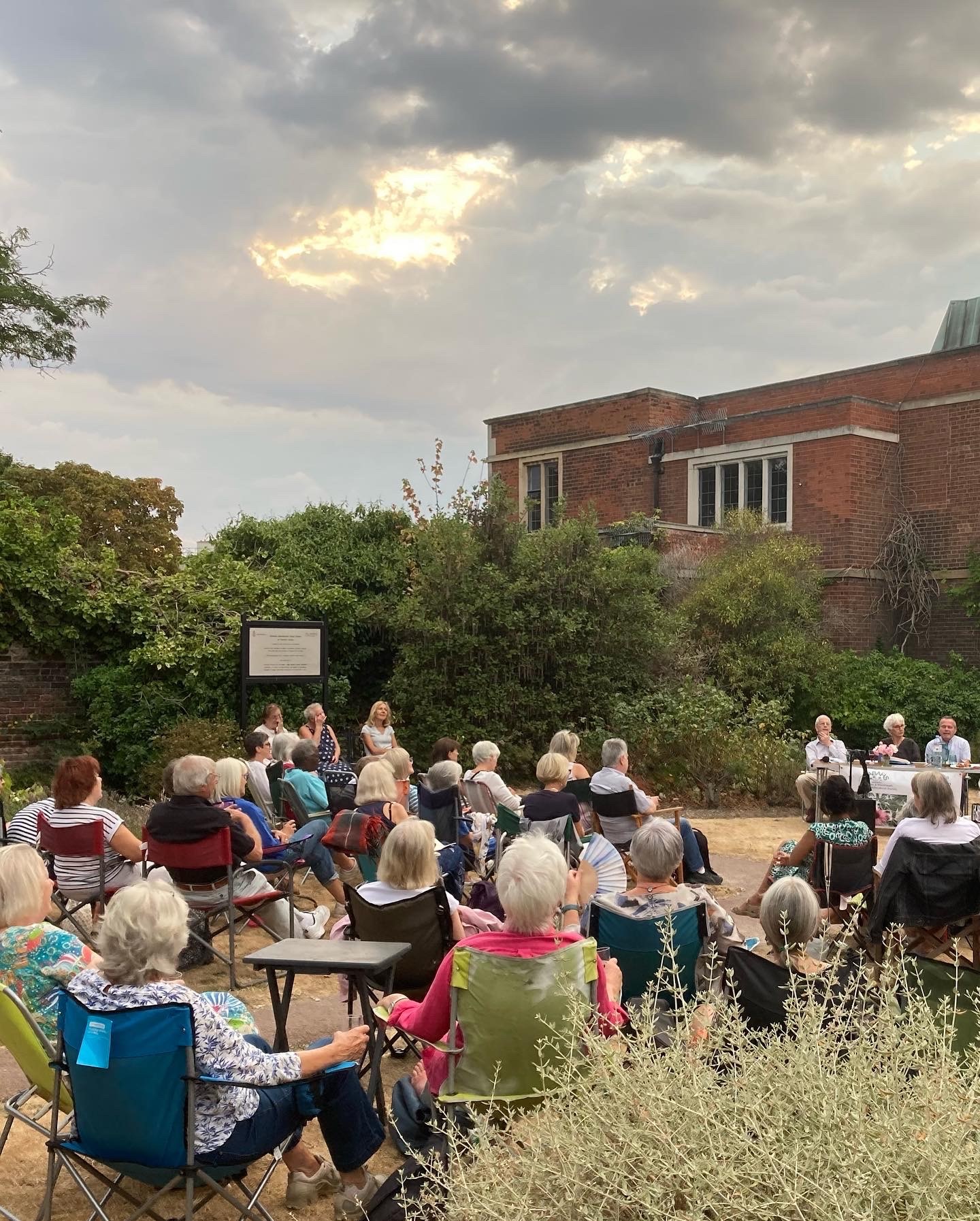
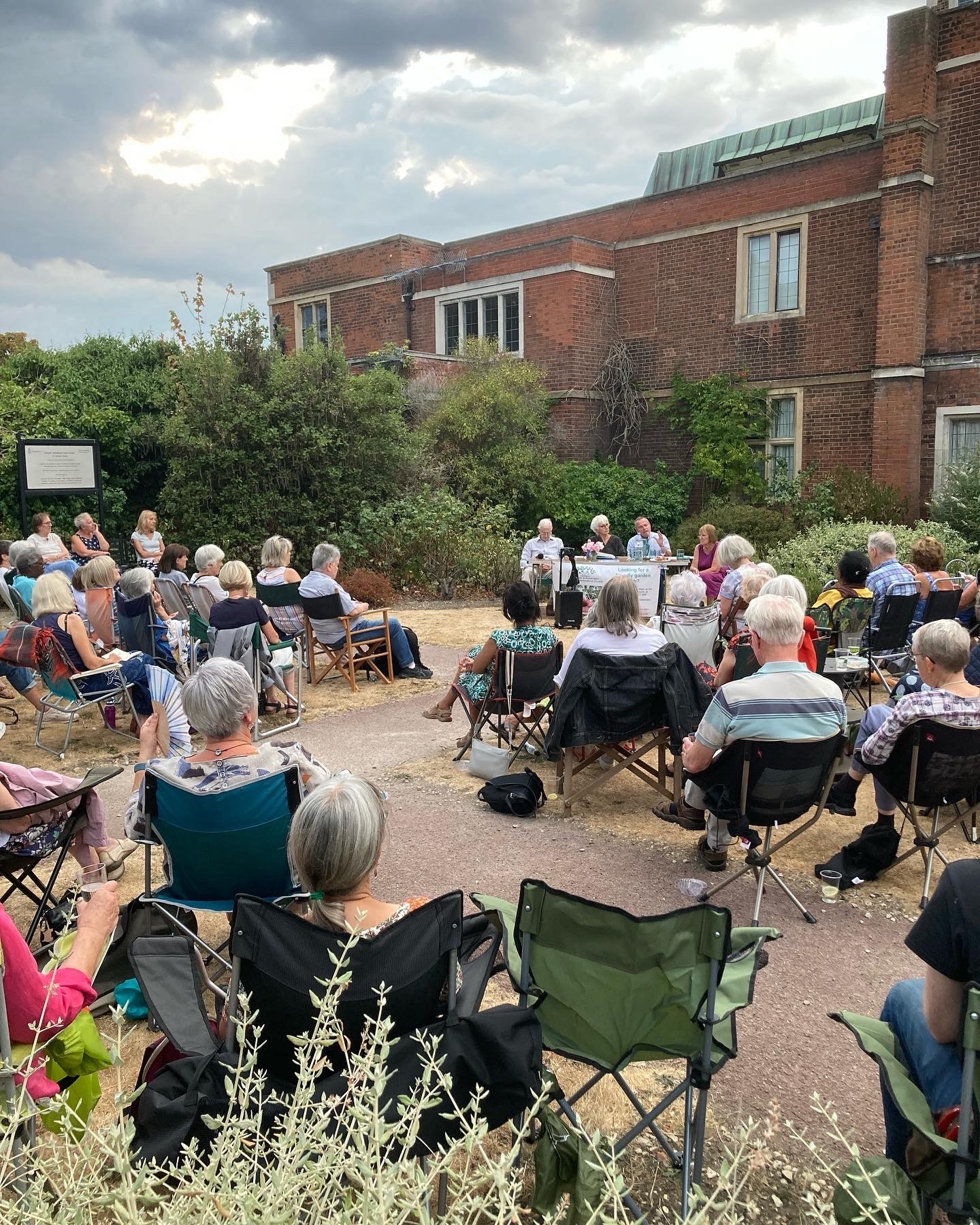
Our annual amateur Gardeners Question Time meeting was once again held in the Peace Garden at Charlton House. Some members will remember last year, when everyone was in thermals and anoraks and it was the coldest August evening for years – ah, not this year we thought, it has been so warm and dry for weeks! Well, best laid plans as they say. Everyone was settled and happily getting in to the swing of questions about the drought. And so of course, the heavens opened!

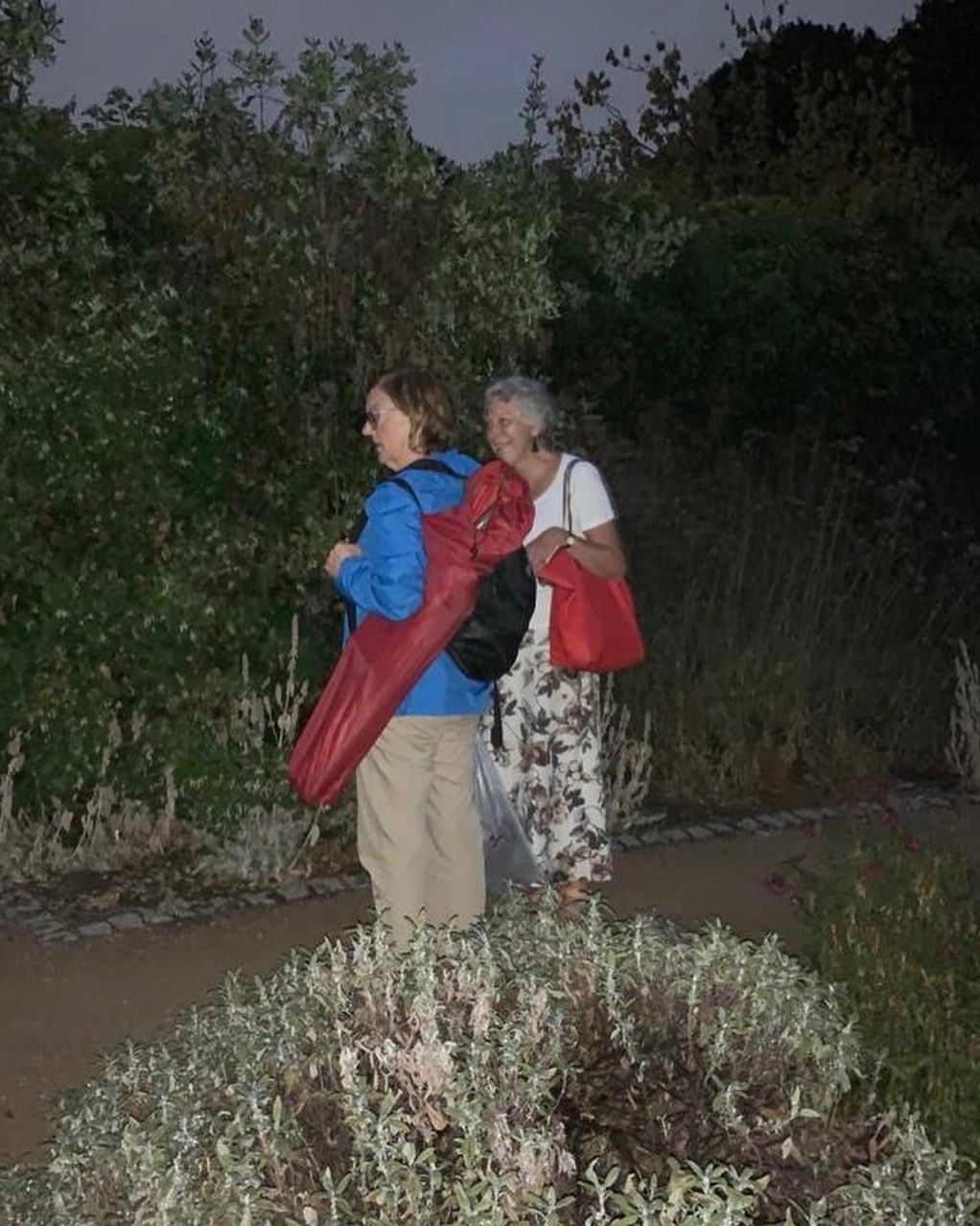
True to type, we gardeners just picked up our things and decamped to Frilly’s Tea Room for a little break. Thank you to our stalwart committee and helpers who covered things up in the garden (do you know what Doritos and Pringles look like when they are soaked? ugh!). As the thunderstorm carried on, so too did we and the questions continued in the Tea rooms.

GQT in the tea rooms

Thank you to our panel, especially guest panellist Joe Woodcock, for cheerfully answering our questions, and to Charlton House for letting us drip all over their cafe. It was still a very enjoyable evening, but sad that not many members saw the old Pond Garden in the dusk, lit up with solar lights and looking magical.

The committee will be having a think about whether to have next years GQT meeting in the safety of the Old Library!

Kathy A

June 2022: Steve Edney on ‘The Salutation Garden, Tenders and Tropicals’

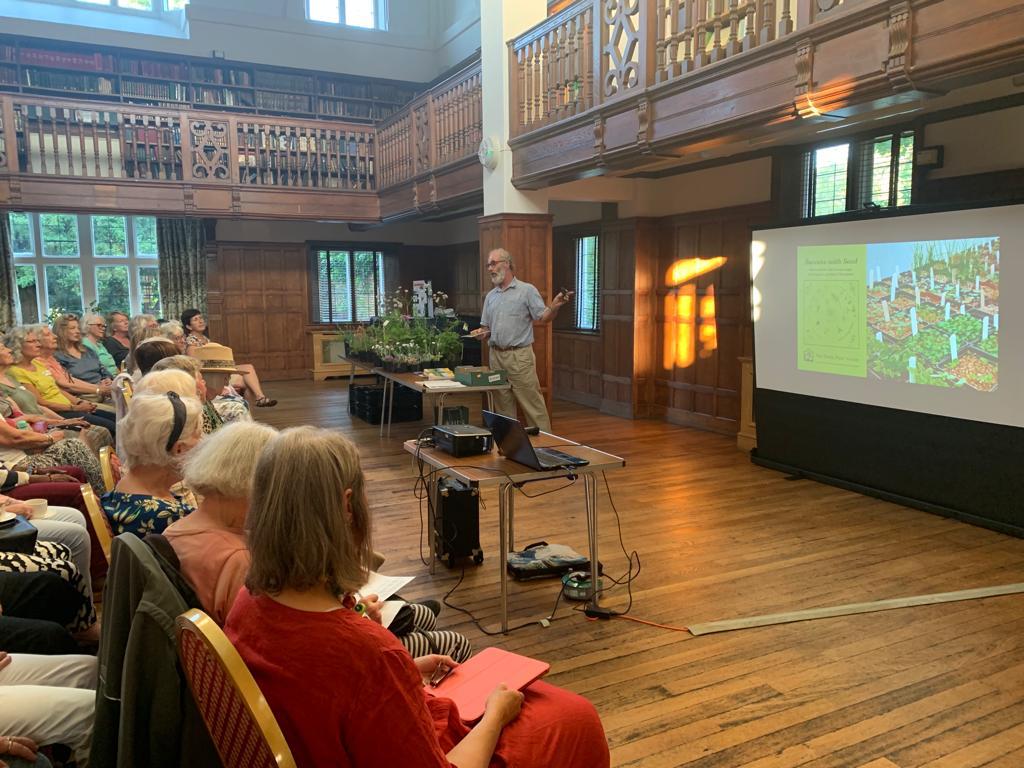
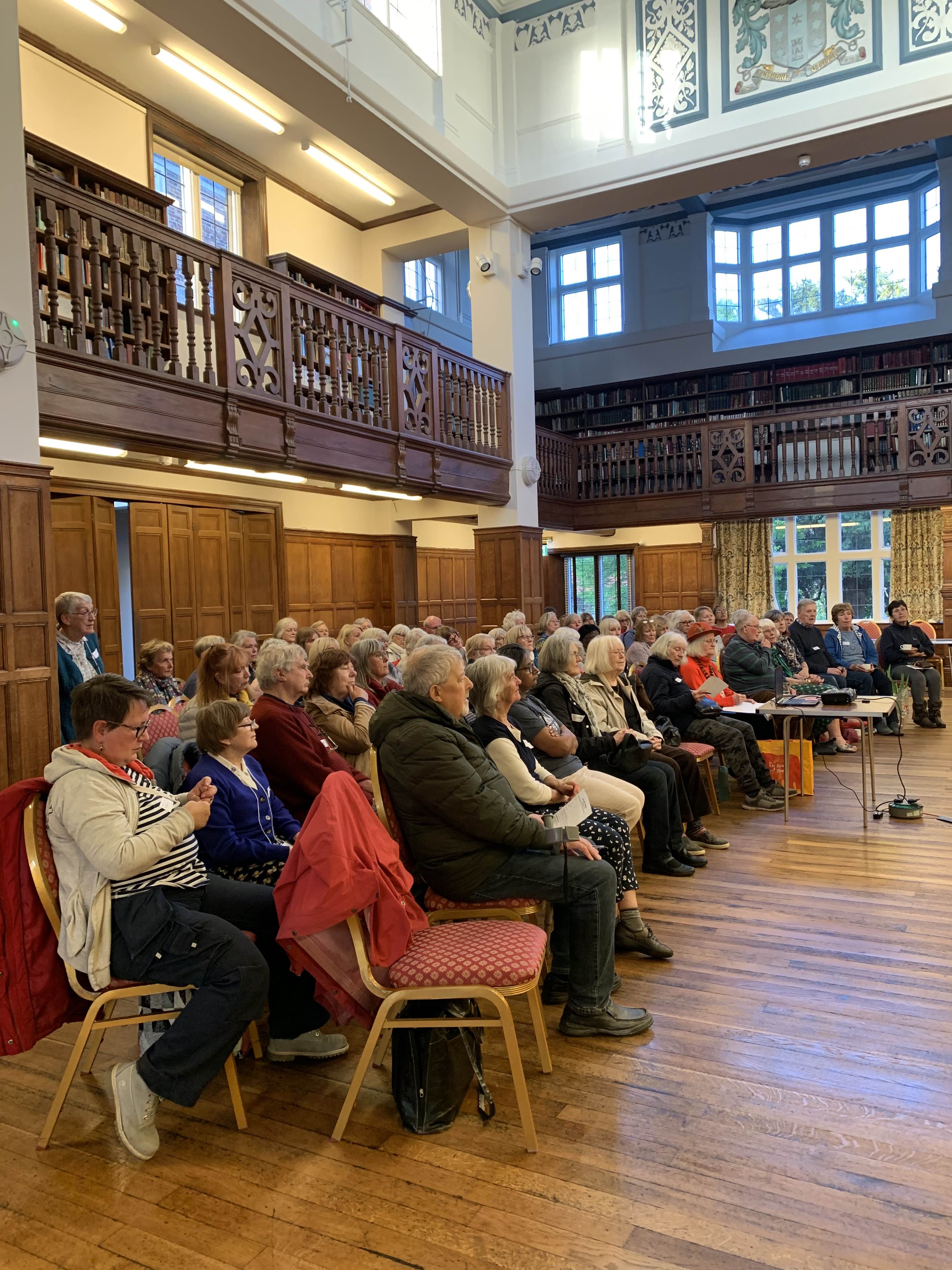
We were back in the Old Library for an interesting and entertaining talk given by Steve Edney on his work as head gardener at Salutation and subsequent development of his own private garden and nursery. He is also a RHS volunteer trial judge involved in the Nepeta AGM.

Salutation House and garden is located in Sandwich by the River Stour.  Designed  by Edward Lutyens in 1912 as a weekend retreat for the three London-based Farrer brothers. Noted for the outstanding design symmetry between house and garden. Sold in 1945 when the brothers died, the magnificent gardens became  somewhat overgrown and neglected over time. In the 1970’s  Portland Stone was smashed up and laid as crazy paving!

Steve was appointed head gardener in 2005 to oversee the restoration. The owners by then were Steph and Dom of Gogglebox fame. With little interest in the garden apart from being a party space,  they allowed him a somewhat free hand.

An initial task was stripping back an avenue of 50’ Holm trees to almost sticks. Our own Old Pond Garden volunteers were very interested in his idea of topiary using Holm Oaks, given how many we have at Charlton House!

2013 saw the garden devastated by salt water flooding and 1,500 plants, 9 mature trees and hedging were lost. 5 million litres of water became trapped in the lower third of the garden and had to be pumped out. Steve and his team overcame this and in 2019 they went on to win Gold at Chelsea for a winter border, which only cost £157! He followed with his Plant Hunter’s Jungle Camp taking best exhibit in the Floral Marquee at Hampton Court.

Continue reading June 2022: Steve Edney on ‘The Salutation Garden, Tenders and Tropicals’

May 2022: Val Bourne on ‘Butterflies in Gardens’

CABAHS welcomed Val Bourne to speak at our May meeting, sharing her photographs, experience and knowledge of butterflies in the garden. She emphasised that she is not a butterfly expert (but she knows one!), she’s an organic gardener who has spent a lot of time observing butterflies, their habits and preferences – and, sadly, their decline in recent years.

Photograph of the FSC's Butterfly ID chart

As a starting point, Val recommended a book and a tool: ‘The Philips Guide to Butterflies’ and the Field Studies Council’s butterfly identification chart. Butterfly Conservation also provide a range of identification guides online. Photographs of a wide range of species – 24 different ones have been spotted in the Spring Cottage garden – showed us the beauty of even the smallest, brownest examples!

Val explained how useful even a small meadow area is for many species, how some species rely on quite a narrow range of plants for nectar, and how the timing of a butterfly lifecycle is intrinsically linked to the lifecycle of their food plants. She stated that climate change – causing plants to flower at different times – is demonstrably messing up this synchronisation, so as gardeners it’s important to grow a wide range of butterfly-friendly plants to try to mitigate that situation.

Some examples of butterfly-friendly plants, and the butterflies that particularly need or enjoy them:

Continue reading May 2022: Val Bourne on ‘Butterflies in Gardens’

Spring Show 2022 Report

We held our first actual Spring Show on Monday 11th April in Charlton House Long Gallery, after two years of Online Shows. Everyone seemed pleased to be back but there was clearly a shortage of suitable material in some classes, with no entries in the Hellebore Class and only one in the Flowering Shrub Class. This seems to have been caused by recent weather conditions and their effect on flowering.

Vija and Pat judged the entries and because Vija’s was the only entry in Class 3, that class wasn’t judged! Vija announced the winners as:
Class 1 Daffodils/Narcissi – 3 stems: Maria B
Class 2 Tulips – 3 stems: Margaret M
Class 3 Flowering shrubs – 3 stems: (insufficient entries)
Class 4 Camellias, Rhododendrons, Azaleas or Magnolia – 1 stem of any: Maggie T
Class 5 Small vase of mixed Spring Flowers: Anna L
Class 6 Any pot-grown plant (indoor or outdoor): Kathy A
Class 7 A pot of Spring bulbs: Nicolas B
Class 8 Hellebores – 3 stems: (no entries)
Class 9 Tea cup floral display: Kay P

The Best in Show was selected by John King, a guest from Eltham & Avery Hill Gardens Society. He chose Sian T’s entry for the Tea Cup Floral display which she called “Teacup Fantasy”.

Vija reminded everyone of upcoming Events and Outings and encouraged everyone to check out our updated Website, Subscribe to receive an email whenever any new post is added and email CABAHS any feedback the website. Subscribing costs you nothing, keeps you up-to-date and you can Unsubscribe when you wish.

February 2022: Melanie Aspey on the Rothschild Legacy in Horticulture

The talk was given by Melanie Aspey, a CABAHS member who has been the Rothschild archivist for 28 years. Providing photographs and documentation from the Rothschild archives, she said the Rothschilds are best known for banking, their art collections, philanthropy and wine, but many of them have also had  a keen  interest in horticulture reaching back to Mayer Amschel Rothschild (1744-1812), the founder of the dynasty, who lived in the Frankfurt Jewish Ghetto.

After the defeat of Napoleon, thanks to their support for the allies, the Rothschild family was able to lobby for the retention of the right for the Jewish Community to buy real estate outside the ghetto. Mayer Amschel’s son, Amschel, considered that building a house would be too ostentatious, but a garden would better serve their needs. Instead he established a garden which he subsequently opened to visitors and for charitable purposes. He spent vast sums on plants, some of which (and Melanie showed one of the plant sale receipts from the archives) he imported from England. Later taken over by the Nazis and bombed by the allies, the garden fell into disrepair but parts have recently been renovated.

Continue reading February 2022: Melanie Aspey on the Rothschild Legacy in Horticulture

January 2022: Anne Barnard on Dahlias

Anne Barnard from Rose Cottage Plants nursery in Essex has many years experience of and is a specialist in growing dahlias, as well as exhibiting widely including at RHS shows. Dahlias, which originate in Mexico and Central America, come in a wide variety of colours from pastel to rich reds and mahogany.

Anne described how planting dahlias in summer beds can transform them and suggested how to choose and use them to best effect. Anne said they provide an outlet for personal creativity, style and artistic expression. She used her own garden, field displays in Holland and Chenies Manor as illustrations.

Dahlias had gone out of fashion, but in recent years there had been a revival of interest in them.  Their rich colours were particularly attractive and ‘jewel’ gardens had become common.  Many new and more popular and often exotic looking varieties had been developed. Many originate in Holland and she visited several important and influential growers. She said after bulbs, tulips and alliums have flowered by June/July,  gardens begin to look tired and dahlias wide variety and rich colours give life to the garden and make a good display right up to the first frosts.

Anne went on to describe a wide variety of dahlias:

Continue reading January 2022: Anne Barnard on Dahlias

October 2021: Dr Mark Spencer on ‘Murder Most Florid’

The guest speaker for October was Dr Mark Spencer who gave a fascinating glimpse into his experience of working as a forensic botanist. It became clear that forensic botanists are a rare find throughout the UK and the world.

He explained that from being brought up within a rural farming background in Warwickshire, he studied at the Royal Botanic Gardens, Kew. However he realised he did not want to pursue horticulture as a job and moved onto studying Botany culminating in a Doctorate looking at the evolution of fungi. While working at the Natural History Museum where he had become an expert on various aspects of botany, he was approached by a Police department asking whether he could help work out how long a body had been in a canal.

He has now worked alongside numerous police forces and an array of other experts such as soil scientists, experts in the study of pollen and forensic entomologists (study of insects) to assist in missing person searches, assessing how long human remains had been in-situ and linking suspects to crime scenes.

As a forensic botanist, Dr Mark Spencer looks for useful evidence using his knowledge of the rhythm, structure and behaviour of plants within their eco-systems. This can range from observation and interpretation of how vegetation is growing at a scene being investigated, to a microscopic identification of fragments of foliage found on clothing, to looking at the stomach contents and understanding the botany within a person’s digestive tract.

He explained how the roots of plants can help provide understanding of how long ago human activity occurred at the scene. Brambles (Rubus fruticosis) can be very useful tools for estimating how long bodies had been lying in woodlands or hedgerows through the knowledge of how they grow at different stages, when they send out side shoots and number of stems produced. I have a feeling that my walks through Oxleas Woods, which are full of brambles, will never be quite the same again!

Sharon


Dr Mark Spencer is an experienced and internationally respected botanist. His expertise covers many disciplines including forensic botany, the plants of North-west Europe, invasive species and the history of botanical science. He works globally as a writer, public speaker and television presenter and has appeared on BBC Radio 4’s The Infinite Monkey Cage. He is also Hon. Botany Curator of the Linnean Society of London. Dr Spencer’s website gives a detailed description of his range of expertise.

Autumn Flower, Fruit and Vegetable Display 2021

This was held on Monday 20 September in the Long Gallery of Charlton House. As one of many new members of the Society since meetings were forced to stop by COVID-19, it was my first indoor meeting!

It was a very impressive event with a total of 66 entries and I didn’t envy our guest judge, Joe Woodcock, his task. But Joe made it clear how impressed he was with all the entries, providing an encouraging commentary on the horticultural skills demonstrated, and explained why he selected the winning entry in each class.

The classes and winners were as follows:

1. Vase with single stem of any flowering plant – Viv P

2. Bowl of mixed flowers – Margaret T

3. Five Fuchsia blooms – Ruth Y

4. Ornamental pot plant – Pat K

5. A display of fruit and vegetables – Mandy & Brownie

6. A display of herbs – Ruth Y

7. Floral arrangement in a teacup – Anna L

8a. Potato Competition – Pam D

8b. Sunflower head competition – Annie H

Joe selected as Best in Show Margaret T’s wonderful display of varieties of dahlia in Class 2. Class 7 the Floral Arrangement was selected by popular vote (using buttons) and the Potato Competition was weighed by the trusty scales of Hugh P.

Joe was kind enough to answer a few gardening questions at the end of proceedings, and tea, coffee and biscuits were provided to round off the evening.

We counted 56 attendees. Everyone seemed to enjoy the event and be grateful to be able to meet up in person again. Long may that continue!

Lynda