Snippets of news relating to gardens, the environment and the local area, CABAHS members’ posts about garden topics, gardening hints and tips, and short pieces about garden design and history
The Woolwich Garrison Church Trust has commissioned Chelsea Gold Medal winner Juliet Sargeant to create a Commonwealth and Gurkha garden on their site. They already had outline drawings, above, by local designer Don Albrecht, and are now looking for feedback about the plans.
The idea is to have an English Orchard and wildflower garden on one side of the church, and the Commonwealth countries and Gurkhas reflected in the planning on the other side. Chair of the Trust, Tim Barnes, says that in Gurkha villages there is always a central tree which acts as a focal point for village life – so there are plans for a circular seat around the base of one of the trees to reflect this tradition.
There are some lovely ideas, download the full document below if you are interested.
The City of London might not be the first place that you would look to understand how nature conservancy developed in this country. The Wildlife Trusts, the umbrella organisation for local groups that care for their environment, makes it clear that they owe their existence to the Society for the Promotion of Nature Reserves, for which Charles Rothschild, a partner in the merchant bank of N M Rothschild & Sons, was the catalyst.
I thought about him during Joe Beale’s excellent talk on Zoom to the CABAHS meeting on 17 May. Members learned a lot about biodiversity in the area of Greenwich Park, Blackheath and Charlton. We also learned how important it is for people to work together. Joe didn’t just mean small groups of concerned individuals, although those are crucial. He meant engaging with local councils and other bodies to make sure everyone’s interests and concerns are understood.
This is what Charles Rothschild did. He sent out questionnaires to local natural history societies, asking for nominations for sites that could be nature reserves: sites that were ‘worthy of preservation’. On the basis of these returns, the newly-created Society for the Protection of Nature Reserves published a list – Rothschild’s List – and sought government intervention to protect the sites. Here is the list, published in 1915.
Joe also brought home the importance of keeping records over time so that measurements of improvement and, sadly, deterioration have value. In the link above The Wildlife Trusts also presents an analysis of the condition of Rothschild’s Reserves, 100 years on.
This document features a pie chart of habitats, 2% of which are pavements. I wonder if our very own Terry might well be responsible for some of that, based on what he told us he was up to at the end of his road!
Charles Rothschild was an extraordinary man by any measure of means. His collection of fleas, now the national collection of fleas in the Natural History Museum, was lovingly catalogued by his daughter, Miriam, who was herself a powerful advocate for nature, advising the Prince of Wales on the creation of his garden at Highgrove.
One of his fans is sports- and nature-writer Simon Barnes, whose book, Prophet and Loss: Time and the Rothschild List is available on Kindle for only £2.37. If members were to buy the book (profits to The Wildlife Trusts) they could buy a cake from the WI at the CABAHS community day at Charlton House on 30 May and still have change from a fiver!
In his book The Flower Yard, Arthur Parkinson writes lovingly about his grandmother Min and her gardening practices, typical, he writes, of an older generation of gardeners. He describes the kinds of plots tended by Min and her neighbours and how ‘there was no acceptance of insect life, as proved by the cupboard of death in the garage, its shelves packed with poison, weed killers and bug spray’[1].
My Mother’s death bequeathed to me not only her gardening tools, but a similar shelf’s worth of gardening aids. I have very vivid memories of the shed she and my Father had in their garden, the tools neatly lined up and clean, sweet jars ready for pickled vegetables, saved seed in envelopes and plant labels ready to be re-used. But alongside all this were also the toxins.
And it is not only a younger generation of gardeners who believe in far more environmentally friendly gardening practices. In a recent online talk given by Fergus Garrett, he argued that ‘gardening and ecology have to come closer together’ and devoted one whole lecture to how gardening at Great Dixter has become much more sustainable in recent years and delighting in the huge quantity of species that the gardens are home to.
Driving somewhere in the 1970s meant cleaning the windscreen and headlights of bugs on arrival home. That no longer happens and is a sure indication of how much insect life has been destroyed in a very short space of time.
Vija
[1] Parkinson, A. The Flower Yard (2021) Kyle Books p.119.
Catherine Horwood’s mention of Cedric Morris in her talk is a reminder of the close relationship between artists and their gardens. In 2016 The Royal Academy held a wonderful exhibition ‘Painting the Modern Garden, Monet to Matisse’, which devoted one room to Monet’s triptych of waterlilies. Many of us have had the pleasure of visiting his garden at Giverny, which is the subject of some of his most famous works of art.
Alfred Parsons (1847 – 1920) was an English artist who not only created his own garden, but designed for others. He provided the illustrations for many famous garden writers including Ellen Willmott (The Genus Rosa) and William Robinson (The Wild Garden). His friendship with Robinson led to him lending advice on the planting at Gravetye Manor.
Parsons had a wide mix of friends in both America and England, including John Singer Sargent and the novelist Henry James. Parsons’ paintings apparently mirrored the aspirations of Americans for an English garden and in 1899, when Henry James bought Lamb House in Rye, he invited Parsons to design the garden for him. It was here that he wrote some of his most acclaimed novels. Lamb House was much later bought by E.F. Benson and the view of the garden from the windows provided the inspiration for the Mapp and Lucia novels. In 2014, the BBC adapted these for a television series and used the garden at Lamb House for filming.
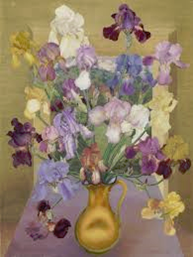
And so, to Cedric Morris. As well as painting portraits, still lifes and landscapes, Morris painted flowers extensively. In Higham Suffolk, he and his partner founded the East Anglia School of Art, but here Morris also indulged his passion for plants and, in particular, irises. He produced at least 90 named varieties and also exhibited at the Chelsea Flower Show. His gravestone reads ‘Cedric Morris Artist and Plantsman’.
I am often struck by how much a beautifully designed herbaceous border, the Long Border at Great Dixter for example, resembles a work of art.
I have spent some time over the past two days trying to protect the more tender plants I still have outside. The greenhouse is full and there is nowhere else for anything to go, short of bringing everything indoors! I therefore have varying layers of fleece and old sheets propped up with canes to keep them clear of the plants and all looking very ugly. With a weather forecast now predicting temperatures of -6 I have added blankets.
I look with envy to countries like Japan who so effectively seem to support their plants, making the supporting structure a thing of beauty in itself. The technique below is called yakitsuri and I first saw it in a Monty Don television series. This is designed to stop the weight of the snow from breaking the branches of the trees.
Similarly, the woven willow used to support border plants through the summer in our own gardens such as Great Dixter is not only functional, but looks nice.
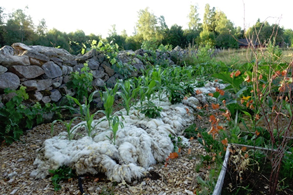
When Pat and I visited in a brief respite from lockdown in 2020, to protect dahlias from slugs at Great Dixter, they had used sheep’s wool spread out over the soil at the base of plants. Where this was dark brown it worked, but the white sheep’s wool was not in the least appealing and detracted from the overall beauty of the borders.
(Photo NOT from Great Dixter, just an example.)
There is an art to protecting your plants in winter (or summer) in a way that looks attractive, or at the very least not as offensive as my own efforts and is which not damaging to the environment. I have yet to master it.
I recently attended a lecture (on Zoom of course!) about Thomas Gainsborough and his connection to the English landscape. Many people will be familiar with his portraits, but the landscapes in the background are not always commented on so widely, unless it is the painting of Mr. and Mrs. Andrews, which seems to be the subject of a huge range of interpretations (not all repeatable in a horticultural blog perhaps).
Heart of Oak – Royal Navy Anthem
The 18th century was a period of great upheaval – the South Sea Bubble burst in 1720 triggering a financial panic; in 1721 the country had its first prime minister in Sir Robert Walpole; in 1739 Britain declared war on Spain; in 1745 Bonnie Prince Charlie landed in Scotland to claim the British throne; in 1756 the Seven Years war between Britain and France began; there was unrest both in America and at home and throughout this period, there was a Hanoverian king. It is all too easy to forget that two of the great names associated with landscape architecture, William Kent and Lancelot Brown, were working against this background, with Brown finding little favour with the ordinary person by uprooting and moving whole villages when they stood in the way of his designs.
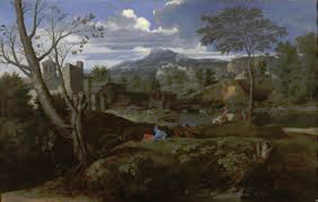
It is also no coincidence that Brown, Kent and their peers were creating landscapes which came to be seen as quintessentially English. Reacting against the formality of the classic gardens which were inspired by those on the continent and France in particular, they designed gardens that were intended to reflect the ‘sinuous curves’ of the English countryside. Ironically, Brown, who never travelled outside the shores of his home island, was inspired by the paintings of French artists such as Poussin.
Nicolas Poussin Landscape with Figures c1646
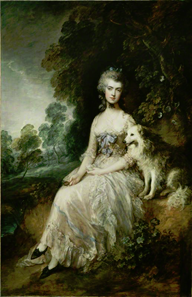
In the background of Gainsborough’s paintings, this same concern with the natural is evident. Even in his most famous portraits, for example the one of Georgiana, Duchess of Devonshire and the actress Perdita. Both show an English landscape populated by English trees, most commonly the oak.
Mrs Mary Robinson (Perdita) by Thomas GainsboroughDuchess of Devonshire by Thomas Gainsborough
Apparently, as Gainsborough was not a ‘plein air’ artist, in order to remind himself of the shape of the oak he would arrange stems of sprouting broccoli in front of his easel!
This tension between what is an English garden and what is from mainland Europe has influenced garden design throughout history.
With the RHS encouraging people to plant a tree in their Roots for Remembrance, a nationwide memorial initiative, it seems an appropriate time to think about the role of the oak in English landscape culture.
The Royal Greenwich Heritage Trust has just launched an online exhibition from the borough museum archive, including a place where residents can record their personal experience of living through the pandemic. Most of the featured ‘tales’ are from Charlton, but the idea is to collect stories from all over the Borough.
I hadn’t really thought about a New Year’s resolution for 2021, apart from the one that most of us have in the forefront of our minds at the moment: test negative, stay positive. (Sent to me in a Christmas card by a friend). But as we get closer to the end of January, to move forward into the year without one seems a bit neglectful.
I was therefore interested to read about the drive to encourage people to save seed and to encourage seed saving communities to develop. One of the few upsides of the lockdowns over the past year has been a huge boost in demand for seed. The argument is that this “grow your own” revolution re-diversifies seed crops and provides more security for not only our seed supplies, but food in general.
Josie Cowgill, one of the women who works with the Stroud Community Seed Bank in Gloucestershire sums up the impact of seed-saving in the context of 2020: “It’s difficult times we are living in. We have got a pandemic, we’ve got climate change, we’ve got biodiversity loss, habitat loss and economic collapse as well. It might feel quite small, just saving beans and growing your own food, but actually I think it is really fundamental. By doing something infinitesimally small like this tiny little gesture in a tiny little group, in a tiny little country somewhere, you are working towards something that makes you feel more hopeful. It’s a positive step. I’m not saying this is a magic wand or a cure-all, but it’s a positive step.”
Former ‘Bake Off’ winner Nancy Birtwhistle claims we have been ‘brainwashed’ into believing we need harsh chemicals to clean our homes. In an interview with her, what caught my attention was the amount of plant-based materials she used. It sounds miraculous, but she swears by ivy as a laundry detergent (about 60g, cut up and put in a muslin bag, then put in the drum). “It excites me so much; my husband thinks I’m crackers. I knew in the depths of my memory something about ivy and saponin [a natural foaming detergent], so I Googled it. Conkers have it as well.” (Although we should remember that ivy can be a skin irritant for some people.) In the autumn, she collects conkers and boils them up to create a creamy laundry liquid. (Nancy Birtwhistle’s book Clean & Green is published on 21 January by Pan Macmillan £12.99).I’m prepared to give this one a try, but have visions of a ‘green’ wash in a way I did not intend.
This year, for the first time, I decided to put up a Christmas light curtain along the back windows of my house, never thinking that it would be such a difficult job! Having finally got the things up, with a good deal of foul language, I have felt reluctant to take them down. As well as the candles and lights around the house they have provided a welcome point of light in a rather dim January.
Imagine my delight when I heard a representative from English Heritage talking about Candlemas on the radio recently. Apparently, a tradition preceding the one which instructs us to take down Christmas decorations on the twelfth night, this allows for decorations to remain until Candlemas – the second day of February, which means that my lights can stay put for some time yet!
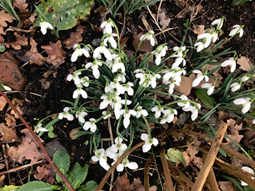
And snowdrops are also known as Candlemas Bells as they bloom so early in the year, and often before February 2nd. At one time it was believed that it was bad luck to bring these flowers into the house before Candlemas, but an opposing view has it that they are believed to purify the home. According to folklore, an angel helped these Candlemas Bells to bloom and pointed them out as a sign of hope to Eve and the flower is thus often seen as a sign of hope for the world.
It seems to me that everything comes together quite neatly: lights, illumination, snowdrops and hope. I think I will continue with this tradition!










 Charlton and Blackheath Amateur Horticultural Society