Suburbian writers and Jane Loudon

I have recently finished reading Sarah Bilston’s book  ‘The Promise of the Suburbs’. This is a very readable study of the history and development of the suburbs and their representation in literature. Rather than being the incredibly boring places often demonised in popular culture and variously vilified as boring, conventional and unimaginative (Bilston’s introductory chapter is titled ‘The “Horror” of Suburbia’) Bilston shows how they provided opportunities for female professionalism and new ideas about modernity.

The massive expansion of the suburbs during the Victorian period enabled an increasing role for the middle class people who were to occupy them. Central to this were ideas of taste. Visions of landscape gardens and spacious country home interiors were not appropriate to these smaller scale domestic environments and a new market developed for advice texts. With the removal of the paper tax, the end of the 18th century and the beginning of the 19th century saw a burgeoning of journals of all kinds and many of these were written and contributed to by women. This was the period of Mary Wollstonecraft, George Eliot and Jane Austen when middle class women were finding a voice and journals provided an opportunity to share ideas, in many cases anonymously if these were particularly controversial. [1] Bilston includes a chapter on Jane Loudon (b. 1807, d.1858), a name which, until fairly recently, I was unfamiliar with. More popular than Mrs. Beeton in her day and writing at the same time, selling huge numbers of books in print, as a female gardener writing for people in the suburbs, she didn’t stand a chance and, for the most part, has disappeared from view, receiving scant attention in the scholarly discussions of horticulture.


Jane Wells Webb Loudon was born on 19 August 1807 and died on 13 July 1858. After the death of her mother in 1819, she travelled in Europe for a year with her father, clearly a far-sighted man with regard to a suitable education for girls, but who lost his business to excessive speculation. He died penniless in 1824, when Jane Webb was only 17, forcing her into a position where she had to financially support herself. Already quite a prolific writer, she wrote ‘The Mummy; Or a Tale of the Twenty-second Century’ which was published anonymously in 1827 and has been seen as an early forerunner of science fiction. (Mary Shelley had written Frankenstein in 1818, but The Mummy is a very different narrative).

Through this she came to the attention of John Claudius Loudon, who, on meeting, was surprised to find that she was a woman.

Although much older than she (he was 47) and well established with a reputation in horticulture, the two were married seven months later. Jane Loudon makes it clear in her diaries that, knowing nothing whatsoever about plants, she was determined to make up her knowledge deficit. She studied botany (at the time this was considered a suitable subject for girls and women ) under John Lindley and worked closely alongside her husband. By the 1840s she was publishing horticultural journals and books in her own right, supporting her husband’s work and his family (his sisters lived next door) and continued to do so for the rest of her life – John Claudius died in 1843, leaving her to bring up and to financially support their 10 year old daughter single-handedly. She died age 50 in the family home in Bayswater.

Vija

[1] See work such as ‘The Proper Lady and the Woman Writer’ by Mary Poovey and Alexis Easely’s ‘First Person Anonymous’.
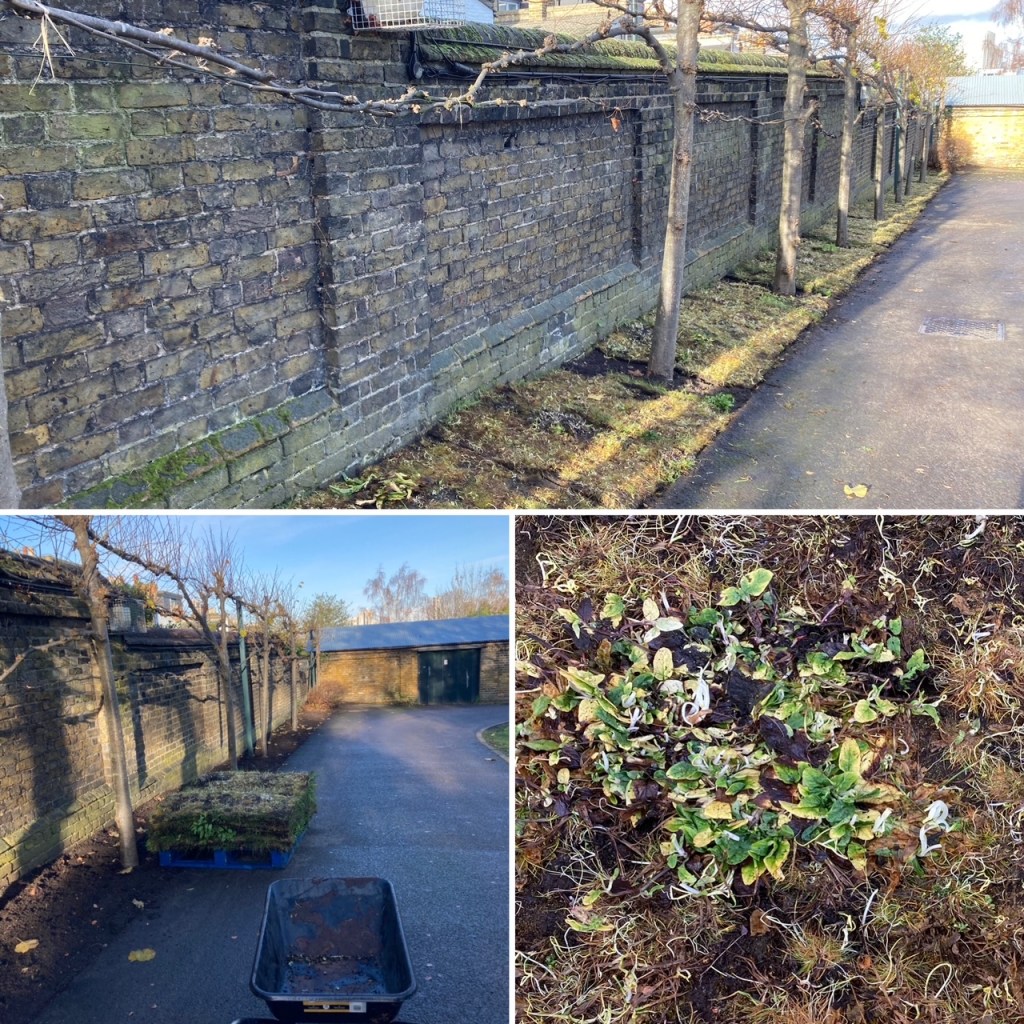
East Greenwich Pleasaunce wildflowers

EGP volunteers have laid 40m of wildflower turf all along the west side under the lime trees, so we can look forward to a wonderful display next year. RBG gardeners kindly weeded all the Alkanet plants out of the border, and three pallets of wildflower turf was donated by a local developer. Fingers crossed now!

Blackheath Flower Club remembers

Sian’s latest Newsletter to the members of the Blackheath Flower Club:

Here we are in Lockdown once more, on remembrance day 11/11/2020. Elizabeth Crawley’s great granddaughter, Daisy, wrote this moving poem when she was 10, she is 17 now:

Earl Haig founded the Royal British Legion in 1921 adopting the poppy as its emblem. He ordered 9 million poppies from a French woman, Anna Guerin, and sold them on 11th November, 1921. That first ‘Poppy Appeal’ raised over £106, 000 to help veterans with housing and jobs. To ensure plenty of poppies for the next appeal a Poppy Factory was set up to employ disabled ex-servicemen.

Everyone has been busy decorating churches and windows with poppies etc: Richard put a collage of petals in his window, Yvonne decorated Saint Alfege’s, I put a display in Ascension Church.

Meanwhile, in Westminster Abbey, NAFAS (National Association of Flower Arrangement Societies) Ladies (lead by Kathy Stangaard, who has demonstrated regularly at Blackheath and Mottingham Clubs) put foliage round the Tomb of the Unknown Warrior. They also made a posy for Camilla to put on the Tomb. Also they were asked to place a rose🌹on 82 chairs for the only guests allowed. They heard Jools Holland and Ruby Turner practising ‘Abide with me’. The picture of decorating the Tomb was on BBC news, but no mention of NAFAS…

The British tomb of the Unknown Warrior holds an unidentified British soldier killed on a European battlefield during the First World War. He was buried in Westminster Abbey on 11th November 1920, simultaneously with a similar interment of a French unknown soldier at the Arc de Triomphe in Paris.

…We will remember them.

Now is the quince season…

With apologies to Rod Liddle, writing in The Spectator!

I am sad that my Quince tree (the produce of which gave me the CABAHS “Best in Show” cup once upon a time!) has not managed to bring a single fruit to maturity this year. Squirrels and the dreaded brown rot have taken all.

Quinces were first grown in England by Edward I, the ‘Hammer of the Scots’, a man who would have made short work of Nicola Sturgeon. The fruit resembles a degenerate pear — a pear which has made bad choices in its life. Downy and squat. The tree from which it emerges is a delight, especially in early May when fecund with blossom, which is the time that famous perfume begins to emanate. That perfume stays with you — in the fruit bowl, when you are peeling it and, most of all, while it is being cooked.

Like all good food, the quince requires work, time and an appetite for deferred gratification. It is a beast to prepare. Peel and core a quince and you will find a swede can be sliced through like butter in comparison. The flesh of the quince is fibrously obstinate and the core intractable; be careful with that knife. When you have finished peeling and quartering, set the seeds aside in case someone you really don’t like comes over. They are rich in cyanide. Toast them and say to your adversary they are pumpkin seeds..

Anyway, cook those quarters gently. Either poach in a couple of inches of sugared water, a dash of honey and perhaps a strand of thyme in a saucepan on the stove top, or in a bath of the same in the oven. The recipe instructions vary as to how long you should do this — some suggest 40 minutes. Rubbish. You need at least two hours on a low heat. Only then will the quince reveal its magic — the gradual metamorphosis from a wan, pale yellow to a rich crimson, the anthocyanins doing their work. Add another hour or so if you’re making quince cheese from the pulp and then another six to rest, before straining and cooking again with added sugar. It will set just fine due to its natural load of pectin.

I prefer the quartered fruit to still have a little bite; five or six segments and the reserved cooking juice will transform your apple crumble with a gentle tartness. You can purée the red fruit into an accompaniment for duck, or simply serve as they are, with their gloriously red and sticky cooking juice, topped with cream. Either way, hurry: the quince season is nearly at an end.

Kathy

Early November blog

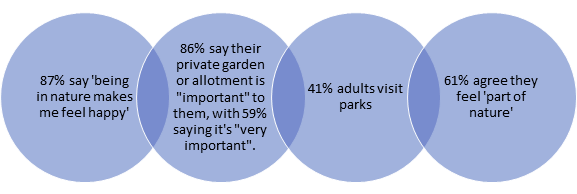
It has become a bit of a truism to say that gardens and open green spaces have become a lifeline to many during 2020. A survey examining life under lockdown as measured by Natural England’s People and Nature Survey, conducted in May 2020 found the following:

Our own project to renovate the Old Pond Garden at Charlton House has shown that many volunteers have appreciated the opportunity to get out into the open air and to be with other people. It has become the perfect community project.

Sue Stuart-Smith’s (many gardeners may be more familiar with her husband Tom Stuart-Smith, the garden designer and Chelsea gold winner) ‘The Well Gardened Mind’ was published earlier this year. Sue Stuart-Smith is a prominent psychiatrist and psychotherapist and her book examines neuroscience and psychoanalysis in the context of gardening and makes a strong claim for the benefits of gardening for mental well-being. Monty Don has long argued for the role of the garden in relieving depression and several episodes of Gardener’s World have featured individuals whose lives have been supported by the activity of gardening.

Gardens do not stand still; they are dynamic and ever-changing environments. Gardeners are always planning and looking forward. At the moment many of us, if we haven’t already done so, are ordering our bulbs for next spring. I am thinking about colour combinations (again) and I have a plan to move around my dahlias and make room for new varieties. On another recent visit to Great Dixter there was a stunning variety which, on enquiry, turned out to be Dovegrove. If I can find a supplier, I would like to include this in my borders next year.

Dahlia Dovegrove in borders at Great Dixter, Oct 2020
Quotation from "Elizabeth and her German Garden"
And so we look forward to the next year.

“Hardy geraniums are tough, they will grow anywhere”

On Wednesday evening I sat in on a Garden Masterclass presentation from Rosy Hardy on geraniums. Many people will know of Hardy’s Cottage Garden plants already; they have had a stand at the Chelsea Flower Show for many years and have won in excess of 20 RHS gold medals. Rosy’s energy and enthusiasm for plants seems undimmed by all the years! However, she did point out that 2020 was going to be their final year at Chelsea because the months of April and May are a busy time for the nursery and it all becomes too much work at a critical time. That final year will now be 2021.

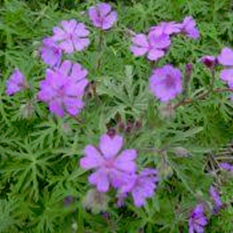
G. Wlassovianum
G. Wlassovianum
The range of geraniums presented was astonishing and I found my knowledge being extended further and further. From varieties that I had not heard of such as G. wlassovianum to the very biddable G. malviflorum, which flowers in spring only to die back and  then produce attractive leaf clumps through the winter. It sounds like the ideal plant for the herbaceous border. There is a geranium for every garden situation, Rosy claimed, and even those which are flagged to grow in a free draining sunny position for example, if they find themselves somewhere moist and rather shady they often thrive.
G. malviforum
G. malviforum
Participants had joined from around the world: from London to Scotland, the east coast of America to Japan. Questions at the end demonstrated the range of interest and the conditions to which geraniums will adapt. I for one, will certainly be  checking out some of the varieties to include more in my garden.

Vija

Members’ gardens, October 2020

Enjoy a walk around Sian’s beautiful garden this October: click on the button below and the video will play. We love Sian’s pebble beach idea!

Val & Harry have sent in this selection of their Autumn stars. They have a wonderful stripy Tagetes patula ” Jolly Jester” in their border. Harry says it germinates like mustard & cress and grows to 75cm-1m. It looks stand-out!

Last of the summer annuals, including stripy Tagetes
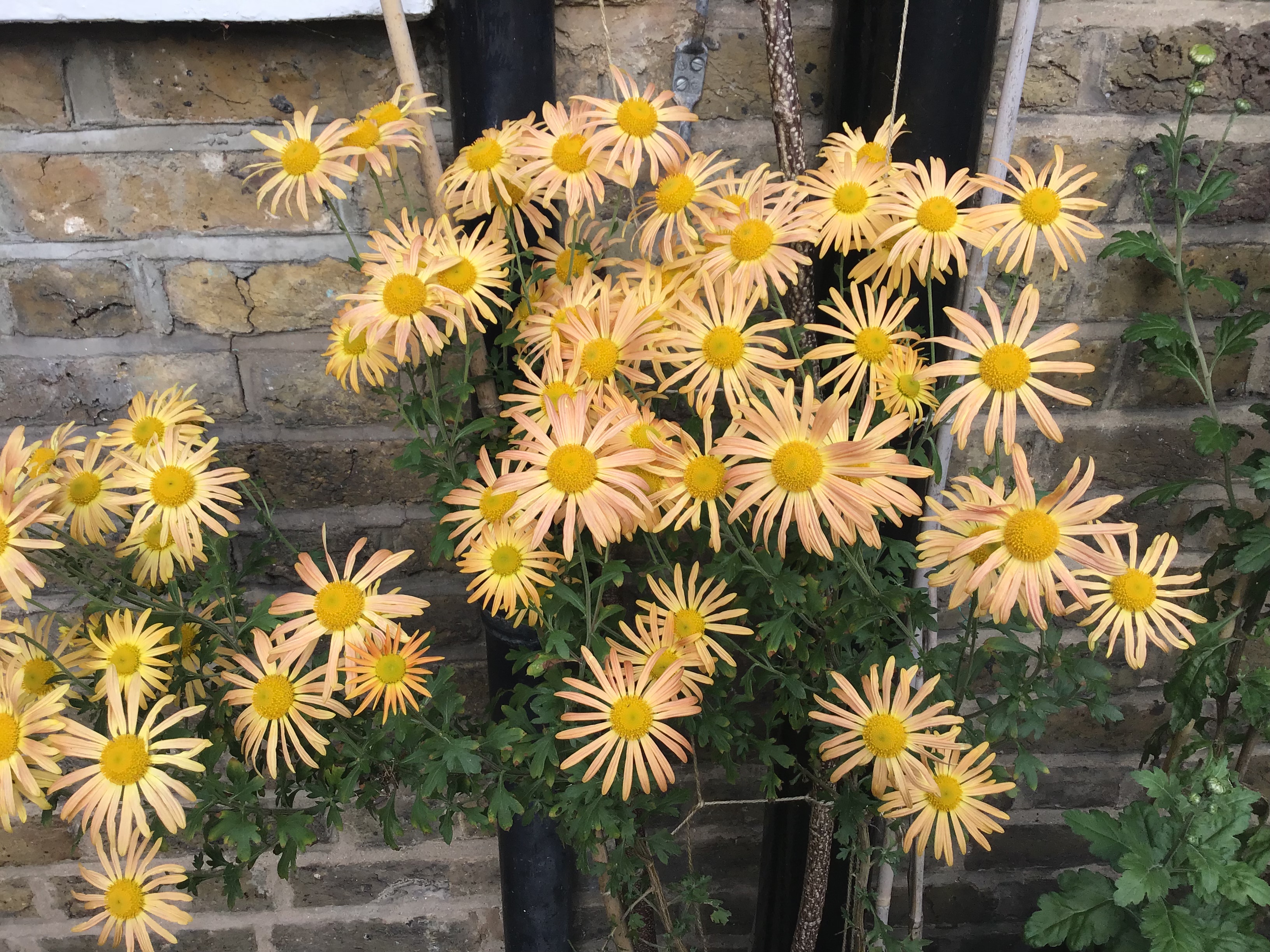
Korean chrysanthemum “Mary Stoker”
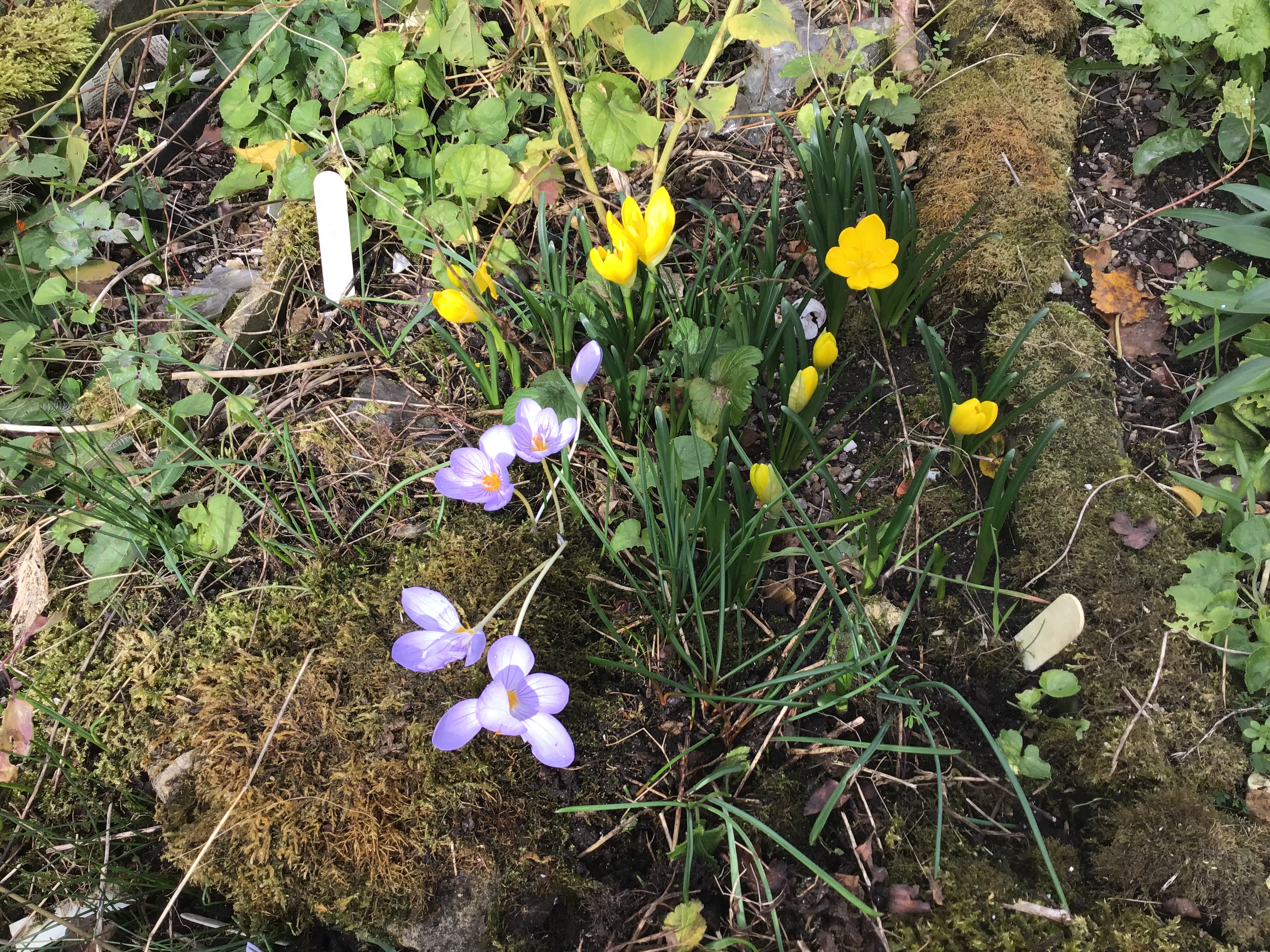
Crocus speciosus and Sternbergia lutea
Val and Harry’s perennial border

Here is Jillian’s garden, she has a lovely display of cyclamen in her borders, some of the corms are the size of saucers!

The succulent display in Jillian’s greenhouse is looking good:

Here is Marian’s dewy autumnal rose:

Show those Autumn colours! This is Kathy’s Blueberry “Goldtraube”, what a waste to have this in the soft fruit bed, it should be on full view in a border. All the books say it needs acid soil or to be in a pot of ericaceous compost, but it fruits and thrives very happily in normal soil with a watering can of Sequestrene a couple of times a year.

Autumn colours

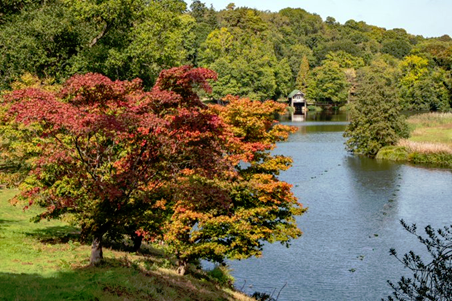
I have been reading that the Autumn colours this year should be lovely, following an unusually warm September and the coming month will provide an opportunity to get out into the gardens to experience these first hand.

One of the most spectacular displays may be at Stourhead in Wiltshire, where exotic species such as tulip and katsura trees stand alongside natives such as oak, beech and birch. Tom Hill, who looks after sites at Winkworth Arboretum in Surrey and Petworth Park in West Sussex, says he can already see the colours beginning to change. And it isn’t just the colour of the trees. At Mount Stewart in Northern Ireland, the assistant head gardener, Oliver Johnson, says he loves the light at this time of year.

Living as we do, on the edge of Kent, within fairly easy reach of a number of lovely gardens, it might be worth taking advantage of our privileged location. With the evenings already drawing in and with the potential of further localised lockdowns due to coronavirus, taking the time to notice nature and to take in the colourful landscapes that we can see at this time of year seems more important than ever.

Simon Toomer, a plant specialist at the National Trust, says that “The particular dusky, heavy scent of autumn and the sounds of crisp leaves crunching under foot, will all serve to help our wellbeing through the next few colder, darker months.”


Vija

OPG diary – October 2020

13 October
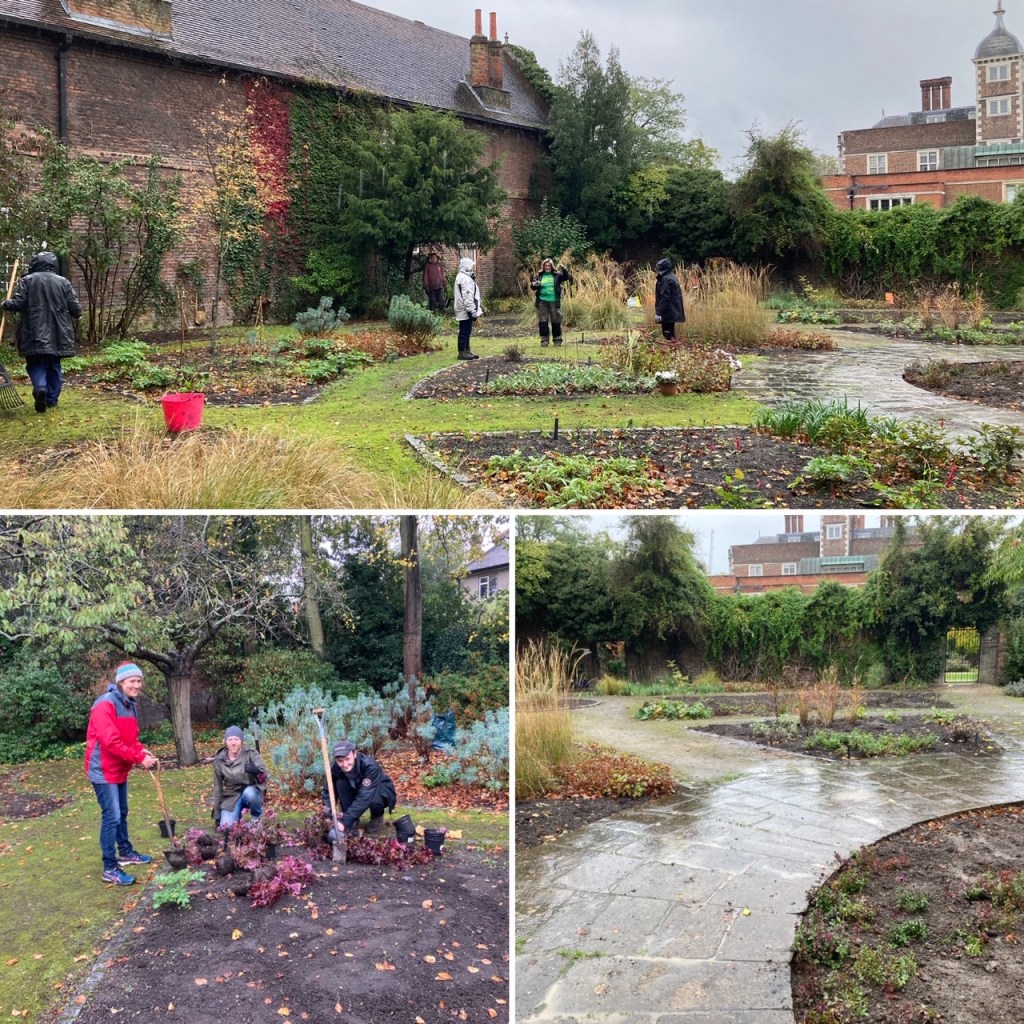
Heroic (and very wet) volunteers in the garden today. A lot of the plants from our shopping trip to Provender Nurseries are now in place. We really appreciated extra help from students from the University of Greenwich, who sportingly also got very wet. Donations of cinnamon buns from Charlton Bakehouse went down well. Thank you everyone. The picture below will be used as a ‘Before’ picture – so looking forward to taking some ‘After’ pictures next year!

CABAHS volunteers in the Old Pond Garden, Charlton House, October 2020

20 October
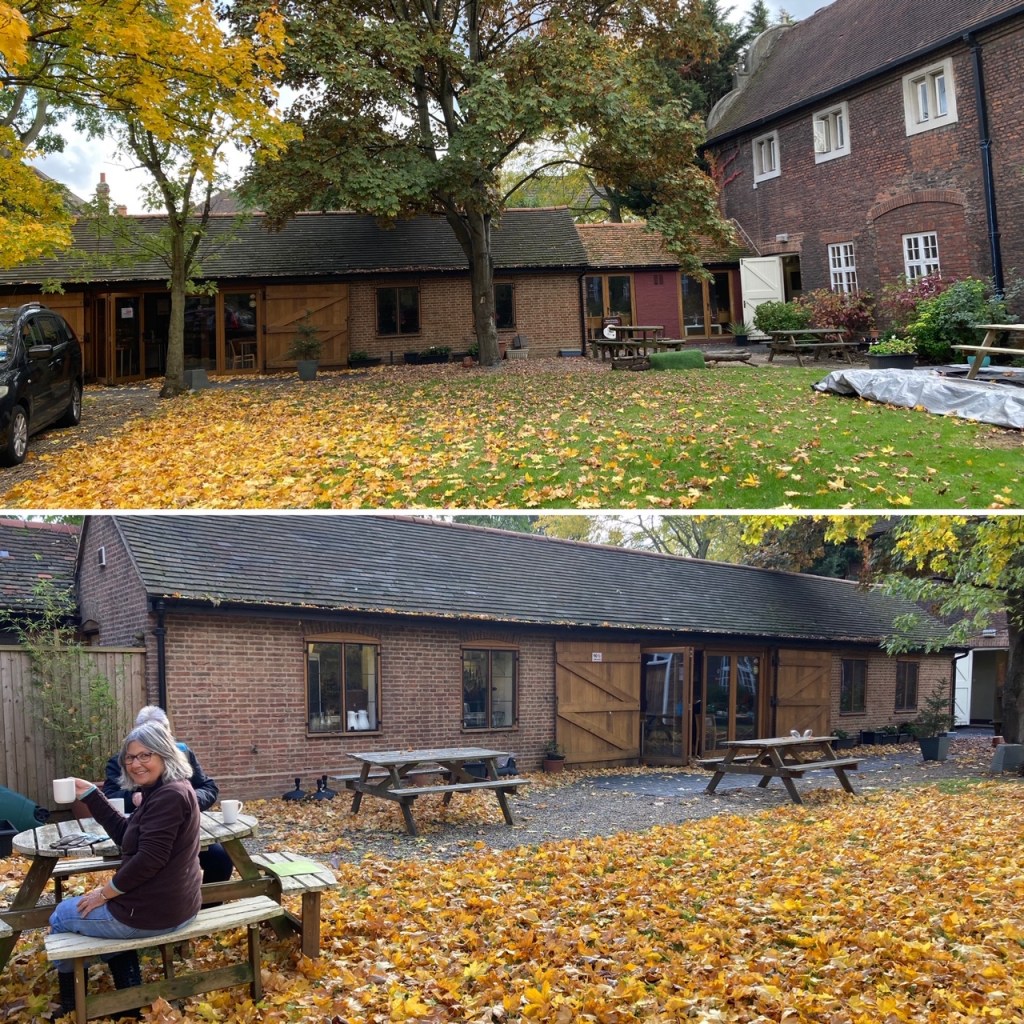
Another glorious Autumn day! Lots of volunteers and a bit of sun, what more do you want? We discovered the friendly Greenwich Carers café in the Stables next door. Bring your own cup/mug.

CABAHS volunteers in the Old Pond Garden, Charlton House, October 2020
CABAHS volunteers, Charlton House gardens, October 2020

22 October
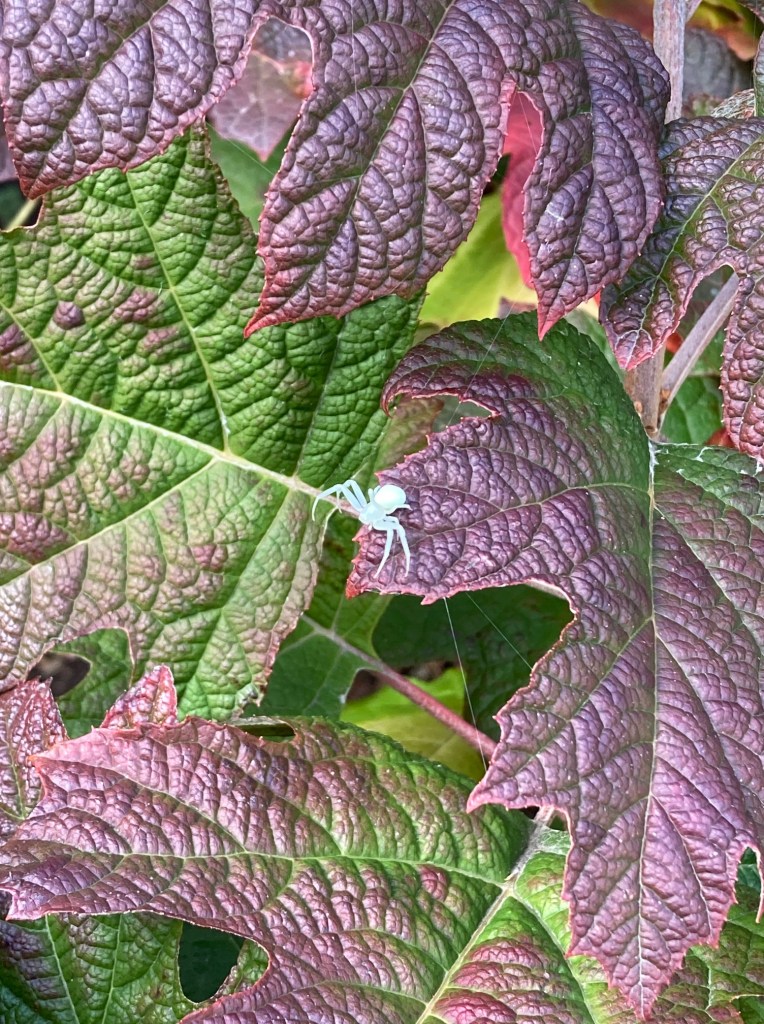
Our Oak-leaved Hydrangea is turning a lovely colour. Look what has taken up residence in it – a crab spider. Apparently they camouflage themselves but it takes a few days to change colour – this one must have been in a white flower recently!

Crab spider on Hydrangea quercifolia, Charlton House gardens, October 2020