Eat your Christmas tree!

One of my presents this Christmas was a fun book called “How to eat your Christmas Tree” by Julia Georgallis. As you would expect for a book with such a title, there are some bonkers ideas in it – but there is a serious message behind it and some quite intriguing recipes too.

The statistics are quite sobering: the author calculates that if we DIDN’T cut down one years worth of Christmas trees, the carbon emissions saved would be the equivalent of banning all global air travel traffic for a year, or taking all the cars in the United Kingdom off the road for the next five years.

On a much lighter note, here are a couple of her recipes:

Christmas Tree Tea!

Apparently pine, fir and spruce contain a lot of vitamin C, although pine produces quite a weak tea. If you have a go, make sure you wash all the needles thoroughly. (And never use Yew, obviously.)

Ingredients: A handful of pine, fir or spruce needles / Juice of a lemon / 30ml (1fl oz or 2 Tbsp) Honey

Method: Brew the needles in a teapot for 6 minutes. Add a dash of lemon juice and 2 teaspoons of honey to each cup. Pour over the brewed tree tea and serve.

Christmas Tree Cordial

This tastes a bit like grapefruit juice according to the author!

Ingredients: Juice of 10 lemons, zest of 4 / 2 litres water / 700g caster sugar / 400g spruce and/or fir needles (you can also use some of the branches for flavour)

Method: Sterilise a 2l glass bottle. Bring the ingredients to the boil over medium-high heat, turn down low and simmer for 2 hours. Strain through a fine mesh strainer, a few times, to make sure no needles are left and pour into the sterilised bottle. Keeps for 2 weeks in the fridge.

Christmas Tree Mimosa

Ingredients: 70 ml Christmas tree cordial (above)/ 140 ml prosecco / Ice cubes and lemon

Method: Combine in a cocktail shaker, pour into a cold glass and serve!

How to eat your Christmas Tree by Julia Georgallis

Kathy

A walk to the bottom of the garden

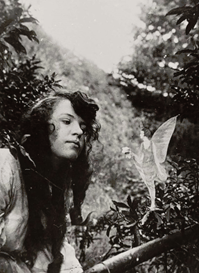
Like Francis Griffiths and Elsie Wright, as a child I believed there were fairies at the bottom of my garden. Unlike Francis and Elsie, I didn’t take this any further. The story of the Cottingley Fairies went on to become one of the greatest hoaxes of the twentieth century.

When Elsie’s mother showed the photographs to the local Theosophical Society, it set in motion a chain of events that led Sir Arthur Conan Doyle to conclude that the photographs were authentic.

Then in 1920, when Conan Doyle wrote an article on fairy life, fairy fever gripped the nation.

But there are other reasons to go to the bottom of your garden!

In one of the December entries in his book The Ivington Diaries, Monty Don writes that, in order to feed his chickens, he has to walk right to the end of the garden and back, ‘which means that whatever the weather … I am obliged to have a good look at things’. There is no doubt that, in the depths of winter, having to get from one end of your garden is quite an education. You can make all kind of assessments in terms of use of space and structure, when everything is so bare.

And there are, of course, additional benefits. The scent of the Viburnum bodnantense at the end of my garden is astonishing. It knocks me out every time.  Perhaps even more so in winter when there is less competition. I think I should have it closer to the house, or perhaps I should get another one.

But I do like the idea of a little cluster of fairies whispering somewhere under the still green leaves of my nasturtiums at the bottom of my garden!

Members’ gardens, December 2020

Fuchsia thymifolia

Kathy’s garden – a Fuchsia thymifolia which seems to bear its tiny flowers for 365 days a year and thrives in part-shade. What’s not to like? An added bonus that it is apparently slightly resistant to the gall mite too.

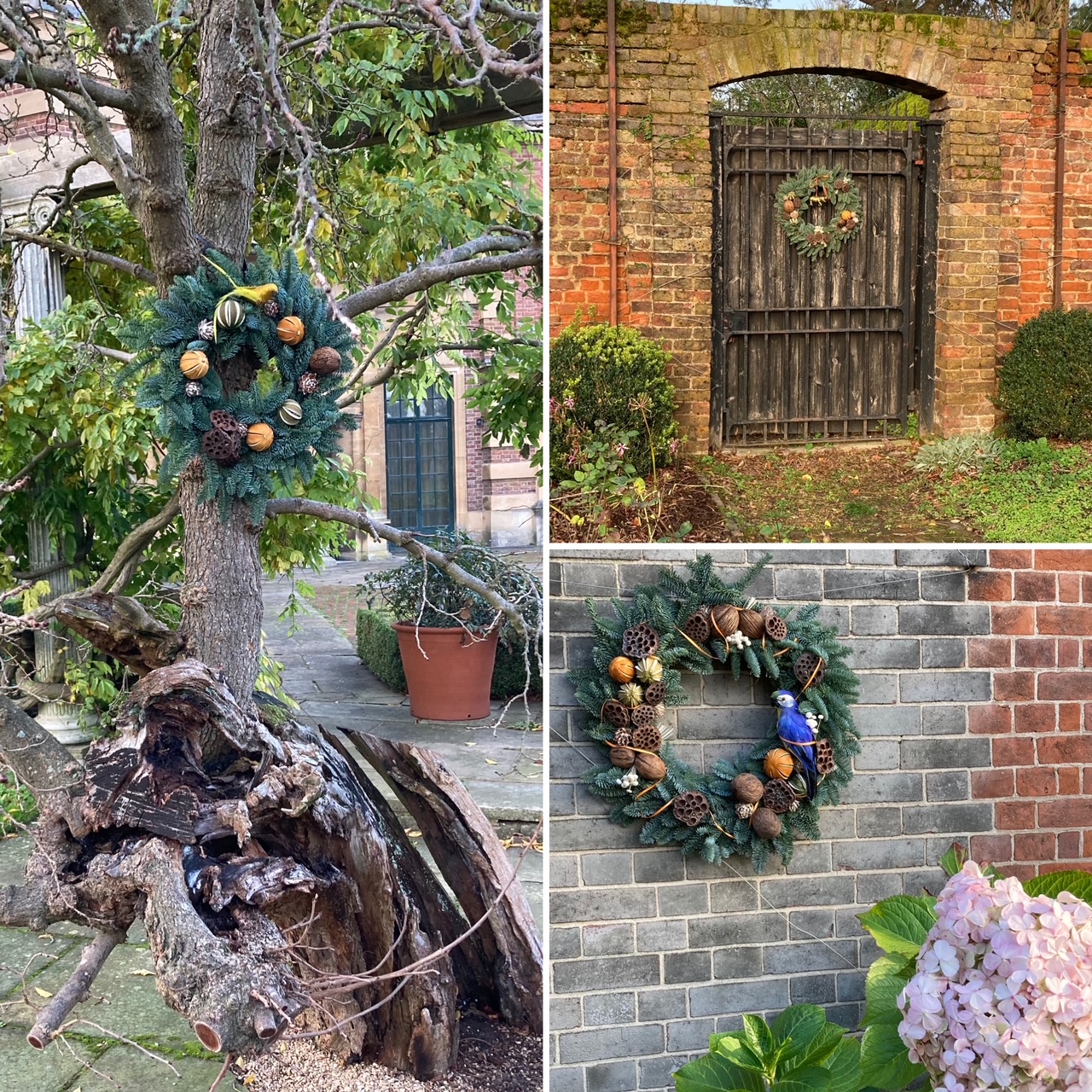
Anne R’s beautiful fully compostable wreath – ivy with osmanthus, rosemary, bay, honesty, rose hips, haws.

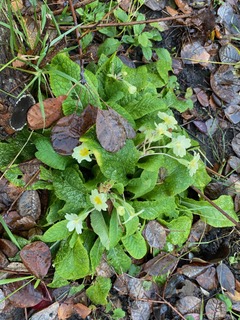
Primroses, snowdrops and Christmas rose out and doing their thing in Jan’s garden. Everything so early!

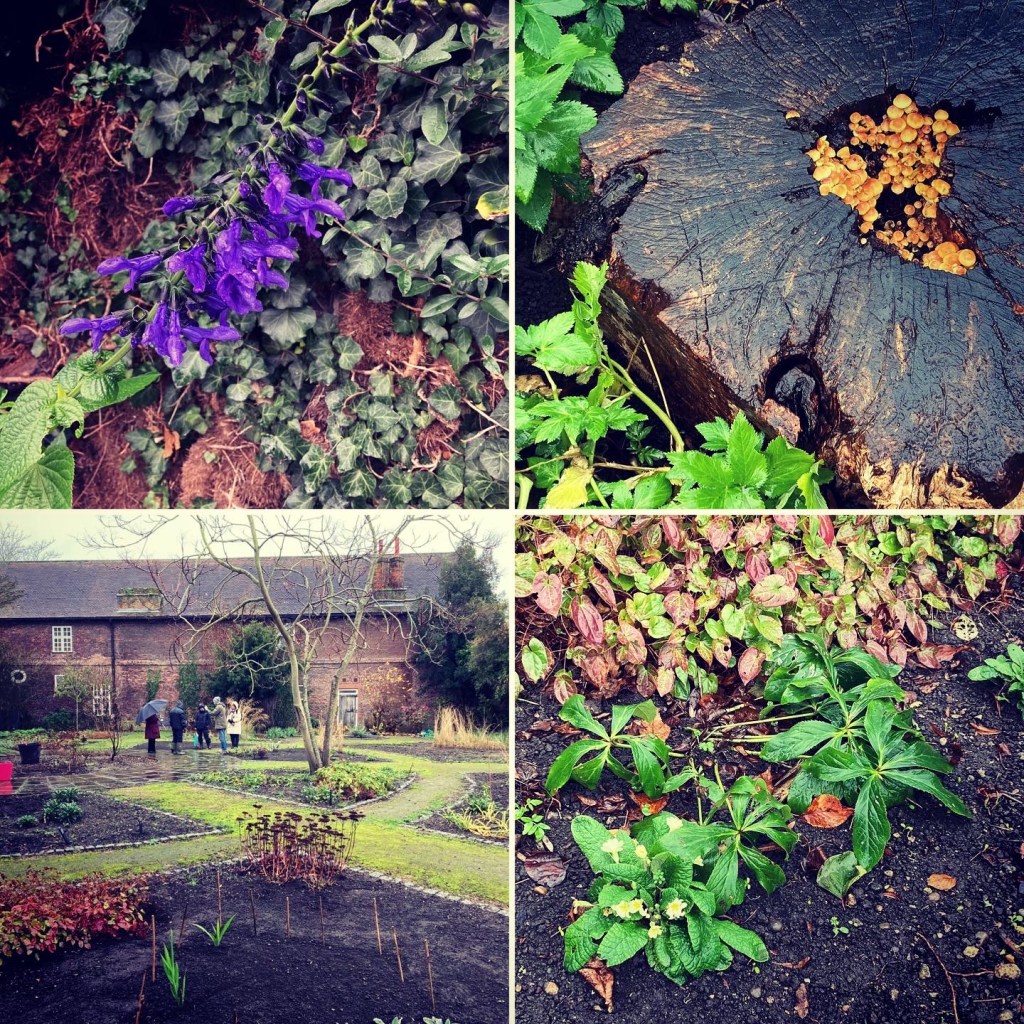
Lots of late colour in Chris B’s garden, Osteospermum, Pyracantha, Cotoneaster and a very pink Salvia.

Humanising our plants

Many of us anthropomorphise plants. It is often a winning combination when writing about them. Anna Pavord, a particular favourite of mine, writes about Symphytum grandiflorum as being ‘thuggish in its attitude to neighbours’.[1] Violas are described as ‘well drilled miniature rent-a crowds, all gazing in the same direction, each bloom well-mannered enough not to get in the way of the one behind’[2].

This image has an empty alt attribute; its file name is image-1.png

I have a pretty little Fittonia sitting on a table indoors and bought one for my daughter a while ago, as they seem fairly bullet proof. I tend to under water my houseplants and have noted this Fittonia in particular suddenly looking terribly limp; its leaves really hang down and it looks very miserable. However, a spot of water revives it swiftly and it looks complete sprightly again. My daughter commented that her plant ‘fainted’ – this is such an apt description it made me smile.

Of course, attributing human characteristics to plants may be another way of expressing the care we have for them. There are many keen gardeners who talk to their plants. I apologise profusely if I accidentally dig up and damage a bulb and it is often said that gardening is a form of nurturing.

Although anthropomorphisation has long been regarded as something of a lovable quirk, recent studies suggest it promotes a view of the object as prosocial, intelligent and able to suffer, all of which are important aspects in conservation. If this is not limited to species which we view as somehow ‘being like us’, the empathy intrinsic to anthropomorphisation can be a useful tool to conserve threatened biodiversity. Of course, this is a huge debate, but it does highlight the relationship between private attitudes and public approaches.

Vija


[1] Pavord, A. (1991) The Flowering Year Chatto and Windus, p. 56

[2] Pavord, A. (2001) Plant Partners Doring Kindersley, P 106.

OPG diary – December 2020

2 December
A wet and chilly session, but good to be back after Lockdown II.

15 December
A great day for gardening! Lots of planting was done, path clearing was started, and as for the gate decoration – we’re getting really festive now. Mince pies (from Charlton Bakehouse) at half-time were much appreciated.

This image has an empty alt attribute; its file name is img_0889.jpg

The CABAHS bench, to commemorate our Platinum (70th) Anniversary, in situ. A lovely shady spot to look forward to next summer. We think perhaps a Trachelospermum climber up the back wall..

Christmas message tree at St Luke’s

The 'Christmas message tree' at St Luke's Church, Charlton, December 2021

Isn’t this a great idea? St Luke’s Church in Charlton Village asked residents to send in their Christmas messages and they would be hung on the tree outside, so everyone can read them as they walk past. There are some lovely children’s drawings and heartfelt messages. CABAHS has added a message on members’ behalf too.

A robin for Christmas

John Sturgis has recently written an article in the Spectator, much after my own heart. He says he has two birds on the go, one in the garden, one at the allotment, both real beauties — and both robins.

With much of the nation still working from home, robins have become more familiar than ever. Most species of garden birds are horribly in decline, but the robin has stubbornly stuck around in great numbers.

While those other great survivors, magpies and pigeons, are brash and ungainly, the robin is a delicate little gem: magpie song is shrill, pigeon dumbly repetitive, but robin chirrups are a delight. They’re bold, too. Other garden birds flap away when we appear, but not robins. In fact, they approach — as inquisitive as a kitten.

The robin has a territory that ‘can be as small as a half acre’ so where I live I must share my robin with several neighbours. But one always appears as soon as I venture out of the back door, for human activity is their cue. My robin particularly likes it when I use my daisy grubber on the lawn. The stabbing activity seems to prompt all the worms near the daisy to come to the surface, in case I stab them too, I suppose. But there she comes, Mrs Robin following my every footstep, darting around where I have just been, feasting on the worms leaving their cover.

I say ‘she’ but frankly I don’t know. No doubt your Chris Packham types would be able to gender a robin from half an acre away, but to the untrained amateur, male and female are very much interchangeable.

Sturgis points out that robins frequently come up in literature and songs – John Donne’s Robin Redbreast, or The Secret Garden, or Rockin Robin of the Jackson 5. And, of course, the robin is the Boy Wonder’s spirit bird in Batman. Imagine trying to pitch that set-up today. ‘I like this Bat guy – very dark and cool. What are we doing for the kid? A scorpion? Eagle?’ ‘No, we thought a robin.’ Yet it works, accentuating the character’s chirpy loyalty.

But their definitive place is on Christmas cards. They’ve somehow smuggled themselves into the greeting card nativity scene, apparent survivors, along with holly, ivy and mistletoe, of pre-Christian winter festivals, one of the few flashes of colour in the bleak midwinter.

So just go outside with a trowel or daisy grubber and she will soon appear. And despite the Christmas connotation, she’ll still be there in the bleaker days of January and February. Because robins are very much for enhancing life, not just for Christmas!

Kathy

Members’ gardens, November 2020

This is Harry & Val’s Eucharis amazonica, which is flowering for them for the fourth time this year!

Here is Jean’s rose “Compassion”, still blooming away in November:

Penny has sent in a picture of her Cobea plant, which she says is sited in a cold part of her garden but still insisting on flowering in November. It is beautiful, and usually grows as an annual in this country, so it must love her!

Cobea scandens

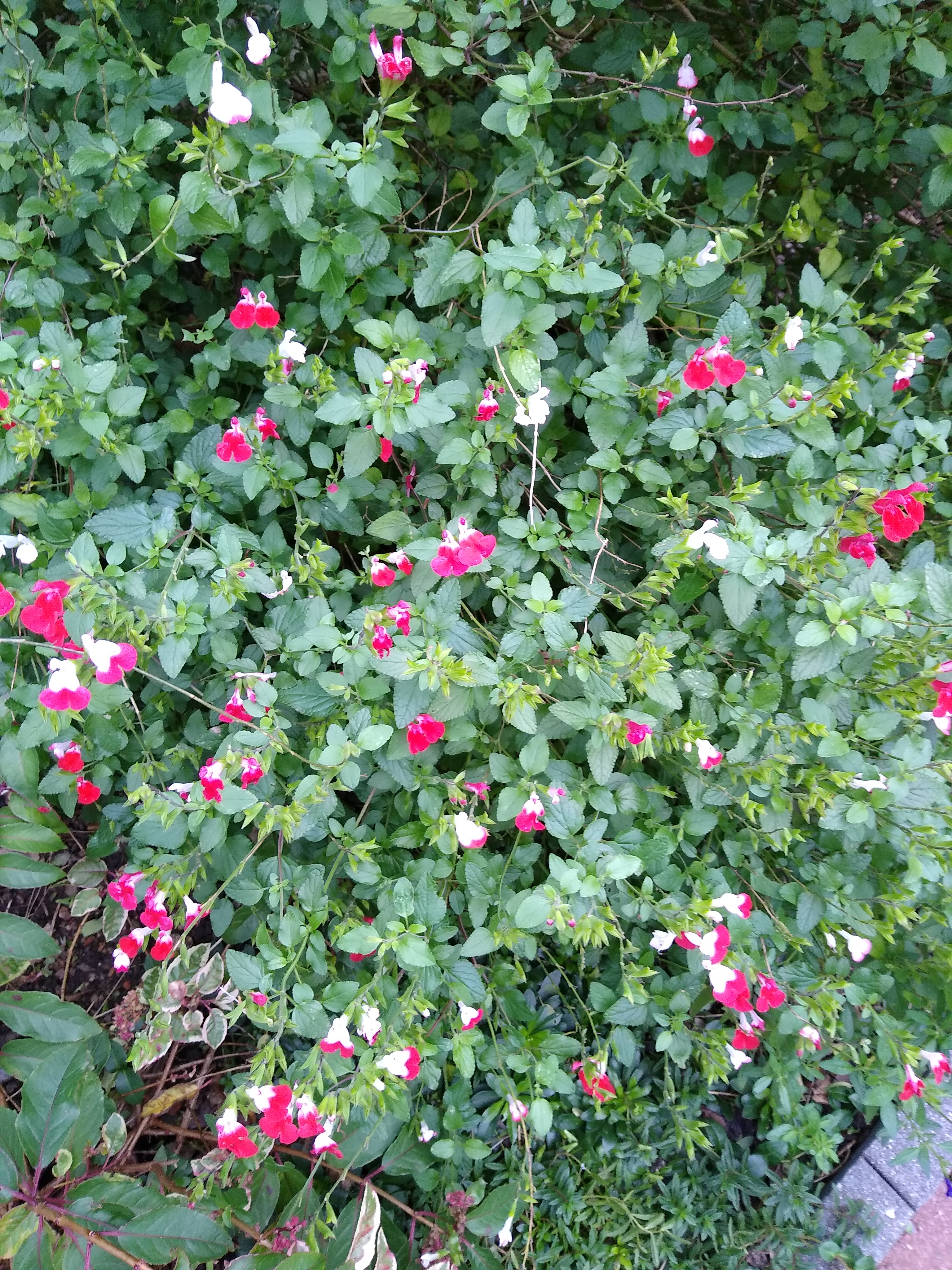
Carolyn’s Salvia “Hotlips” is providing late colour and cheer in her garden, having been flowering all summer long.

Salvia Hotlips

Viv has sent in her star performers, Schizostylus coccinea in two colours. Or Hesperantha as I suppose we should call them. Also known as Kaffir Lily or River Lily.