One of the things I like best about RHS Wisley is how useful it is – beautiful to walk around, pleasant to visit, but also how just being there can answer a multitude of gardening questions: ‘Will this plant survive outside?’‘Just how big can an Indian Bean Tree get?’ or ‘How best can I display alpine plants in my small garden?’
But one of the most useful parts of RHS Wisley helps to answer a question that has become louder and more frequent with every passing year, especially here in the South East:
‘What can I use to replace my ravaged box hedges?’
On Wednesday 11 May, a coachload of CABAHS members went on a much anticipated trip to RHS Wisley. This was my first experience of a CABAHS coach trip and it was brilliantly organised by Anna (thank you Anna!).
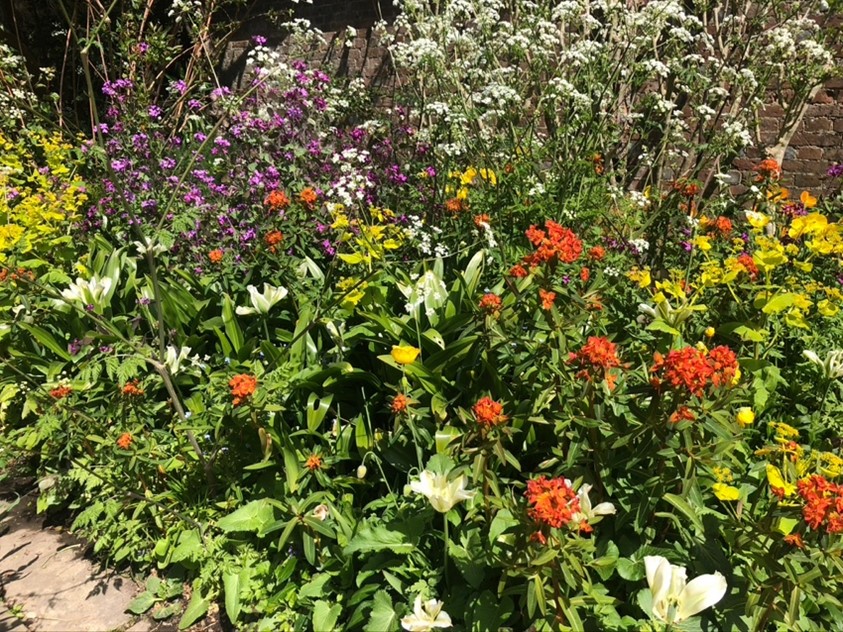
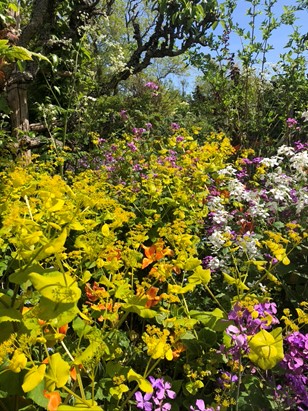
Just before the rain started… RHS Wisley May 2022
After experiencing dry weather for weeks, the forecast was for rain mid-afternoon, so it felt important to pack as much in as possible before the rain started. Several members had signed up for a tour with a Wisley volunteer, but as the tours started, so did the rain – several hours earlier than forecast! We were, however, undeterred.
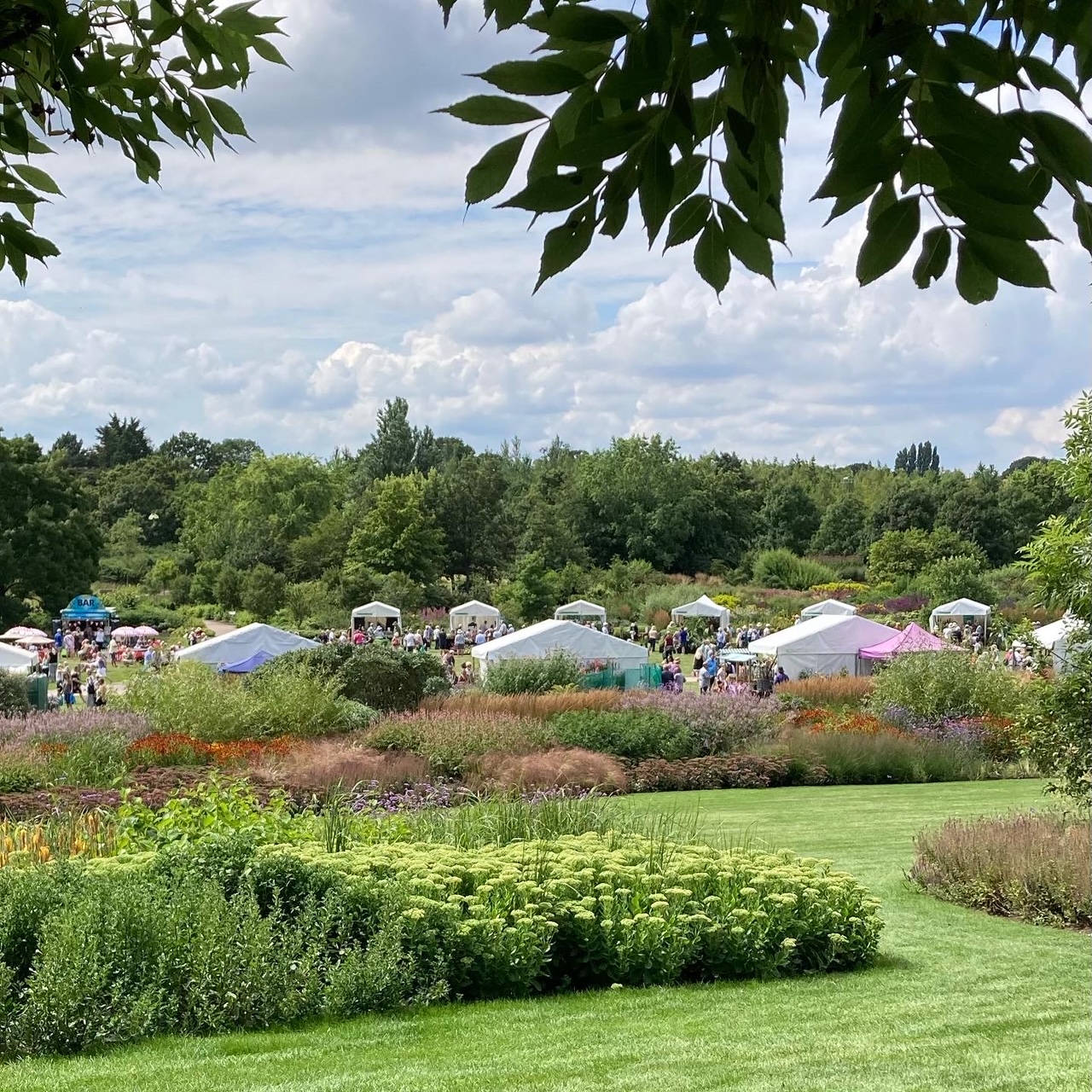
Late April is a great time to remind yourself that spring happens outside of London, and I had the joy of meeting a group of friends in Yorkshire for the Harrogate Flower Show. This is quite a major show, running over 4 days, but it’s not run by the RHS and it has quite different emphases. It does, though, have lots of exhibitors and we enjoyed a full day there, in brilliant sunshine.
First off, we looked at the flower arranging, clearly a major component with several training colleges nearby. There were lots of competition categories, from big set pieces to carefully chosen themes. We admired long-horned cows fashioned from garlands of flowers, and saw a heavy emphasis on arum lilies, which featured on the Best In Show winner, for instance.
By contrast, the show gardens were a very minor element of the event. They were small, commercially-sponsored but not carefully themed, and quite underwhelming. And they had very few people looking at them.
The area for various Societies was dominated by the Daffodil Society Northern Group, where competitors were vying for prizes in nearly 100 categories. The variety of blooms was extraordinary, with a strong emphasis on precision and newly-developed cultivars. Among others, the Yorkshire Bonsai Society was also showing beautiful specimens, as were the National Auricula and Primula Society, the National Dahlia Society, and the West Yorkshire Hardy Plant Society, which won a Premier Gold award for its spectacular display.
The gardens at Keukenhof in April are quite remarkable. Great rivers of tulips are everywhere. Small exhibitions in the Juliana house give background information to the history and also to the planting practices of this huge venture: 7 million tulips (and other flowering bulbs) are planted each year and each year, at the end of flowering, these are all taken up and crushed to be used as compost around the trees in the garden and made into pulp for the paper which covers the guides to the estate.
As a not-for-profit organisation, in addition to the garden architects, the gardens rely on an army of volunteers. From May onwards the gardens are closed to allow time for the essential work of taking up the tulips and replanting, until reopening for the spring display. The bulbs in each garden area are given to Keukenhof by growers in the Netherlands and the name of the company appears as signage on the beds. For those wishing to make a note of their favourites, tulips are also discretely labelled, although it is easy to feel overwhelmed by the enormous range on display!
Inspired by Melanie’s wonderful talk to members about the various Rothschild gardens, Sharon & I accompanied her on a trip to see the restoration project at Gunnersbury Park. We had our volunteer project at Charlton House & Gardens firmly in mind throughout the day, and were pleased to find parallels – albeit on a much grander scale there! Gunnersbury was bought by Ealing & Acton council in 1925 (Charlton was bought by Greenwich Council in the 1920s) and used as a public park in much the same way that Charlton Park has been.
In 2018 the “Large Mansion” was restored using Heritage Lottery and other funding and opened as a Museum housing the borough archive. Major parts of the park were included in the funding, the Orangery, lake and orchards for example. The Friends of Gunnersbury Park were instrumental in the restoration effort, and volunteers clearly play a large part in the day-to-day running.
On Thursday I joined a tour of Avery Hill Park with the Mottingham Horticultural Society, who had extended an invitation to CABAHS members. It was a beautiful, crisp, sunny afternoon and the park looked gorgeous. Our guide John, from the Friends of Avery Hill Park, told us about the history and prehistory of the park before leading us around the extensive area.
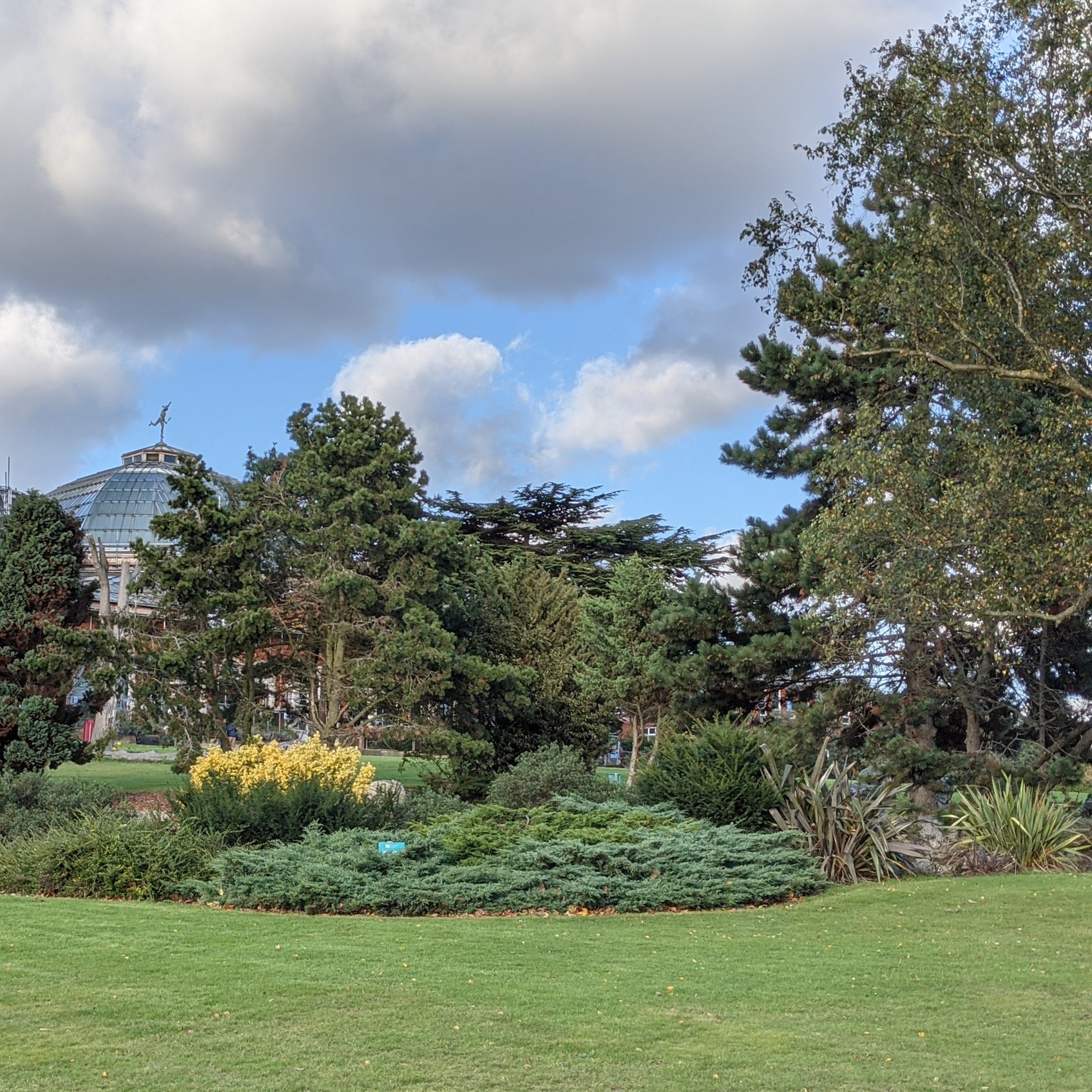
Autumn tree colour in Avery Hill ParkThe Avery Hill Winter Garden, viewed from the park
Some members may be familiar with the Winter Garden, a glasshouse currently undergoing renovation work (therefore closed) and about to pass from the hands of the University of Greenwich back to the local council. I look forward to seeing it after renovation is complete!
Recently cut meadow area and former hedgerow (with dozens of cross country runners!)
There are two main areas of the park, historically and now. The more manicured, grassed parkland associated with Avery Hill Mansion (which is currently being converted into a school), and former farmland, with field boundaries and drainage ditches. The Friends are working to make the latter areas more wildlife-friendly by negotiating a meadow-style mowing regime (ie: cutting only twice a year, removing the mowings once seed has dropped, and sowing wildflower seeds) with some mown paths. Even after just a year, it’s possible to see that the range of plant species is extensive. The increase in butterfly numbers and activity in summer 2021 was notable. It is hoped that a general increase in biodiversity will also encourage an increase in bat numbers, which have declined in recent years.
Looking toward Great Stony Acre – field boundary trees and drainage ditch
The former field boundaries are still visible, and what would have been hedgerow has grown into rows of trees and scrub, which is excellent for wildlife. A new mixed hedgerow has been planted where one had disappeared, and the drainage ditches have been cleared by volunteers. Another historical feature which lives on through the Friends is the old field names, such as Henley’s Meadow, Little Stony Acre, Grey’s Field and Great Stony Acre. The latter is being planted with native tree species – oak, hornbeam, birch, hawthorn and field maple. Around 1500 trees have been planted over a five year period, and there are plans for a natural drainage pond in the centre as the area is at the bottom of a slope, is mostly heavy clay and becomes very boggy in winter.
Young trees in Great Stony Acre
It was a very enjoyable afternoon and I appreciated the chance to visit the Park with a knowledgeable guide.
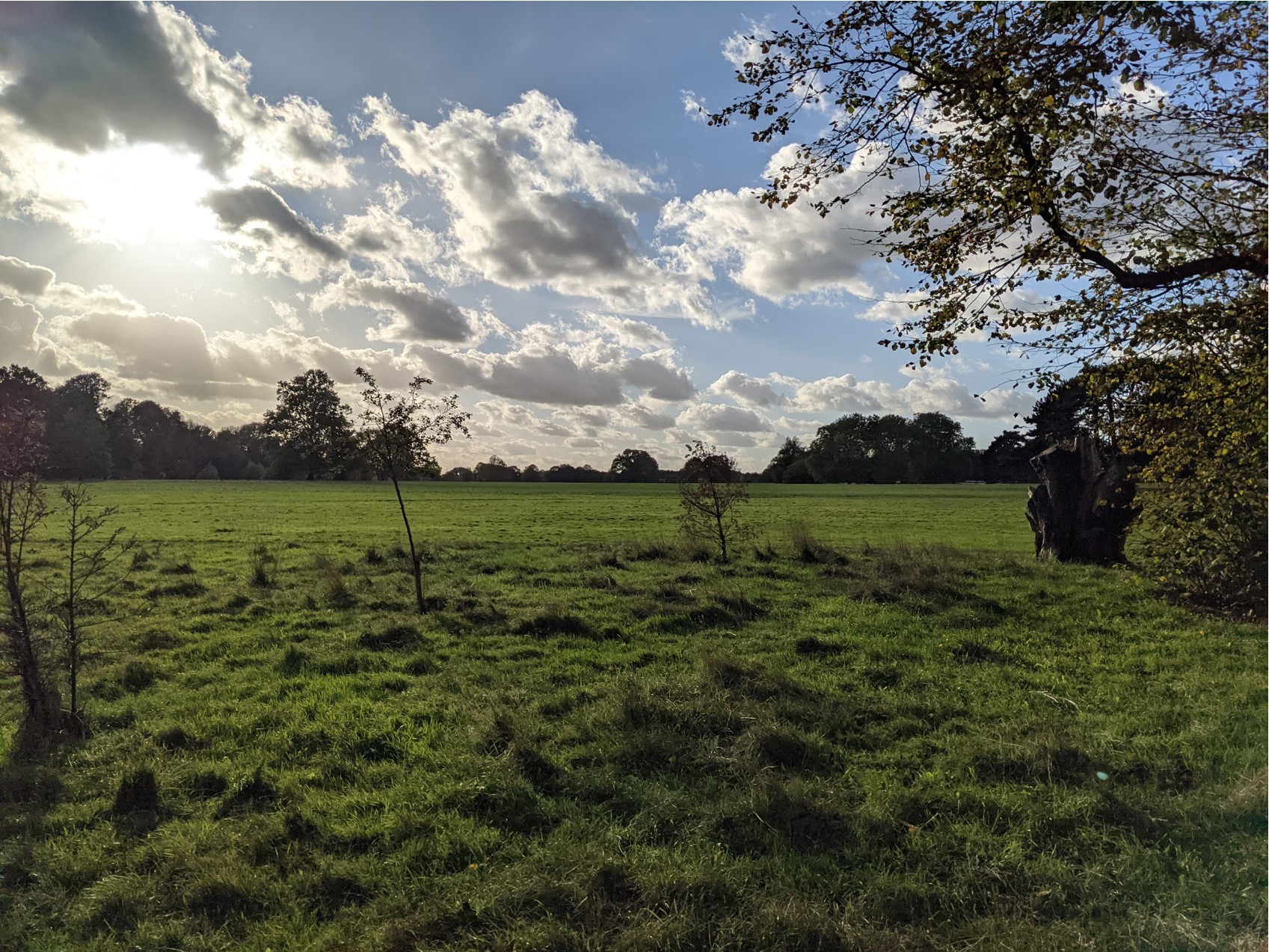
Looking across Avery Hill Park, late afternoon October 2021
10 October 2021: A special opening of Sian’s garden for CABAHS members, a lovely chance to catch up and £251 raised for Greenwich & Bexley Community Hospice.
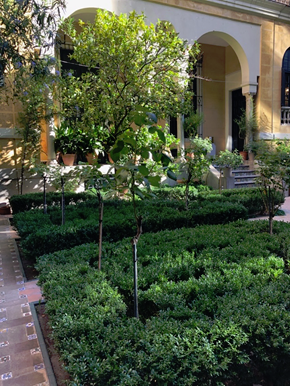
On a recent visit to Madrid, I called in to the house of Joaquim Sorolla (to my mind, one of the greatest of the Impressionist painters). Like Monet and others, he was one of those artists who loved his garden and, in later life, used it for inspiration and as subject matter. Located in the heart of Madrid, the garden has been created to manage the heat of the city. ‘The garden with its Moorish echoes is the quintessence of the Spanish garden’[1]. It is divided up into three linked but clearly distinguished parts. There is extensive use of aspidistras in huge pots to line balconies and provide focal points around the garden. Roses are grown in pots and situated throughout the garden – the ones I saw in flower were of a cream I associate with ‘Buff Beauty’. And, of course, plenty of pelargoniums in pots, most of which had finished flowering (my visit was in September). If in Madrid, do visit!
Luca de Tena, C. (2021) Museo de Sorolla, Madrid. Ediciones el Viseo.
Self-drive/car share trip to the Flower Show at RHS Hyde Hall on 4 August 2021. A lovely day, with lots of quality plant stalls. A difficult journey home due to traffic, but it didn’t spoil the day!