Compton Acres, Poole, Dorset

Before the 1920’s, the ten acres of land at Canford Cliffs was heathland.  But along came a man with vision, one Thomas William Simpson, and, with the help of his head gardener Mr Middleton, a magical garden was created. 

Mr Simpson was a businessman and entrepreneur (margarine) and having visited many countries, knew exactly what he wanted.  Influenced by the gardens and architecture of Italy, Japan and the UK Arts and Crafts movement, he and his gardener set about creating a series of gardens, starting with the Italianate gardens, then a necklace of paths and ponds which connected finally to his Japanese Garden, thus turning his vision into reality, right up until WW2. 

The garden sadly fell into neglect following the conflict, but in the 1950’s and 60’s, a new owner set about restoring it, planting the magnificent trees we see today – their maturity and majesty makes this garden quite a magical place to explore.
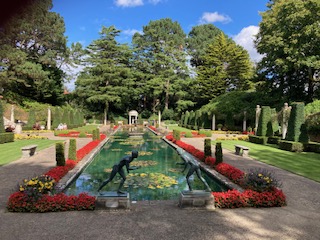
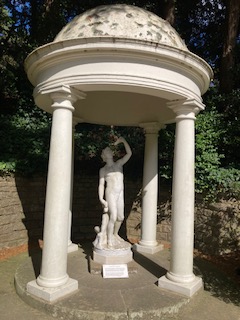
Upon entry into the garden, I came into the Roman Garden, passed through the Grotto and into the very impressive Grand Italianate Garden, the focal point being the rectangular formal pond and beyond, the statue of Bacchus, the Roman God of Wine, sheltering within a temple at the far end of the garden. This sheltered, south-facing, formal garden is a relaxing place to sit and admire its many features.  This garden then leads into Palm Court, a formal garden with its row of impressive Chusan palms.

Continue reading Compton Acres, Poole, Dorset
A visit to East Lambrook Manor Garden

East Lambrook Manor, April 2024
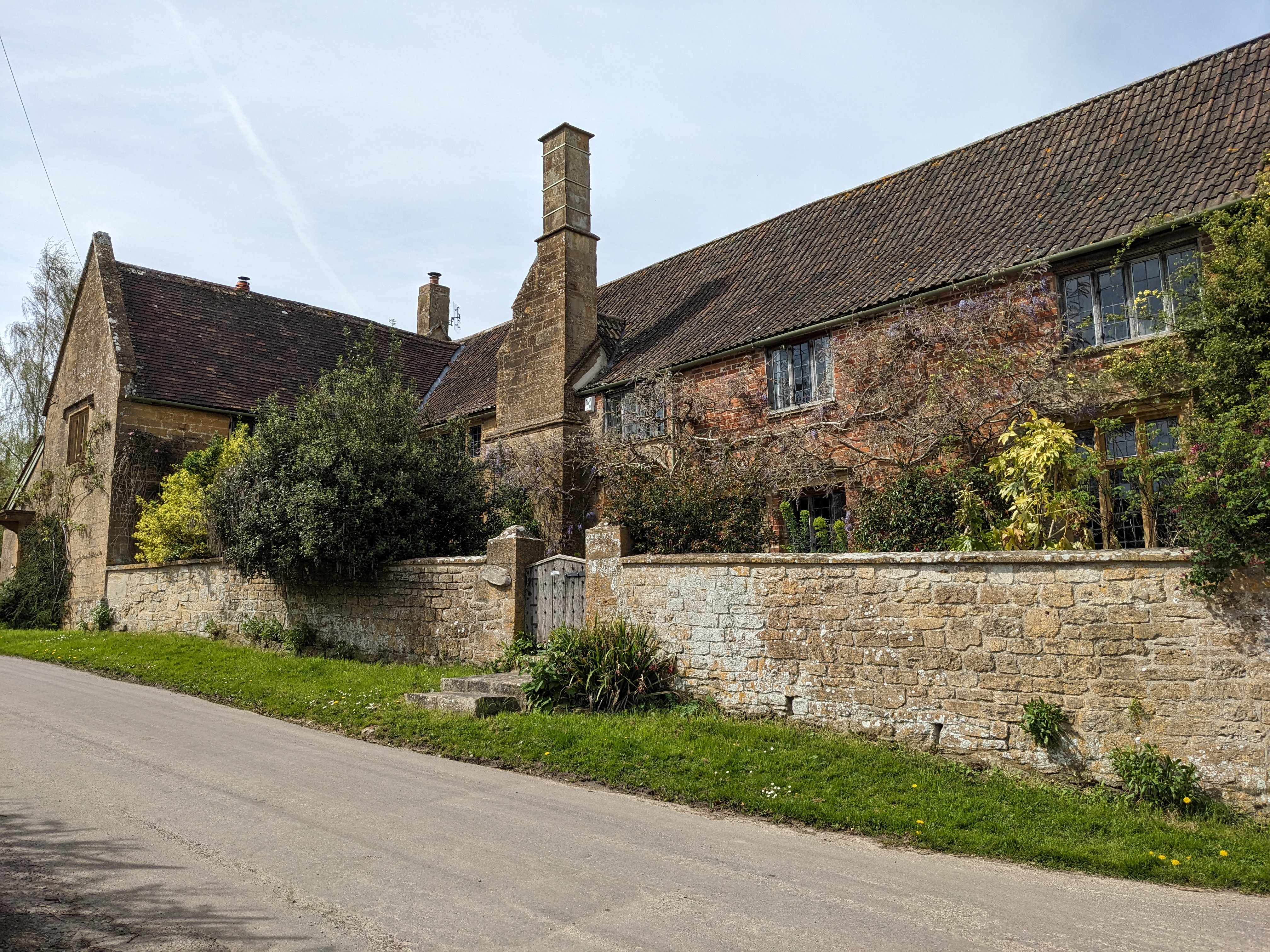
East Lambrook Manor from the road.

After years of repeatedly reading about East Lambrook Manor in Margery Fish’s classic book ‘We Made a Garden’ [book review], I discovered late in 2023 that the house and garden were to be sold. While the garden is Grade 1 listed and therefore protected to some extent, it may not have to be open to the public, so I determined to visit as soon as I possibly could. The garden is not open over the winter – its season begins with the snowdrop festival in February – so I waited nervously to see if it would re-open in 2024. It did, so plans were hatched as there was now a caveat on the East Lambrook Manor website that opening arrangements could change if it is sold.

East Lambrook Manor Gardens, April 2024
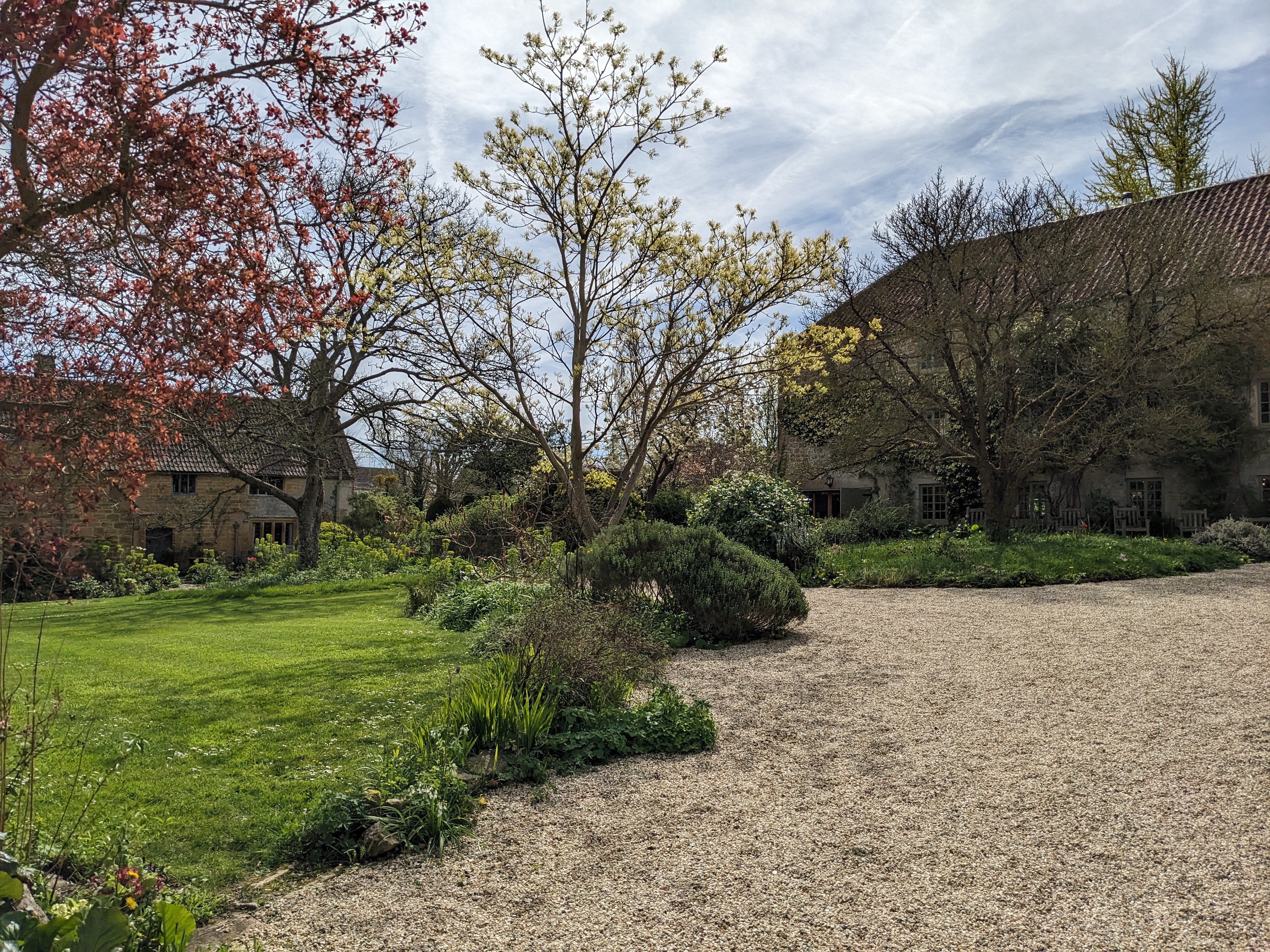
First view: House and lawn to the left, Barton ahead and Malthouse behind.

On a sunny morning in early April we set off to walk from South Petherton, where we were staying, to East Lambrook. It was a lovely walk of just under two miles, leading us into a small village with some very nice front gardens… and we turned into a driveway with the manor house on our left, the Malthouse ahead and a beautiful tree with a host of snakeshead fritillaries (Fritillaria meleagris) below. This was The Barton – the former farmyard.

Continue reading A visit to East Lambrook Manor Garden

Anna’s Visit to the Tibetan Peace Garden, Geraldine Mary Harmsworth Park, Lambeth

After the busyness of a visit during half-term to the Imperial War Museum, it was relaxing to visit the adjacent Tibetan Peace Garden on an amazingly warm and sunny, winter’s day in February. 

This is a lovely, partially enclosed garden which was opened by the Dalal Lama in 1999 and it was named ‘Samten Kyil’, meaning the Garden of Contemplation and this is exactly what the designers have achieved.  

The garden is made up of two parts: an outer garden of trees and lawn sweeping around and enclosing the inner circular garden, the whole bordered by a circular pathway in which to enjoy the views.  White-barked Himalayan Birches, making a striking contrast against the green and blue of the grass and the sky, are interspersed with Weeping Cherries and Prunus serrula (Tibetan Cherry) with polished, red-purple bark.  

Continue reading Anna’s Visit to the Tibetan Peace Garden, Geraldine Mary Harmsworth Park, Lambeth

Wellbeing Garden at Lewisham Hospital

During September 2023 I revisited the newly-built Wellbeing Garden, located at the rear of University Hospital, Lewisham.

Wellbeing Garden and Pergola

There have been some exciting changes and the most notable is the large, beautifully-built, pergola that pulls the whole garden together. The pergola not only provides shelter but acts as a meeting place for various classes, including the Gardening Club. Some of the structure’s uprights are decorated with painted terracotta tiles, showcasing talented and creative individuals. 

The planting in the garden had matured, and, being autumn, the grasses were in their prime, growing alongside the flowering stars of pink Tulbaghia violacea.   I noticed a Snow Drop tree (Halesia diptera) and an additional small tree, Heptacodium miconioides, a species I had never seen before.  The tree was displaying clusters of prominent, white, flowers with an intoxicating perfume, so, for me, this was an exciting find.

Continue reading Wellbeing Garden at Lewisham Hospital

Down at Down House

According to my (many) English Heritage emails, Down House and garden is one of the best of their sites to visit in the autumn. We went expecting a show of bright autumn colours but I have to say we were rather disappointed.

However, there were compensations. There were autumn colours aplenty on the drive down with the low autumn sun sparkling through the yellow trees.

The house itself is very interesting. The staff were friendly and welcoming and keen to impart their knowledge of Charles Darwin and to ensure that we were enjoying our visit. The original kitchen with its flag-stoned floor is a good place to start with coffee and cakes.

Charles Darwin lived in the house for 40 years with his wife, Emma Wedgewood (also his first cousin). They had ten children, seven of whom survived beyond the age of eleven. Darwin was an unconventional Victorian father, allowing the children into his study and providing them with the means to play noisily in the house, building a wooden slide that fitted on one of the staircases.

Continue reading Down at Down House

Overbeck’s Garden Devon

On a recent visit to Devon we decided to visit Overbeck’s Garden owned by the National Trust. If you can brave the narrowest of South Devon lanes (and scarily so!)  you’ll come to Overbecks built into a cliffside at Salcombe and overlooking the Kingsbridge estuary. The setting is stunning and because it’s so sheltered supports plants and trees from around the globe.

The day was very warm but luckily there’s plenty of shade provided by the collection of trees including magnolias, olives and palms of various sorts and the feel is very much sub-tropical.  Amongst many areas there’s a Gazebo Garden, a Banana Garden, the Old Quarry, the Statue Garden and a lovely shady Woodland garden with a viewing point over to Salcombe with stunning views. Many lovely plants grow on the slopes and with only 3 full time gardeners I should think they rely heavily on volunteers although how they regularly navigate those lanes was a mystery to us. There’s a refreshment area (outdoors) and a picnic area. If you are in South Devon it is very well worth a visit and I hope the pictures convey the variety of lovely plants and trees you can see. 

Continue reading Overbeck’s Garden Devon

Sunday morning in the jungle

Last Sunday Jean, Val and I spent a very pleasant couple of hours in the jungle! The jungle in question is only a few minutes from Peckham High Street.

The owner, Clive, generously opened the garden to CABAHS members for a private view. Some of you may have visited before as the garden is regularly open on Open Garden weekends and has featured on TV with Carol Klein.  

Clive lives with various members of his family in a huge house in a leafy street in Camberwell. When they bought the house, the back garden had been severely neglected and was a ‘jungle’ of brambles. A digger sculpted out the different areas of the garden, paths were laid and interesting artefacts (many associated with Buddhism) added, to create a sense of discovery around each bend and corner. A few years ago, part of the next door garden was acquired, thus extending the original garden.   

There are numerous chairs, benches and sofas dotted around in quiet, sheltered corners and even a cosy shed/garden house full of interesting pictures and objects – perfect for a peaceful read on a summers day with just the swishing of the wind in the leaves for company.

Continue reading Sunday morning in the jungle

Lullingstone World Garden

I made my first visit to the charming Lullingstone World Garden today, and am very sure I will be back! This is the most eccentric and fun walled garden, as you might expect if you are trying to fit a worldwide range of plants into it. I especially liked the plant labels everywhere, so you know what you are looking at.

There is a nursery selling high quality plants and a cafe serving great sandwiches and drinks, also lots of seating for picnics. The private House wasn’t open when I visited, but opens sometimes for events. Add it to your list for visiting!

Continue reading Lullingstone World Garden

Beth Chatto’s garden

Trying to select photos to use from a visit to Beth Chatto’s garden is not easy! All aspects of this Essex garden are stunning and there are numerous ‘take homes’ from a visit. The cluster of pots around a wooden bench is easy to replicate, with its mixture of plectranthus, fuschia, a small but perfect blechium, pelargonium ‘Vancouver centennial’  (keep a lookout for this at our plant sales – it was our ex-Chair Jillian Smith who originally provided a steady supply) and a charmingly named begonia, ‘Beth’s Houseplant’.

Beth Chatto's garden - cluster of pots around a wooden bench

Of course, the dry garden is stunning with gaura, various grasses and verbenas (Bonariensis, hastata and ‘Bampton’) dominating the display in mid-August. Stipa gigantea and verbascums add height and Althaea cannabina has seeded itself generously. The blue of Catanche caerulea looked startlingly beautiful in one corner. This area of the garden is always a useful guide to what will manage with little water and good drainage.

Continue reading Beth Chatto’s garden

Great Dixter

Throughout the year Great Dixter hold various events for their Friends membership. So, on yet another dismal July evening this year, Pat and I drove to Sussex. The evening began with drinks and canapes and a talk from Fergus which should have been held on the front lawn but, due to the inclement weather, was inside in the Great Hall. Three boxes of plants from the nursery, designed for dry, wet and shady aspects of the garden, were raffled at £5.00 a ticket. Surprisingly, as Fergus was talking, the sun came out and what could have been a wet evening turned into a very pleasant one. Although the colour of the sky in the photo demonstrates it was still fairly cloudy!

Great Dixter Long Border with Cosmos bipinnatus Apricotta in centre

We had arrived slightly early, so were already able to explore the garden which is always full of surprises. The phlox were particularly beautiful and Pat and I were trying to note varieties for our own gardens! Following Fergus’ talk, which was generally about the work of Great Dixter and collaborative projects that were ongoing including one with Hastings council, we divided up into groups according to our chosen tour/talk. Each one of these was conducted by one of the students at Great Dixter. Pat and I had opted for the Long Border and Jungle Garden (although we popped out of the latter and into the Nursery!). The students are articulate and engaging and certainly know their material. Having watched Fergus’ lectures on the Long Border, it was interesting to see this in practice and explained to us by Andrew Wiley, one of the Chanticleer Scholars. A particularly interesting stand of Salvia Indigo Spires was a huge clump of individual cuttings rather than one big plant. Also in use was a lovely creamy apricot Cosmos (Cosmos bipinnatus Apricotta) –  a colour which we have seen a lot in other gardens this year and can be picked out in the photo (one to be ordered for sowing next year!). We always leave these gardens full of ideas and plans!

Vija V