Thank you to all our volunteers, members and local residents who donated plastic bottle bases over the past year – look what we did with them! It might not be quite Tower of London level, but our poppy cascade makes a great “Stop and Remember” point on your walk around the park this week.
The Garden Museum was created in 1977 in order to rescue from demolition the then abandoned church of St Mary’s at Lambeth, a church which now is restored and renewed: restored in the outer and inner structure of the church, and renewed as exhibition spaces on all matters related to the history of gardening, and to the history of the Tradescant family, father and son both named John, in turn each appointed Royal Gardener to the Stuarts and whose family tomb is within the grounds, fittingly in a garden that reflects their world-wide plant collecting.
The Tradescant family tomb though is overshadowed by that of William Bligh, the hero/villain of the Mutiny on the Bounty.
The visitor must tread over centuries-old gravestones set in the floor, and past memorials to some very late indeed Archbishops of Canterbury: St Mary-at-Lambeth was a popular resting place, right next door to Lambeth Palace.
The Museum has a permanent exhibition of the history of gardening in all aspects from grand estates to allotmenteering, from Gertrude Jekyll to Alan Titchmarsh. Art is of interest generally here, with currently a showing of Lucian Freud’s paintings of plants. The Museum has an archive/study room on garden design: visits for research are by appointment.
I’m sure we can all remember the particular joy that gardens gave us during the dark days of lockdown. Gardeners of course have always known the benefits that green spaces can bring.
This fact was brought home to me recently when I spent time in the Florence Nightingale Garden at St Thomas’s Hospital, Southwark – happily as a guest, not a patient or loved-one of a patient. The theme of the garden is ‘nurture through nature’.
The archivist in me loved the fact that enlarged extracts from Florence Nightingale’s letters in which she campaigned for healthcare reform featured in the original design, printed onto the boundary walls and overlaid with images of her pressed flower collection.
September started off with the tail end of The Drought and as it became wetter the Volunteers were very grateful to get back to some proper gardening. The great news is that we hardly lost any plants at all.
Volunteers on Tea Break
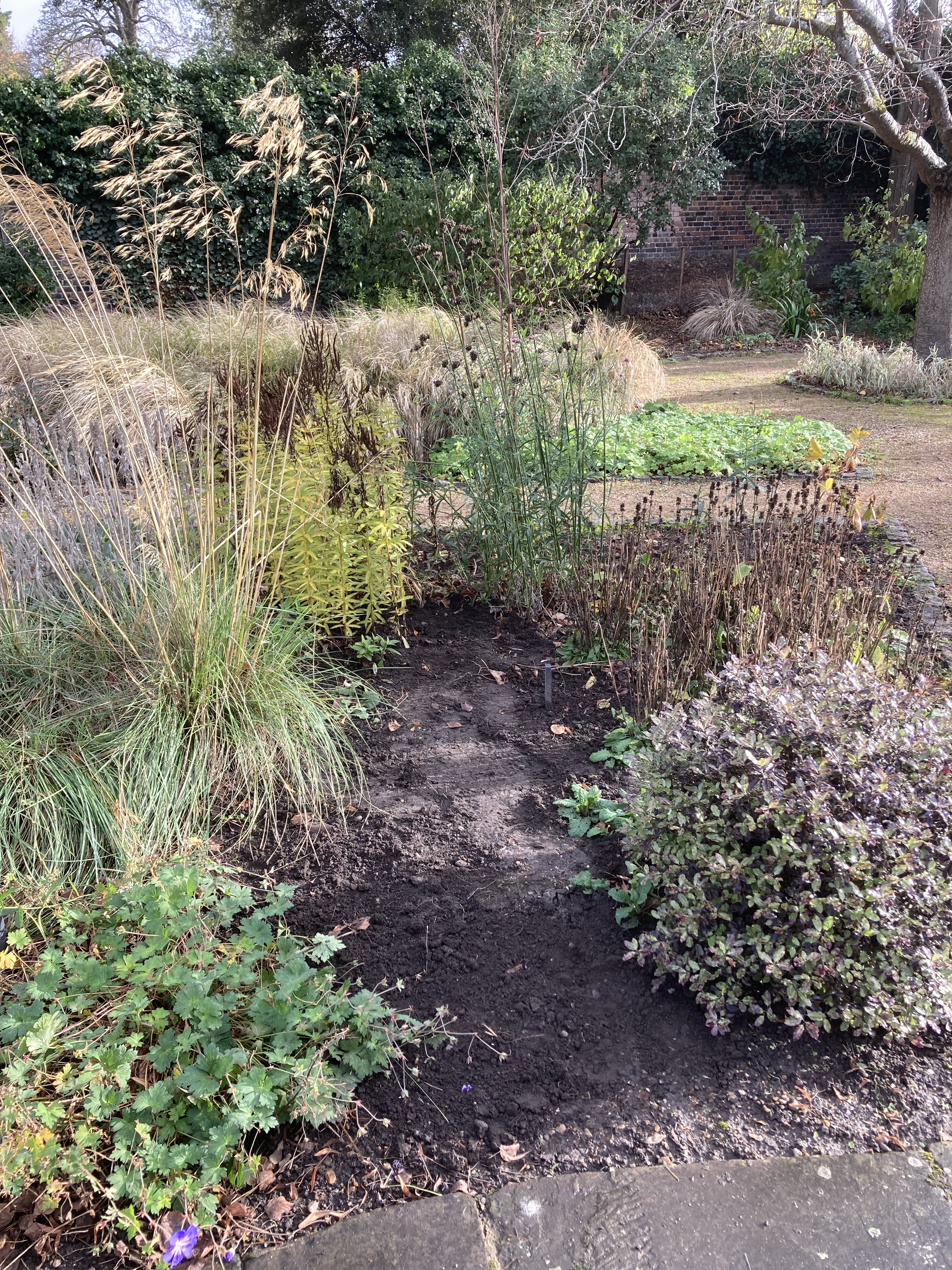
The Peace Garden has benefited from our attention, with the last of the annoying stones on the path edges being removed, and work on the shrubs and climbers along the walls making them look much more defined and trim.
Removing the last loose stones, saving the lawn mower!
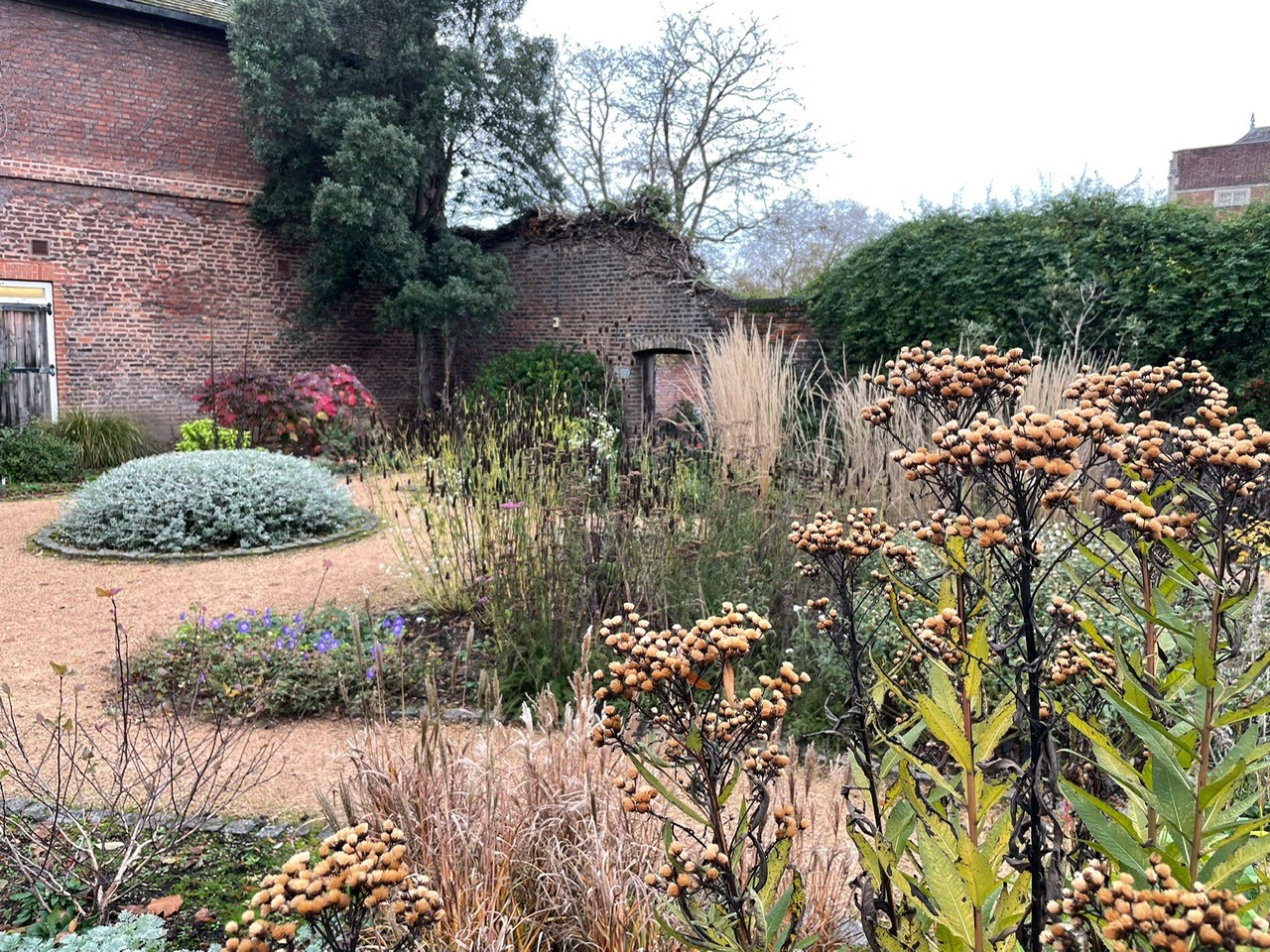
In the Old Pond Garden, many perennials went to seed earlier than usual, due to the drought, but the seedheads are quite spectacular.
TeaselSea Holly
The Volunteers were thrilled to receive a donation of jars of honey from the Charlton House Beekeepers. The bees had a bumper year, partly due to our lovely gardens. To stop any squabbling, we held a raffle to decide who got a jar and the happy winners are shown here:
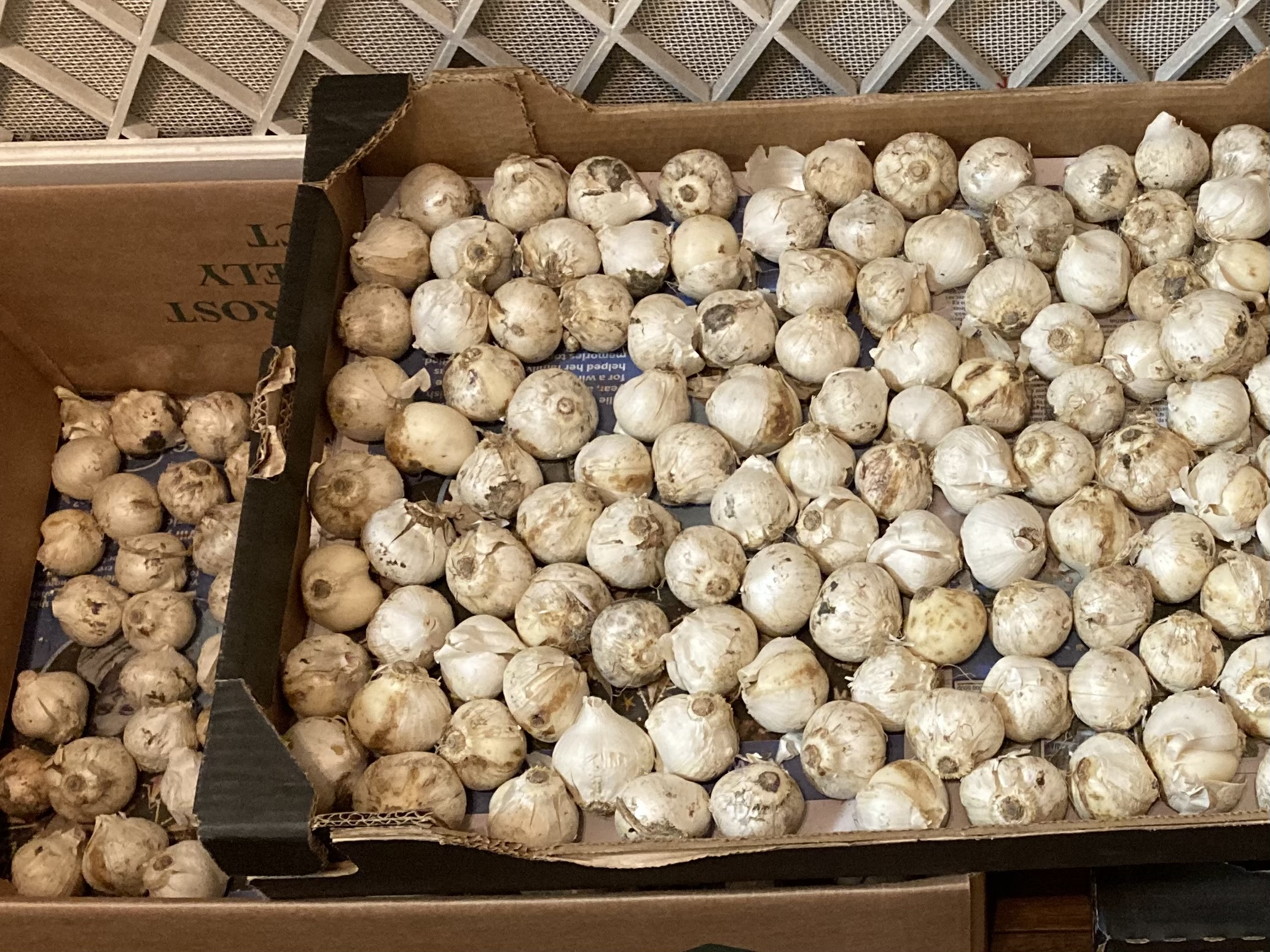
Our October members meeting was held on 17th October in the magnificent Old Library at Charlton House. A well attended meeting, we were treated to a great talk from Peter of Thorncroft Clematis, a wonderful Show Table, bulbs for sale and an amazing Autumn mandala from members gardens, which covered the entire grand piano!
It was clear that we were in for a treat of a talk. As well as a box of Thorncroft Clematis Catalogues, Peter Skeggs-Gooch laid out the nursery’s impressive collection of Flower Show medals: several Chelsea golds as well as a smattering of Silver-Gilts. Peter’s slide show took us from evergreen winter varieties such as the familiar ‘Freckles’ and the lovely, if large, armandii ‘Apple Blossom’; through Spring, with much-loved montanas now smaller and more manageable; into Summer with several scented varieties including the coconut-perfumed ‘Lambton Park’; and finally finishing with the viticellas of Autumn such as ‘Prince William’ and super easy ‘Alba Luxurians’. His nursery produces over three hundred varieties, so we were being given only a glimpse of what is on offer. For more information or to order head to their website.
Charlton House held another very successful Horn Fair on Sunday 16th October and CABAHS contributed to that with a range of opportunities for adults and children. We focused on the Old Pond Garden, with a Spooky Spider, Bat and Pumpkin trail for the children, and well-attended tours by Head Gardener Jason Sylvan who explained the work he is leading with the volunteers there. Just outside the Peace Garden, we held one of our famous plant stalls – it was as popular as ever! Here are some photographs of all the activities. Thank you to everyone who contributed to its success.
We will have our usual stall at the Horn Fair at Charlton House this Sunday, October 16th, from 11am. This year we will be outside in the gardens, by the Peace Garden gate – hopefully in some lovely Autumnal sunshine!
Members have been very generous with their plant donations and we also have some great plants grown on by the Volunteers in the walled gardens. As well as plants, there will be lavender bags (from the Peace Garden), and seeds for sale, as well as some Notecards featuring the Old Pond Garden, painted by local artist Amabel Barlow. https://www.amabelbarlow.online/my-portfolio-1
Head Gardener Jason Sylvan will be running tours of the garden on the hour from 12, there will be loads of activities for kids including Bouncy Castles, Autumn crafts with Montessori Moments, and our very own Spooky Spider Bat and Pumpkin trail.
In addition, St Luke’s Church will be open (it is their patron saint St Luke’s day after all.) If you can visit the Church tower, this is highly recommended, the views are incredible!
Vita Sackville-West wrote that “Of all fruits the pomegranate is surely one of the most romantic.” I would be willing to bet that most people walk through the Peace Garden gate at Charlton House without realising they have just passed under two “most romantic” pomegranate trees.
Pomegranates in the Peace Garden
When the Volunteer scheme started in 2020, these two trees were deeply entwined with ivy, choking them very UNromantically. I wish I had taken a photo of our volunteers, wrestling and chopping at the ivy around the base of the trees! It was one of the team’s early successes, as the next year the trees were covered in their startlingly bright orange flowers and looked very happy. We have yet to get the flowers to “set”, so no pomegranate fruits yet. But of course as gardeners, we live in hope.
This summer’s heatwave feels like a distant memory now, but it was a good one for ripening lots of tomatoes! However, if you’ve got green ones struggling in the cooler temperatures, here’s BBC Gardener’s World Magazine’s advice on the best way to ripen them: How to ripen late tomatoes.
Using the ethylene released by bananas to help ripen other fruit is a well known method, but while Which? Gardening agree with GW on most points, they differ on the banana:
You may have heard different techniques recommended for ripening green tomatoes, including putting them with a banana, but when Which? Gardening magazine tested different methods we found that putting them in a dark place indoors, such as a drawer, works best. Tomatoes left with bananas were one of the worst methods for causing the tomatoes to rot.
CABAHS member Melanie told us about an unusual collection: Exbury Gardens in Hampshire, perhaps best known for the springtime magnificence of its rhododendrons, is also home to a special collection of Nerines.
If you can visit Exbury, the Nerine collection is on view from 4 – 30 October.
As it’s quite a long way to travel, you might instead like to see photographer Lisa Creagh’s website, where she has captured the extraordinary quality of this South African native ‘Jewel lily’ in some stunning images: The Rothschild Nerines. Lisa gives a super description of the collection’s history as well as describing the drama of the Nerines’ lifecycle.