Pat’s Jobs for July

1. Top of the list for July is pruning wisteria, taking back that whippy growth to 2 to 3 buds from the main stems.

2. Sweetpeas should be flowering by now so make sure to keep cutting the blooms and give them a feed and plenty of water. They cease flowering quickly if not picked twice a week. 

Vase of sweetpeas

3. Deadhead all your perennials and annuals regularly unless you want them to set seed for next years sowing.

Continue reading Pat’s Jobs for July

Plant of the Month: Dierama pulcherrimum (July 2024)

We might complain about all the rain we have had over the last few months but the plants have just loved, loved, loved it!

So, for the first time ever, I can celebrate, as my Angel’s Fishing Rod (beautiful name) is due to send up at least four flowering stems after many years and I put this down to the extensive rain we have endured this past winter and spring. 

Dierama pulcherrimum in Anna's garden

At Sissinghurst Gardens recently, I spotted two Dieramas in flower – the maturer pink-flowering specimen in the sheltered Rose garden, in a front-of-border, corner position where two paths meet, and a smaller, delicate-blush-mauve-flowering specimen growing in a south-facing border, situated in front of a tall brick wall – both looking absolutely gorgeous. 

Continue reading Plant of the Month: Dierama pulcherrimum (July 2024)

June 2024 Meeting and Talk: Hever Castle and Gardens

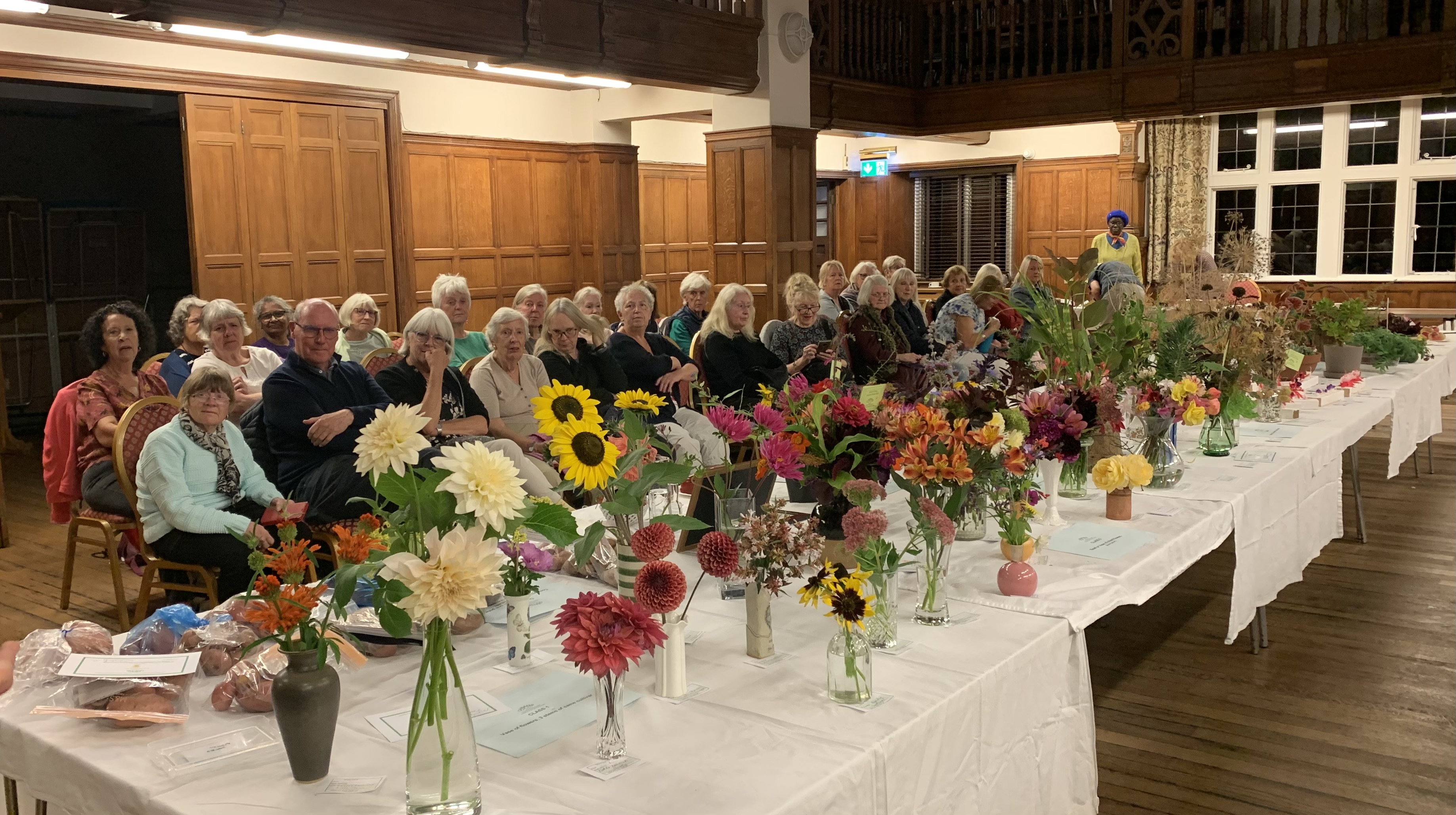
A successful meeting was held in June with a packed audience and we were lucky to be given an engaging and informative talk by Neil Miller, Head Gardener at Hever Castle. In 2002 Neil started as a junior gardener at Hever following 10 years as an Insurance Broker and within 4 years was Head Gardener. Quite an achievement!

Audience for talk June 2024

Famously Hever Castle was the childhood home of Anne Boleyn, and Henry VIII frequently visited her there. At that time the surrounding land was marsh and bog land. Though there were many changes of ownership in the following centuries, it was not until 1903, when William Waldorf Astor bought the estate, that serious restoration and renovation took place and the design for the gardens was drawn up. Alongside the castle, a Tudor style Village was also built so that invited guests had rooms to stay.

Continue reading June 2024 Meeting and Talk: Hever Castle and Gardens

A visit to East Lambrook Manor Garden

East Lambrook Manor, April 2024
East Lambrook Manor from the road.

After years of repeatedly reading about East Lambrook Manor in Margery Fish’s classic book ‘We Made a Garden’ [book review], I discovered late in 2023 that the house and garden were to be sold. While the garden is Grade 1 listed and therefore protected to some extent, it may not have to be open to the public, so I determined to visit as soon as I possibly could. The garden is not open over the winter – its season begins with the snowdrop festival in February – so I waited nervously to see if it would re-open in 2024. It did, so plans were hatched as there was now a caveat on the East Lambrook Manor website that opening arrangements could change if it is sold.

East Lambrook Manor Gardens, April 2024
First view: House and lawn to the left, Barton ahead and Malthouse behind.

On a sunny morning in early April we set off to walk from South Petherton, where we were staying, to East Lambrook. It was a lovely walk of just under two miles, leading us into a small village with some very nice front gardens… and we turned into a driveway with the manor house on our left, the Malthouse ahead and a beautiful tree with a host of snakeshead fritillaries (Fritillaria meleagris) below. This was The Barton – the former farmyard.

Continue reading A visit to East Lambrook Manor Garden

Plant of the Month: Rose (June 2024)

June really is the month for roses and when I saw Margaret T’s roses growing on her allotment, I was enchanted by each and every one and I have listed below a few that are in flower now.

Rosa 'James Galway'
Rosa ‘James Galway’

A David Austin climbing rose, introduced in the year 2000 and named after the Irish flautist. Margaret grows this rose as a shrub, so the flowers are at head height and the pink blooms, paler at the edges, have an old rose appearance and fragrance.

Rosa 'A Whiter Shade of Pale'
Rosa ‘A Whiter Shade of Pale’

What a name!   And, what a rose! This gorgeous hybrid tea has blush-pink, very fragrant, repeat-flowering clusters, and glossy dark-green leaves.  Considered disease resistant. Introduced in 2006 by rose-breeder, Colin Pearce.

Continue reading Plant of the Month: Rose (June 2024)

Pat’s Jobs for June

What a strange spring this has been as everything has grown so tall ….but then some things especially vegetables have hardly grown at all and are struggling as there has been little warmth.

Anyway we soldier on….

1. Divide spring flowering bulbs as soon as foliage fades. My own stock has diminished and badly need splitting.

2. Prune ornamental cherries when flowering has finished making as few cuts as possible as they have difficulty healing.

3. Tie in shoots on sweetpeas which are finally growing  and revelling in the cool conditions. 

4. Cut early flowering hardy geraniums to the ground when they finish as they have a tendency to seed everywhere…unless you want them to of course.

Continue reading Pat’s Jobs for June

What to look out for in the Old Pond Garden: June 2024

We hope you are enjoying a walk around the walled gardens at Charlton House! This month, look out for:

Turkish sage (Phlomis russeliana)

Phlomis, or turkish sage

A herbaceous perennial in the Mint family, native to Syria and Turkey. The name ‘Phlomis’ comes from the Greek word meaning ‘flame’. Heart shaped leaves of some species were used as lamp wicks in ancient times. The stiff upright stems carry yellow flowers, which look good as seed heads in winter and provide shelter in winter.

Woodland sage or Balkan Clary (Salvia nemorosa ‘Caradonna’)

Salvia nemorosa Caradonna

A bee magnet because it offers both nectar and pollen, this a hardy herbaceous perennial with dazzling violet flowers. Susceptible to slugs and snails sadly, but luckily we don’t get too many of those in the Old Pond Garden.

Catchfly (Silene armeria ‘Electra’)

Silene armeria 'Electra' in the Old Pond Garden, Charlton House, June 2023

Blue-grey leaves and hot pink flowers for weeks on end. An annual which self-seeds prolifically. It is called catchfly because there is a sticky area on the stems just below the flowers, which greenfly and small insects get stuck to. Feel it gently with your fingers!

Continue reading What to look out for in the Old Pond Garden: June 2024

Book review: We Made a Garden

We Made a Garden, by Margery Fish - book cover


I can’t remember how many years ago I picked up Margery Fish’s first book, the tale of how she and her husband Walter bought a house in Somerset just before World War Two and created a garden on its two acres of land. It’s an easy and enjoyable read, and I loved it. Her barely-veiled criticism of Walter’s martinet tendencies made me laugh, and her joy and enthusiasm for plants and gardening informed and excited me. On every re-reading (there have been many!) I learn more, and get new ideas, though as time goes on I think I like Walter less and less.

Each area of the garden gets a name: the Lido, the Ditch, the Herb Garden, etc – and each short chapter has a pithy title such as ‘Rock gardening’, ‘Gardening with a Knife’ and ‘We Made Mistakes’. Although the Fishes were of a class that would have been used to staff, the times meant that they did most of the work themselves, with just an occasional ‘garden boy’, so the descriptions are very hands-on. They did, however, still dress for dinner, and the image of Margery clambering up a rockery to water precious new plantings in the top of a wall whilst still in her satin finery is vivid in my mind.

Mrs Fish was in her forties when they bought East Lambrook Manor, and hadn’t really gardened before. She only really got into her stride after Walter died in her fifties (he was 18 years older), and wrote this, her first book, in her sixties, at which point she became known as a gardener and wrote several more books. All are lightly written and informative, but the combination of memoir, wry humour and discovery in ‘We Made a Garden’ makes it the most successful, in my opinion – a gardening classic.

As you can imagine, it has been a long-held ambition to visit East Lambrook Manor, now a Grade 1 listed garden, and I finally managed to get there in April 2024 …

Ali H

If you read a book that would be of interest to our members, please think about writing a review and sending it to garden@cabahs.com and it could become a post like this.

May 2024 Talk: Silent Earth – Averting the Insect Apocalypse

Dave Goulson, Professor of Biological Sciences at the University of Sussex specialising in the ecology and conservation of insects, and author of several books*, gave a talk about the dramatic insect decline worldwide. He outlined some of actions required on a National and International scale to reverse this apocalypse and what we as gardeners can do.

Dave Goulson with our Chair, Stella and the range of his books for sale at the meeting

When he was a boy, he started collecting caterpillars (in his lunchbox) and his interest in insects became a life long passion when one of them pupated into a Cinnabar Moth. He explained that insects evolved over 480 million years ago and there are now around one million known species worldwide. They were the first creatures to fly and sing and many have complex inventive ways to camouflage themselves or mimic others. Examples of some ‘weird and wonderful’ insects were shared with us such as the Shield Bug from Thailand whose back very much looks like the face of Elvis.

The horrifying statistics on insect decline were shown, particularly over the last 30 to 40 years. Studies show that the decline is around 75%. He has researched the Shrill Carder Bee which was common across Southern England pre-1960 but by the year 2000 the populations of this bee had greatly decreased and there were only about six populations left. Since 2000, the population which inhabited the Salisbury Levels has become extinct.

Continue reading May 2024 Talk: Silent Earth – Averting the Insect Apocalypse

King John’s Nursery and Garden, Etchingham, Sussex

On a gloriously sunny day in May, a visit was paid to the garden at King John’s Nursery.  This ‘naturalistic’ garden is set within a beautiful landscape of ancient trees and meadows. We were given a laminated map of the garden layout and proceeded through the old honeysuckle-clad, wrought-iron gate to the garden beyond. This led us to the first garden room, beautifully planted in soft-pinks, the focal point being a circular, brick-built pond, fed by an imaginative water-gully.   This led us into the gravel garden room, consisting of sun-loving and tender plants displayed to great effect on a slab-table, an artefact that many of us would love to possess for our own gardens!

From there we entered a magical place – a charming meadow with mauve-blue spires of camassias threading through and rising above the grasses, a stunning contrast to the shades of green all around.  White-flowered camassias were in bud, ready to take over and bloom in the next week or so.  In one corner of the meadow sat a toadstool circle, an enchanting addition for children to let their imaginations run wild.  We exit beneath the clipped hedge archway into a larger meadow which includes an herbaceous long border, consisting of many taller plants such as grasses and flowering angelica. We follow the path around, to a shaded woodland dell and admire the luminosity of the rhododendron’s stunning white flowers by a gateway entrance, cow-parsley billowing alongside solomon’s seal and pass beneath the 350-year-old oak tree. Amongst the grasses, glistening in the sun, wild orchids are to be admired. We sat on the bench to absorb the idyllic setting before us, noticing glimpses of an old apple orchard beyond the boundary.

Continue reading King John’s Nursery and Garden, Etchingham, Sussex