Florence Nightingale Garden

I’m sure we can all remember the particular joy that gardens gave us during the dark days of lockdown. Gardeners of course have always known the benefits that green spaces can bring.

This fact was brought home to me recently when I spent time in the Florence Nightingale Garden at St Thomas’s Hospital, Southwark – happily as a guest, not a patient or loved-one of a patient.  The theme of the garden is ‘nurture through nature’.

Florence Nightingale Garden


The archivist in me loved the fact that enlarged extracts from Florence Nightingale’s letters in which she campaigned for healthcare reform featured in the original design, printed onto the boundary walls and overlaid with images of her pressed flower collection.

Continue reading Florence Nightingale Garden

Horn Fair Sunday Oct 16th

We will have our usual stall at the Horn Fair at Charlton House this Sunday, October 16th, from 11am. This year we will be outside in the gardens, by the Peace Garden gate – hopefully in some lovely Autumnal sunshine!

Flyer for horn fair

Members have been very generous with their plant donations and we also have some great plants grown on by the Volunteers in the walled gardens. As well as plants, there will be lavender bags (from the Peace Garden), and seeds for sale, as well as some Notecards featuring the Old Pond Garden, painted by local artist Amabel Barlow. https://www.amabelbarlow.online/my-portfolio-1

Head Gardener Jason Sylvan will be running tours of the garden on the hour from 12, there will be loads of activities for kids including Bouncy Castles, Autumn crafts with Montessori Moments, and our very own Spooky Spider Bat and Pumpkin trail.

Volunteers getting ready for Horn Fair and Spider trail
GETTING READY!

Frilly’s cafe, plus loads of street food, dance and music performances, Morris men and Artisan and Producers Markets. See RGHT website for full details: https://www.greenwichheritage.org/events/horn-fair-2022/

In addition, St Luke’s Church will be open (it is their patron saint St Luke’s day after all.) If you can visit the Church tower, this is highly recommended, the views are incredible!

Kathy

A Romance with Punica granatum

Vita Sackville-West wrote that “Of all fruits the pomegranate is surely one of the most romantic.” I would be willing to bet that most people walk through the Peace Garden gate at Charlton House without realising they have just passed under two “most romantic” pomegranate trees.

Pomegranate trees in the Peace Garden
Pomegranates in the Peace Garden

When the Volunteer scheme started in 2020, these two trees were deeply entwined with ivy, choking them very UNromantically. I wish I had taken a photo of our volunteers, wrestling and chopping at the ivy around the base of the trees! It was one of the team’s early successes, as the next year the trees were covered in their startlingly bright orange flowers and looked very happy. We have yet to get the flowers to “set”, so no pomegranate fruits yet. But of course as gardeners, we live in hope.

Continue reading A Romance with Punica granatum

The best way to ripen green tomatoes

Green, orange and red tomatoes

This summer’s heatwave feels like a distant memory now, but it was a good one for ripening lots of tomatoes! However, if you’ve got green ones struggling in the cooler temperatures, here’s BBC Gardener’s World Magazine’s advice on the best way to ripen them: How to ripen late tomatoes.

Using the ethylene released by bananas to help ripen other fruit is a well known method, but while Which? Gardening agree with GW on most points, they differ on the banana:

You may have heard different techniques recommended for ripening green tomatoes, including putting them with a banana, but when Which? Gardening magazine tested different methods we found that putting them in a dark place indoors, such as a drawer, works best. Tomatoes left with bananas were one of the worst methods for causing the tomatoes to rot.

Which? Gardening, How to Grow Tomatoes

Do you use a banana to help ripen tomatoes? Or do you relish the prospect of green tomatoes for cookery? Let us know in the comments.

The Rothschild Nerine Collection

Nerine bowdenii

CABAHS member Melanie told us about an unusual collection:  Exbury Gardens in Hampshire, perhaps best known for the springtime magnificence of its rhododendrons, is also home to a special collection of Nerines.

If you can visit Exbury, the Nerine collection is on view from 4 – 30 October.

As it’s quite a long way to travel, you might instead like to see photographer Lisa Creagh’s website, where she has captured the extraordinary quality of this South African native ‘Jewel lily’ in some stunning images: The Rothschild Nerines. Lisa gives a super description of the collection’s history as well as describing the drama of the Nerines’ lifecycle.

Sussex Prairie Gardens

The Sussex Prairie Garden is a six acre garden with naturalistic planting, created by Paul and Pauline McBride, who worked with Piet Oudolf some years ago. The garden is on a farm and surrounded by oak trees, featuring a wide range of herbaceous perennials, Veronicastrums, Thalictrums, Persicarias, Sanguisorbas, Kniphofias and Hemerocallis. Huge drifts of ornamental grasses and Asters extend the season of interest hugely. In addition to the planting in the borders there are some massive pots beautifully planted up with huge salvias, Melianthus Major and splendid Pelargonium Tomentosum. The expansive beds are planned with winding rough paths to allow visitors to wander through, brushing grasses and Heleniums as they pass. It is definitely a garden for a late summer visit and seems to have managed remarkably well through this hot summer of 2022.

The plant fair on the day of our visit was spread out through the garden and accompanied by a band and stalls selling refreshments. It had a decidedly festive air! There are dozens of varieties of Miscanthus, Panicums, Molinias, Sporobolis and Penisetum and several of the plant stalls capitalize on this by selling a good selection of grasses.

Beds of mixed grasses and herbaceous perennials

The garden is at its best in late summer and into the autumn as might be expected from the nature of the plants. I have visited earlier in the year when there is far less to see.

Beds of mixed grasses and herbaceous perennials

The planting is bold and on a grand scale, not much of it less than a metre tall, but for anyone interested in growing prairie type plants or simply just interested, this is a garden well worth visiting.

Vija

Colour in the garden

Begonia ‘Glowing Embers’
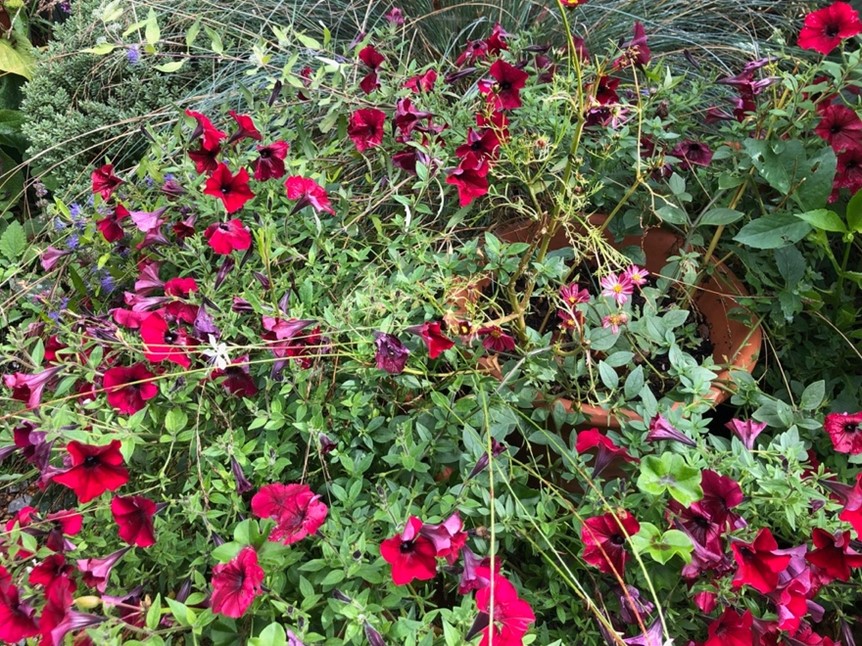
Petunia ‘Tidal Wave Red Velour’

During this blistering summer a number of people have commented on the colour in my garden (such as it is). I think this is down to a very few plants. (For those of you not enamoured with Sarah Raven, look away now). The top photograph is of Begonia ‘Glowing Embers’. These have flowered continuously all through the summer and I think the contrast of the leaf and flower is lovely. Although often grown as an annual, I have found that if I keep them in a sheltered and frost-free place over the winter they will flower again year-on-year. But be patient! The little stone-like tubers look thoroughly lifeless for a long time and, just when you might think they were totally dead, little green shoots appear.

The bottom photograph is of Petunia ‘Tidal Wave Red Velour’. These were originally plants in pots with cosmos and coleus, the latter two turned up their toes leaving only the petunia to inhabit the pot. It is only one plant and this too has continued to flower continuously through the summer. The pots have only been watered with waste water and have had no additional feed.

Both of these hard workers have come from Sarah Raven and, no, I don’t get a discount!

Vija

Perch Hill

Thinking we would take advantage of the extra days made available for visits to Perch Hill, we chose the one for container planting. However, on the day it was the dahlias that stole the show and which we will remember!

Although rain was not forecast, we arrived to a little bit of a mizzle and a very grey sky – in the photographs this has tended to deaden the exuberant colours. We were knocked out by Penhill Watermelon, Geri Scott and the delicious Apricot Desire, but it would be impossible to choose one favourite out of all the lovely colours. Although some are critical of the Sarah Raven enterprise, there is no question that the gardens are beautifully styled. Of course, plants are labelled so that anything you see you will find on their website, but it is a commercial business. In fact, it is good to find a label so that you can identify what you are looking at! Salvias are everywhere, edging the herbaceous borders, in pots as well as mixed through the beds. These are such versatile plants.

Dahlias at Perch Hill
Continue reading Perch Hill

Being a ‘good’ gardener

People today garden for a whole host of reasons – as a hobby, a delight in horticulture generally, exercise, well-being and being out of doors, to grow their own produce – but, historically at least, gardening has also been seen as a highly moral activity.

By the end of the 19th century the garden was advocated as a way of keeping the working classes away from the public house, where they could be usefully engaged in a more wholesome and productive activity. William Hogarth’s cartoons of ‘Beer Street’ and ‘Gin Lane’ are visual reminders of the conditions which were a cause of concern.

William Hogarth's cartoon of Beer Street and Gin Lane (1751)
Beer Street and Gin Lane (1751)

John Claudius Loudon (1783 – 1843) championed the creation of public parks to improve both the mental and physical health of working people, so that ‘the pale mechanic and exhausted factory operative might inhale the freshening breeze and some portion of recovered health’.[1] It was Joseph Strutt who picked up on these ideas and put Loudon’s vision into practice to create the Derby Arboretum in 1840. Strutt was very clear on the rationale behind this work: to wean people away from the ‘brutalising pleasures’ they might seek elsewhere and to offer them a new form of ‘rational enjoyment’. In Edinburgh recreation in a park was thought to be a solution for drunkenness and in the Midlands it was thought to lead to a decrease in crime rates.

‘In 1919 the Conservative MP for Chelmsford was reconciled to spending money on housing by the thought that good garden plots would ensure that when the man of the house got home at night “he will find not only a healthy family, but healthy occupation outside where they can go and work together as a family”’.[2] A well maintained garden was also viewed as an indication of a well maintained (and thus moral household). As late as the 1920s and 1930s inspectors were employed to visit the gardens of council estates to ensure that they were being kept tidy.

Vija

[1] Loudon, J.C. (1822) Encyclopaedia of Gardening.

[2] Floud, R. (2019) An Economic History of the English Garden, Penguin Books, p247.