Snippets of news relating to gardens, the environment and the local area, CABAHS members’ posts about garden topics, gardening hints and tips, and short pieces about garden design and history
Jean and I were very sorry to miss the (highly successful) plant fair on 19 May but we did have a lovely visit to the fabulous garden at RHS Harlow Carr instead.
RHS Harlow Carr is a short drive or bus ride away from Harrogate, a very elegant spa town in North Yorkshire. The garden opened in 1950 with the intention of trialling and showcasing plants that would thrive in a northern climate as opposed to the possibly easier growing conditions of RHS Wisley.
Those of you who are regular viewers of BBC Gardeners’ World will most likely have noted Monty Don’s table of potted plants, which varies throughout the seasons and looks like something most of us can only dream of! In a recent article by Alice Vincent, she describes what she calls Monty Don’s ‘Fantasy table’. (My latest garden fantasy? An elegant table covered in flower pots)
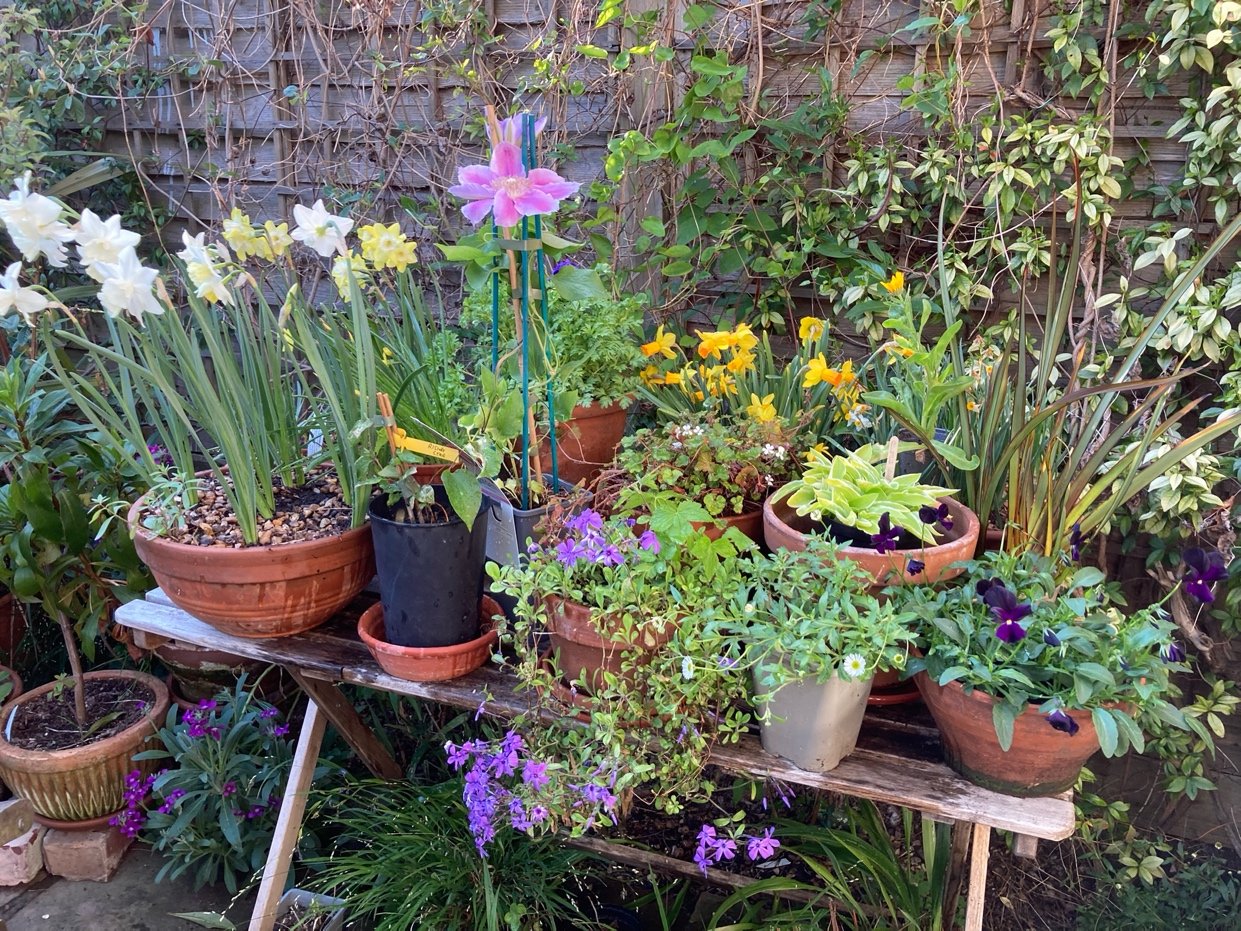
The scale of Don’s table and the amount he has displayed is something many of us may aspire to, myself included! On a recent visit to Anna L’s garden, I was impressed by how she had similarly grouped a range of plants in pots, a mix of bulbs, a small Phlox stolonifera, Violas, a Clematis waiting to be planted and a miniature Hosta. Anna very kindly listed the plants for me and you can see from this that a display does not have to be carefully curated, but a selection of whatever takes your fancy!
Anna’s plant table in late spring, featuring: Narcissus ‘Thalia’ and N. ‘Pipit’; Clematis ‘Rising Star’ and C. ‘Bees’ Jubilee’; Pelargonium australe; Phlox stolonifera ‘Fran’s Purple’; Anemone de Caen blue-flowered; Primula ‘Stella Neon Violet’; Phormium; purple Viola; Hosta ‘Lemon Stiletto’
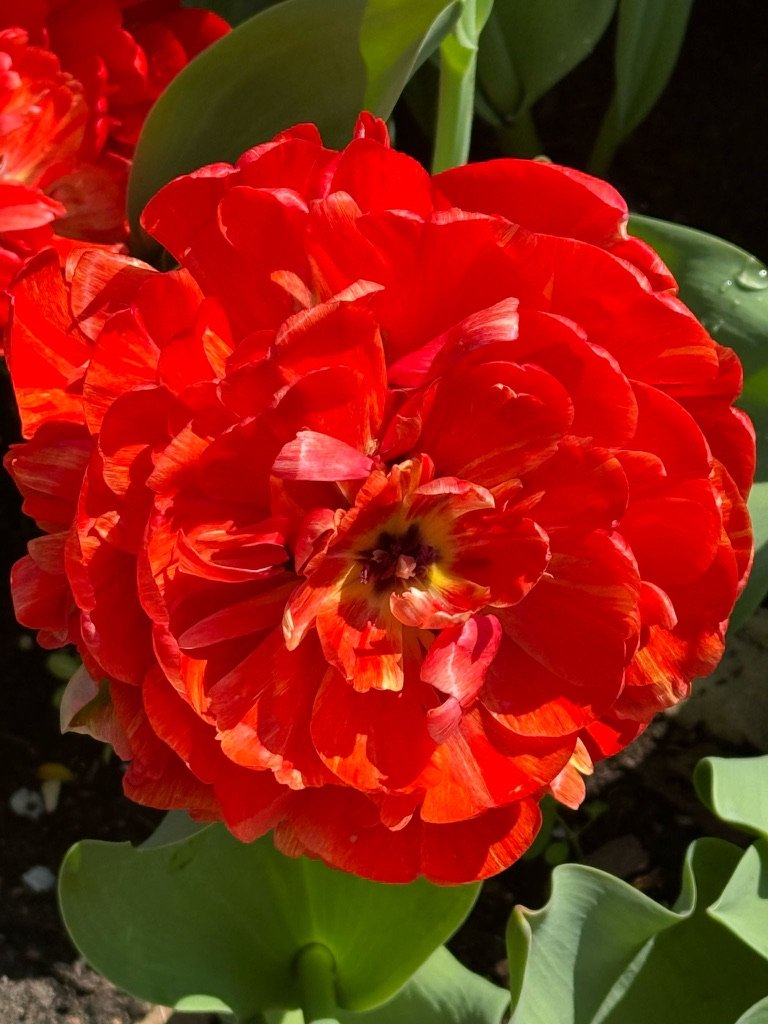
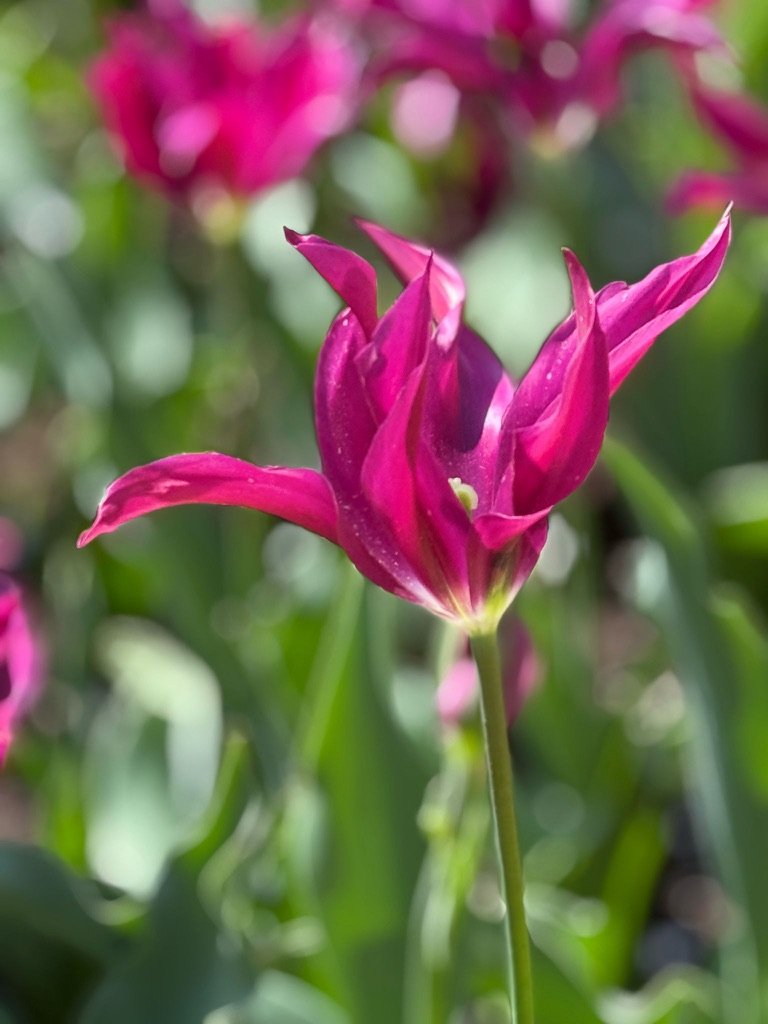
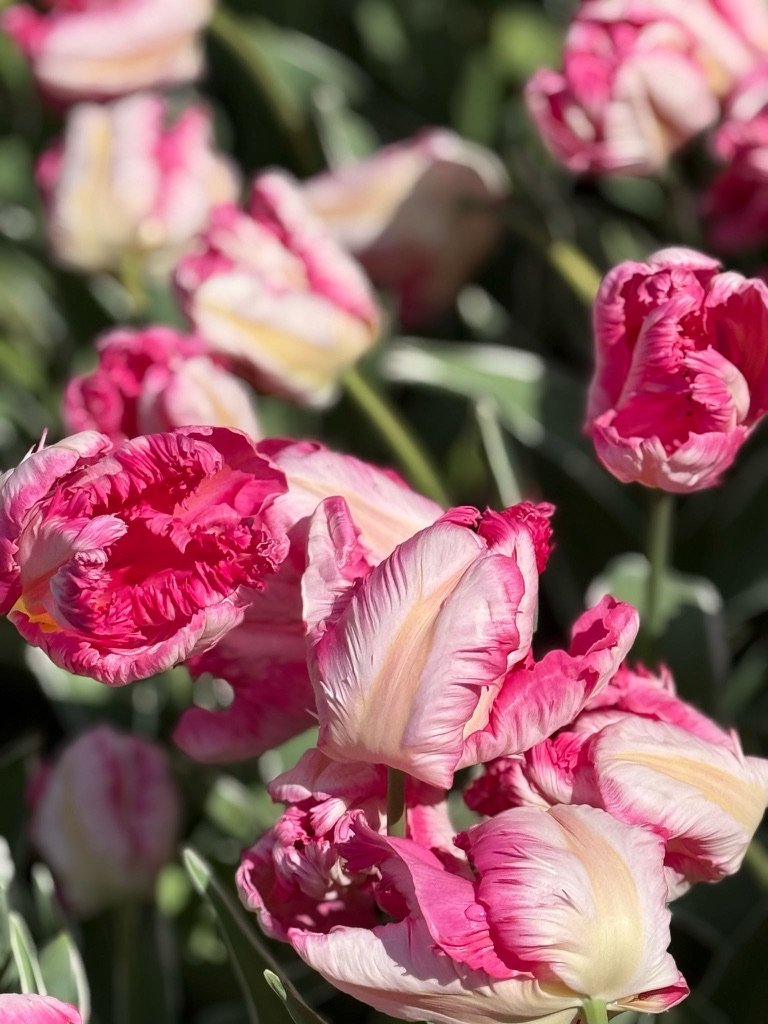
I returned to Keukenhof for a brief visit again this year. Transport in the Netherlands makes this a very easy trip and it is well worth making a stopover in Haarlem, which is a lovely town. I have little to add to the descriptions of my previous visits (April 2022, April 2023) so have just included a selection of photos which lovers of colour and tulips might enjoy!
Led by members of the garden team, the Behind the Scenes tours of Great Dixter provide an opportunity to explore the garden and meadows to examine the plants which are putting on a display at particular times of the year, offering an insight into the work that makes this happen. Limited to a maximum of 25 people, they allow visitors to have a good view of the plants.
A tour of the gardens in February was always going to be a little hit and miss in terms of the weather, but we were fortunate enough to arrive just as the rain stopped, so were able to enjoy the tour without getting soaked through!
As we enter through the front meadow, the area is full of Crocus tommasinianus, Crocus flavus and various forms of Crocus chrysanthus. Of course there are snowdrops everywhere. Our guides introduced us to the wide range that are cultivated here, from the common (but no less lovely) Galanthus nivalis, to G. Atkinsii and G. S. Arnott which are all doing fabulously well, as well as the less common G. Diggory and G. Washfield Colesbourne. We all peered at the diminutive G. Wendy’s Gold in a corner, sheltered by a wall and still tiny enough that if it wasn’t pointed out, you might walk past it! Some of the differences between the types are so small: those with an upturned tepal and look like little helicopters, while G. Diggory is plump and round.
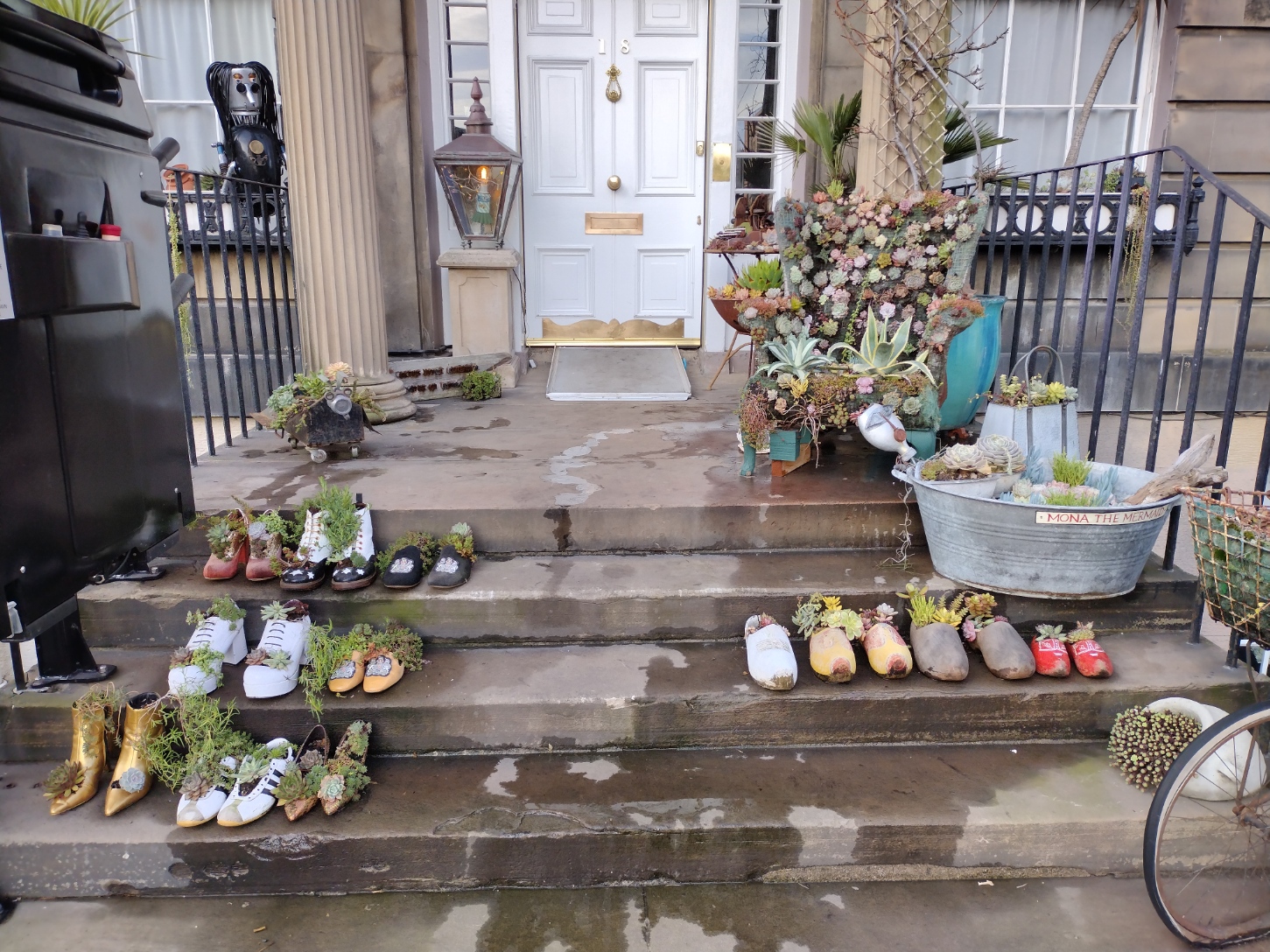
I spent a weekend this February in Edinburgh, and came across this interesting doorstep display on my travels around the city. Some new ideas for displaying your succulents …!
I also visited the Royal Botanic Garden. The morning I visited was bright, cold and calm, in stark contrast to the previous weekend when the garden had been ravaged by storm Eowyn. The sad remains of the garden’s tallest tree – a 166 year-old conifer – were clear to see.
The sun was shining and the sky a bright blue but the frost remained in the shadier parts of the beds and the Rhododendrons had bowed their leaves to protect themselves from the cold. But they were also covered in buds, waiting to burst forth in a few weeks time.
This year’s Orchid display, based on the beauty of Peru, is being show-cased in the Princess of Wales Conservatory. The display is absolutely stunning and should not be missed.
The glasshouse is divided in two sections: the arid, dry zone, featuring cacti and succulents; and the lush, tropical zone. Within the dry zone several large containers of orchids and hanging orchid planters are on display but it’s the tropical zone that contains the main display and you won’t be disappointed.
Inspired by the Peruvian flag and coat of arms, the display centres on a cornucopia (an ornamental goat-horn), overflowing with orchids, to signify the abundance of mineral wealth of Peru. Adjacent (keeping guard?) stands a distant relative of the alpaca.
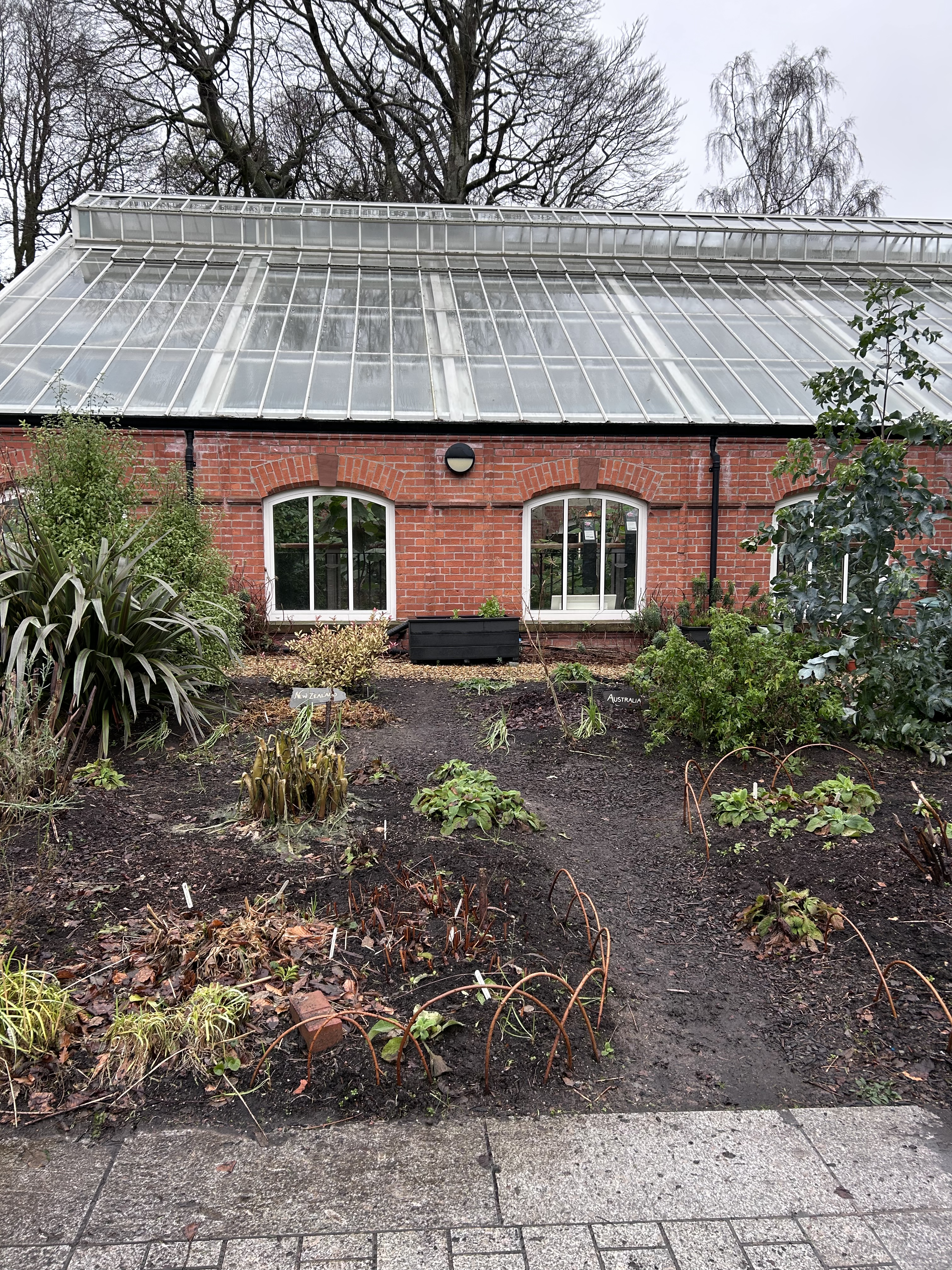
I have been spending some time recently in Northern Ireland, and was enchanted to find the Belfast Botanic Gardens are right on my doorstep here.. just waiting to be explored.
The gardens started in 1828, when the “Belfast Botanic and Horticultural Society” was formed and a 14 acre site purchased. The Palm House was built in 1839 by ironmaster Richard Turner of Dublin, who went on to build the Palm House at Kew a few years later! If this one was a practice run, it is still really impressive.
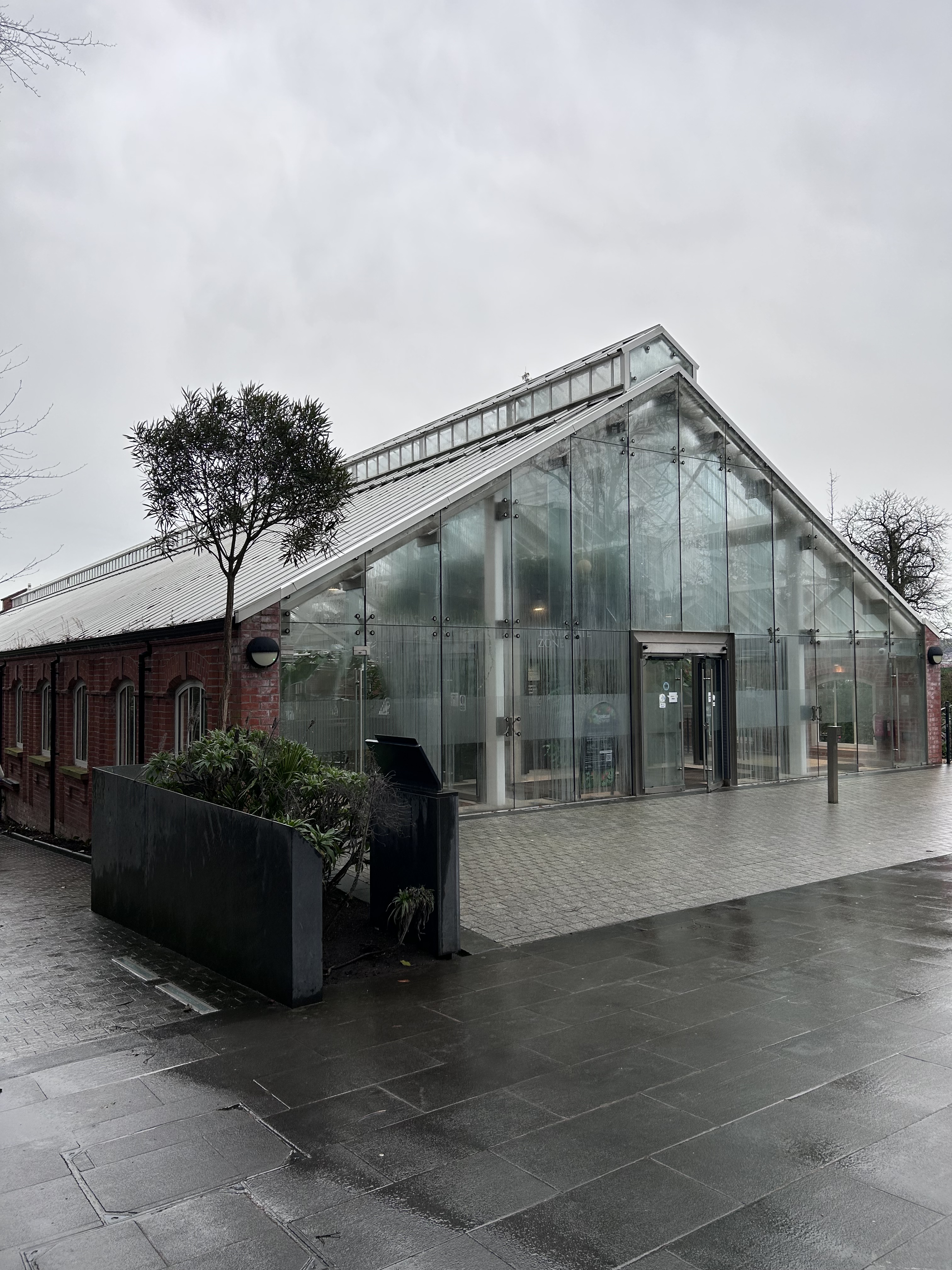
It is not large, but cleverly designed to incorporate a Cool Wing, a central Dome which is sub-tropical, and a Tropical wing, so it can house a wide range of plants. Sadly it was closed for repairs on the day of my visit, courtesy of the recent winter storms.
There is another glasshouse on the site, the Tropical Ravine House, which is just amazing. It was built by “the Head Gardener and his staff” (Jason & the Garden volunteers – there’s an idea!) and was finished in 1889. Uniquely constructed into a hillside, so the visitor walks around a balcony and looks down into a moist glen filled with tropical planting.
It was renovated in 2019 with help from the Friends of Belfast Botanic Gardens, who clearly play a large part in supporting and maintaining these gardens. They have also created a fascinating new Global Medicine Garden just to the side of the glasshouse. https://fobbg.co.uk/
One autumn Saturday morning in 2024 my companion and I visited the Sarah Price-designed garden at The Exchange in Erith, South-East London and we were in for a treat.
As Erith Library for over 100 years, and Grade II-listed, this Carnegie-financed building of 1906 finally closed its doors in 2009, thus becoming an unused space with unkept grounds. Two visionary locals, respectively with conservation and community arts experience, approached Bexley Council in 2016. Their initiative resulted in a community arts hub which opened in 2022 – a refurbished building with a new garden to match.
Mediterranean front garden
The garden surrounds the building on all sides, with various plantings complementing each of the four different areas. The forefront of the building has become a Mediterranean garden with a tapestry of lime-greens, blue-greens and greys. In amongst the herbaceous and shrubs I noticed Myrtle, Euphorbias, Irises, California poppies and particular favourites, sub-shrub Dorycnium hirsutum and several Hesperaloe parviflora (red yucca), a very choice succulent that I have at home (and managed to keep alive!). On our visit we noticed that flowering was just finishing, with its tall stem of red-orange pendulum flowers just going over.
The park is sparkling! Our visit to the first night of Sparkle was very impressive, the light installations have been fitted really thoughtfully around the layout of Charlton House grounds.
The trail starts by the Mulberry, and the avenue of trees have been lit up beautifully as you walk through a snow storm and then past installations based on Christmases in Ukraine, St Lucia and Lagos. We loved the Ukrainian stars decorated by local schoolchildren.
At the end of the avenue you turn back towards the House – and can’t miss the glowing giant spheres (sorry, I didn’t note down the artistic reasoning for those, but they are certainly eye-catching!) and beautiful blue and white snowflakes played onto the back of the House.
The Barbican isn’t a place one would normally expect to be among crowds of garden enthusiasts. But no-one was concerned about the venue, its brutalist architecture and its slightly bizarre layout. We were all eager to find our seats and hear the stories national treasure Monty Don had in store for us. And what seats! Our seats (thanks to a donation from a generous CABAHS member) were front and central, in touching distance of the stage (and indeed of Monty Don himself).