A visit to Hall Place

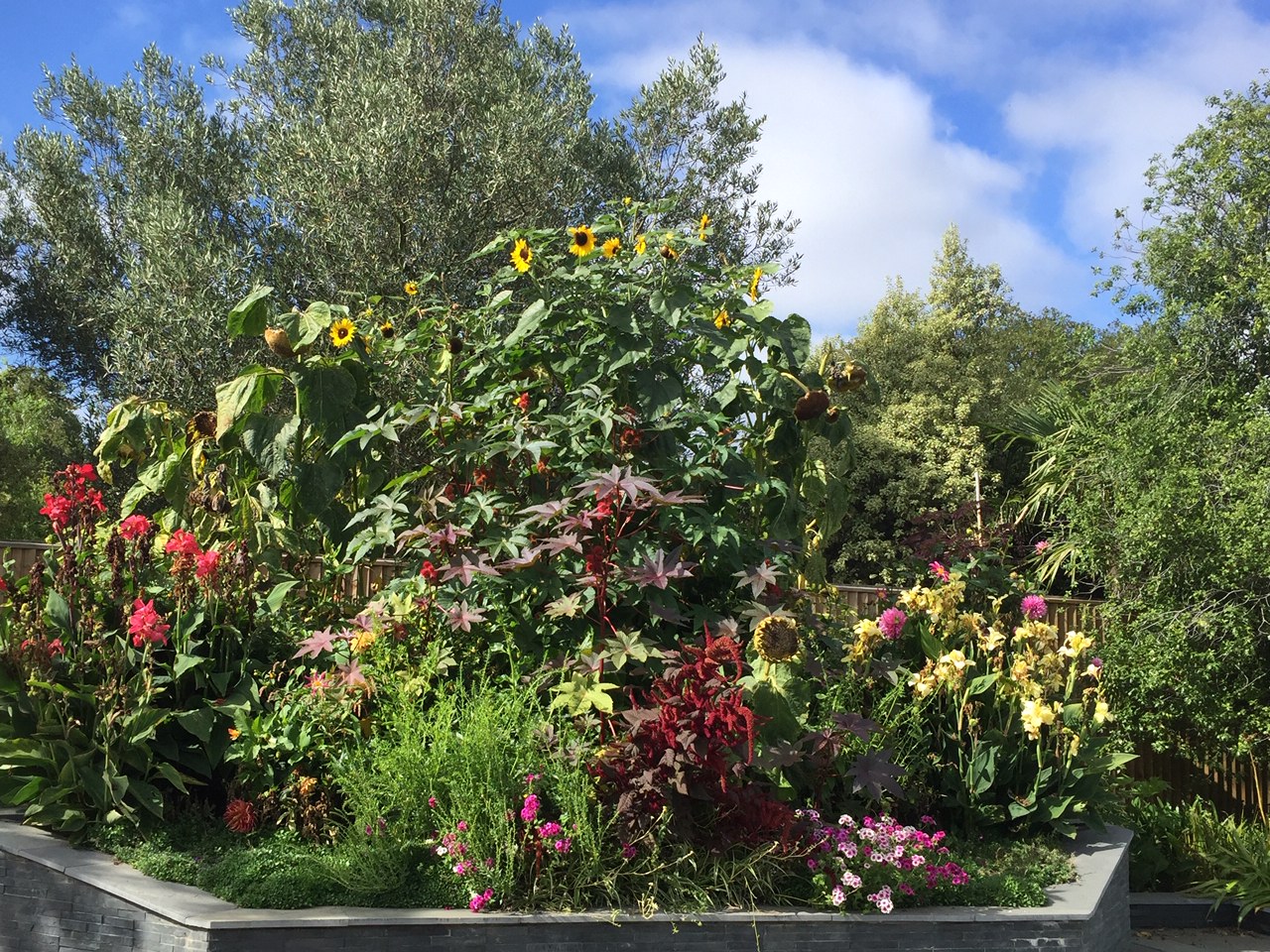
We had a lovely relaxing day at Hall Place on 9 September 2020. It has been maintained very well considering lockdown issues. This “tropical” display near the main entrance was particularly colourful, with cannas, castor oil plants, dahlias and sunflowers. The topiary “beasts” looked very smart and the long borders were interesting for ideas as they were laid out by colour. After a picnic lunch, visiting the small but very good quality plant centre finished off an excellent day.

Hall Place, September 2020

Glut reactions

Whenever I am asked about my plans for dealing with a glut of produce from my allotment, my initial response is usually, “Chance would be a fine thing!”

I’m still on the lower slopes of allotmenteering, constantly marvelling at the (seemingly) effortless heights achieved by my neighbours.

Storm Ellen did her best to scupper my chances of a substantial tomato haul, but thanks to a tendency I have to cram things close together in the ground – I can’t get over how much space I have! –  the plants and their stakes more or less held each other up. In spite of many hours agonising over the seed catalogues and subsequent cossetting of seedlings, I have to report that the finest and most prolific tomato crop on my patch this year comes from the gift of a neighbour.  In the early days of lockdown she realised that she wouldn’t be able to get any seedlings from garden centres in time so she simply dried the seeds from some piccolino tomatoes she had bought at the supermarket and planted them.

Amazing results!  She shared out dozens of seedings with nearby allotments, and now I am in the happy position of trying to decide what I should do to preserve this abundant harvest.

Last year, caught out with no plan for the cherry tomatoes on the eve of a holiday, I turned to Google for help.  A combination of the words, “tomato”, “glut”, “preserve” and “easy” produced a range of solutions (literally) involving vodka.

All I had to do was pierce the tomatoes, pop them into a sterilised glass jar, add the celery salt and chillies that I didn’t have (but that doesn’t seem to have been a problem), cover with vodka and store the jar in the fridge.  I was assured that the residual vodka would be the perfect base for a Bloody Mary, and that the tomatoes would form an impressive element of any tray of canapés.  Do they ever get that far?  Do they heck!  With admirable restraint, I have enjoyed the odd tomato or two straight from the jar over many months.

As holidays are more or less out of the question in 2020, I will have some more time to think about what to do with my expected glut of tomatoes and be on hand at the right time to deal with them.  I wondered what suggestions CABAHS members might have:  what is your favourite way to preserve tomatoes?

Perhaps we can start a separate section, sharing ideas for making the most of our produce.

Melanie

Artistic licence

From time to time I suffer a degree of frustration when watching films which include shots of gardens or cultivation of some sort. I remember an adaptation of one of E. M. Forster’s novels which included a scene of a cottage with flowering wisteria climbing over the house and tulips and roses in the herbaceous borders. I’m not sure quite what kind of climactic freak would have forced all of these to be flowering at the same time.

In the Martian, Matt Damon cultivates potatoes in order to survive. But images of the potato plants showed thin spindly stems topped by a little  green growth. I don’t know of a potato that grows in such a thin layer of soil and which produces growth like this and crops well!  I’m not convinced that this is possible. OK perhaps I am being a little too literal here and should suspend disbelief for a while – after all it is only a film!

Martian-xlarge

When I visited Giverny some years ago in a wet May, I noticed that the wisteria on the bridge was blooming beautifully. When I took a closer look, I discovered that the blooms were silk!  I queried this with one of the gardeners and he told me that a studio was filming in the garden and this was what they had specified. Film studios spend a great deal of time, money and effort into creating interiors, costumes and the like which are authentic. A whole industry has been built up around ensuring the integrity of films. But when it comes to gardens there seems to be a lapse which takes place. Of interest or knowledge I am not sure. I wonder if there is an opening for a garden consultant somewhere?

Vija

A visit to Great Dixter

As you will see from our website What’s On, there are a lot of virtual garden tours now taking place online, but for those members who like to smell the plants and feel the breeze, this isn’t quite the same!  Great excitement then as Pat and I decided to visit Great Dixter – for both of us it was the first garden visit of the year.

Fennel at Great Dixter

We had wondered quite how social distancing would work at Great Dixter, mindful of the narrow paths and tight spaces. However, the one way system in operation and the limitation on the number of visitors at any one time proved very effective. The only area currently out of bounds was the vegetable garden. Covid-19 is a truly devastating disease and it is hard to see any good in the current situation, but reductions in visitor numbers in galleries and in gardens does mean that you can take your time and appreciate things better.

We marvelled at the huge Fennel, which Fergus Garrett loves, scattered throughout the gardens.

The glory of the varieties of Phlox which seem to be in abundance everywhere. We mourned the loss of the name Aster (now the unpronounceable  Symphyotrichium). I fell in love with the Pelargonium Concolor Lace.

We discovered a beautifully unusual double burgundy coloured Antirrhinum, but couldn’t find seeds for it. And, of course, we bought some plants! Both Pat and I have gardens already crammed with plants, but have a similar approach to gardening which is that there is always room for one more! In my garden, at least, this results in an undisciplined profusion. I look with envy at spaces which are carefully laid out (like the Chelsea garden below) and where every plant has its place, but this is something I can only aspire to!

Chelsea 2018 calm garden
Chelsea 2018, calm, restful and carefully curated

Vija and Pat

Calming colours

In his gardening column, Allan Jenkins has recently written about the colours he is using in his garden this summer, which he calls ‘candy colours’. He describes petunias and pelargoniums brightly clashing. ‘In these fearful, difficult days it seems I am cheered by childish colours’. By contrast, a friend has said that she is using a lot of white in her garden this summer, which she feels is calming in these uncertain times. I too am using a lot of pastels this summer, mainly in pots, as later in the year the dahlias will be providing bright splashes of colour.

VV Clematis Fleuri and Bijou
Trailing Clematis Fleuri and Bijou in a pot

VVPetunia Lime Green
Petunia Lime Green, and a scented Lupin

Colour is a funny thing as I have written before. Dahlias were considered ‘vulgar’ by some people at one time, but are enjoying a renaissance as they are promoted by Monty Don, Sarah Raven and of course Christopher Lloyd and Fergus Garrett who have been using them to great effect at Great Dixter for many years. Nothing can match that eye-popping brightness of these fabulous plants. CABAHS members, Alex and Joe had some lovely colour clashes in their front garden last year!

But this year, for me, a limited palette will suit. I remember one year at the Chelsea Flower Show the overwhelming impression from a large number of the show gardens was that green was the dominant colour. It was remarkably soothing.

VV Green at Chelsea
Andy Sturgeon’s Chelsea garden, all the greens

Vija

“Opportunities for change” in the garden

A recent article by Nigel Slater vividly describes the various incarnations his garden has gone through in the past twenty years. The first iteration was designed by Monty Don over lunch and on the back of an envelope. The second, many years later, by Dan Pearson. Not all of us are so lucky to have such well-connected friends! But each change was inspired by the need to deal with a problem, whether it was a large family of boisterous foxes or the depredations of the box moth. What Slater points to is that gardens change (obviously) and that sometimes we can be forced into making changes which are an improvement on what we had already. In the business world ‘threats’ are re-purposed into ‘opportunities for change’. I don’t think this is always easy and I have been heartbroken to lose what I regard as old friends, but spaces and areas can be opened up in the garden which give opportunities to be more creative and to introduce something which you might not have tried before.

Many years ago, on one of my visits to gardens in France, I visited Le Jardin D’Agapanthe. I have never seen a garden quite like this anywhere else in the world. It was created by a landscape architect, Alexandre Thomas and includes no lawns, borders or views – the kinds of things you would normally associate with a garden, just winding paths of sand through lavish planting. It is at once romantic and exotic. There is an interesting inclusion of small stands or tables to raise plants above ground level and add interest. For anyone who loves pots, this place is inspirational.

When I have lost something in my garden I trawl back through photographs of places I have visited and loved to find new ideas and ways of using plants and spaces. Le Jardin D’Agapanthe is one that I often return to.

Have you lost a favourite plant recently? What “opportunity” did it open up? Let us know, write to cabahshortisoc@gmail.com

Vija

Rare and specialist plant fairs – news, and list of nurseries

All the recent rare and specialist plant fairs have had to be cancelled due to COVID-19, but it’s worth keeping an eye on the industry websites for latest news.

The Rare Plant Fair website also has articles – a past CABAHS speaker, Colin Moat of Pineview Nurseries has just written an article on ferns, and there is a very good one on Salvias this month too.

Keep an eye on the Plant Fairs site as well. All the contributing small nurseries are listed and a lot of them offer mail order.

Shout out for self-seeders

I have recently watched two online Lectures from Fergus Garrett. These are replacing the events which had been planned at Great Dixter. More are planned. The second lecture was on the subject of self seeders in the garden. Of course, Great Dixter uses these extensively and it was interesting to see how self seeding is managed by the team there and how much they value the contribution the self seeders make to the herbaceous borders.

I have never planted Valerian, but it pops up in random spots and this year makes a lovely splash of colour combined with Salvia ‘Jezebel’, and a Californian poppy. Forget-me-nots I have to be careful with as they are smotherers. But primroses are a joy (apart from when they get into the lawn). Tanicetum (tansy) and the grass Milium effusum (wood millet) make a lovely splash of colour in late spring and Erigeron karavinskianus (Mexican fleabane) makes itself at home in many inhospitable corners. Although I allow a large number of Pulmonaria (Lungwort) to provide an early food source for bees, these can be a problem if I am not ruthless, so they have to be thinned out when they finish flowering.

Part of my garden includes a gravel path and a number of plants have self seeded there very generously over the years. Many of these I take out and pot on to be used in my own garden, or give away or bring to the sales table. On occasion, this has even included Phlomis and Clematis. Spotting the gems before I tread on them takes care!

In my garden, as in all gardens, there are some plants which seem not to like where they have been planted and have made their way to anothePlume poppyr spot where they feel far more comfortable. I am thinking in particular of the Plume Poppy, Macleaya microcarpa. It has completely ceased to exist in its original spot and is now doing very well a good 5 metres further along the border. In fact, it actually looks better there. Once again, I am reminded of the maxim that plants will grow well if you provide them with the conditions  which they need to succeed. Alternatively, it seems they find these for themselves.

For more Fergus Garrett lectures, see: https://www.greatdixter.co.uk/whats-on/events/online-lectures-2020/ 

Vija

A relaxing garden task

A friend of mine, quite keen on gardening, but a recent convert to properly growing due to the current situation, recently sent me a photograph of some seedlings she had received via mail order and which she had pricked out into trays. She was very proud of herself! For some reason, pricking out of seedlings I find one of the most relaxing gardening tasks. I am sure that this will differ from person to person, but there is something about the orderliness of this basic task which I find very rewarding. It also has a clearly defined beginning and end and does not require huge amounts of effort.

Some gardening jobs such as cutting back buddleia or reducing the size of an overgrown phormium can seem overwhelming  by comparison. At the moment I am looking at a fig (Brown Turkey) which began life in a pot and was then moved into the part of my garden where I grow salad vegetables. It has taken off here and is clearly in its element. However, it is really getting much too big and is a complete bully, threatening to overwhelm everything else. It needs to come out. I have also realised why they do so well at the roadsides in Italy and France: there is a network of roots that stretches out well beyond the plant itself , creating a dense mat just below the surface of the soil and making it difficult for anything else to survive. While I consider precisely how I am going to remove the fig, I opt to prick out more seedlings…

“Tomatoes and Cyclamen” was painted in 1935 by Eric Ravilious.

Tomatoes and Cyclamen Ravilious

Like the pricking out of seedlings and potting on, this painting of arrayed pots in a greenhouse brings immense satisfaction. The beauty and neatness remind me of the greenhouses at West Dean.  It is something I will never achieve and can only aspire to!

What gardening tasks do you find most relaxing? Let us know! cabahshortisoc@gmail.com

Vija