Snippets of news relating to gardens, the environment and the local area, CABAHS members’ posts about garden topics, gardening hints and tips, and short pieces about garden design and history
Shed: noun. a small building or lean-to of light construction, used for storage, shelter, etc.
In times past, every garden path had a little wooden shed at the end of it, for keeping the boring bits to do with gardening – the lawn mower, spades, other tools and a few noxious chemicals for blitzing any insect daring to land on the beds.
So, in 2022, is your shed still just used for storing tools? Is it still small and wooden? If so, you are in the minority. I have just had a fascinating browse on the Cuprinol SOTY (Shed Of The Year) website – which has been running for 16 years, I can’t imagine how I missed it! You have until April 19th to enter your shed by the way, but I recommend you check out previous winners to see what you are up against before you bother. My favourite is definitely the Roman Temple shed complete with colonnades and portico. It was entered in the ‘Unexpected’ category. You think?
As Anna writes in the latest Newsletter, January and February are the months for snowdrops.
Galanthus nivalis – common snowdrop
Joe Sharman, the owner of Monksilver Nursery and who has come to be known as ‘Mr. Snowdrop’ has produced a variety called ‘Golden Tears’, described as ‘A narrow-flowered yellow pterugiform with a very large mark and bright yellow ovary. Very beautiful and distinct.’ The bulb apparently sold for £1,850.
A few years ago, I visited the Snowdrop Sensation weekend at Great Comp where a number of specialist snowdrop growers had stands. Some very beautiful varieties were selling for £100/£100 a bulb. I thought this a bit of a stretch and compromised, buying one for £10.00. I have watched this like a hawk each year, willing it to grow. There would be a great many tears and gnashing of teeth if I bought a more expensive bulb and lost it. I cannot imagine what one would do with a bulb worth £1,850.
British Nestbox weekstarts every year on Valentines Day, have a look at their website to get tips on siting nestboxes to get the best chance of an occupier. Our feathered friends need all the help they can get.
In a fit of New Year zeal, we started (note that I said ‘started’) a bit of a clear-up of what for want of a better word you might call ‘stuff’. Out of this stuff emerged some old family photographs, reminding me that I should organise them a bit better and finally get around to finding out more about the people featured in them, adding to sometimes unreliable family tales. Those with subscriptions to Ancestry or other genealogical databases will know immediately what’s coming: I was soon addicted.
What might this sorry story have to do with horticulture? Bear with me, please.
Amongst the stuff were box-loads of index cards recording research material that we had produced literally decades ago in pre-Google times. The purpose of the research was to compile a database of British and Irish Journalists – at least that task was accomplished and published!- and my Ancestry addiction offered the chance to do a bit of editing.
Here we reach the point of this post. Among the information gleaned from the records of the Society of Women Journalists at the British Library and other sources was a biographical sketch of Helen Colt, a fellow of the RHS. In the 1911 census Helen Ann Mary Colt, of 4 Priory Court Mansions, Mazenod Avenue, West Hampstead, gave her occupation as ‘jobbing gardener’. Indeed the project had already noted one of her appearances in print on the subject:
Woman’s Platform, interviewed on jobbing gardening as a career for women, March 1912.
I have just come across The Meaning of Liff, a satirical dictionary by Douglas Adams and John Lloyd, published in 1983. In it is listed:
Trispen, n., A form of intelligent grass. It grows a single tough stalk and makes its home on lawns. When it sees the lawnmower coming, it lies down and pops up again after it has gone by.
The Meaning of Liff, by Douglas Adams and John Lloyd
Yes, it’s that time of year again, when everyone asks you what your New Year resolutions are. The magazines and papers are full of good ideas, here are some I’m going to copy:
Don’t fence me in:
There are 22 million gardens in the UK, so they are very important for our wildlife – as long as they can get in and out! Fences are a barrier to many mammals, reptiles and even some insects, but if all those gardens had little gaps between the fences (or better still fences replaced with hedges) wildlife could move freely between them all and biodiversity would increase.
On Thursday I joined a tour of Avery Hill Park with the Mottingham Horticultural Society, who had extended an invitation to CABAHS members. It was a beautiful, crisp, sunny afternoon and the park looked gorgeous. Our guide John, from the Friends of Avery Hill Park, told us about the history and prehistory of the park before leading us around the extensive area.
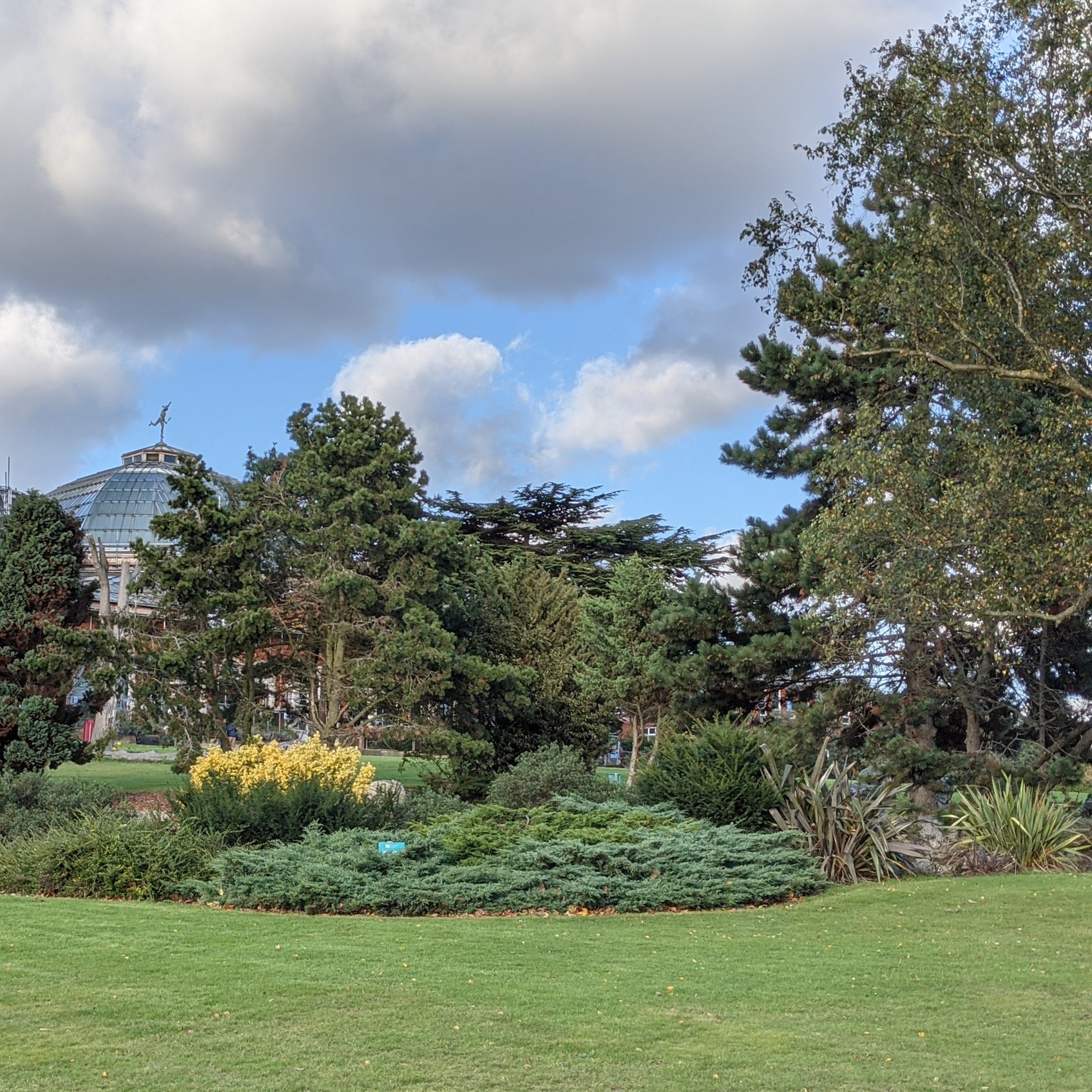
Autumn tree colour in Avery Hill ParkThe Avery Hill Winter Garden, viewed from the park
Some members may be familiar with the Winter Garden, a glasshouse currently undergoing renovation work (therefore closed) and about to pass from the hands of the University of Greenwich back to the local council. I look forward to seeing it after renovation is complete!
Recently cut meadow area and former hedgerow (with dozens of cross country runners!)
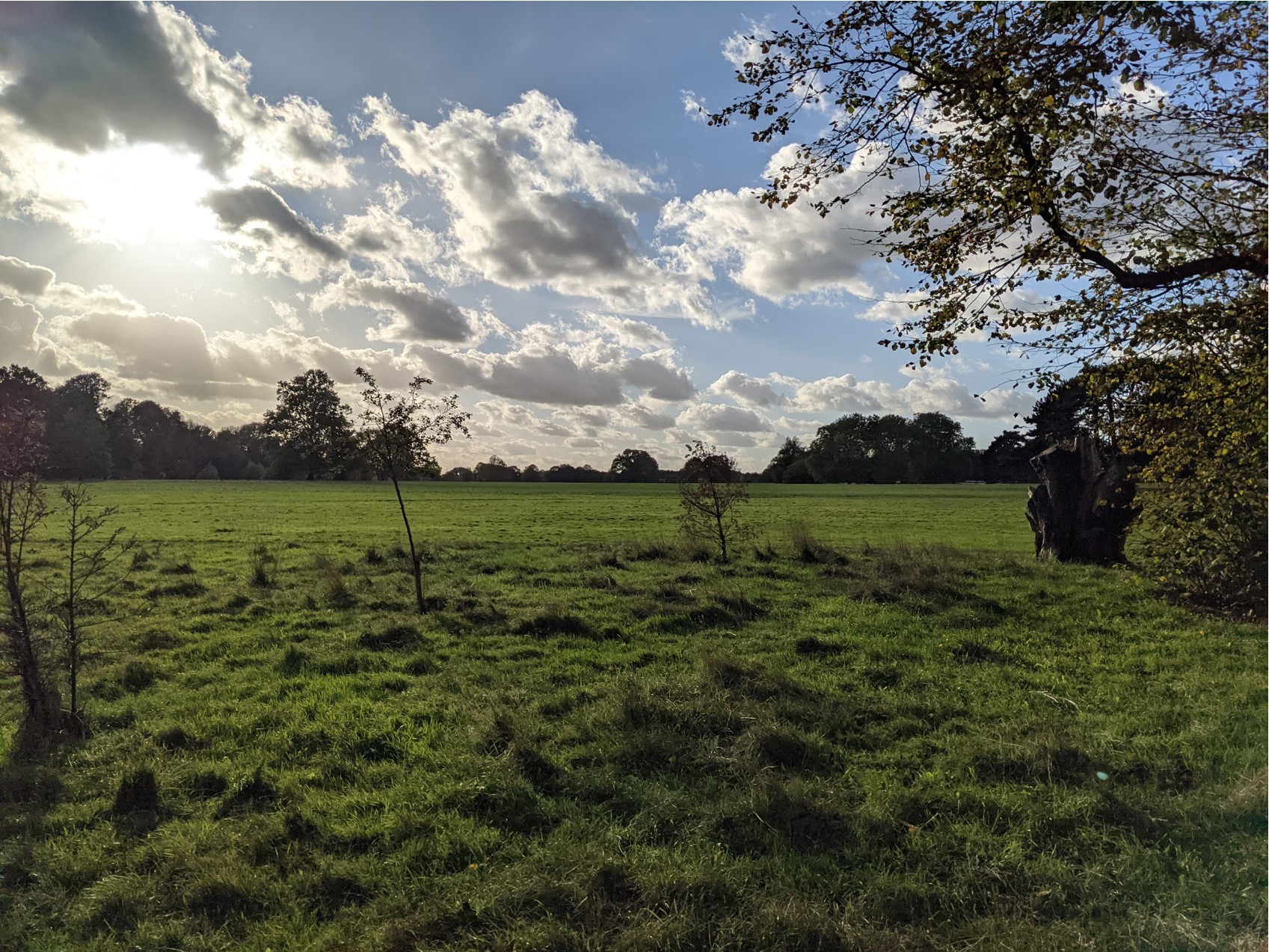
There are two main areas of the park, historically and now. The more manicured, grassed parkland associated with Avery Hill Mansion (which is currently being converted into a school), and former farmland, with field boundaries and drainage ditches. The Friends are working to make the latter areas more wildlife-friendly by negotiating a meadow-style mowing regime (ie: cutting only twice a year, removing the mowings once seed has dropped, and sowing wildflower seeds) with some mown paths. Even after just a year, it’s possible to see that the range of plant species is extensive. The increase in butterfly numbers and activity in summer 2021 was notable. It is hoped that a general increase in biodiversity will also encourage an increase in bat numbers, which have declined in recent years.
Looking toward Great Stony Acre – field boundary trees and drainage ditch
The former field boundaries are still visible, and what would have been hedgerow has grown into rows of trees and scrub, which is excellent for wildlife. A new mixed hedgerow has been planted where one had disappeared, and the drainage ditches have been cleared by volunteers. Another historical feature which lives on through the Friends is the old field names, such as Henley’s Meadow, Little Stony Acre, Grey’s Field and Great Stony Acre. The latter is being planted with native tree species – oak, hornbeam, birch, hawthorn and field maple. Around 1500 trees have been planted over a five year period, and there are plans for a natural drainage pond in the centre as the area is at the bottom of a slope, is mostly heavy clay and becomes very boggy in winter.
Young trees in Great Stony Acre
It was a very enjoyable afternoon and I appreciated the chance to visit the Park with a knowledgeable guide.
Looking across Avery Hill Park, late afternoon October 2021
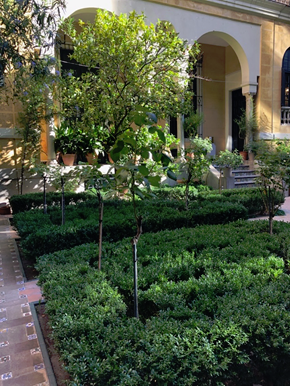
On a recent visit to Madrid, I called in to the house of Joaquim Sorolla (to my mind, one of the greatest of the Impressionist painters). Like Monet and others, he was one of those artists who loved his garden and, in later life, used it for inspiration and as subject matter. Located in the heart of Madrid, the garden has been created to manage the heat of the city. ‘The garden with its Moorish echoes is the quintessence of the Spanish garden’[1]. It is divided up into three linked but clearly distinguished parts. There is extensive use of aspidistras in huge pots to line balconies and provide focal points around the garden. Roses are grown in pots and situated throughout the garden – the ones I saw in flower were of a cream I associate with ‘Buff Beauty’. And, of course, plenty of pelargoniums in pots, most of which had finished flowering (my visit was in September). If in Madrid, do visit!
Luca de Tena, C. (2021) Museo de Sorolla, Madrid. Ediciones el Viseo.
Supporting plants in a timely manner has been one of members’ New Year’s resolutions on more than one occasion. I remember one reading: to support plants before they fall over!
But how to do it in a way that is both attractive and unobtrusive? In addition to which, you have to find the right materials. I have long been an admirer of the ‘birch halos’ used by Sarah Raven and at Great Dixter, for example, but had never attempted to create one.
This year I managed to find myself a pile of birch twigs and, inspired by the clear instructions in Arthur Parkinson’s book The Flower Yard, I had a go.
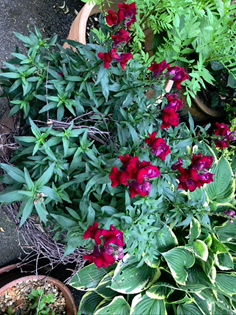
As you can see from the Antirrhinums, although not quite on the same level of skill, my efforts are doing the job and don’t look too bad!
I wonder what other attractive supports members have found for themselves?
CABAHS member Anne R has sent a link to this rather lovely short film. The Excalibur Estate in Catford is being redeveloped, and the gardens will disappear. The film is produced for the Garden Museum, and features Matthew Wilson.







 Charlton and Blackheath Amateur Horticultural Society