Great Dixter

Throughout the year Great Dixter hold various events for their Friends membership. So, on yet another dismal July evening this year, Pat and I drove to Sussex. The evening began with drinks and canapes and a talk from Fergus which should have been held on the front lawn but, due to the inclement weather, was inside in the Great Hall. Three boxes of plants from the nursery, designed for dry, wet and shady aspects of the garden, were raffled at £5.00 a ticket. Surprisingly, as Fergus was talking, the sun came out and what could have been a wet evening turned into a very pleasant one. Although the colour of the sky in the photo demonstrates it was still fairly cloudy!

Great Dixter Long Border with Cosmos bipinnatus Apricotta in centre

We had arrived slightly early, so were already able to explore the garden which is always full of surprises. The phlox were particularly beautiful and Pat and I were trying to note varieties for our own gardens! Following Fergus’ talk, which was generally about the work of Great Dixter and collaborative projects that were ongoing including one with Hastings council, we divided up into groups according to our chosen tour/talk. Each one of these was conducted by one of the students at Great Dixter. Pat and I had opted for the Long Border and Jungle Garden (although we popped out of the latter and into the Nursery!). The students are articulate and engaging and certainly know their material. Having watched Fergus’ lectures on the Long Border, it was interesting to see this in practice and explained to us by Andrew Wiley, one of the Chanticleer Scholars. A particularly interesting stand of Salvia Indigo Spires was a huge clump of individual cuttings rather than one big plant. Also in use was a lovely creamy apricot Cosmos (Cosmos bipinnatus Apricotta) –  a colour which we have seen a lot in other gardens this year and can be picked out in the photo (one to be ordered for sowing next year!). We always leave these gardens full of ideas and plans!

Vija V
Arundel Castle Gardens

I visited Arundel Castle last week with my son and grandson who spent too long in the castle leaving little time for me to see the gardens. The castle is set in over 40 acres of verdant grounds and within that are the formal gardens in a Jacobean style comprising a domed pergola covered in hornbeam, temples, cascading fountains and obelisks. There is also a stumpery, some very colourful herbaceous borders and a wildflower gardens. I just wish I had more time.

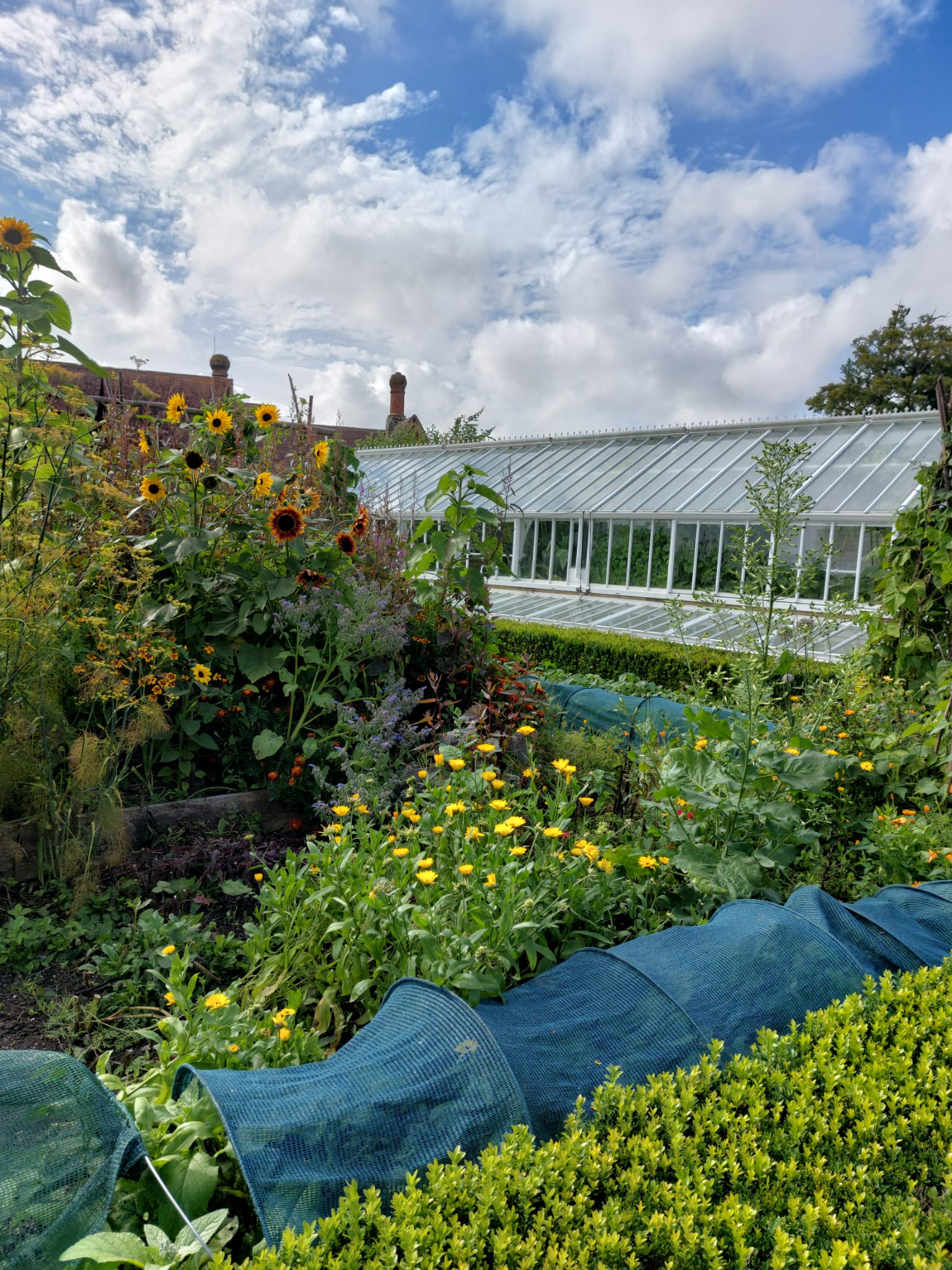
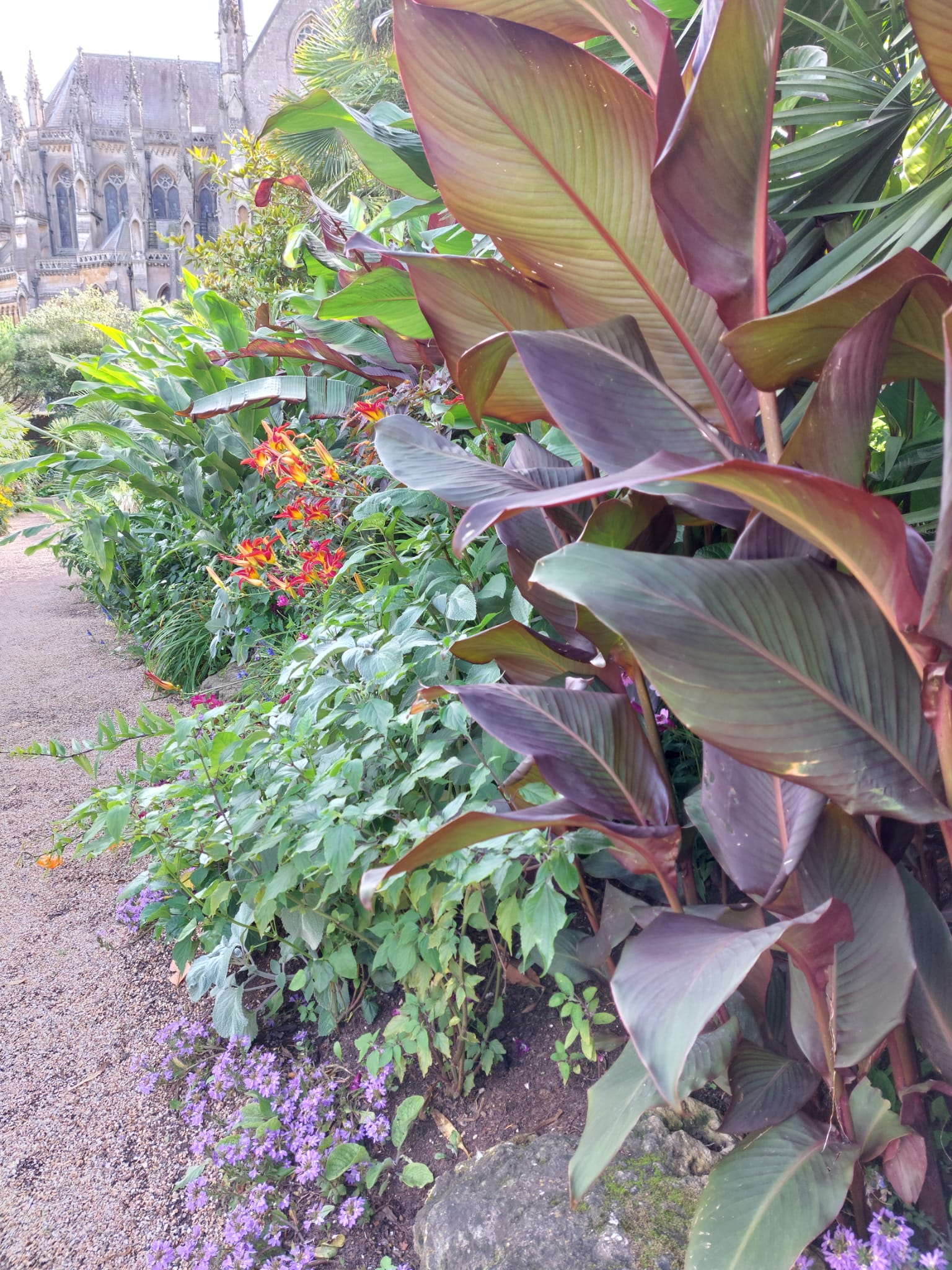
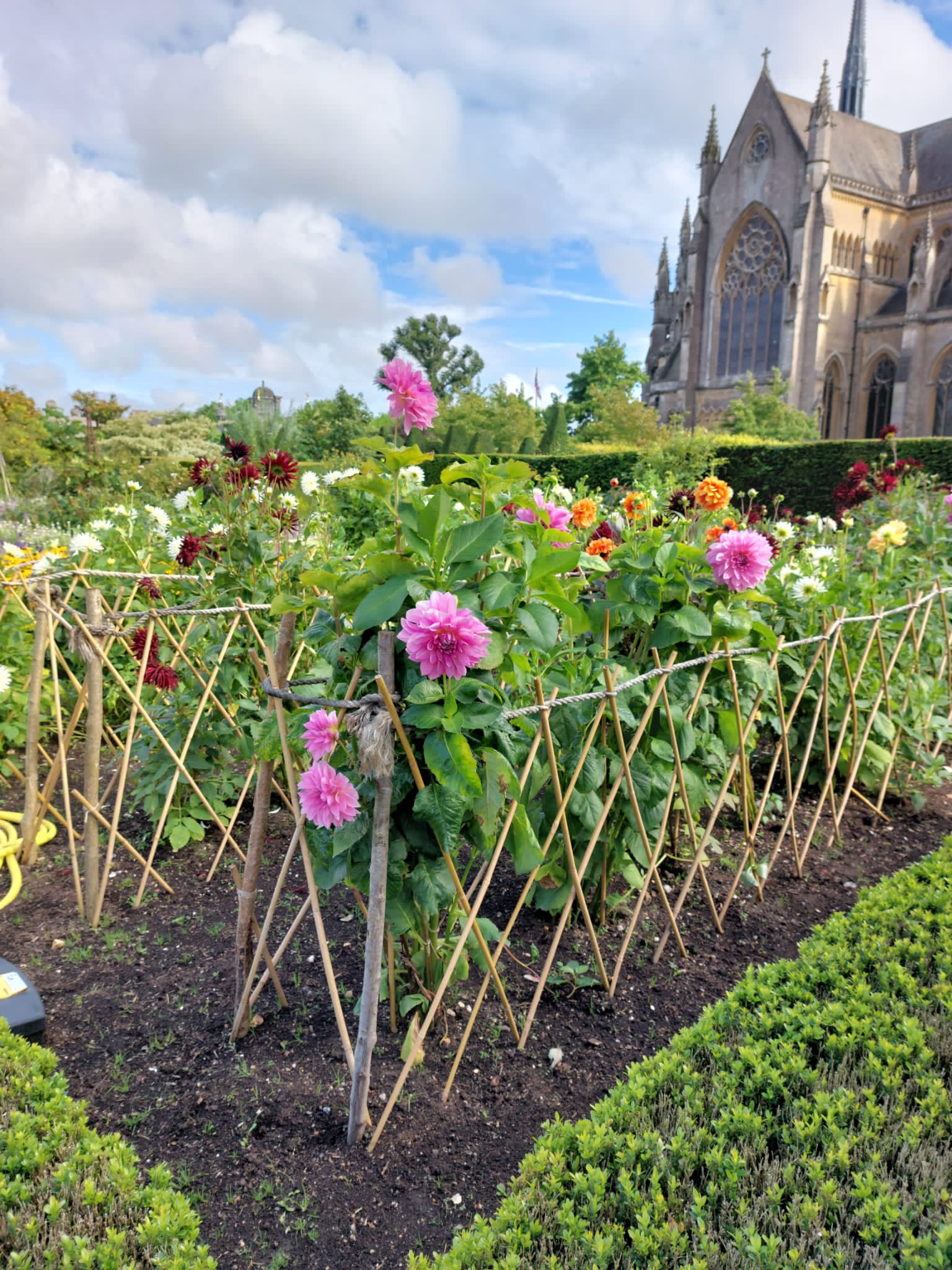
There are two huge Victorian glasshouses, one housing a collection of pelargoniums and another for more tender vegetables in the kitchen gardens. The box parterre was in very good condition with little damage from box moth or blight and had in its midst some lovely healthy looking dahlias. Some of the huge pots housed tender perennials in quite a formal style in what must be a very sheltered spot. I understand that the garden underwent a renewal when the current head gardener arrived and surrounded the lawns with a tropical border based on work he had done in gardens in Bermuda. They also have a tulip festival in the spring which a friend of mine went to and said was spectacular. It certainly packs a punch and if you find yourself in the vicinity of Arundel it is definitely worth a visit but make sure to give yourself time to see it all.


Pat K

July 2023 Talk: The Jungle Garden

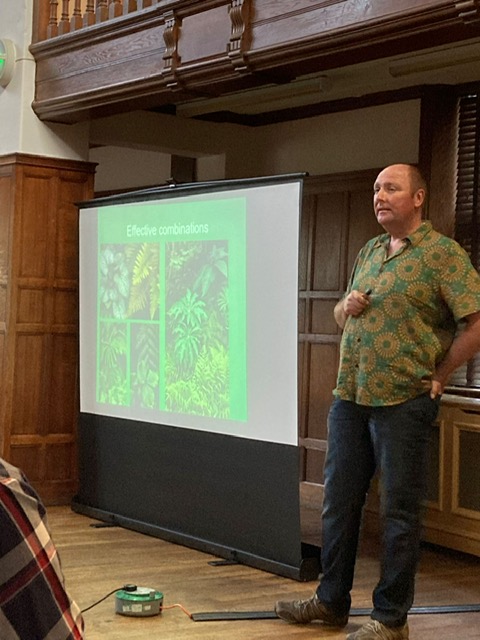
Our Speaker, Philip Oostenbrink, has been the head gardener at Walmer Castle since 2020 and taught horticulture in the Netherlands for 8 years prior to coming to England. He gave  a fascinating and visually illustrated talk on the increasingly fashionable Jungle Gardening. He described how to create at home a garden or patio full of lush, green foliage plants and how to combine different leaf shapes and textures. He said he has been passionate about plants since early childhood, describing himself as a “plantaholic”. He currently holds 4 National Plant Collections. His stall at the Hampton Court Flower Show this year won a gold medal. He said he was inspired by the tropical Tresco Abbey Gardens (see our previous talk on this) and Will Giles’ Exotic Garden in Norwich.

Continue reading July 2023 Talk: The Jungle Garden

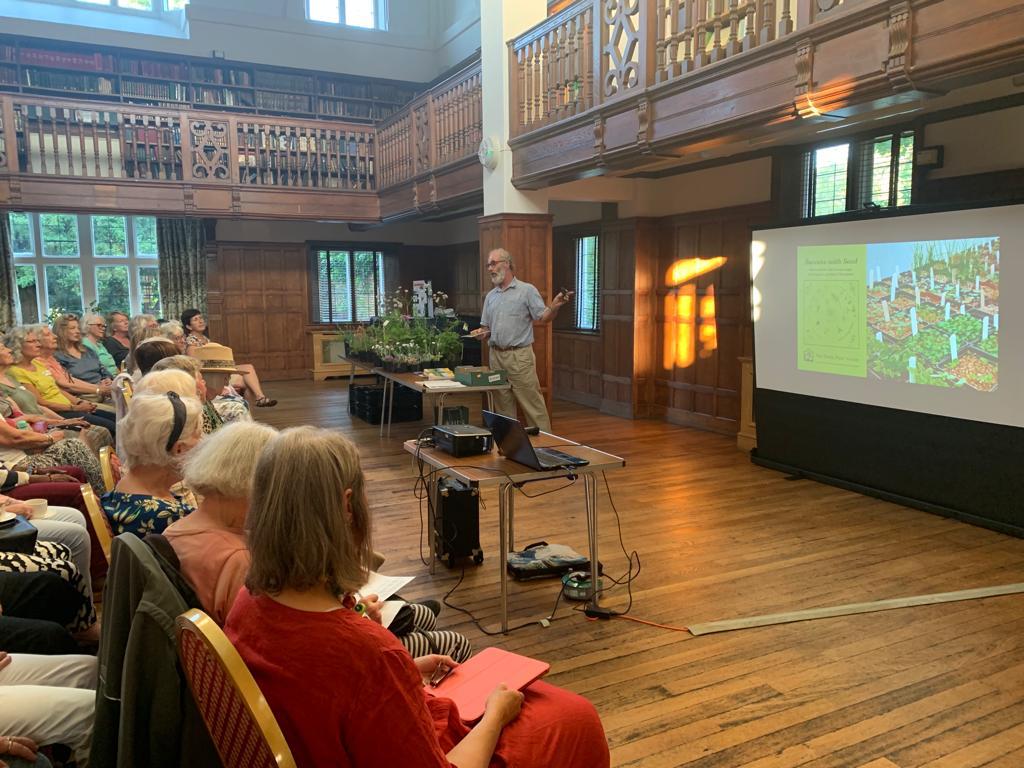
June 2023 Talk: Success with Seeds

CABAHS welcomed back Tim Ingram who last gave a talk in the 1990s. Along with his wife, he is the owner of Copton Ash Gardens in Faversham. He has featured  in a wide range of publications and is co-author of Success with Seeds, a Hardy Plant Society Booklet published in 1997. He is a member of the Hardy Plant Society, Alpine Garden Society and the Plant Fairs Road Show. He is a very keen grower of  plants from fresh seeds, most of which he sources from his own garden. He gave a very informative visually illustrated talk on seeds with great enthusiasm which was catching.


He started the talk with a quote from George Bernard Shaw: “Think of the fierce energy concentrated in an acorn! You bury it in the ground, and it explodes into an oak! Bury a sheep, and nothing happens but decay.”

Tim described how he grew fresh seeds, and the conditions they need for successful growing, the how and when to grow different seeds. Seeds sold in Horticultural Garden Centres are grown to germinate easily at 20C. Fresh seeds may need different and specialist requirements. Seeds vary widely and some seeds are more difficult to grow. Seeds vary in size  and shape. The orchid is very small whilst the coconut is very large and size impacts on how they are sown and the conditions needed for growth. Some fresh seeds have to be sown  soon after they are picked, whilst others may be kept for a long time. Cowslips for example, need to be sown quite fresh in autumn and need a spot of outside winter cold to kickstart them. Early flowering plants such as bulbs and ericaceous need a cold bout to kickstart germination too.

Continue reading June 2023 Talk: Success with Seeds

Stella’s Scottish odyssey

The week didn’t start well. The train was delayed at King’s Cross and then got stuck behind a freight service so was an hour and a half late into Edinburgh. The visits, next day, to two lovely gardens near Peebles, about three quarters of an hour south west from the city more than made up. The Royal Botanic Gardens Edinburgh took responsibility for Dawyck in the 1970s. The gardens of this country estate are renown for their woodland areas and spectacular plantings of rhododendrons and azelas. All tastes in colours are catered for: from deep reds and oranges to more subtle whites and mauves. There are also areas covered in beautiful blue Meconopsis. A former owner, Sir John Naesmith was a patron of the plant-hunter, David Douglas (1799-1834) and there are splendid examples of his fir here as well as some impressive redwoods.

Dawyck Botanic Gardens

While we were in the area we decided to call in at Kailzie Gardens which are undergoing significant development. Their glasshouses were one of the first installed in the 1860s by the famous Scottish firm of Mackenzie and Moncur. We were fascinated to read about the restoration which involves much linseed oil to ensure the wood-framed structures last for another century and a half at least! The gardens themselves provide a peaceful but colourful sanctuary with herbaceous borders to inspire and walks with views of the lovely countryside beyond. We finished our outings with tea in a stylish courtyard café.

Continue reading Stella’s Scottish odyssey

Visit to Community Garden in Open Gardens Festival 2023

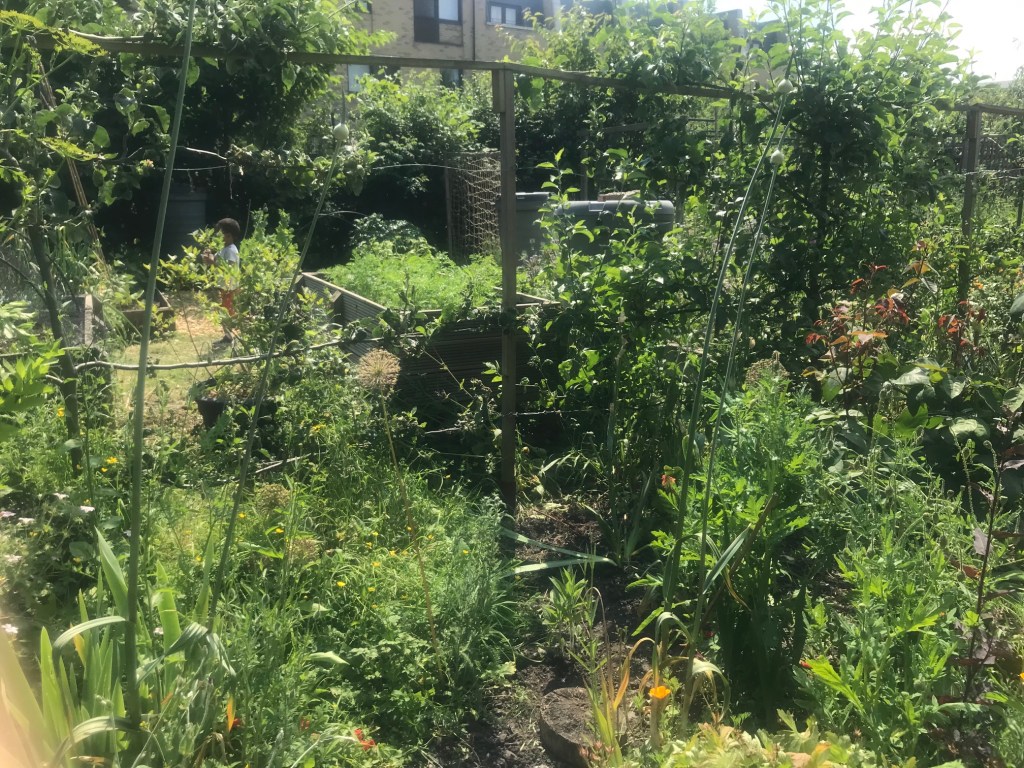
Given the hot weather for this year’s Festival and that this is our third, we focused on Gardens we haven’t seen before. So this afternoon we set off to Christchurch School Community Garden to see what was going on there. And we were pleased. It demonstrates what can be done with a pocket of land, off a busy main road, with some funding and lots of enthusiasm and knowledge – and effort. The description on the Festival brochure referred to raised beds for food crops, a community orchard, ornamental borders, a Forest School and a covered meeting hub. They also have a hugelkultur bed, a bee hive, a wildlife pond – and they were selling goji berry plants!

Continue reading Visit to Community Garden in Open Gardens Festival 2023

Never say ‘Never’

A few years ago I cleared out my greenhouse following the losses of the winter and dumped in my compost the remains of pelargoniums and other dead items. It’s always a little sad to lose much loved plants which have given you their best. I then had some fun ordering new plants to replace the old ones (and some others!). A couple of weeks later, I found several of my ‘dead’ pelargoniums lying in the compost and sprouting new shoots from the roots. Of course, I swiftly took them out and potted them up to achieve lovely healthy plants. I am now a little less impatient to discard anything that looks dead.

Continue reading Never say ‘Never’

May 2023 Talk: Tresco Abbey Gardens

Dr John Hughes, an RHS judge and a long term friend of CABAHS, gave an entertaining and informative talk on Tresco Abbey Gardens in the Isles of Scilly, situated just 28 miles off the coast of Cornwall. Benefiting from the Gulf Stream and Atlantic Drift, it has a mild climate and the magnificent garden is full of exotic and glorious plants from every Mediterranean garden zone, including South Africa, Australia, New Zealand and Chile. It has been called a ‘Kew without the glass’. It is also home to a range of fauna including the red squirrel.


Augustus Smith, the founder  of the garden, bought the island from the Duchy of Cornwall in 1830 and it has been in his family, who have remained keen horticulturalists, ever since – though all the land, except the garden and house which he had built on it, was given back to the Duchy in 1922. The seventeen acre garden has been designed around a ruined Benedictine Abbey and within a sympathetic hard core of paths and arches, including statues supplied by the latest owner.

Continue reading May 2023 Talk: Tresco Abbey Gardens

A visit to Perch Hill

A few weeks back Vija and I went to one of the open days at Sarah Raven’s farm Perch Hill in East Sussex. The preceding evening had seen torrential rain and an email arrived on the morning of the visit warning people of the muddy conditions and that a four wheel drive was essential. And they weren’t exaggerating… the field we were to park in was a mud slide with a tractor towing cars out of the mud! 


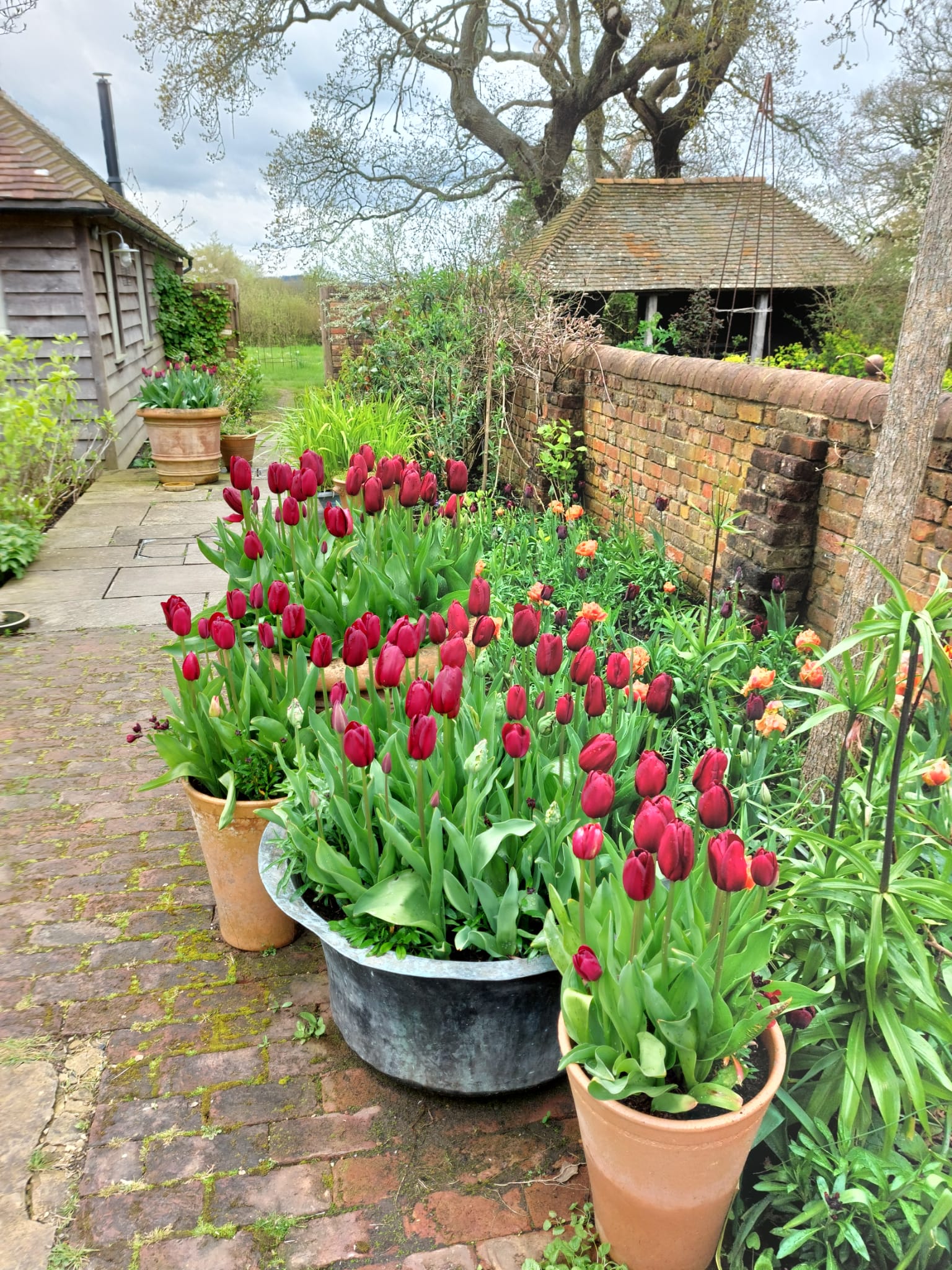
But the rain hadn’t affected the garden. The tulips, many of which were in pots,were stunning with the same colours used repeatedly throughout the garden. They were well labelled  so we could make a note of them and there seemed to be loads of new varieties and quite a lot in oranges and shades of reds. There were lots of pots with pastel shades too and it wasn’t just tulips. There was a whole bed planted with a tall variety of fritillary which you don’t see very often and is certainly different.


Additionally there were displays in pots of some lovely frilly violas and the glasshouse was planted with ranunculus and  other early varieties of annuals. There were displays of early vegetables but they were small and obviously affected by the cold spring. And the tea and cakes were good too!

All in all a stunning display and worth a visit despite the mud and flooded roads.

Pat K

Spring at Exbury Gardens, Hampshire

Lawn at Exbury Gardens

A visit to Exbury Gardens in the week between two May Bank Holidays was a treat for the senses.  I last visited after the summer drought and before the winter storms and asked myself, ‘how would everything look?’  In short, everything looked thrillingly fresh.


There have been some losses, which, while regrettable, have provided opportunities to the gardeners to open up views, plant new (drought-resistant) species and create entirely new gardens. 

Continue reading Spring at Exbury Gardens, Hampshire