CABAHS member Jean R thinks her garden is out of control! She says:
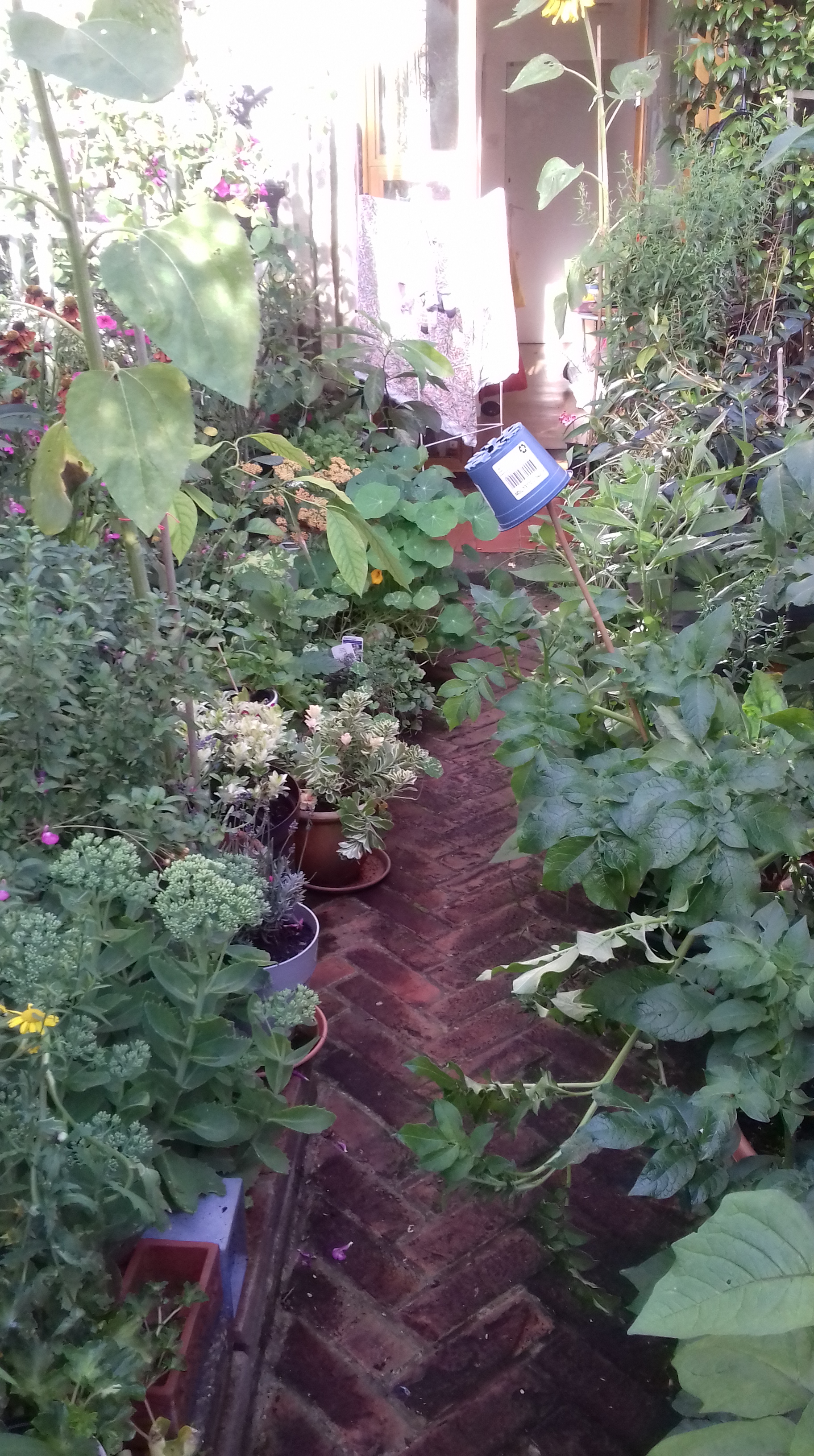
I’m a true amateur gardener and have watched aghast as nasturtiums, chinese lanterns and the leaf cutting bee have almost destroyed all my carefully laid out spring plans! In fact I love those bees, but do they really need so much leaf to line their nests? I also love nasturtiums and Chinese lanterns, but how dare they spread so prolifically!
Then to cap it all, intrepid visitors searching for my garden path find that only a sideways crab-like advance is possible to reach my front door! You can spot my front garden in Vanbrugh Park if you are passing by…….
Jean’s front garden path (somewhere in there)
Evidence of Jean’s leaf cutting bees!
An unusual shrub in Kathy’s garden – this is Sphaeralcea (Globe Mallow) Newleaze Coral. A real toughie, it loves this dry sunny weather.
This is Angela’s pretty Monarda (bee balm), the photo doesn’t really show it but Angela says it is now 5 feet tall!
Rambling Rosie looking great in Carolyn’s garden. Love the name, really suits it!
Dusty Gedge was welcomed to the meeting. Dusty is a professional photographer and green structure and nature conservationist. He is President of the European Federation of Green Roof and Wall Associations. He said he was pleased to talk to CABAHS as he was local, Lewisham and Blackheath based, and had done a lot of work in the area. He said he is not a gardener but is involved in plants and soil.
Dusty made the point that green roofs and roof gardens have a local history, firstly showing a photograph of the 1997-built sustainable green roof on the now demolished Sainsburys on the Peninsular, followed by one of the 2019-built IKEA roof garden. In fact, Greenwich and Lewisham have the second and third most green roofs in London. Nowadays in England, including the City of London, it is planning policy that all tall buildings should have green roofs.
Dusty said that nowadays green roofs are becoming numerous. He showed photographs of a wide variety of them from Europe and the UK. From roofs in parts of Europe where traditionally turf and sedums were used to modern schemes, including nearer to home such as the roof garden at the National Theatre. He said there were 4 types of green roof (intensive, semi-intensive, biodiverse and extensive) and discussed the environment, conditions and maintenance needed for the various types to flourish.
Green roofs and roof gardens are taking soil and plants into the cities. He referred to ‘plumbing with plants’ using soil and vegetation as they store water, helping to ameliorate floods. They also help in heatwaves and the green space they provide fosters health, wellbeing and social cohesion.
He discussed two projects, the Museum of Home and Design which balances diversity with formal garden design using mediterranean and native plants and then IKEA with its four different sections. He said he would be happy next year to take CABAHS members on a tour of IKEA’s roof garden.
Afterwards, Dusty took questions and was asked by a member (who is also a surveyor) about infrastructure needed to support the roof and prevent leaks. He agreed that is an issue and said there were many structural strategies existing to prevent this happening. Another asked what would be the effect of wind on tall buildings. Dusty pointed out that the roofs of tall buildings were generally less windy than at ground level due to the funnel effect. He also reassured members that he collects local wildflower seeds in a sustainable way.
Angela
Dusty Gedge is a green infrastructure professional, public speaker, photographer, nature conservationist and social media influencer. He is President of the European Federation of Green Roof and Wall Associations and a recognised international speaker on green roofs, green infrastructure and biodiversity.
Dusty gave several links to useful websites and a podcast, below. He said members are welcome to contact him for advice.
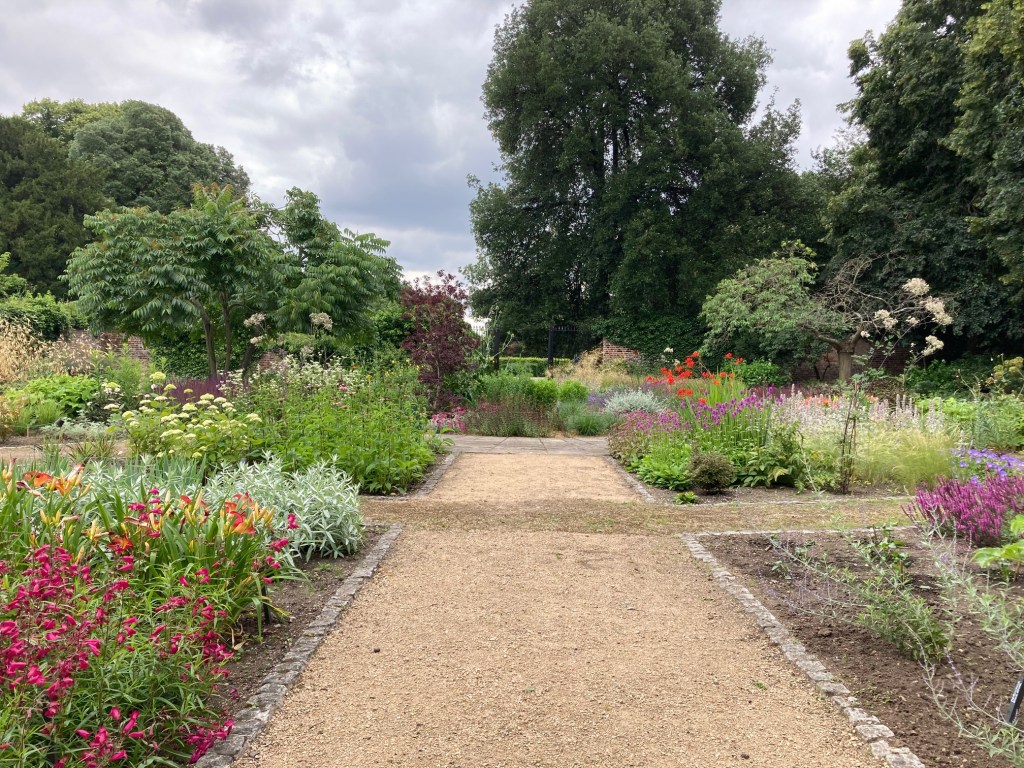
The garden is getting into it’s summer swing now, so much is in flower. It is amazing how complete it looks for a “first year”. Penstemon Garnet is just going on and on and on!
This is the view in July from the CABAHS 70th Anniversary bench:
A recent initiative – Star Plant of the Week. No contest: it was the teasels this week, they are gigantic, and covered in bees.
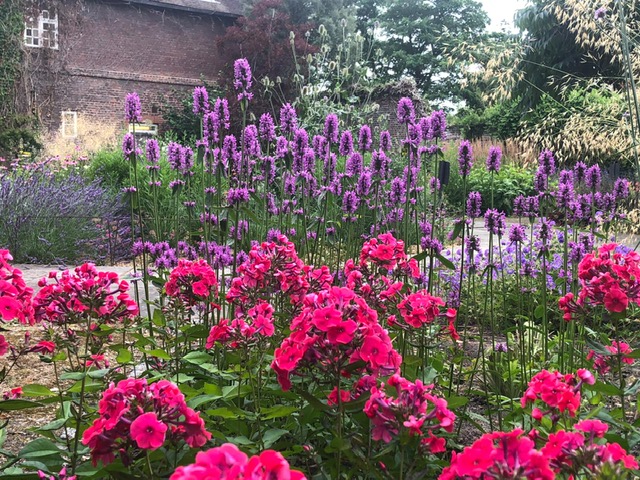
Betony and Phlox demonstrating The Clash!
And now it’s the turn of the Echinacea purpurea “Magnus”, with white Erigeron annuus frothing at the back and a yellow Patrinia photo-bombing in the front.
A selection of photos of Ruth & Matthew’s beautiful garden ‘The Gatehouse’. CABAHS members attended a lovely open evening, wandering around their garden recently, with donations in aid of the Hospice.
The Gatehouse bordersRoses (red one is WB Yeats) grown in a bed in the shape of a Tudor Rose
CABAHS member Anne R has sent a link to this rather lovely short film. The Excalibur Estate in Catford is being redeveloped, and the gardens will disappear. The film is produced for the Garden Museum, and features Matthew Wilson.
The Woolwich Garrison Church Trust has commissioned Chelsea Gold Medal winner Juliet Sargeant to create a Commonwealth and Gurkha garden on their site. They already had outline drawings, above, by local designer Don Albrecht, and are now looking for feedback about the plans.
The idea is to have an English Orchard and wildflower garden on one side of the church, and the Commonwealth countries and Gurkhas reflected in the planning on the other side. Chair of the Trust, Tim Barnes, says that in Gurkha villages there is always a central tree which acts as a focal point for village life – so there are plans for a circular seat around the base of one of the trees to reflect this tradition.
There are some lovely ideas, download the full document below if you are interested.








 Charlton and Blackheath Amateur Horticultural Society