What to look out for in the Old Pond Garden: March 2025

We hope you enjoy a spring walk around the walled gardens at Charlton House! Look out for:

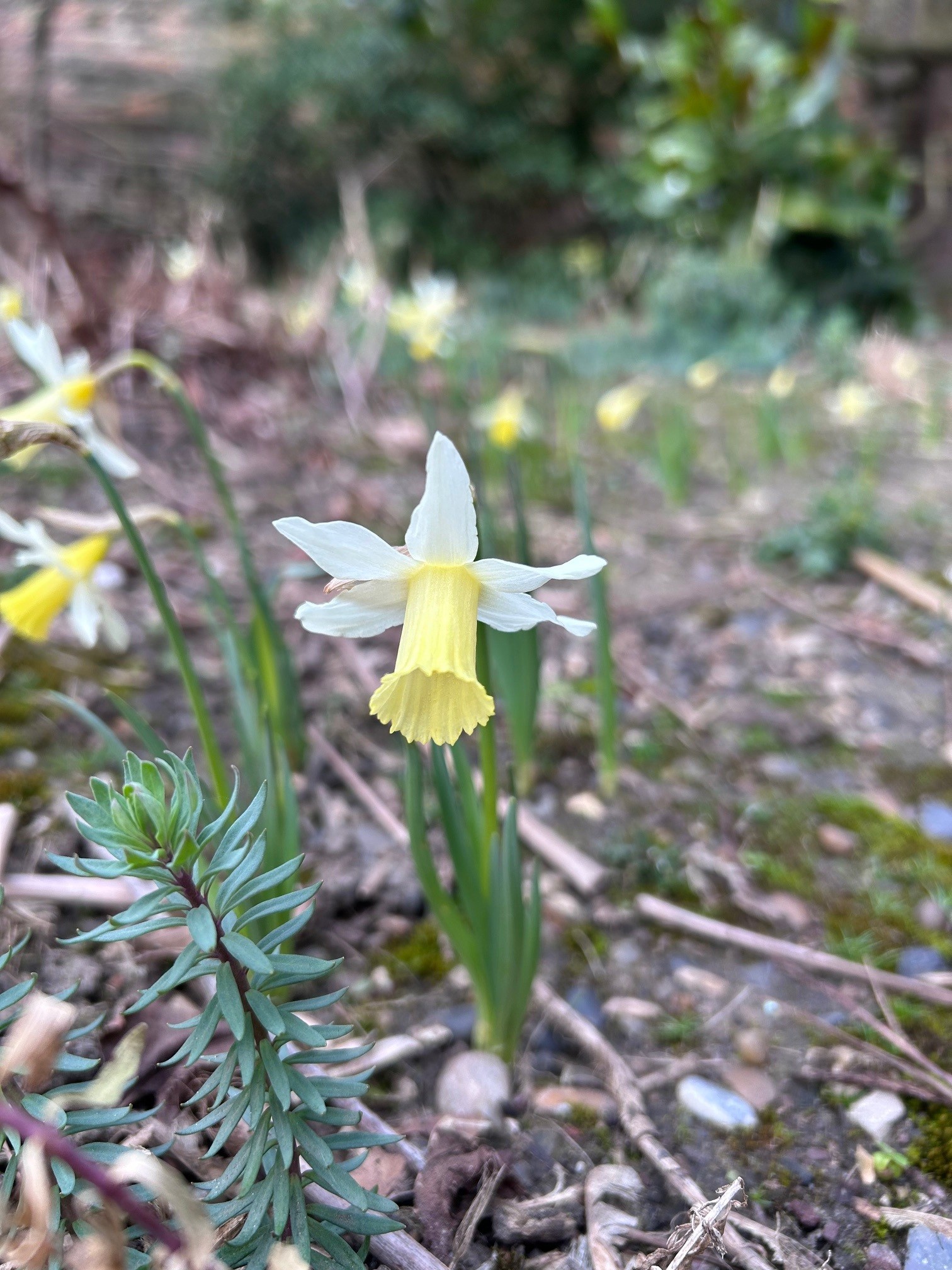
Daffodil (Narcissus ‘Elke’)

Narcissus 'Elke' in the Old Pond Garden at Charlton House

A fragrant, small and early-flowering daffodil, you can spot Narcissis ‘Elke’ in the Peace Garden. It has pale petals and a creamy yellow trumpet. The name ‘Elka’ is apparently from a combination of the names of two ‘lady daffodil growers’: Elizabeth and Kate.

Wood spurge (Euphorbia amygdaloides var. robbiae)

Euphorbia amygdaloides var. robbiae (wood spurge / Mrs Robb's Bonnet) in the Old Pond Garden, Charlton House, March 2024

Wood spurge is in the Euphorbia family, so take care! If the stems are broken, they gush with a thick milky latex substance that can cause blisters on skin. They are handsome perennial plants, shade loving, with zingy lime-green flowers in late Spring and rosettes of glossy dark green leaves. Another name for this plant is ‘Mrs Robb’s Bonnet’ – we would like to see the hat that inspired that name!

Continue reading What to look out for in the Old Pond Garden: March 2025

Pat’s Jobs for March 2025

  1. Time to pot up those Dahlia tubers in 3 litre pots, making sure the tubers have an ‘eye’ which will shoot. Cover in compost, allowing the stem to rest at the surface, then label and water and keep somewhere reasonably light and frost free (greenhouse or windowsill) until they start growing.
Potting up dahlias
Potting up dahlias

2. Now is the time I start sowing sweetpeas: five seeds to a 3 inch pot and keep on a light windowsill or greenhouse until they germinate. You can try sowing directly into the soil which I think works well for some.

Continue reading Pat’s Jobs for March 2025

Great Dixter Behind the Scenes

Led by members of the garden team, the Behind the Scenes tours of Great Dixter provide an opportunity to explore the garden and meadows to examine the plants which are putting on a display at particular times of the year, offering an insight into the work that makes this happen. Limited to a maximum of 25 people, they allow visitors to have a good view of the plants.

A tour of the gardens in February was always going to be a little hit and miss in terms of the weather, but we were fortunate enough to arrive just as the rain stopped, so were able to enjoy the tour without getting soaked through!

As we enter through the front meadow, the area is full of Crocus tommasinianus, Crocus flavus and various forms of Crocus chrysanthus. Of course there are snowdrops everywhere. Our guides introduced us to the wide range that are cultivated here, from the common (but no less lovely) Galanthus nivalis, to G. Atkinsii and G. S. Arnott which are all doing fabulously well, as well as the less common G. Diggory and G. Washfield Colesbourne. We all peered at the diminutive G. Wendy’s Gold in a corner, sheltered by a wall and still tiny enough that if it wasn’t pointed out, you might walk past it! Some of the differences between the types are so small: those with an upturned tepal and look like little helicopters, while G. Diggory is plump and round.

Continue reading Great Dixter Behind the Scenes

Outing to Royal Botanic Gardens, Kew for Orchid display

This year’s Orchid display, based on the beauty of Peru, is being show-cased in the Princess of Wales Conservatory. The display is absolutely stunning and should not be missed.

The glasshouse is divided in two sections: the arid, dry zone, featuring cacti and succulents; and the lush, tropical zone. Within the dry zone several large containers of orchids and hanging orchid planters are on display but it’s the tropical zone that contains the main display and you won’t be disappointed.  

Inspired by the Peruvian flag and coat of arms, the display centres on a cornucopia (an ornamental goat-horn), overflowing with orchids, to signify the abundance of mineral wealth of Peru. Adjacent (keeping guard?) stands a distant relative of the alpaca. 

Continue reading Outing to Royal Botanic Gardens, Kew for Orchid display

June 2024 Meeting and Talk: Hever Castle and Gardens

A successful meeting was held in June with a packed audience and we were lucky to be given an engaging and informative talk by Neil Miller, Head Gardener at Hever Castle. In 2002 Neil started as a junior gardener at Hever following 10 years as an Insurance Broker and within 4 years was Head Gardener. Quite an achievement!

Audience for talk June 2024

Famously Hever Castle was the childhood home of Anne Boleyn, and Henry VIII frequently visited her there. At that time the surrounding land was marsh and bog land. Though there were many changes of ownership in the following centuries, it was not until 1903, when William Waldorf Astor bought the estate, that serious restoration and renovation took place and the design for the gardens was drawn up. Alongside the castle, a Tudor style Village was also built so that invited guests had rooms to stay.

Continue reading June 2024 Meeting and Talk: Hever Castle and Gardens

May 2024 Talk: Silent Earth – Averting the Insect Apocalypse

Dave Goulson, Professor of Biological Sciences at the University of Sussex specialising in the ecology and conservation of insects, and author of several books*, gave a talk about the dramatic insect decline worldwide. He outlined some of actions required on a National and International scale to reverse this apocalypse and what we as gardeners can do.

Dave Goulson with our Chair, Stella and the range of his books for sale at the meeting

When he was a boy, he started collecting caterpillars (in his lunchbox) and his interest in insects became a life long passion when one of them pupated into a Cinnabar Moth. He explained that insects evolved over 480 million years ago and there are now around one million known species worldwide. They were the first creatures to fly and sing and many have complex inventive ways to camouflage themselves or mimic others. Examples of some ‘weird and wonderful’ insects were shared with us such as the Shield Bug from Thailand whose back very much looks like the face of Elvis.

The horrifying statistics on insect decline were shown, particularly over the last 30 to 40 years. Studies show that the decline is around 75%. He has researched the Shrill Carder Bee which was common across Southern England pre-1960 but by the year 2000 the populations of this bee had greatly decreased and there were only about six populations left. Since 2000, the population which inhabited the Salisbury Levels has become extinct.

Continue reading May 2024 Talk: Silent Earth – Averting the Insect Apocalypse

King John’s Nursery and Garden, Etchingham, Sussex

On a gloriously sunny day in May, a visit was paid to the garden at King John’s Nursery.  This ‘naturalistic’ garden is set within a beautiful landscape of ancient trees and meadows. We were given a laminated map of the garden layout and proceeded through the old honeysuckle-clad, wrought-iron gate to the garden beyond. This led us to the first garden room, beautifully planted in soft-pinks, the focal point being a circular, brick-built pond, fed by an imaginative water-gully.   This led us into the gravel garden room, consisting of sun-loving and tender plants displayed to great effect on a slab-table, an artefact that many of us would love to possess for our own gardens!

From there we entered a magical place – a charming meadow with mauve-blue spires of camassias threading through and rising above the grasses, a stunning contrast to the shades of green all around.  White-flowered camassias were in bud, ready to take over and bloom in the next week or so.  In one corner of the meadow sat a toadstool circle, an enchanting addition for children to let their imaginations run wild.  We exit beneath the clipped hedge archway into a larger meadow which includes an herbaceous long border, consisting of many taller plants such as grasses and flowering angelica. We follow the path around, to a shaded woodland dell and admire the luminosity of the rhododendron’s stunning white flowers by a gateway entrance, cow-parsley billowing alongside solomon’s seal and pass beneath the 350-year-old oak tree. Amongst the grasses, glistening in the sun, wild orchids are to be admired. We sat on the bench to absorb the idyllic setting before us, noticing glimpses of an old apple orchard beyond the boundary.

Continue reading King John’s Nursery and Garden, Etchingham, Sussex

Plant of the Month: Iris (May 2024)

The show gardens at the Chelsea Flower Show each May just zing with the stunning colours of the irises in bloom and they really are one of the main attractions (apart from roses) that are on display.  Being ‘show-stoppers’, their impact allows the designers to then infill and arrange around them the more delicate flowers and foliage to an harmonious effect.  Visitors admire, with ‘oooh’s and aaah’s’ at the soft, subtle shades and again, of the deeply-rich and vibrant colours of each and every iris grouping.

The name Iris means rainbow and in Greek mythology ‘Goddess of the Rainbow’.  The petals and roots of several species, including Iris germanica  (bearded) and Iris pallida (Dalmatian/Orris root) are used in the beauty industry, in the manufacture of perfumes, lotions, in food such as spices and even added to gin. Seemingly, the dried root, after 3 years, has the aroma of violets.  This industry goes back to the ancient Greeks, Romans and Egyptians and probably long before their time.

I have an Iris pallida flowering in my front garden, low-growing, which is highly fragrant. This was kindly given to me by Penny S some years ago.  The flower is fading so unfortunately not worthy of a photograph but it certainly should be grown, as the variegated grey-foliage blends nicely with neighbouring plants. I wouldn’t be without it.

My number-one favourite, though, is Iris ‘Langport Wren’, a Kelways‘ introduction from 1973 and deservedly worthy of the RHS Award of Garden Merit.  It was flowering in my front garden until a few days ago when the slugs/snails chomped its head off!  The fragrance is reputedly of orange and chocolate – but I wouldn’t know as I haven’t had the chance to find out!!!   The first photo below is of this delectable flower, a painterly amalgamation of browns, purples and russets, growing in Margaret T’s garden. 

Continue reading Plant of the Month: Iris (May 2024)

Spring in Cornwall

I have just spent a very happy week at Duloe Manor, a complex of self-catering holiday apartments and cottages near Looe in Cornwall. The main house was built in the 1690s for the Rectors of the local church. The whole complex is set in lush gardens of around three acres: a few mixed beds contained lovely combinations of saxifrages, irises and other familiar perennials while in less formal areas, swathes of wild garlic provided backdrops for beautiful pink campions as well as English bluebells in full bloom. In the car park several banks of pale yellow primroses remained stubbornly but delightfully in flower! Majestic rhododendrons provided splashes of magenta and purple.

Continue reading Spring in Cornwall

Pat’s Jobs for May

1. It’s a good time to take softwood cuttings of both tender and hardy perennials such as pelargoniums, anthemis and penstemons. Place in a shady spot until roots begin to form. 

2. Put plant supports in place to stop things flopping and make them yourself from shrubby prunings or just push prunings in the soil around the plant. 

3. I’ve Chelsea chopped my phlox today and also done a few clematis as they are far too tall and leggy after all the rain we’ve had. 

Continue reading Pat’s Jobs for May