Technically, a small garden is considered to be one that is approximately 100m2 (33 x 33ft) or less. While the average UK garden is apparently about twice that size (225m2 – almost a tennis court), and most new build etc gardens are about half the size of ‘small’ (50m2), we are based in London and what really defines a small garden is probably more a matter of opinion and perception than exact dimensions. To complicate the topic further, many larger gardens are divided into smaller spaces or ‘rooms’, which will often have features and considerations in common with smaller gardens.
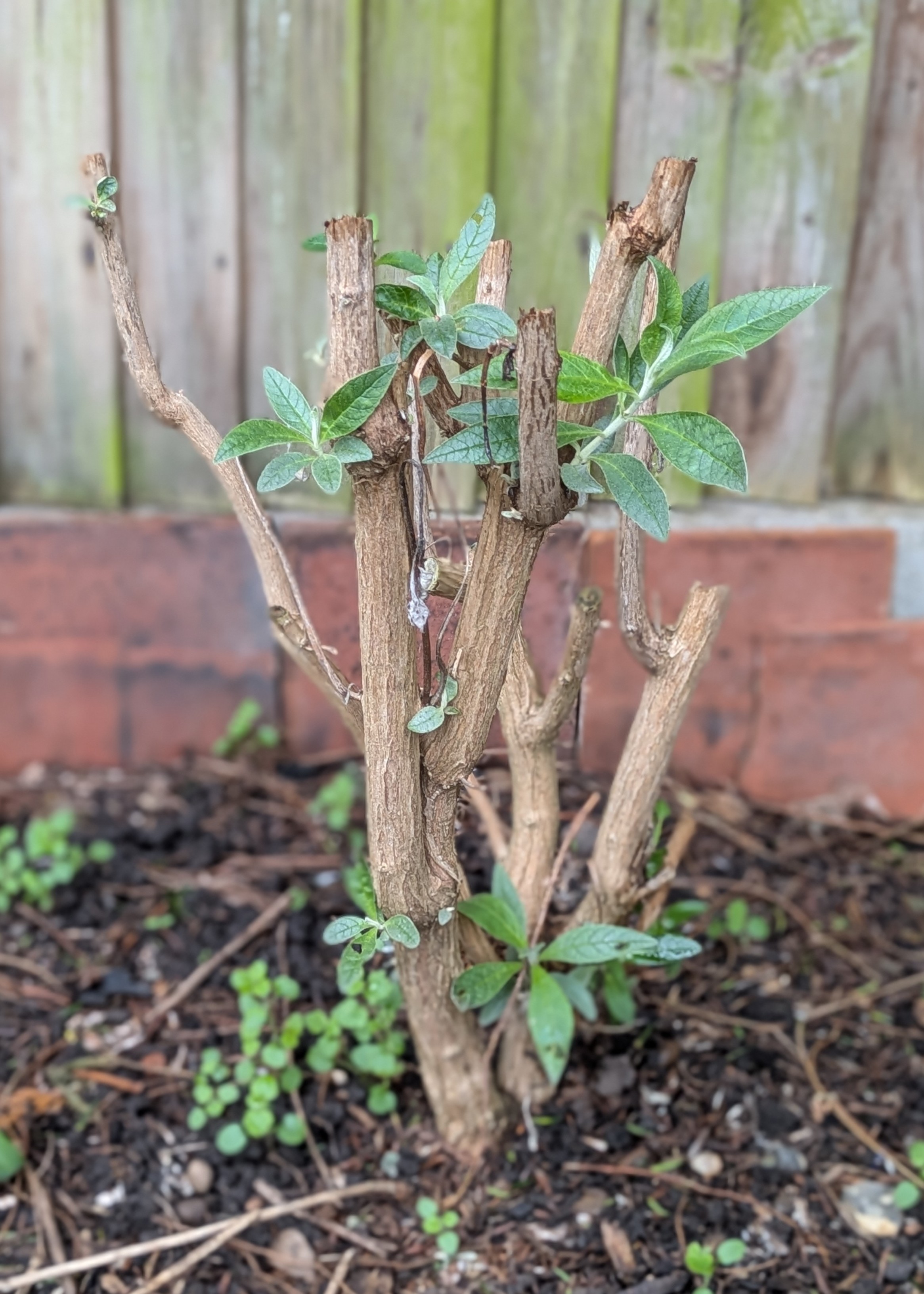
1. Time to cut back Buddleja davidii hard… don’t be timid, take it right back to 40cm to a pair of buds. If you want a taller plant make the cuts higher up the stem. It will grow back in no time. The prunings make good hardwood cuttings and root easily straight in the ground.
Buddlejas before and after a hard prune (not the same plant!)
2. You can pot up Dahlia tubers now by placing in pots or trays of peat-free compost in a frost-free place, and water once with no need to water again until shoots appear. Make sure the tubers are firm with no sign of rot.
Not too far away (and on the 54 bus route from Charlton and Blackheath!) lies a ‘new’ old park: Beckenham Place Park. The name can be confusing – it lies on the border between the London Boroughs of Bromley and Lewisham, but is run by Lewisham Council. It is larger than you might think, at 96 hectares (well over 200 acres), and stretches from Beckenham Hill railway station in the north to Ravensbourne railway station in the south, west into Beckenham ‘proper’ and east toward Bromley.
Beloved of dogwalkers, wild swimmers, park runners, bluebell spotters and vintage shoppers, since Heritage Lottery Funding was awarded in 2016 there have been many changes and a huge increase in community use. Old features of the 18th century estate have been brought back, playgrounds added and the 1762 mansion (which was formerly a golf club house with a small visitor centre) is now home to artists’ studios, a café, a vintage shop and hosts multiple events.
1. Prune Wisteria this month and next by taking all side shoots back to 2 or 3 buds. Very old plants may need severe pruning to show off the flowers.
Very tangled Wisteria in need of pruning!
2. Start pruning roses in earnest although some are still unbelievably flowering. Remove any foliage with blackspot and don’t compost. Old roses respond well to hard pruning so don’t be afraid, removing all dead and dying wood and cutting stems back to above a bud.
3. I had to remove dead Clematis shoots from a Daphne Jacqueline Postill and in doing so pulled off some of the flowers so take care and do it soon if you can. But leave the main prune until next month.
Before the 1920’s, the ten acres of land at Canford Cliffs was heathland. But along came a man with vision, one Thomas William Simpson, and, with the help of his head gardener Mr Middleton, a magical garden was created.
Mr Simpson was a businessman and entrepreneur (margarine) and having visited many countries, knew exactly what he wanted. Influenced by the gardens and architecture of Italy, Japan and the UK Arts and Crafts movement, he and his gardener set about creating a series of gardens, starting with the Italianate gardens, then a necklace of paths and ponds which connected finally to his Japanese Garden, thus turning his vision into reality, right up until WW2.
The garden sadly fell into neglect following the conflict, but in the 1950’s and 60’s, a new owner set about restoring it, planting the magnificent trees we see today – their maturity and majesty makes this garden quite a magical place to explore.
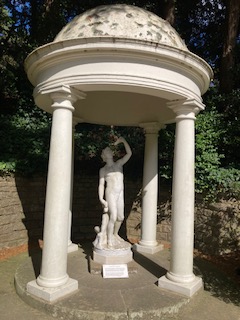
The Italianate GardenThe steps leading down to the Italianate GardenBacchus, God of Wine, sheltering beneath the temple
Upon entry into the garden, I came into the Roman Garden, passed through the Grotto and into the very impressive Grand Italianate Garden, the focal point being the rectangular formal pond and beyond, the statue of Bacchus, the Roman God of Wine, sheltering within a temple at the far end of the garden. This sheltered, south-facing, formal garden is a relaxing place to sit and admire its many features. This garden then leads into Palm Court, a formal garden with its row of impressive Chusan palms.
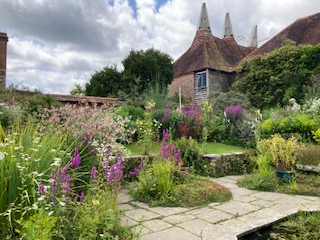
Christopher Lloyd loved colour, and as I stand on the upper pathway of the Sunk Garden, here at Great Dixter, I notice the pops of colour from the spires of pink-purple Lythrum and terracotta-orange Crocosmia all around me.
Designed by Nathaniel Lloyd, Christopher Lloyd’s father, after WW1, this south-facing and sheltered sunken garden is enclosed by two barns, a magnificent yew hedge and a wall on the southern boundary, thus creating its own micro-climate and the plants love it!
1. Top of the list for July is pruning wisteria, taking back that whippy growth to 2 to 3 buds from the main stems.
2. Sweetpeas should be flowering by now so make sure to keep cutting the blooms and give them a feed and plenty of water. They cease flowering quickly if not picked twice a week.
3. Deadhead all your perennials and annuals regularly unless you want them to set seed for next years sowing.
On a gloriously sunny day in May, a visit was paid to the garden at King John’s Nursery. This ‘naturalistic’ garden is set within a beautiful landscape of ancient trees and meadows. We were given a laminated map of the garden layout and proceeded through the old honeysuckle-clad, wrought-iron gate to the garden beyond. This led us to the first garden room, beautifully planted in soft-pinks, the focal point being a circular, brick-built pond, fed by an imaginative water-gully. This led us into the gravel garden room, consisting of sun-loving and tender plants displayed to great effect on a slab-table, an artefact that many of us would love to possess for our own gardens!
Honeysuckle-clad wrought iron gate entrance to the gardenFirst garden room, planted with soft-pink flowersPond and water feature in the first garden roomSecond garden room featuring sun-loving and tender plants on the slab-table
From there we entered a magical place – a charming meadow with mauve-blue spires of camassias threading through and rising above the grasses, a stunning contrast to the shades of green all around. White-flowered camassias were in bud, ready to take over and bloom in the next week or so. In one corner of the meadow sat a toadstool circle, an enchanting addition for children to let their imaginations run wild. We exit beneath the clipped hedge archway into a larger meadow which includes an herbaceous long border, consisting of many taller plants such as grasses and flowering angelica. We follow the path around, to a shaded woodland dell and admire the luminosity of the rhododendron’s stunning white flowers by a gateway entrance, cow-parsley billowing alongside solomon’s seal and pass beneath the 350-year-old oak tree. Amongst the grasses, glistening in the sun, wild orchids are to be admired. We sat on the bench to absorb the idyllic setting before us, noticing glimpses of an old apple orchard beyond the boundary.
28 Marsden Road SE15 4EE, Open Sunday to Thursday inclusive, 10.30 to 16.30. No charge
We are members of the London Wildlife Trust, which runs the Centre for Wildlife Gardening (CWG), but it was word-of-mouth from a volunteer at Christchurch Community Garden that made us aware. We visited on London Marathon Day, passing through a crowded Blackheath Station on our way to Peckham Rye Station.
Marsden Road itself is remarkable: its houses all along have designer ironwork gates & railings on wildlife themes, and each lamppost has a ‘squirrel’ high above. These, and the wildlife-themed iron gates to CWG, were designed by Heather Burrell: bollards at the entrance and within were designed by Antony Gormley: a gable-end has a large mural of a Goshawk.
1. Prune hardy fuchsias now both in pots and in the ground to promote new growth and to prevent the plants from becoming too woody.
2. Plant out pot grown sweet peas now making sure to pinch out the shoots to promote bushy plants. You can also sow directly in the ground now if you didn’t sow earlier but watch out for slugs munching new seedlings.
3. Someone said the other day that they hadn’t cut back their clematis but I don’t think its too late as the growth on them is phenomenal. It just means they will flower a bit later but then that extends the season.
Pat’s unpruned clematis already at the top of the arch!Pat’s cosmos seedlings – germinated in under a weekPat’s Cosmos flowers









 Charlton and Blackheath Amateur Horticultural Society