Jean and I were very sorry to miss the (highly successful) plant fair on 19 May but we did have a lovely visit to the fabulous garden at RHS Harlow Carr instead.
RHS Harlow Carr is a short drive or bus ride away from Harrogate, a very elegant spa town in North Yorkshire. The garden opened in 1950 with the intention of trialling and showcasing plants that would thrive in a northern climate as opposed to the possibly easier growing conditions of RHS Wisley.
1. Border irises are really doing their thing now and the show can be brief but make sure to keep the soil around their roots free of weeds so their rhizomes can bake a bit in the sun.
2. Time to Chelsea chop your tall perennials to stop them flopping later or to extend flowering. Good candidates are Phlox, Penstemon, Helianthus, Sedum/Hylotelephium – and I include vigorous Clematis too. You can either do the whole plant at once or just some stems to extend flowering, although it may result in smaller flowers.
3. Deadhead displays of pot plants like Violas to keep them flowering and stop them going to seed. Remember to give them a feed to keep the display going.
1. Top of the list for July is pruning wisteria, taking back that whippy growth to 2 to 3 buds from the main stems.
2. Sweetpeas should be flowering by now so make sure to keep cutting the blooms and give them a feed and plenty of water. They cease flowering quickly if not picked twice a week.
3. Deadhead all your perennials and annuals regularly unless you want them to set seed for next years sowing.
The show gardens at the Chelsea Flower Show each May just zing with the stunning colours of the irises in bloom and they really are one of the main attractions (apart from roses) that are on display. Being ‘show-stoppers’, their impact allows the designers to then infill and arrange around them the more delicate flowers and foliage to an harmonious effect. Visitors admire, with ‘oooh’s and aaah’s’ at the soft, subtle shades and again, of the deeply-rich and vibrant colours of each and every iris grouping.
The name Iris means rainbow and in Greek mythology ‘Goddess of the Rainbow’. The petals and roots of several species, including Iris germanica (bearded) and Iris pallida (Dalmatian/Orris root) are used in the beauty industry, in the manufacture of perfumes, lotions, in food such as spices and even added to gin. Seemingly, the dried root, after 3 years, has the aroma of violets. This industry goes back to the ancient Greeks, Romans and Egyptians and probably long before their time.
I have an Iris pallida flowering in my front garden, low-growing, which is highly fragrant. This was kindly given to me by Penny S some years ago. The flower is fading so unfortunately not worthy of a photograph but it certainly should be grown, as the variegated grey-foliage blends nicely with neighbouring plants. I wouldn’t be without it.
My number-one favourite, though, is Iris ‘Langport Wren’, a Kelways‘ introduction from 1973 and deservedly worthy of the RHS Award of Garden Merit. It was flowering in my front garden until a few days ago when the slugs/snails chomped its head off! The fragrance is reputedly of orange and chocolate – but I wouldn’t know as I haven’t had the chance to find out!!! The first photo below is of this delectable flower, a painterly amalgamation of browns, purples and russets, growing in Margaret T’s garden.
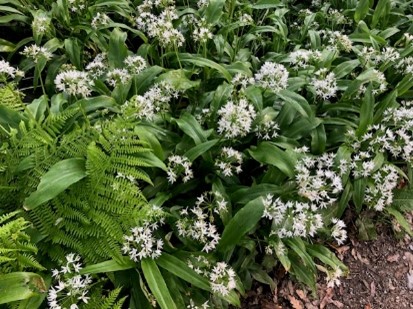
I have just spent a very happy week at Duloe Manor, a complex of self-catering holiday apartments and cottages near Looe in Cornwall. The main house was built in the 1690s for the Rectors of the local church. The whole complex is set in lush gardens of around three acres: a few mixed beds contained lovely combinations of saxifrages, irises and other familiar perennials while in less formal areas, swathes of wild garlic provided backdrops for beautiful pink campions as well as English bluebells in full bloom. In the car park several banks of pale yellow primroses remained stubbornly but delightfully in flower! Majestic rhododendrons provided splashes of magenta and purple.
I, too, have a comfy seat looking out on my garden where I spend many happy hours deciding what changes need to be made in my garden (there is always something).
I am currently enjoying watching my pots of bulbs grow and begin to flower. I posted a photo on Facebook of my Harmony irises and my friend in Norfolk (who I think was rather envious) suggested I had a microclimate in my garden. It is very sheltered and faces west so maybe I do.
I have just decided to empty my rather unsightly compost bin and replace it with a smaller, more discreet one. I therefore have a large pile of compost which I am in the process of shovelling around the garden. I am expecting a spectacular display later in the year!
My Clematis Armandii under the tree is budding nicely. I planted it some years ago and was disappointed last year that I had so few flowers on it. That was until I looked out from the upstairs window and discovered that my neighbours were enjoying a beautiful display! It had put all its energy into growing to a lighter spot in the garden next door!
I find this time of year quite difficult garden-wise, especially when the weather is mild, as it is at the moment. I am having to restrain myself from going wild with the secateurs and cutting everything back. I shall wait another month before giving my clematis, roses and salvia a good hair cut. I think it is also time to give the Hibiscus Syriacus Woodbridge a trim as it has grown rather tall and thin.
I hope other people will write about their views, as Kathy suggested.
As much as I love this perennial and have planted many clumps over the years, I find it struggles in my clay soil. My now, one-and-only plant, obviously needs more sun and perhaps lighter soil, as it has flowered perhaps only once this winter and that was on 23rd November, when I took the photograph below. But Margaret T’s winter irises have been really putting on a display, with her two clumps producing 2-3 flowers at a time, on and off since December. And these will carry on flowering well into March. I’ve seen them flowering profusely when nestled against sunny, front elevations, in poor soil. But in Margaret T’s garden, the soil is rich from regular additions of compost and manure and you can see by her photograph that she has healthy, plump plants.
On Saturday 11th February Jean and I spent a very pleasant day at RHS Wisley. This was the last day of the Iris and Cyclamen Show held in the Hilltop event hall.
The displays were beautiful. So uplifting to see so many spring colours after a long, cold winter. We were amazed at the variety in size and pattern of cyclamen leaves, all in perfect condition of course.
The Iris Fields of Hall Road, Wenhaston IP19 9HF were selling small pots of irises to which we both succumbed!
Catherine Horwood’s mention of Cedric Morris in her talk is a reminder of the close relationship between artists and their gardens. In 2016 The Royal Academy held a wonderful exhibition ‘Painting the Modern Garden, Monet to Matisse’, which devoted one room to Monet’s triptych of waterlilies. Many of us have had the pleasure of visiting his garden at Giverny, which is the subject of some of his most famous works of art.
Alfred Parsons (1847 – 1920) was an English artist who not only created his own garden, but designed for others. He provided the illustrations for many famous garden writers including Ellen Willmott (The Genus Rosa) and William Robinson (The Wild Garden). His friendship with Robinson led to him lending advice on the planting at Gravetye Manor.
Parsons had a wide mix of friends in both America and England, including John Singer Sargent and the novelist Henry James. Parsons’ paintings apparently mirrored the aspirations of Americans for an English garden and in 1899, when Henry James bought Lamb House in Rye, he invited Parsons to design the garden for him. It was here that he wrote some of his most acclaimed novels. Lamb House was much later bought by E.F. Benson and the view of the garden from the windows provided the inspiration for the Mapp and Lucia novels. In 2014, the BBC adapted these for a television series and used the garden at Lamb House for filming.
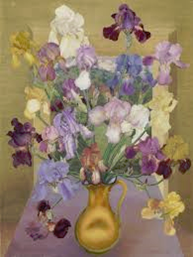
And so, to Cedric Morris. As well as painting portraits, still lifes and landscapes, Morris painted flowers extensively. In Higham Suffolk, he and his partner founded the East Anglia School of Art, but here Morris also indulged his passion for plants and, in particular, irises. He produced at least 90 named varieties and also exhibited at the Chelsea Flower Show. His gravestone reads ‘Cedric Morris Artist and Plantsman’.
I am often struck by how much a beautifully designed herbaceous border, the Long Border at Great Dixter for example, resembles a work of art.







 Charlton and Blackheath Amateur Horticultural Society