It was a pleasure to welcome back Dr David Marsh, garden historian, academic and former trustee of The Gardens Trust. The intriguing title of his talk was ‘The Great Geranium Robbery’, about an Old Bailey trial in 1795 following the theft of numerous expensive plants…
The scene:
Daniel Grimwood’s Nursery (formerly The Kensington Nursery) in West Kensington.
You may have spotted that the Charlton House Mulberry has just featured at Number 8 in the list of 20 Greatest Trees of Britain (the Telegraph) – what a well deserved honour!
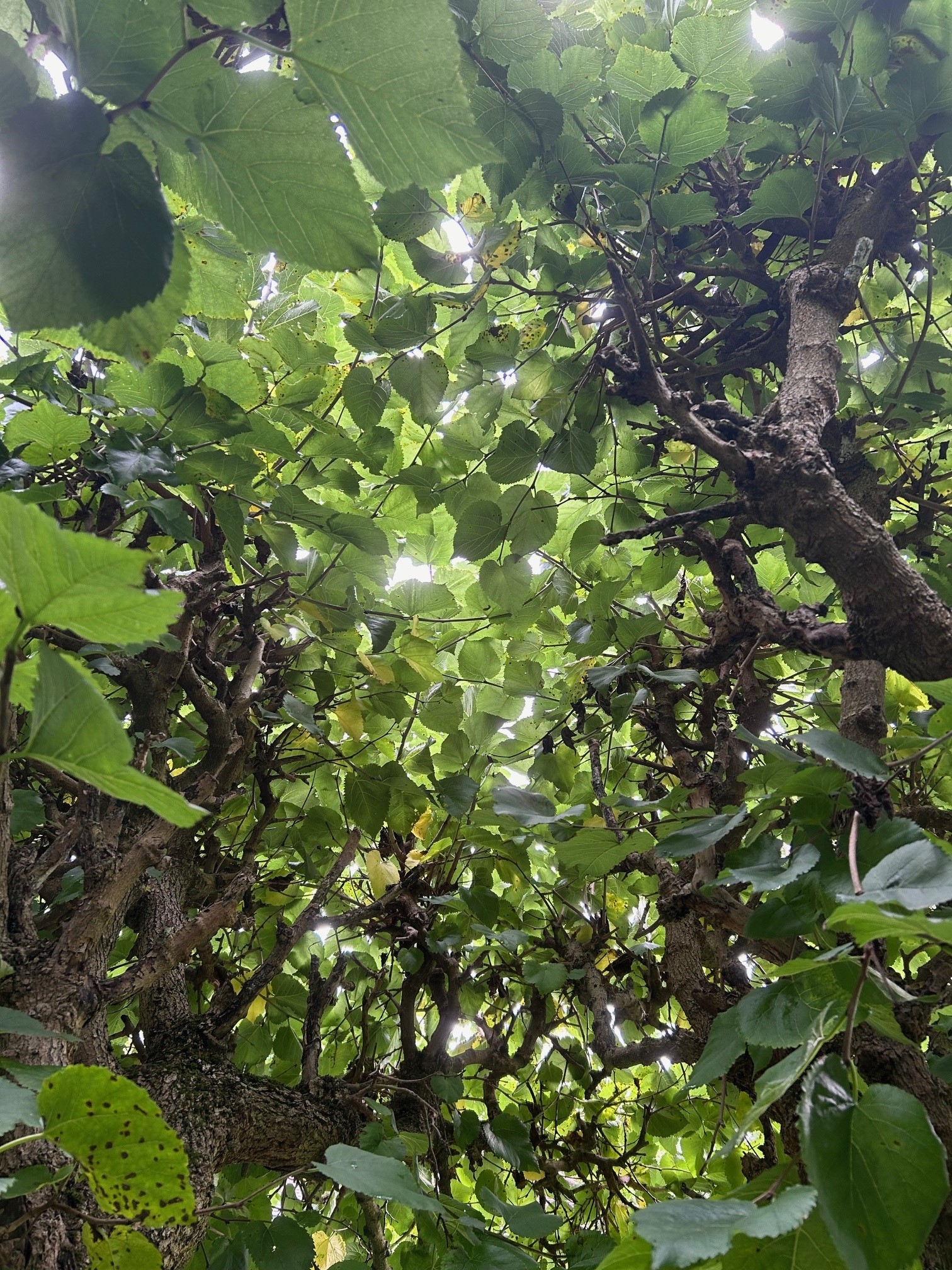
I confess to being a bit of a Mulberry tree fan, having planted one in our garden in Westcombe Park just over 35 years ago. Our tree was a favourite retreat for my kids when they were growing up since, like all Mulberries, it has a very climbable branch structure and wonderful leaf canopy. Even Jerry our Jack Russell can climb up it when he has the momentum to chase squirrels!
Morus nigra trunkGreen canopyJerry
Last year I bought my grandson a lovely children’s book about an old tree standing through the ages (What did the Tree See, by Charlotte Guillain) and reading it led me to ponder what our venerable Mulberry Tree at Charlton House might have been witness to over its 400 plus years?
The story would start in 1607, around the time the House was being built, when King James required landowners to purchase and plant 10,000 Mulberry trees between them, to start his ill-fated silk industry. When Sir Adam Newton bought the “Manor of Charlton”, it included six orchards, 260 acres of land, 100 acres of meadow, 200 acres of pasture and 200 acres of wood – so he certainly had space to please the King by planting a whole field of Mulberries. A pity that the wrong kind of trees were planted for silkworms and the climate was too cold for them to thrive. At Charlton House we know that “a few trees” remained by 1845 but our beautiful and venerable one is all that remains today.
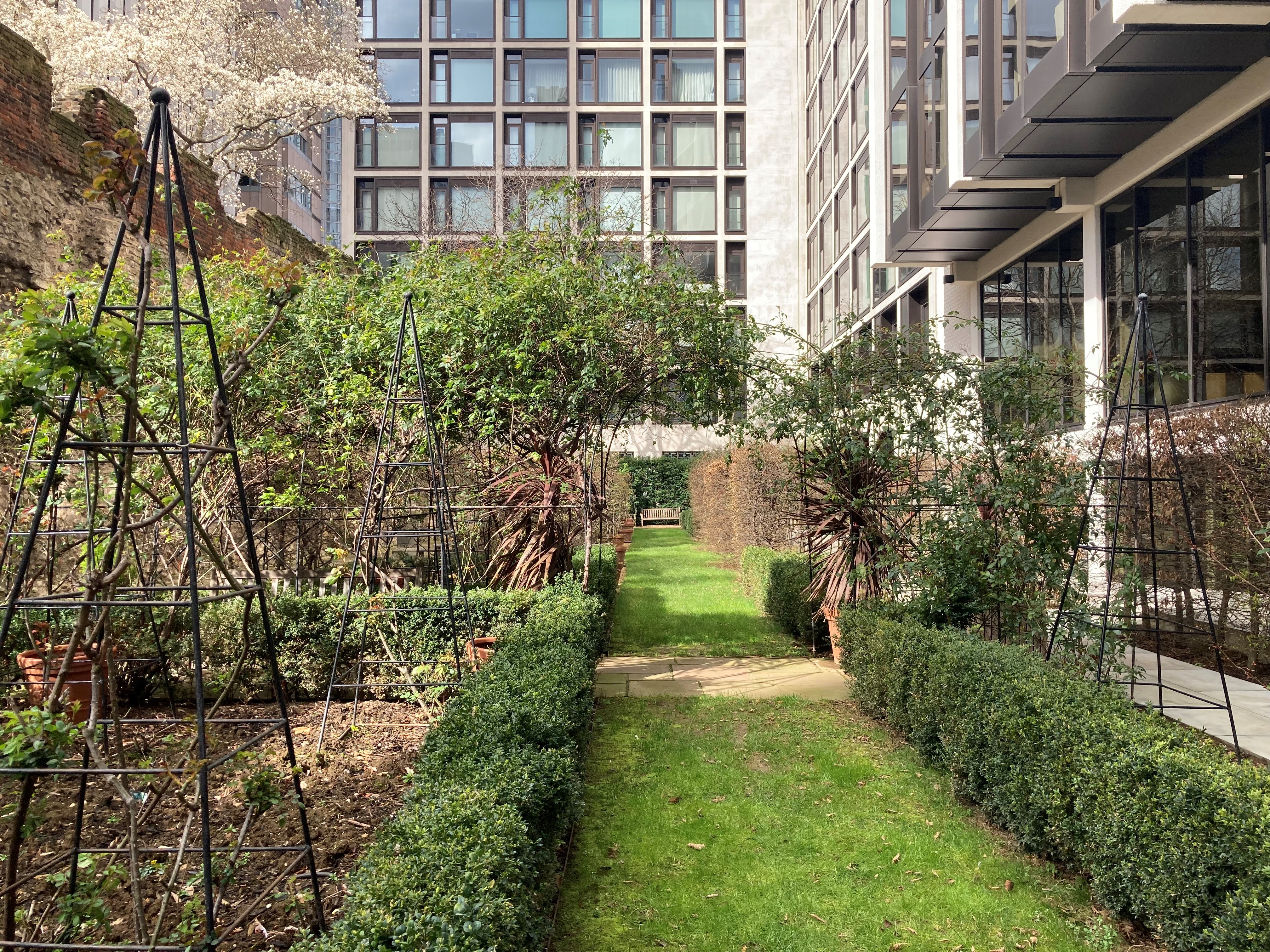
The City of London is a wonderful place to explore and is full of hidden- away gardens for us to access. We came upon this garden in early spring when we were meandering (slightly lost, really) towards the Barbican to visit the Conservatory.
The Garden Museum was created in 1977 in order to rescue from demolition the then abandoned church of St Mary’s at Lambeth, a church which now is restored and renewed: restored in the outer and inner structure of the church, and renewed as exhibition spaces on all matters related to the history of gardening, and to the history of the Tradescant family, father and son both named John, in turn each appointed Royal Gardener to the Stuarts and whose family tomb is within the grounds, fittingly in a garden that reflects their world-wide plant collecting.
The Tradescant family tomb though is overshadowed by that of William Bligh, the hero/villain of the Mutiny on the Bounty.
The visitor must tread over centuries-old gravestones set in the floor, and past memorials to some very late indeed Archbishops of Canterbury: St Mary-at-Lambeth was a popular resting place, right next door to Lambeth Palace.
The Museum has a permanent exhibition of the history of gardening in all aspects from grand estates to allotmenteering, from Gertrude Jekyll to Alan Titchmarsh. Art is of interest generally here, with currently a showing of Lucian Freud’s paintings of plants. The Museum has an archive/study room on garden design: visits for research are by appointment.
Vita Sackville-West wrote that “Of all fruits the pomegranate is surely one of the most romantic.” I would be willing to bet that most people walk through the Peace Garden gate at Charlton House without realising they have just passed under two “most romantic” pomegranate trees.
Pomegranates in the Peace Garden
When the Volunteer scheme started in 2020, these two trees were deeply entwined with ivy, choking them very UNromantically. I wish I had taken a photo of our volunteers, wrestling and chopping at the ivy around the base of the trees! It was one of the team’s early successes, as the next year the trees were covered in their startlingly bright orange flowers and looked very happy. We have yet to get the flowers to “set”, so no pomegranate fruits yet. But of course as gardeners, we live in hope.
People today garden for a whole host of reasons – as a hobby, a delight in horticulture generally, exercise, well-being and being out of doors, to grow their own produce – but, historically at least, gardening has also been seen as a highly moral activity.
By the end of the 19th century the garden was advocated as a way of keeping the working classes away from the public house, where they could be usefully engaged in a more wholesome and productive activity. William Hogarth’s cartoons of ‘Beer Street’ and ‘Gin Lane’ are visual reminders of the conditions which were a cause of concern.
Beer Street and Gin Lane (1751)
John Claudius Loudon (1783 – 1843) championed the creation of public parks to improve both the mental and physical health of working people, so that ‘the pale mechanic and exhausted factory operative might inhale the freshening breeze and some portion of recovered health’.[1] It was Joseph Strutt who picked up on these ideas and put Loudon’s vision into practice to create the Derby Arboretum in 1840. Strutt was very clear on the rationale behind this work: to wean people away from the ‘brutalising pleasures’ they might seek elsewhere and to offer them a new form of ‘rational enjoyment’. In Edinburgh recreation in a park was thought to be a solution for drunkenness and in the Midlands it was thought to lead to a decrease in crime rates.
‘In 1919 the Conservative MP for Chelmsford was reconciled to spending money on housing by the thought that good garden plots would ensure that when the man of the house got home at night “he will find not only a healthy family, but healthy occupation outside where they can go and work together as a family”’.[2] A well maintained garden was also viewed as an indication of a well maintained (and thus moral household). As late as the 1920s and 1930s inspectors were employed to visit the gardens of council estates to ensure that they were being kept tidy.
Vija
[1] Loudon, J.C. (1822) Encyclopaedia of Gardening.
[2] Floud, R. (2019) An Economic History of the English Garden, Penguin Books, p247.
Inspired by Melanie’s wonderful talk to members about the various Rothschild gardens, Sharon & I accompanied her on a trip to see the restoration project at Gunnersbury Park. We had our volunteer project at Charlton House & Gardens firmly in mind throughout the day, and were pleased to find parallels – albeit on a much grander scale there! Gunnersbury was bought by Ealing & Acton council in 1925 (Charlton was bought by Greenwich Council in the 1920s) and used as a public park in much the same way that Charlton Park has been.
In 2018 the “Large Mansion” was restored using Heritage Lottery and other funding and opened as a Museum housing the borough archive. Major parts of the park were included in the funding, the Orangery, lake and orchards for example. The Friends of Gunnersbury Park were instrumental in the restoration effort, and volunteers clearly play a large part in the day-to-day running.
The talk was given by Melanie Aspey, a CABAHS member who has been the Rothschild archivist for 28 years. Providing photographs and documentation from the Rothschild archives, she said the Rothschilds are best known for banking, their art collections, philanthropy and wine, but many of them have also had a keen interest in horticulture reaching back to Mayer Amschel Rothschild (1744-1812), the founder of the dynasty, who lived in the Frankfurt Jewish Ghetto.
After the defeat of Napoleon, thanks to their support for the allies, the Rothschild family was able to lobby for the retention of the right for the Jewish Community to buy real estate outside the ghetto. Mayer Amschel’s son, Amschel, considered that building a house would be too ostentatious, but a garden would better serve their needs. Instead he established a garden which he subsequently opened to visitors and for charitable purposes. He spent vast sums on plants, some of which (and Melanie showed one of the plant sale receipts from the archives) he imported from England. Later taken over by the Nazis and bombed by the allies, the garden fell into disrepair but parts have recently been renovated.
In a fit of New Year zeal, we started (note that I said ‘started’) a bit of a clear-up of what for want of a better word you might call ‘stuff’. Out of this stuff emerged some old family photographs, reminding me that I should organise them a bit better and finally get around to finding out more about the people featured in them, adding to sometimes unreliable family tales. Those with subscriptions to Ancestry or other genealogical databases will know immediately what’s coming: I was soon addicted.
What might this sorry story have to do with horticulture? Bear with me, please.
Amongst the stuff were box-loads of index cards recording research material that we had produced literally decades ago in pre-Google times. The purpose of the research was to compile a database of British and Irish Journalists – at least that task was accomplished and published!- and my Ancestry addiction offered the chance to do a bit of editing.
Here we reach the point of this post. Among the information gleaned from the records of the Society of Women Journalists at the British Library and other sources was a biographical sketch of Helen Colt, a fellow of the RHS. In the 1911 census Helen Ann Mary Colt, of 4 Priory Court Mansions, Mazenod Avenue, West Hampstead, gave her occupation as ‘jobbing gardener’. Indeed the project had already noted one of her appearances in print on the subject:
Woman’s Platform, interviewed on jobbing gardening as a career for women, March 1912.
On Thursday I joined a tour of Avery Hill Park with the Mottingham Horticultural Society, who had extended an invitation to CABAHS members. It was a beautiful, crisp, sunny afternoon and the park looked gorgeous. Our guide John, from the Friends of Avery Hill Park, told us about the history and prehistory of the park before leading us around the extensive area.
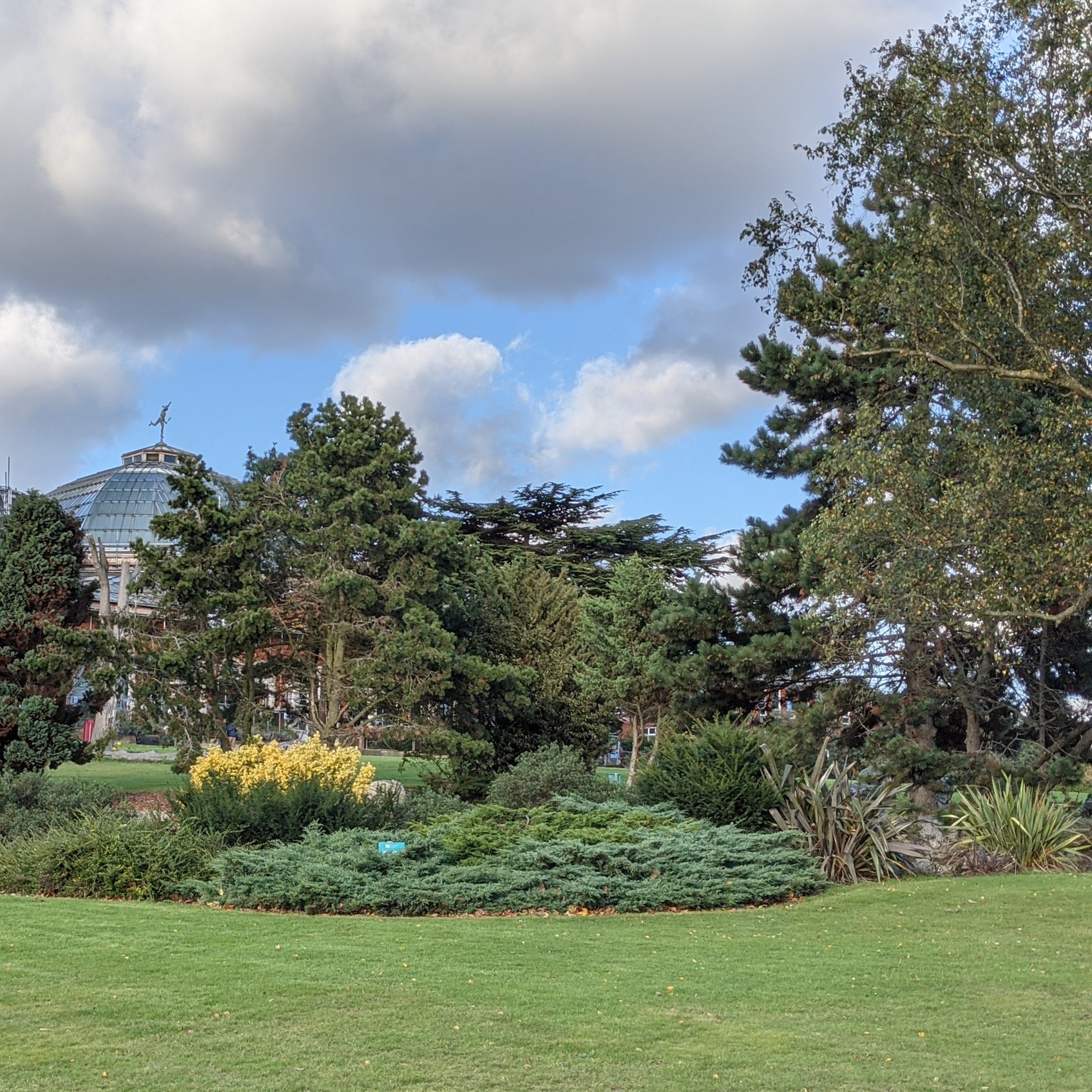
Autumn tree colour in Avery Hill ParkThe Avery Hill Winter Garden, viewed from the park
Some members may be familiar with the Winter Garden, a glasshouse currently undergoing renovation work (therefore closed) and about to pass from the hands of the University of Greenwich back to the local council. I look forward to seeing it after renovation is complete!
Recently cut meadow area and former hedgerow (with dozens of cross country runners!)
There are two main areas of the park, historically and now. The more manicured, grassed parkland associated with Avery Hill Mansion (which is currently being converted into a school), and former farmland, with field boundaries and drainage ditches. The Friends are working to make the latter areas more wildlife-friendly by negotiating a meadow-style mowing regime (ie: cutting only twice a year, removing the mowings once seed has dropped, and sowing wildflower seeds) with some mown paths. Even after just a year, it’s possible to see that the range of plant species is extensive. The increase in butterfly numbers and activity in summer 2021 was notable. It is hoped that a general increase in biodiversity will also encourage an increase in bat numbers, which have declined in recent years.
Looking toward Great Stony Acre – field boundary trees and drainage ditch
The former field boundaries are still visible, and what would have been hedgerow has grown into rows of trees and scrub, which is excellent for wildlife. A new mixed hedgerow has been planted where one had disappeared, and the drainage ditches have been cleared by volunteers. Another historical feature which lives on through the Friends is the old field names, such as Henley’s Meadow, Little Stony Acre, Grey’s Field and Great Stony Acre. The latter is being planted with native tree species – oak, hornbeam, birch, hawthorn and field maple. Around 1500 trees have been planted over a five year period, and there are plans for a natural drainage pond in the centre as the area is at the bottom of a slope, is mostly heavy clay and becomes very boggy in winter.
Young trees in Great Stony Acre
It was a very enjoyable afternoon and I appreciated the chance to visit the Park with a knowledgeable guide.
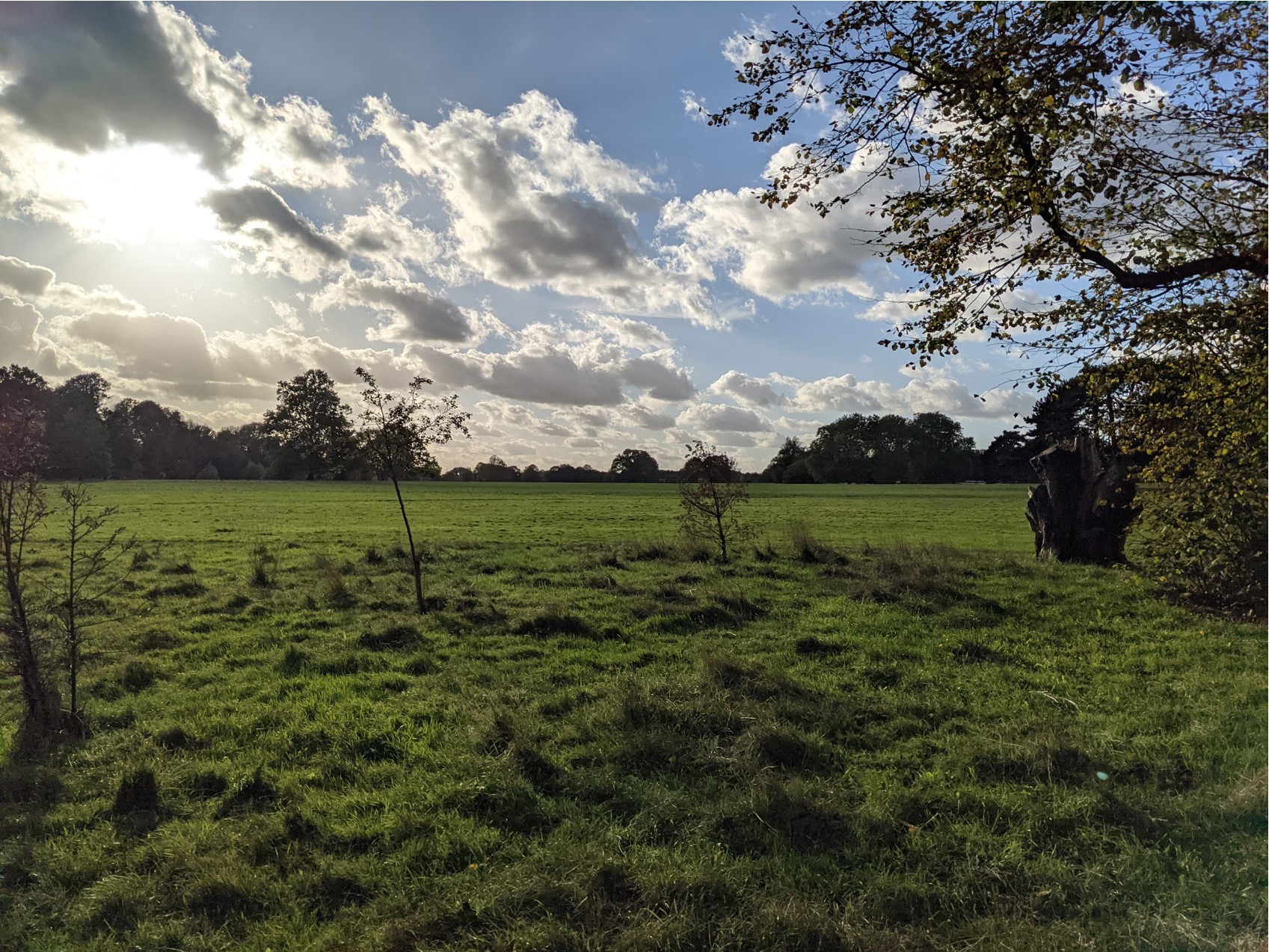
Looking across Avery Hill Park, late afternoon October 2021








 Charlton and Blackheath Amateur Horticultural Society
