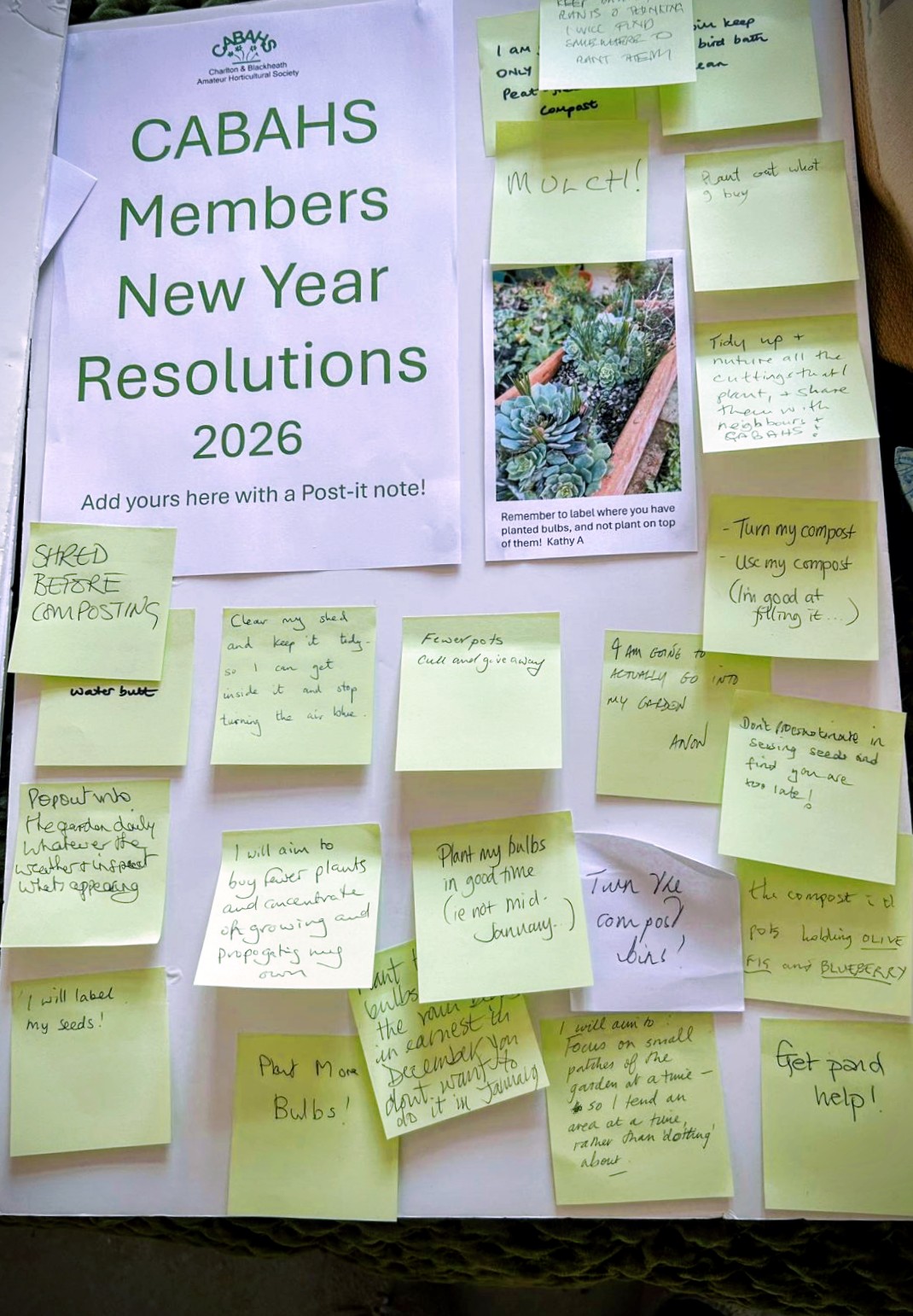
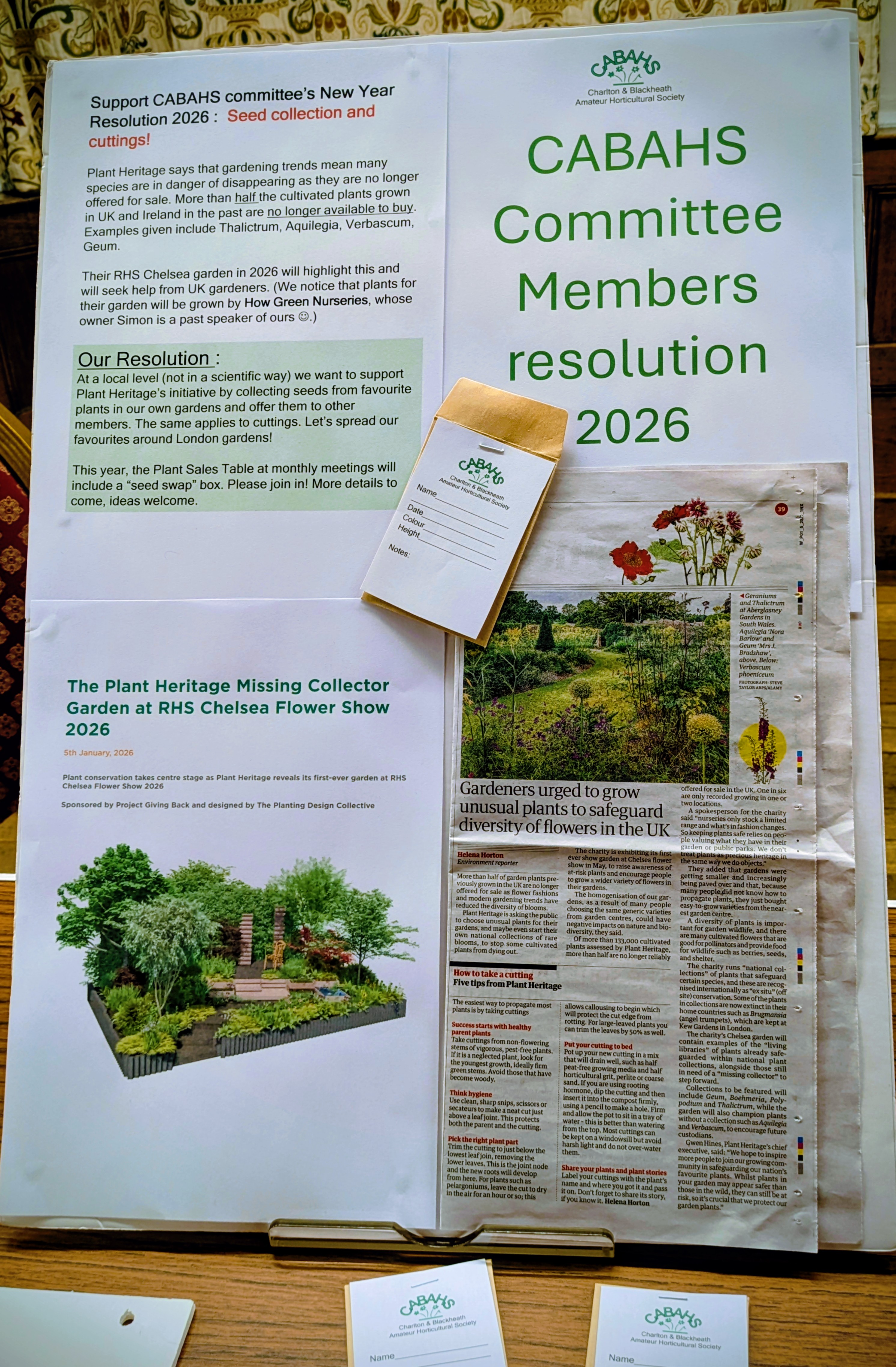
At our January meeting, members were asked to share – anonymously – their garden-related resolutions for the coming year. In addition, the CABAHS Committee put forward a suggestion for a CABAHS-wide resolution for 2026 (more on this in a separate post).
A fine, wise, and hopefully achievable range of planned actions were submitted, with members resolving to complete practical tasks that are easily put off or forgotten, right through to adjusting their attitudes / approaches to their gardens.
2. Any form of mulch is good on the soil now, in the form of your own homemade or bought compost, or even leaf mould if you have it. If you can’t face lightly forking it in, the worms will do it for you.
December is a month when the garden often takes a back seat, and when Pat deserves a break from helping you all with your garden jobs, so the CABAHS Committee have come up with a list of 10 Things that they are doing this month in, from, or for their gardens.
1. You can start planting tulips now, either in pots or in the ground. The deeper they are planted in the ground the more chance there is of them reappearing next year – but do protect them well from squirrels who love to eat them.
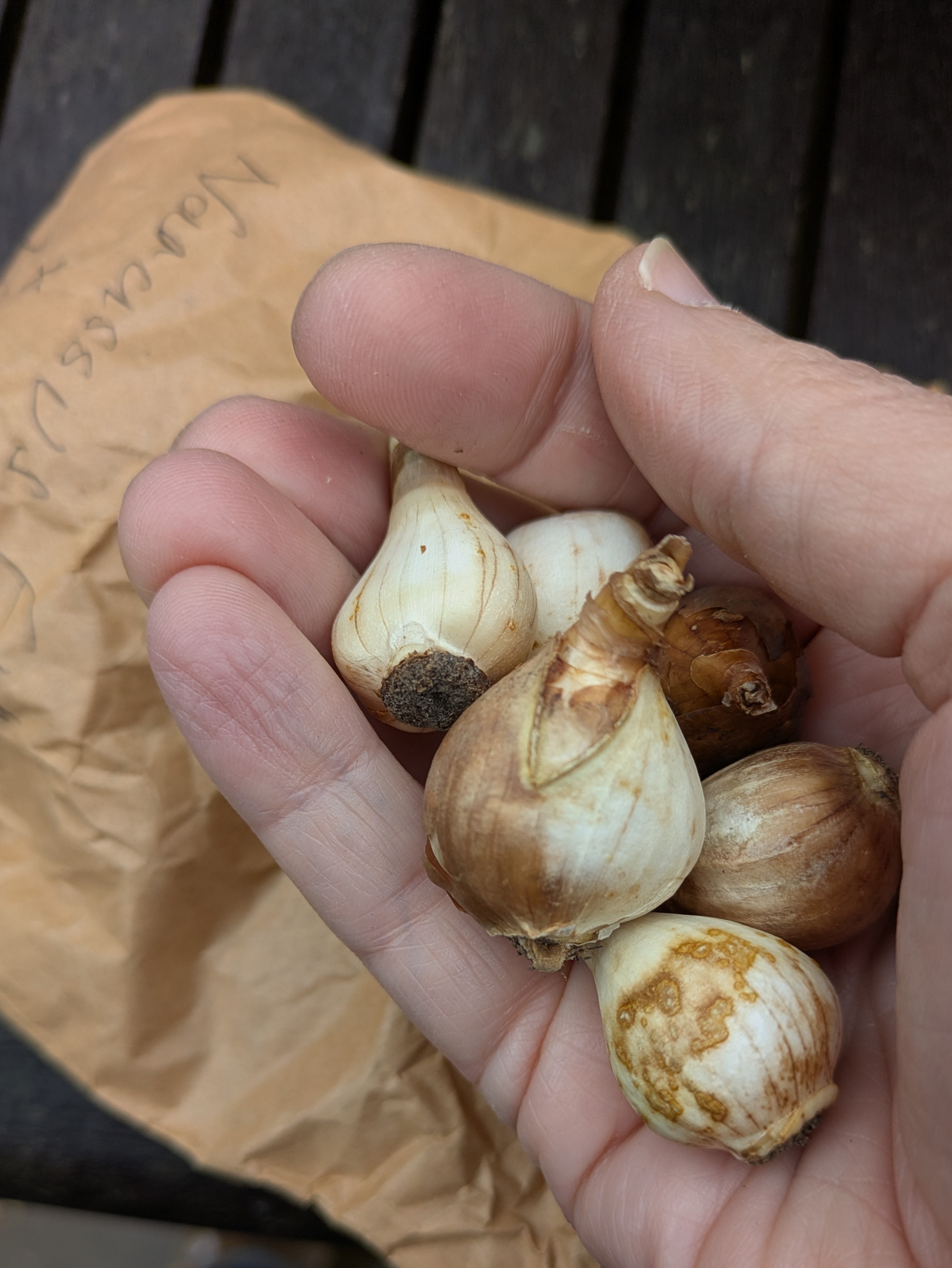
2. It’s not too late to plant Narcissus and other bulbs like Allium, but again as deep as you can if planting in the ground as squirrels do love to lunch on Allium.
1. Salvias are flowering their hearts out now but make sure you have some cuttings on stand by to cover any winter losses. And remember that quite a few are tender and will need winter protection in the colder months.
2. Last year I dug up my Dahlia tubers and potted them up once they had died down but lost quite a few despite keeping them frost free. So this time I will try leaving some in the ground and giving them a thick mulch. Of course, the problem then is trying to protect the new growth in spring from slugs and snails, so they’ll need keeping an eye on.
1. Pinch out sweet pea plants above the third leaf to make bushier plants and then, as the shoots grow, pinch out side shoots in the same way.
2. Sow hardy annuals now like Nigella, opium poppies and poached egg plants in any bit of empty ground you may have and mark them so you don’t forget where they are. Many of these are excellent for pollinators.
3. Prune hardy Fuchsias now to stimulate growth by cutting back to just above a healthy bud which will prevent them from getting too woody.
Young sweet pea plantsNigella seedlingsPruning hardy Fuchsia
4. Check Dahlia tubers for any growth and make sure they’re getting enough light by turning them round regularly towards the light.
28 Marsden Road SE15 4EE, Open Sunday to Thursday inclusive, 10.30 to 16.30. No charge
We are members of the London Wildlife Trust, which runs the Centre for Wildlife Gardening (CWG), but it was word-of-mouth from a volunteer at Christchurch Community Garden that made us aware. We visited on London Marathon Day, passing through a crowded Blackheath Station on our way to Peckham Rye Station.
Marsden Road itself is remarkable: its houses all along have designer ironwork gates & railings on wildlife themes, and each lamppost has a ‘squirrel’ high above. These, and the wildlife-themed iron gates to CWG, were designed by Heather Burrell: bollards at the entrance and within were designed by Antony Gormley: a gable-end has a large mural of a Goshawk.
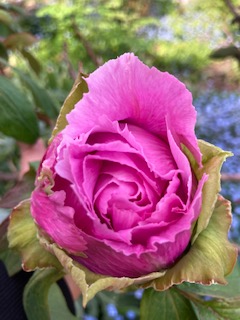
One morning in mid-April – the warmest of the month so far, I had the pleasure of visiting our ex-chairman, Jillian S, to see the display of her stunningly beautiful tree peony flowers. These are well established shrubs with one or two still in bud and the rest nearly finished flowering, apart from the 2-metre species Paeonia delavayi, which is covered in red flowers and buds.
Every gardener should possess at least one tree peony – just to experience their few weeks of fleeting beauty – and, of course, their very handsome and large foliage, which is an added bonus to every garden for many months of the year.
I noticed that Jillian’s tree peonies have or had far more buds than mine, which is about 20 years old. Why is that? Jillian tells me that she has always had a strict policy upon purchasing any plant, including the tree peonies, and that is to immediately repot the plant with one-third multi-purpose and two-thirds of soil from her own garden. Only when the roots have established themselves in the new soil mix does Jillian then plant them in her borders. This method ensures there are fewer plant losses as the roots get the chance to adjust slowly to the change of soil, with the outcome being much stronger and robust root systems and, ultimately, stronger and healthier plants. And, that is the best gardening tip I have ever received!
Jillian tells me that all her peony varieties (Paeonia x suffruticosa) arrived as ‘freebies’ during 2009 and 2011, as special offers advertised in one of our major newspapers. They would arrive in good condition: an 18” stem with two or three branches and a sturdy root system of approximately 9” in length. These would, after potting on, be left for around 9 months to 1-year before being planted into a bed. In springtime, from then on, when the soil is still moist, a mulch of homegrown compost is added around the base of the plants to retain the health of these specimens.
Over the years, Jillian has diligently and systematically recorded in notebooks all of her purchases. And in one of her notebooks she has found her notes on the exact dates the tree peonies arrived: 4th June 2009: Hai Huang Yao (yellow) and Huang Hu Huang Dao Jin (cerise with white splashes). 11th November 2009: Wu Long Peng Sheng (pink/red) and Honxia Hu Hong (pink). 23rd April 2011: Wedding Day.
Peonies prefer morning sun and dappled shade if possible and Jillian’s peonies are perfectly positioned, growing on the north side in the spring garden, some protected by the apple trees. Very little pruning is necessary but I notice that Jillian’s tree peonies are more elegant than my shrub, so a little judicious pruning on my part would not go amiss!
I, too, have a comfy seat looking out on my garden where I spend many happy hours deciding what changes need to be made in my garden (there is always something).
I am currently enjoying watching my pots of bulbs grow and begin to flower. I posted a photo on Facebook of my Harmony irises and my friend in Norfolk (who I think was rather envious) suggested I had a microclimate in my garden. It is very sheltered and faces west so maybe I do.
I have just decided to empty my rather unsightly compost bin and replace it with a smaller, more discreet one. I therefore have a large pile of compost which I am in the process of shovelling around the garden. I am expecting a spectacular display later in the year!
My Clematis Armandii under the tree is budding nicely. I planted it some years ago and was disappointed last year that I had so few flowers on it. That was until I looked out from the upstairs window and discovered that my neighbours were enjoying a beautiful display! It had put all its energy into growing to a lighter spot in the garden next door!
I find this time of year quite difficult garden-wise, especially when the weather is mild, as it is at the moment. I am having to restrain myself from going wild with the secateurs and cutting everything back. I shall wait another month before giving my clematis, roses and salvia a good hair cut. I think it is also time to give the Hibiscus Syriacus Woodbridge a trim as it has grown rather tall and thin.
I hope other people will write about their views, as Kathy suggested.
A few years ago I cleared out my greenhouse following the losses of the winter and dumped in my compost the remains of pelargoniums and other dead items. It’s always a little sad to lose much loved plants which have given you their best. I then had some fun ordering new plants to replace the old ones (and some others!). A couple of weeks later, I found several of my ‘dead’ pelargoniums lying in the compost and sprouting new shoots from the roots. Of course, I swiftly took them out and potted them up to achieve lovely healthy plants. I am now a little less impatient to discard anything that looks dead.






 Charlton and Blackheath Amateur Horticultural Society