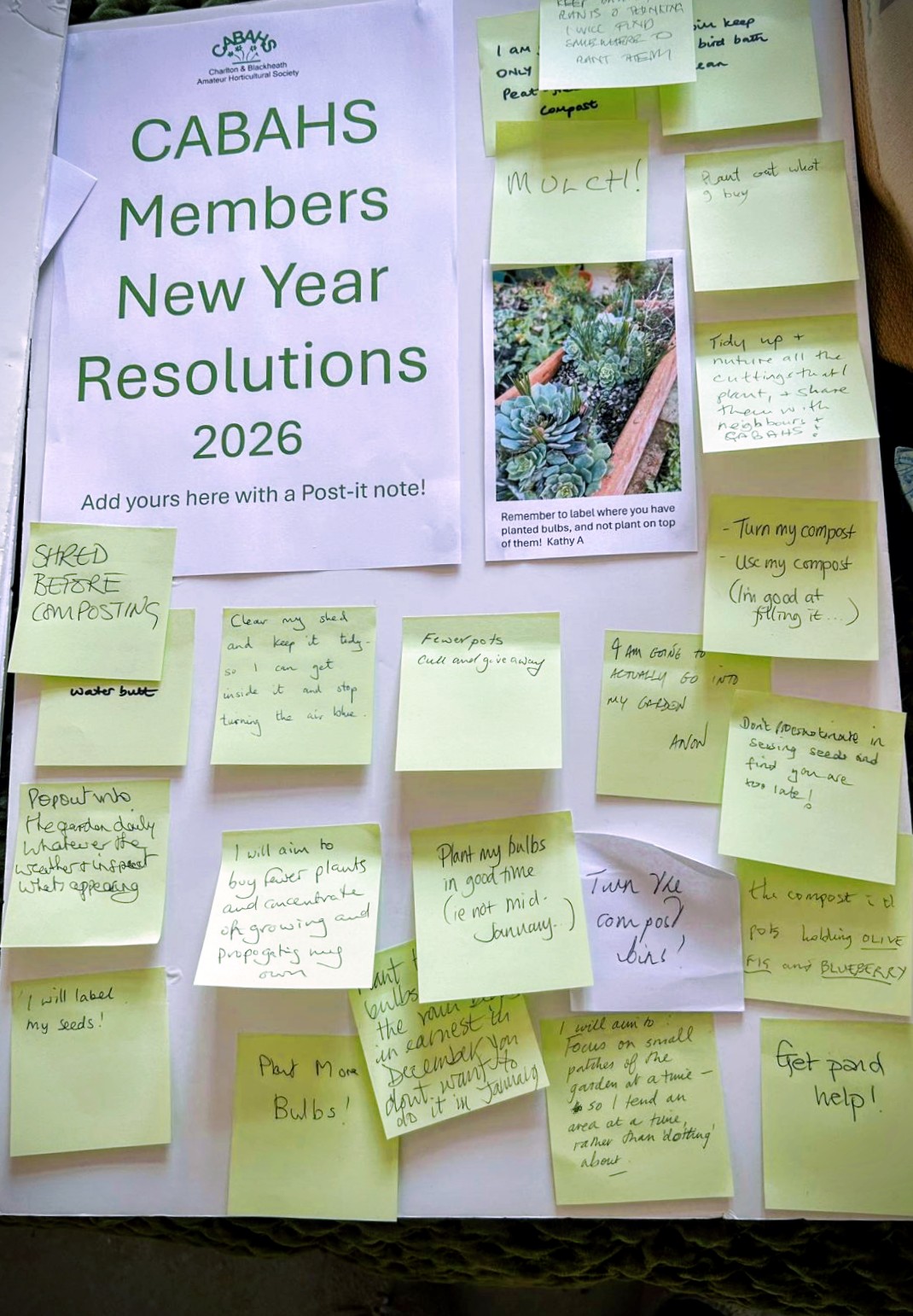
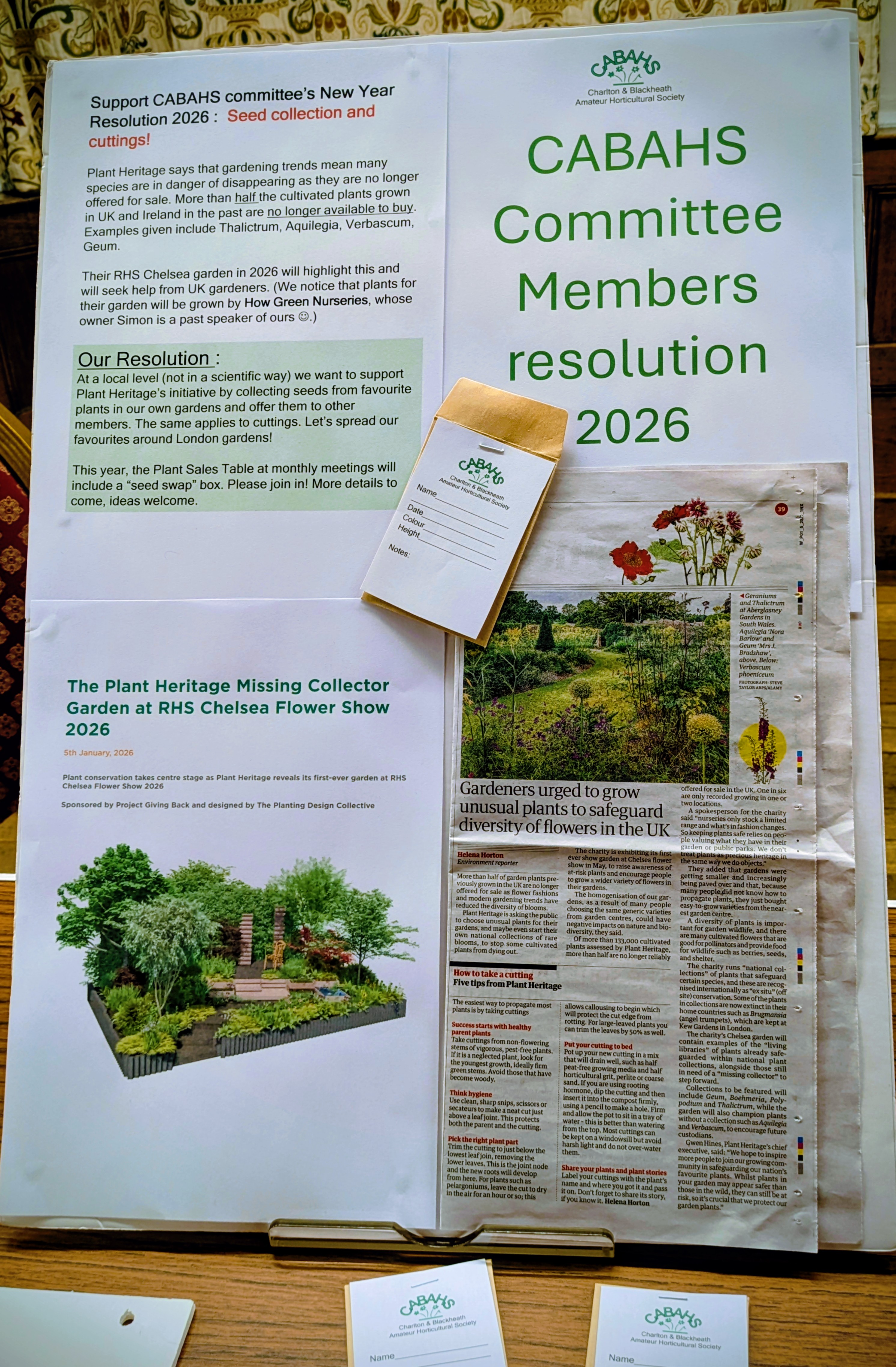
At our January meeting, members were asked to share – anonymously – their garden-related resolutions for the coming year. In addition, the CABAHS Committee put forward a suggestion for a CABAHS-wide resolution for 2026 (more on this in a separate post).
A fine, wise, and hopefully achievable range of planned actions were submitted, with members resolving to complete practical tasks that are easily put off or forgotten, right through to adjusting their attitudes / approaches to their gardens.
As we come up to Christmas and the end of 2025, this is a great time to look back at how the ‘Old Pond Garden’ (OPG) project has fared this year.
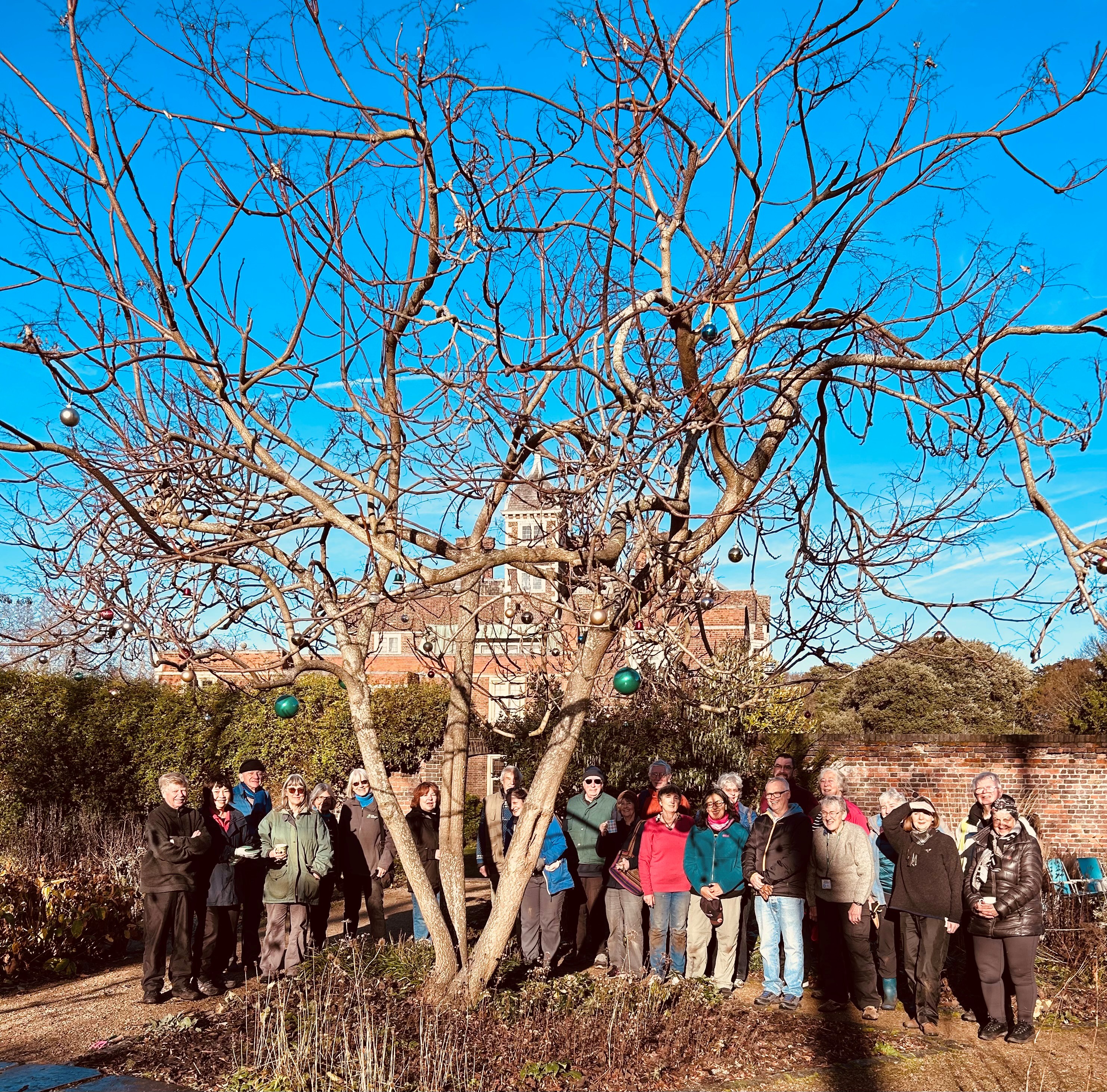
Tree of Heaven, Ailanthus altissima, dressed up for Christmas (plus 27 garden volunteers!)
Of course, it’s not just the ‘Old Pond Garden’ project any longer, as volunteer work now covers the whole estate, but we are still fond of the OPG tag. Since April, the Garden Volunteer scheme has been run by Royal Greenwich Heritage Trust (RGHT), however considering 80% of volunteers are also CABAHS members, it’s fair to say we are still very interested and still very involved.
Sharon has taken on the crucial role of Volunteer Lead for RGHT and works with Head Gardener Jason to make sure everything runs smoothly. She posts lovely updates on the garden team’s WhatsApp after every session, keeping us all on track, and sends a report off to RGHT every month.
Here are some highlights picked from Sharon’s reports of the past few months, I make no apology that this is a rather long post – we have done a lot!
December is a month when the garden often takes a back seat, and when Pat deserves a break from helping you all with your garden jobs, so the CABAHS Committee have come up with a list of 10 Things that they are doing this month in, from, or for their gardens.
1. You can start planting tulips now, either in pots or in the ground. The deeper they are planted in the ground the more chance there is of them reappearing next year – but do protect them well from squirrels who love to eat them.
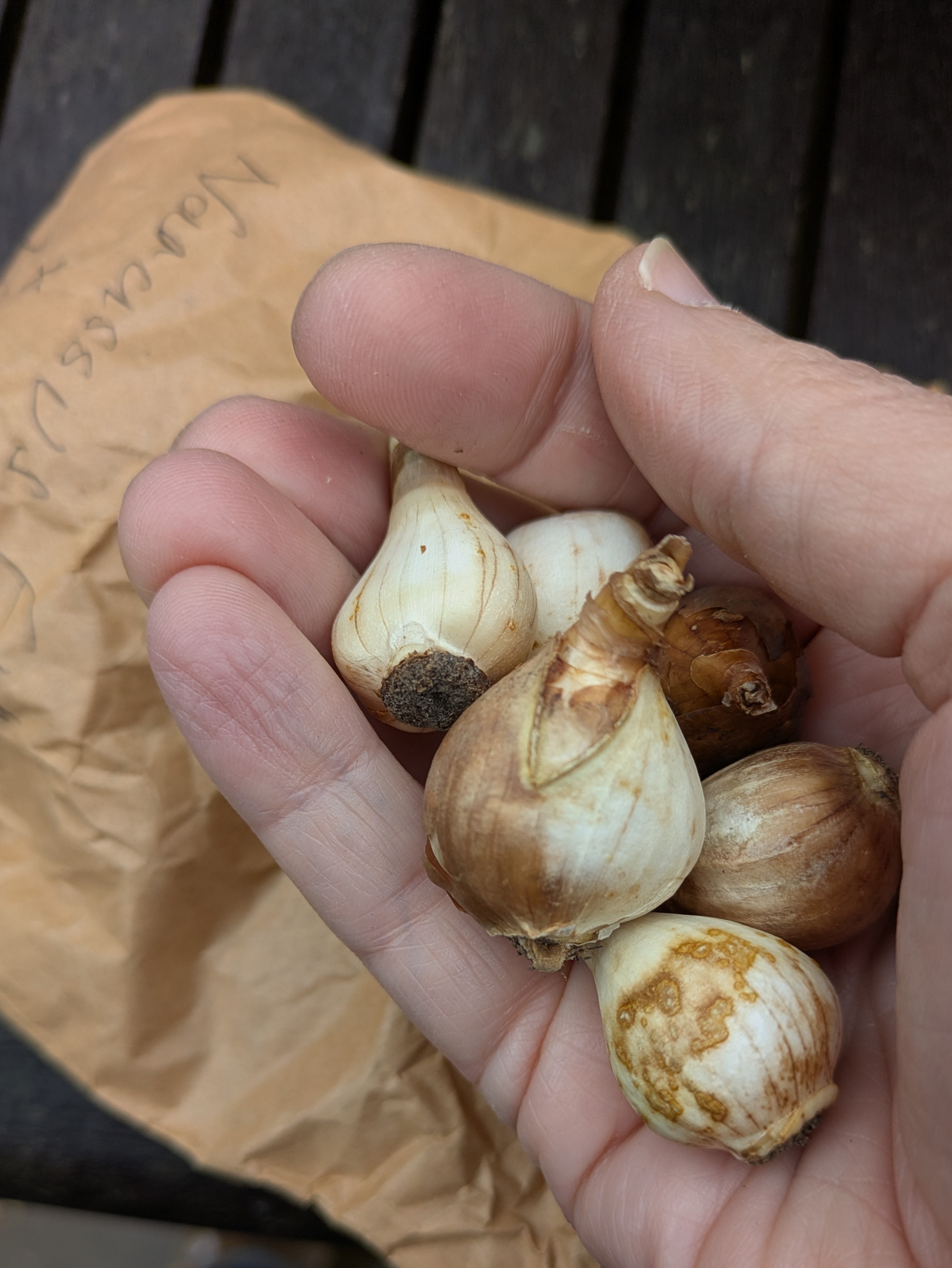
2. It’s not too late to plant Narcissus and other bulbs like Allium, but again as deep as you can if planting in the ground as squirrels do love to lunch on Allium.
Following on from a talk given in October 2024 by Dr Tim Ingram about his family run garden – Copton Ash – he returned for a more detailed presentation about the bulbs grown there. As he was not well that evening, his wife Gillian gallantly stepped up at the last moment to deliver the talk.
A wealth of bulbs have now been planted at Copton Ash, in beds, under trees and also allowed to naturalise in long grass. In particular a circular sunny gravelly bed was highlighted. The planting was at first inspired by the Lime Walk at Sissinghurst Castle which is very much a spring show of narcissus, tulips, primroses, anemones, scillas, violets and erythroniums. Tim has continuously added to and altered the planting in the circular bed so that there is now interest throughout the year.
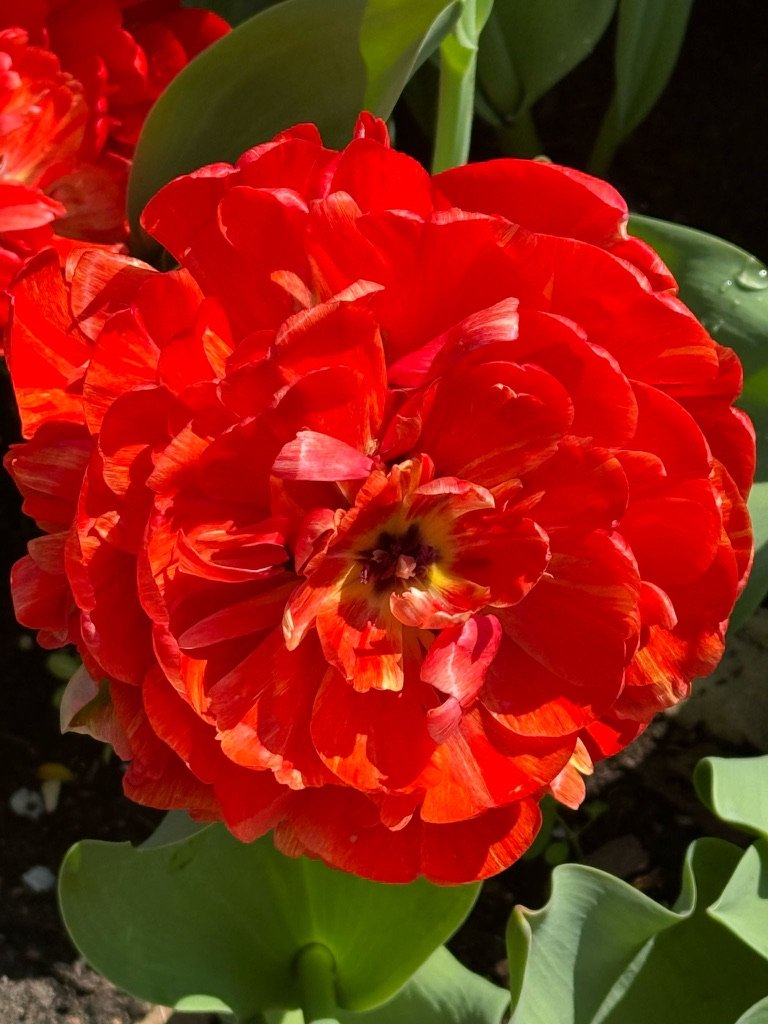
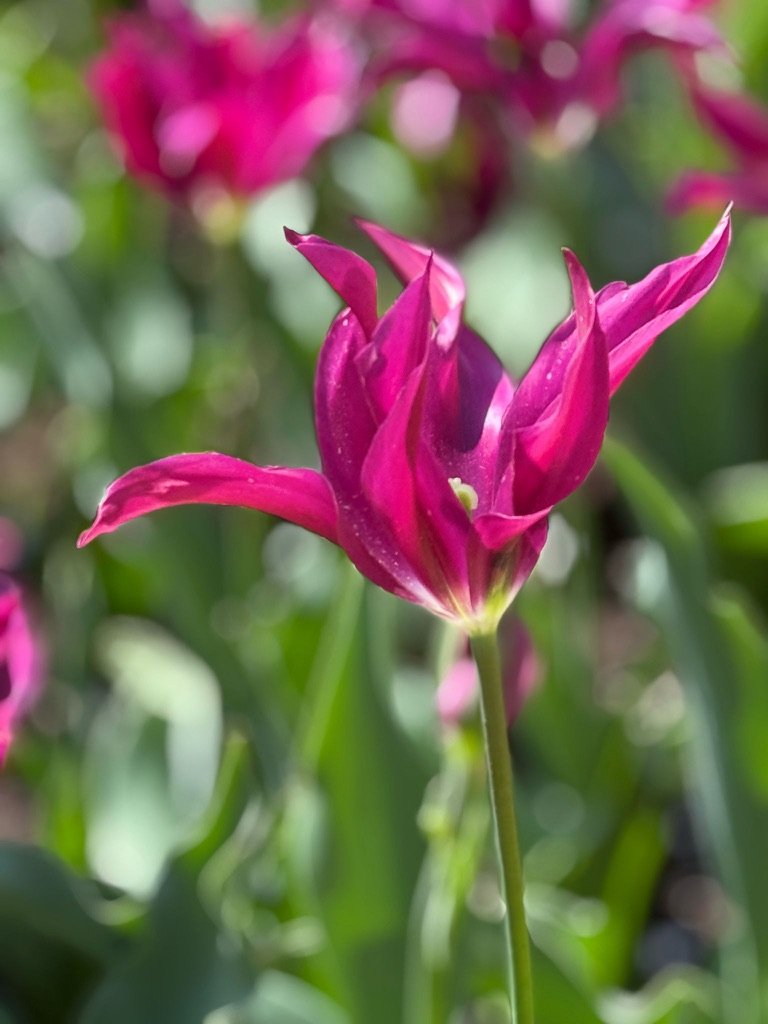
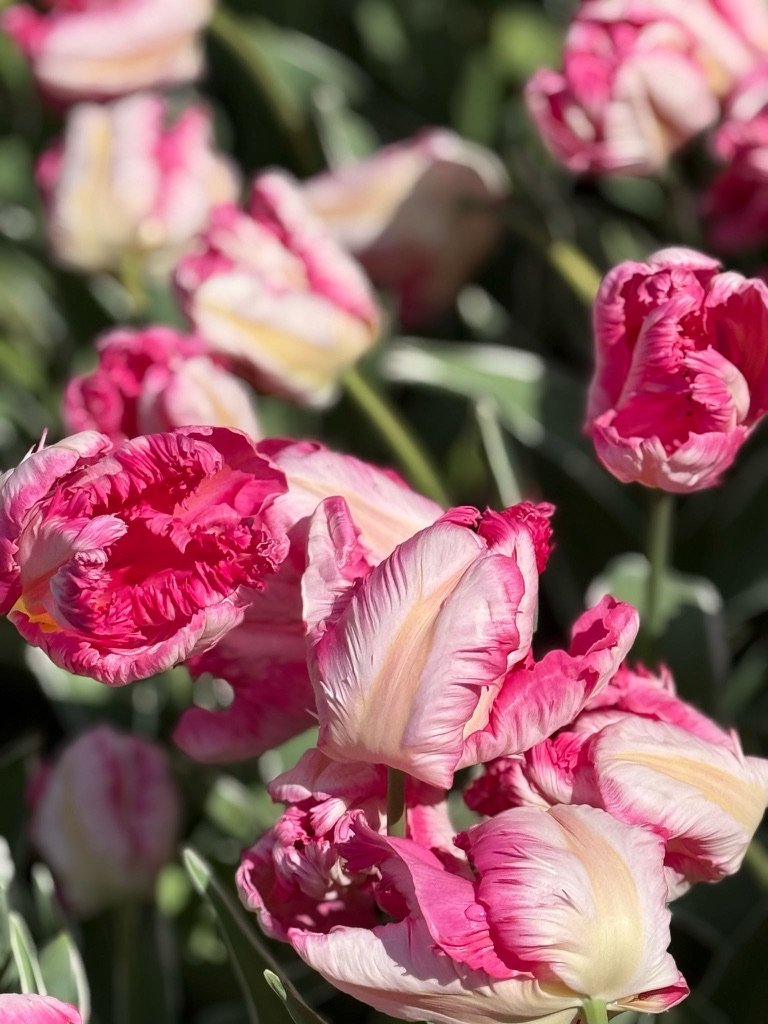
I returned to Keukenhof for a brief visit again this year. Transport in the Netherlands makes this a very easy trip and it is well worth making a stopover in Haarlem, which is a lovely town. I have little to add to the descriptions of my previous visits (April 2022, April 2023) so have just included a selection of photos which lovers of colour and tulips might enjoy!
Time to pot up those Dahlia tubers in 3 litre pots, making sure the tubers have an ‘eye’ which will shoot. Cover in compost, allowing the stem to rest at the surface, then label and water and keep somewhere reasonably light and frost free (greenhouse or windowsill) until they start growing.
Potting up dahlias
2. Now is the time I start sowing sweetpeas: five seeds to a 3 inch pot and keep on a light windowsill or greenhouse until they germinate. You can try sowing directly into the soil which I think works well for some.
Led by members of the garden team, the Behind the Scenes tours of Great Dixter provide an opportunity to explore the garden and meadows to examine the plants which are putting on a display at particular times of the year, offering an insight into the work that makes this happen. Limited to a maximum of 25 people, they allow visitors to have a good view of the plants.
A tour of the gardens in February was always going to be a little hit and miss in terms of the weather, but we were fortunate enough to arrive just as the rain stopped, so were able to enjoy the tour without getting soaked through!
As we enter through the front meadow, the area is full of Crocus tommasinianus, Crocus flavus and various forms of Crocus chrysanthus. Of course there are snowdrops everywhere. Our guides introduced us to the wide range that are cultivated here, from the common (but no less lovely) Galanthus nivalis, to G. Atkinsii and G. S. Arnott which are all doing fabulously well, as well as the less common G. Diggory and G. Washfield Colesbourne. We all peered at the diminutive G. Wendy’s Gold in a corner, sheltered by a wall and still tiny enough that if it wasn’t pointed out, you might walk past it! Some of the differences between the types are so small: those with an upturned tepal and look like little helicopters, while G. Diggory is plump and round.













 Charlton and Blackheath Amateur Horticultural Society