In his book The Flower Yard, Arthur Parkinson writes lovingly about his grandmother Min and her gardening practices, typical, he writes, of an older generation of gardeners. He describes the kinds of plots tended by Min and her neighbours and how ‘there was no acceptance of insect life, as proved by the cupboard of death in the garage, its shelves packed with poison, weed killers and bug spray’[1].
My Mother’s death bequeathed to me not only her gardening tools, but a similar shelf’s worth of gardening aids. I have very vivid memories of the shed she and my Father had in their garden, the tools neatly lined up and clean, sweet jars ready for pickled vegetables, saved seed in envelopes and plant labels ready to be re-used. But alongside all this were also the toxins.
And it is not only a younger generation of gardeners who believe in far more environmentally friendly gardening practices. In a recent online talk given by Fergus Garrett, he argued that ‘gardening and ecology have to come closer together’ and devoted one whole lecture to how gardening at Great Dixter has become much more sustainable in recent years and delighting in the huge quantity of species that the gardens are home to.
Driving somewhere in the 1970s meant cleaning the windscreen and headlights of bugs on arrival home. That no longer happens and is a sure indication of how much insect life has been destroyed in a very short space of time.
Vija
[1] Parkinson, A. The Flower Yard (2021) Kyle Books p.119.
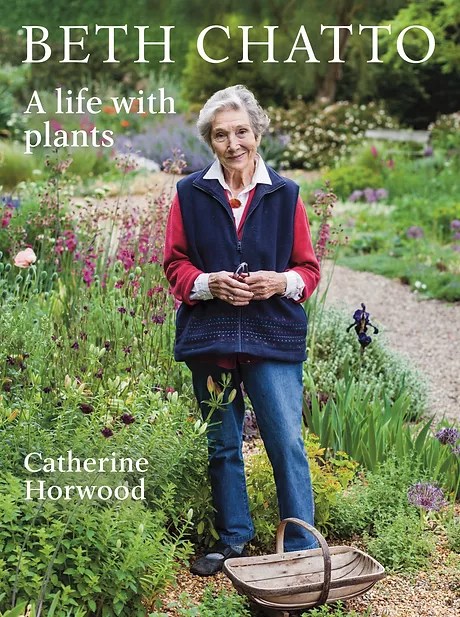
Many of us who are avid and long-time fans of Beth Chatto’s garden and her Unusual Plants Nursery will always remember that she won 10 consecutive Gold Medals at the Chelsea flower show. Her legacy is a garden she created which is unlike any other in the UK and abroad: it is unique.
Dr Catherine Horwood, Beth Chatto’s authorised biographer, introduced Beth Chatto to members and guests via last Monday evening’s Zoom meeting.
The talk was about Beth Chatto’s personal life and the influences that led to the garden’s creation. We learned that she happily gardened alongside her parents and had her own garden patch of cottage garden flowers. And we know that her hobby as a flower arranger as a young woman hugely influenced her interest in plant forms, textures and colours.
Dr Horwood described Beth Chatto as ‘tough’ and ‘steely’, and she must have been extremely determined from a young age, as she trained as a teacher during WW2, instead of taking the usual route of joining the Forces. An advantageous marriage to a fruit farmer, Andrew Chatto, with a life-long interest in plant ecology, set the stage for the purchase of land at Elmstead Market and the garden that followed.
But why did Beth Chatto design the garden the way she did? We know she was influenced by the terrain and various soil conditions, in addition to a natural spring at the lower level. How did her design of a ‘necklace of ponds’ separated by very narrow water channels come about? We know she was influenced by her friend and mentor, Cedric Morris in those early days and Beth Chatto acknowledges the huge debt to her husband at the start of her book, ‘The Dry Garden’, in which she states: “Without Andrew neither my garden nor a book would have been possible”.
Anna
Dr Catherine Horwood is an English journalist, author and social historian who has written extensively on horticulture and garden design and is the authorised biographer of Beth Chatto. A keen gardener for over thirty years, Catherine has created three gardens that have been open through the National Gardens Scheme and was for many years an organiser for the NGS. Her Facebook page gives you links to her other work on women gardeners, growing houseplants and you can check out her blog on growing vegetables. Her book on Beth Chatto won European Garden Book of the Year in 2020.
I hadn’t really thought about a New Year’s resolution for 2021, apart from the one that most of us have in the forefront of our minds at the moment: test negative, stay positive. (Sent to me in a Christmas card by a friend). But as we get closer to the end of January, to move forward into the year without one seems a bit neglectful.
I was therefore interested to read about the drive to encourage people to save seed and to encourage seed saving communities to develop. One of the few upsides of the lockdowns over the past year has been a huge boost in demand for seed. The argument is that this “grow your own” revolution re-diversifies seed crops and provides more security for not only our seed supplies, but food in general.
Josie Cowgill, one of the women who works with the Stroud Community Seed Bank in Gloucestershire sums up the impact of seed-saving in the context of 2020: “It’s difficult times we are living in. We have got a pandemic, we’ve got climate change, we’ve got biodiversity loss, habitat loss and economic collapse as well. It might feel quite small, just saving beans and growing your own food, but actually I think it is really fundamental. By doing something infinitesimally small like this tiny little gesture in a tiny little group, in a tiny little country somewhere, you are working towards something that makes you feel more hopeful. It’s a positive step. I’m not saying this is a magic wand or a cure-all, but it’s a positive step.”
Former ‘Bake Off’ winner Nancy Birtwhistle claims we have been ‘brainwashed’ into believing we need harsh chemicals to clean our homes. In an interview with her, what caught my attention was the amount of plant-based materials she used. It sounds miraculous, but she swears by ivy as a laundry detergent (about 60g, cut up and put in a muslin bag, then put in the drum). “It excites me so much; my husband thinks I’m crackers. I knew in the depths of my memory something about ivy and saponin [a natural foaming detergent], so I Googled it. Conkers have it as well.” (Although we should remember that ivy can be a skin irritant for some people.) In the autumn, she collects conkers and boils them up to create a creamy laundry liquid. (Nancy Birtwhistle’s book Clean & Green is published on 21 January by Pan Macmillan £12.99).I’m prepared to give this one a try, but have visions of a ‘green’ wash in a way I did not intend.
Beginning 2021 on a philosophical note – Voltaire said that it is necessary to cultivate your garden. Andrew Marvell said that green thoughts come from any green shade. More recently, Marc Hamer in his latest book ‘Seed to Dust’ uses his cultivation of someone else’s garden as a catalyst for a range of philosophical meditations. His chapters begin with a gardening task but lead onto thoughts about life itself and his part in it.
I was reminded of ‘Plot 29’, Allan Jenkins’ book about the healing power of gardening, in which he gives an often heartbreaking portrayal of the violence and neglect of children, growing into an adult who seeks solace in tending a London allotment.
In their book ‘The Meaning of Gardens’ , Mark Francis and Randolph Hester argue that gardens have meanings and go on to explore six categories of meaning: faith, power, ordering, cultural expression, personal expression and healing, each of which can operate at a social or an individual level. Jane Brown’s wonderful book ‘The Pursuit of Paradise’ aptly sums up the meaning of gardens for many of us: the desire to create something which may be not only useful, but a pleasure to be in.
One of my presents this Christmas was a fun book called “How to eat your Christmas Tree” by Julia Georgallis. As you would expect for a book with such a title, there are some bonkers ideas in it – but there is a serious message behind it and some quite intriguing recipes too.
The statistics are quite sobering: the author calculates that if we DIDN’T cut down one years worth of Christmas trees, the carbon emissions saved would be the equivalent of banning all global air travel traffic for a year, or taking all the cars in the United Kingdom off the road for the next five years.
On a much lighter note, here are a couple of her recipes:
Christmas Tree Tea!
Apparently pine, fir and spruce contain a lot of vitamin C, although pine produces quite a weak tea. If you have a go, make sure you wash all the needles thoroughly. (And never use Yew, obviously.)
Ingredients: A handful of pine, fir or spruce needles / Juice of a lemon / 30ml (1fl oz or 2 Tbsp) Honey
Method: Brew the needles in a teapot for 6 minutes. Add a dash of lemon juice and 2 teaspoons of honey to each cup. Pour over the brewed tree tea and serve.
Christmas Tree Cordial
This tastes a bit like grapefruit juice according to the author!
Ingredients: Juice of 10 lemons, zest of 4 / 2 litres water / 700g caster sugar / 400g spruce and/or fir needles (you can also use some of the branches for flavour)
Method: Sterilise a 2l glass bottle. Bring the ingredients to the boil over medium-high heat, turn down low and simmer for 2 hours. Strain through a fine mesh strainer, a few times, to make sure no needles are left and pour into the sterilised bottle. Keeps for 2 weeks in the fridge.
Christmas Tree Mimosa
Ingredients: 70 ml Christmas tree cordial (above)/ 140 ml prosecco / Ice cubes and lemon
Method: Combine in a cocktail shaker, pour into a cold glass and serve!
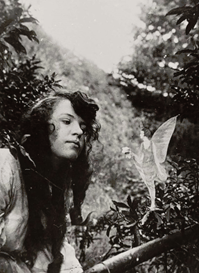
Like Francis Griffiths and Elsie Wright, as a child I believed there were fairies at the bottom of my garden. Unlike Francis and Elsie, I didn’t take this any further. The story of the Cottingley Fairies went on to become one of the greatest hoaxes of the twentieth century.
When Elsie’s mother showed the photographs to the local Theosophical Society, it set in motion a chain of events that led Sir Arthur Conan Doyle to conclude that the photographs were authentic.
Then in 1920, when Conan Doyle wrote an article on fairy life, fairy fever gripped the nation.
But there are other reasons to go to the bottom of your garden!
In one of the December entries in his book The Ivington Diaries, Monty Don writes that, in order to feed his chickens, he has to walk right to the end of the garden and back, ‘which means that whatever the weather … I am obliged to have a good look at things’. There is no doubt that, in the depths of winter, having to get from one end of your garden is quite an education. You can make all kind of assessments in terms of use of space and structure, when everything is so bare.
And there are, of course, additional benefits. The scent of the Viburnum bodnantense at the end of my garden is astonishing. It knocks me out every time. Perhaps even more so in winter when there is less competition. I think I should have it closer to the house, or perhaps I should get another one.
But I do like the idea of a little cluster of fairies whispering somewhere under the still green leaves of my nasturtiums at the bottom of my garden!
As she sought to improve her horticultural knowledge, Jane Loudon had found the gardening manuals of the day were targeted at those who already had a solid level of horticultural understanding – there were no entry-level manuals, for which she saw a need and potential interest and so began to write them herself. She set to writing them as she herself learned: Instructions in Gardening for Ladies; The Ladies’ Flower Garden; The Ladies’ Companion to the Flower Garden; Botany for Ladies; The Lady’s Magazine of Gardening. These became standard books of reference, and attained a large circulation, making gardening an accessible pastime for women, who were often excluded from planting practices.
Like Mary Wollstonecraft, another keen reformer, Jane Loudon was acutely aware of her position. Mary Poovey’s book, The Proper Lady and the Woman Writer (1984) and Alexis Easeley’s First Person Anonymous (2004) explore the challenges female authors faced in a late eighteenth and early nineteenth century society which emphasised the proprieties of the Proper Lady and the accommodations which women writers made. They also point out why many prominent female writers chose to publish anonymously, as it provided effective cover for exploring a variety of conventionally ‘masculine’ issues’.
Despite its associations with virtuous endeavour and the home, the garden also provided opportunities for women to negotiate between domestic space and the larger world. Jane Loudon was not alone in publishing for women, although most focused on botany – a far less ‘practical’ activity than gardening. And it is clear on reading Jane Loudon’s work, that she is actually encouraging women to get outside in the garden and to engage in some gardening activity – the reader is advised on how best to dig, the most suitable types of implement, as well as on soil quality, compost and plants themselves. Her work is encyclopaedic. Not quite advocating the throwing away of dresses, she treads a careful line between decorum, education and reform. For many years she has languished in the shadow of her husband, but her work deserves to be read on its own merits and for the contribution it makes to the study of the history of women in the garden.
For anyone interested in reading a little more about Jane Loudon, Bea Howe’s book, ‘Lady With Green Fingers’ is a very readable account of her life. Bea Howe herself ( a ‘fringe ‘member of the Bloomsbury Group) was born in Chislehurst.
I have recently finished reading Sarah Bilston’s book ‘The Promise of the Suburbs’. This is a very readable study of the history and development of the suburbs and their representation in literature. Rather than being the incredibly boring places often demonised in popular culture and variously vilified as boring, conventional and unimaginative (Bilston’s introductory chapter is titled ‘The “Horror” of Suburbia’) Bilston shows how they provided opportunities for female professionalism and new ideas about modernity.
The massive expansion of the suburbs during the Victorian period enabled an increasing role for the middle class people who were to occupy them. Central to this were ideas of taste. Visions of landscape gardens and spacious country home interiors were not appropriate to these smaller scale domestic environments and a new market developed for advice texts. With the removal of the paper tax, the end of the 18th century and the beginning of the 19th century saw a burgeoning of journals of all kinds and many of these were written and contributed to by women. This was the period of Mary Wollstonecraft, George Eliot and Jane Austen when middle class women were finding a voice and journals provided an opportunity to share ideas, in many cases anonymously if these were particularly controversial. [1] Bilston includes a chapter on Jane Loudon (b. 1807, d.1858), a name which, until fairly recently, I was unfamiliar with. More popular than Mrs. Beeton in her day and writing at the same time, selling huge numbers of books in print, as a female gardener writing for people in the suburbs, she didn’t stand a chance and, for the most part, has disappeared from view, receiving scant attention in the scholarly discussions of horticulture.
Jane Wells Webb Loudon was born on 19 August 1807 and died on 13 July 1858. After the death of her mother in 1819, she travelled in Europe for a year with her father, clearly a far-sighted man with regard to a suitable education for girls, but who lost his business to excessive speculation. He died penniless in 1824, when Jane Webb was only 17, forcing her into a position where she had to financially support herself. Already quite a prolific writer, she wrote ‘The Mummy; Or a Tale of the Twenty-second Century’ which was published anonymously in 1827 and has been seen as an early forerunner of science fiction. (Mary Shelley had written Frankenstein in 1818, but The Mummy is a very different narrative).
Through this she came to the attention of John Claudius Loudon, who, on meeting, was surprised to find that she was a woman.
Although much older than she (he was 47) and well established with a reputation in horticulture, the two were married seven months later. Jane Loudon makes it clear in her diaries that, knowing nothing whatsoever about plants, she was determined to make up her knowledge deficit. She studied botany (at the time this was considered a suitable subject for girls and women ) under John Lindley and worked closely alongside her husband. By the 1840s she was publishing horticultural journals and books in her own right, supporting her husband’s work and his family (his sisters lived next door) and continued to do so for the rest of her life – John Claudius died in 1843, leaving her to bring up and to financially support their 10 year old daughter single-handedly. She died age 50 in the family home in Bayswater.
Vija
[1] See work such as ‘The Proper Lady and the Woman Writer’ by Mary Poovey and Alexis Easely’s ‘First Person Anonymous’.
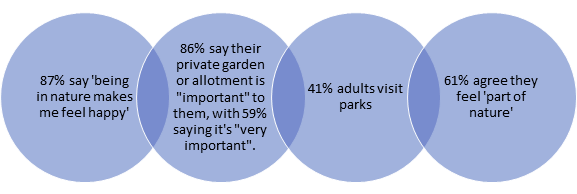
It has become a bit of a truism to say that gardens and open green spaces have become a lifeline to many during 2020. A survey examining life under lockdown as measured by Natural England’s People and Nature Survey, conducted in May 2020 found the following:
Our own project to renovate the Old Pond Garden at Charlton House has shown that many volunteers have appreciated the opportunity to get out into the open air and to be with other people. It has become the perfect community project.
Sue Stuart-Smith’s (many gardeners may be more familiar with her husband Tom Stuart-Smith, the garden designer and Chelsea gold winner) ‘The Well Gardened Mind’ was published earlier this year. Sue Stuart-Smith is a prominent psychiatrist and psychotherapist and her book examines neuroscience and psychoanalysis in the context of gardening and makes a strong claim for the benefits of gardening for mental well-being. Monty Don has long argued for the role of the garden in relieving depression and several episodes of Gardener’s World have featured individuals whose lives have been supported by the activity of gardening.
Gardens do not stand still; they are dynamic and ever-changing environments. Gardeners are always planning and looking forward. At the moment many of us, if we haven’t already done so, are ordering our bulbs for next spring. I am thinking about colour combinations (again) and I have a plan to move around my dahlias and make room for new varieties. On another recent visit to Great Dixter there was a stunning variety which, on enquiry, turned out to be Dovegrove. If I can find a supplier, I would like to include this in my borders next year.
Monty Don has always been a keen exponent of the health benefits of gardening, in particular its effect on the not so quiet mind. I have recently read that some hospitals have introduced ‘secret gardens’ where patients recovering from the Coronovirus are taken for periods every day, even in drizzling rain, for the beneficial effects. And, of course, this week it is Gardens and Health Week, sponsored by the NGS with Rachel de Thame as its Ambassador. The NGS website has various links to the personal stories of people for whom gardens have played a vital role in their recovery.
Also recently published is Sue Stuart-Smith’s (wife of the garden designer Tom Stuart-Smith) book, ‘The Well Gardened Mind: Rediscovering Nature in the Modern World’, in which she points out the pleasures of growing and nurturing things and argues for a ‘greening’ of all of our lives.
Despite exhortations to sit and enjoy our gardens, I think keen gardeners often don’t do that! But this spring there has been one thing that has brought me joy every time I look at it! In the autumn I bought a collection of ‘ tulips for a window box’. When it came to planting them, I decided the window box was too small, so I jammed them all into a pot. The three varieties are absolute beauties and even now they are fading are still immensely lovely.
I rarely sit outside, but I am greeted by them every morning when I have breakfast.
At the end of my garden I have a Clematis ‘Freckles’ which flowered constantly through the winter. However, I only saw this when I ventured further down the garden. I have resolved to plant something which gives me such pleasure closer to the house where I can see it even in inclement weather. In these unusual and difficult times, let us take pleasure where we can.
The tulips are Double Early and Double Lates: Anthracite, Copper Image and Dream Touch.






 Charlton and Blackheath Amateur Horticultural Society