Gardeners’ World have come up with a list of companies selling plants and compost online, it may go out of date (2 April 2020) but is a good place to start.
Hooked on hostas
At the last count, I had 32 hostas and most of these are in pots. Admittedly, some of these are miniatures, but nevertheless this means that in March a lot of checking and potting on needs to take place. My basic collection has increased over the years because people have given me hostas which they have bought and not had much luck with and then passed on to me. I am always grateful!

I check all pots to see whether root growth is coming through the bottom of the pot; where small enough I tip the plant out and check to see whether it is root-bound or the compost is looking a bit stale. However, Sum and Substance and Big Daddy are each about 4 feet tall and Big Daddy is in such a large pot it really needs two strong men to sort him out! Empress Wu is catching up with these guys in terms of size. I then use John Innes number 3 to pot up again. I try and leave a fair bit of space at the top of each pot to allow for the addition of a protective mulch. I make this with a mixture of farmyard manure and home made compost, which I keep as rough as possible with eggshells – this does a good job of discouraging slugs and snails while the plants are young and gives them a good head start. The coarser leaved hostas then tend to manage quite well thereafter. This year I have added a granular feed which should last 6 months. Many years ago I read somewhere that feeding hostas produces weaker growth, more susceptible to attack and I have never fed mine apart from the spring dose of compost, manure and sometimes bonemeal.

In my experience, the general gardening advice that the coarser the leaf the less likely a hosta is to be eaten by slugs and snails is true. Particularly resilient is Frances Williams and I can’t recommend this one enough. I also find Krossa Regal and Patriot very good. It’s also useful to think about where you are growing hostas. If they are crowded together in a border with lots of other plants, slugs and snails will still get to them no matter how many slug pellets you use. Snails can abseil down the leaf or stem of another plant to reach a hosta. As always in the garden, a consideration of the growing environment means there is less need to introduce artificial measures to control the pests.

Vija
Plantlife road verge campaign
Plantlife say “In these challenging times, wild flowers on our verges and waysides are an uplifting sight, contributing significantly to our wellbeing. It’s been wonderful to see on social media many photos of botanical gems that people have spotted whilst out for their daily exercise; there is some solace to be found in nature.”
Have a look at their Road Verge Campaign pages.
Members’ gardens, March 2020
Maggie’s lovely spring garden. The flowering shrub is Exochorda “Magical Springtime” and was a Mother’s Day present a few years ago, what clever children she has!

Christine’s alpine trough, with Thrift in full swing. Lovely blossom on the tree.


Muscari latifolium coming out, just as Hyacinth Splendid Cornelia is going over, on Kathy’s sunny bit of the patio. Rose Cottage bulbs again, they were a winner!

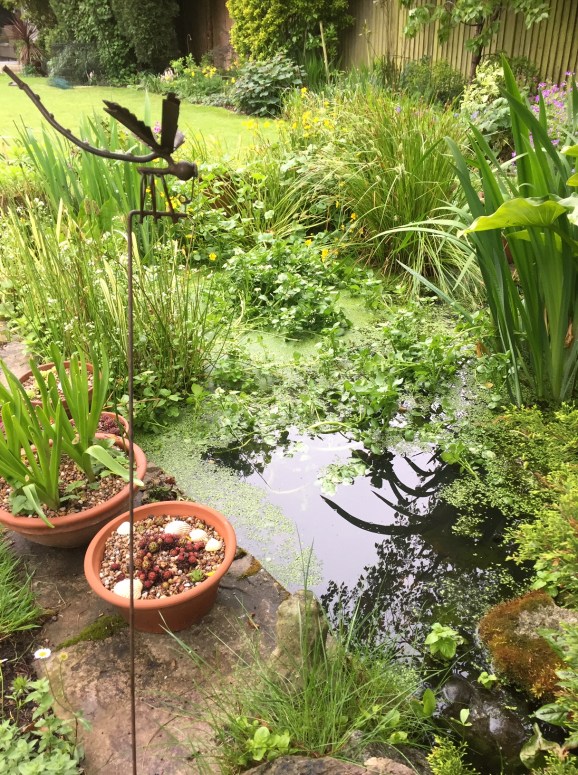
So maybe we have a local heron who is going round checking out members gardens? Chris’ visitor from yesterday has popped over to look at Kathy’s pond. Thankfully the pond is netted, otherwise his breakfast would have been toad spawn..

Here are two of Chris B’s shrubs, looking very good this Spring – Spiraea arguta Bridal Wreath and Viburnham tinus:


Chris was surprised to see this visitor – a Heron, checking out her garden!

Angela says she is not a fan of tulips generally, but the Rose Cottage speaker we had last year convinced her to try these wild tulips, Tulipa sylvestris, and she is so pleased with them. They do look lovely in a “woodland” setting like this.

Jenny’s Camellia is looking wonderful, she says its thanks to all the rain, and she didn’t have to do a thing!

My Australian rosemary
From my kitchen table I am fortunate in being able to admire a shrub growing in a pot on the patio table that is looking glorious at the moment.
Westringia rosemarinformis is an Australian native and commonly known as the Australian rosemary. I was given this plant as a cutting a few years ago and it has grown into a lovely shape. Margaret T has a large shrub growing on the sheltered, south-facing wall of her front garden, where it has thrived for about 12 years.

This is a truly fantastic shrub to grow in London’s dry, sheltered gardens and seems to be completely unknown. Its specialness derives from the fact it flowers during the winter months and will keep on flowering for months afterwards. I imagine Margaret purchased her Westringia from a rare plant fair or specialist nursery years ago.
Westringia is a genus of 25 species, found all over Australia and comprised of rounded to erect specimens from dry coastal, heathland or dry forest areas, which make them ideal to grow as rounded shrubs or as hedging in Australian gardens.
In the UK they are regarded more as conservatory plants, but if they are given a hot, sheltered position, they will thrive happily for many, many years. They tend to like a fertile, well drained soil, with sharp sand and compost added to the mix, although I imagine they grow in poor soil in Australia.
The small, lavender-coloured flowers are not scented but I think they have an orchid-like appearance, with contrasting orange stamens. They are exceedingly beautiful to look at in close-up.
Margaret would be happy to supply cuttings to those interested in growing this shrub (contact cabahshortisoc@gmail.com)
Anna L
Rachel de Thame: How to beat the Coronovirus blues by getting back to nature (The Sunday Times, 29 March 2020)
Great article, read the whole thing if you subscribe. If not here is an extract:
“While we remain largely confined to our homes, really take it all in during your daily walk or run through the park. Above all, make the most of any outdoor growing space you have, be it a narrow suburban strip, roof terrace, balcony or window box. No matter the size, each can provide an escape from the news and break the monotony of being cooped up. Encourage others in your household to get involved. Especially children, who might just tire of games consoles and Snapchat for long enough to become hooked on this “growing things” malarkey. Gardening teaches that the effort and patience required to achieve long-lasting rewards can feel as good as instant gratification.
Getting out in the garden makes us fitter, and growing our own food can transform our diet. Fresh vegetables and fruit are essential for good health, so if you are sowing seeds now then pick as many edible plants as you can. It’s easy, and if you don’t want to dig up your ornamental borders then grow herbs and salads among your roses and dahlias, and sow curly-leaved parsley as an edging for the front of flower beds.
Gardening engenders a sense of wonder and is as good for the soul as it is for the body; the benefits to our mental health and general wellbeing are well documented.”
I love the idea of parsley as an edging for flower beds!
One exercise a day…
If you live anywhere near Angerstein Lane, just off the Heath, it’s worth making a detour for – Stephen’s garden is looking great and all the tulips are coming out.

Go wild gardening
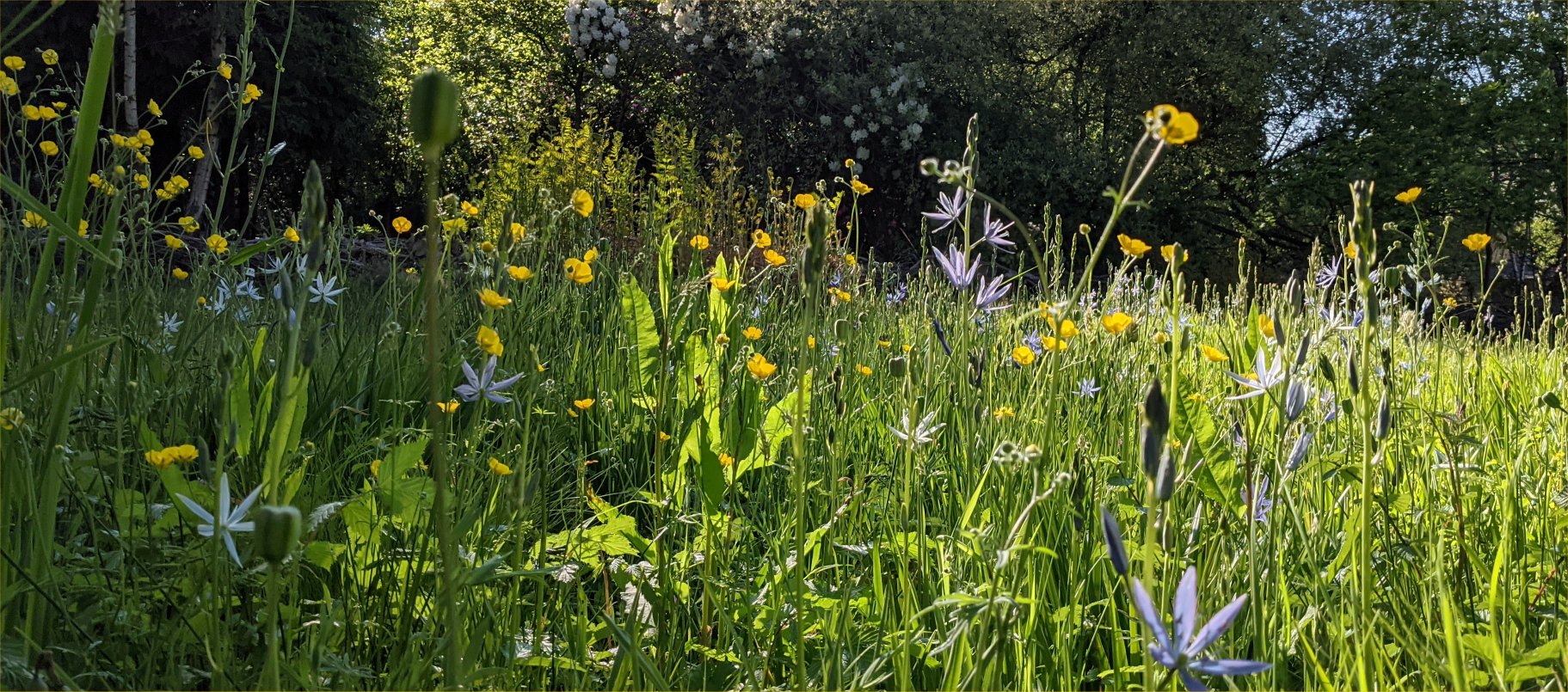
CABAHS Committee member Paula, reminds us that even the smallest urban garden can attract and help wildlife. She suggests you can select a small space in a patch of lawn to sow wild flowers as well as well-known plants. Plants such as Echinacea, Foxgloves, Hollyhocks and Lavender – there is a huge choice to pick from, or how about letting the grass grow and think of the time you will save in not mowing! It will attract insects, bees and who knows what else will show up. Check out the RHS tips for creating a wildlife garden
Has your ‘wild bit’ attracted any unusual wildlife? Let us know!
Pressed flower art
I was recently given a book on the “Art of Pressed Flowers and leaves” by Jennie Ashmore, which aims to re-energise and re-imagine this very traditional craft. It might be a very good time to have a go at this fascinating hobby!
People have collected and pressed plants from the earliest times, when explorers returned from faraway places laden with Botanical specimens. During the Victorian era, pressing became a genteel art and pressed plants were used to create pictures and decorate all manner of objects.
Jennie’s art uses every sort of leaf as a background, to set off the more delicate pressed flowers. This one uses Sycamore leaves (at last, a use for Sycamores!) and Fennel:

This hobby is refreshingly low cost – Jennie uses old telephone directories for her pressing, with a brick weight on top. Inexpensive photocopying paper can be used, or blotting paper if you can get hold of it. All material is pressed for a month or two, depending on how thick the leaves are. Check after a month to see.
Jennie suggests experimenting, but says she always cuts off the woody and the fleshy parts of plants for best results. Most shiny leaves (Laurel, rhododendron) are not suitable. You should cut the fleshy middle out of Hosta leaves, otherwise they go mouldy, but they make wonderful colours.
Jennie’s leafworks are mounted on paper or thin card, and she uses Copydex or a rubber-based adhesive that can be easily removed if there is excess. Don’t use much – a dot on a matchstick works – especially when sticking delicate petals. Make a template and use a cutting knife to make backgrounds:

Here’s what you can end up with:

I love this idea too – this is a picture of a walk, and then the pressed picture that Jennie made using material collected on the walk. What a great idea for your daily exercise walk! Have fun.
Kathy A