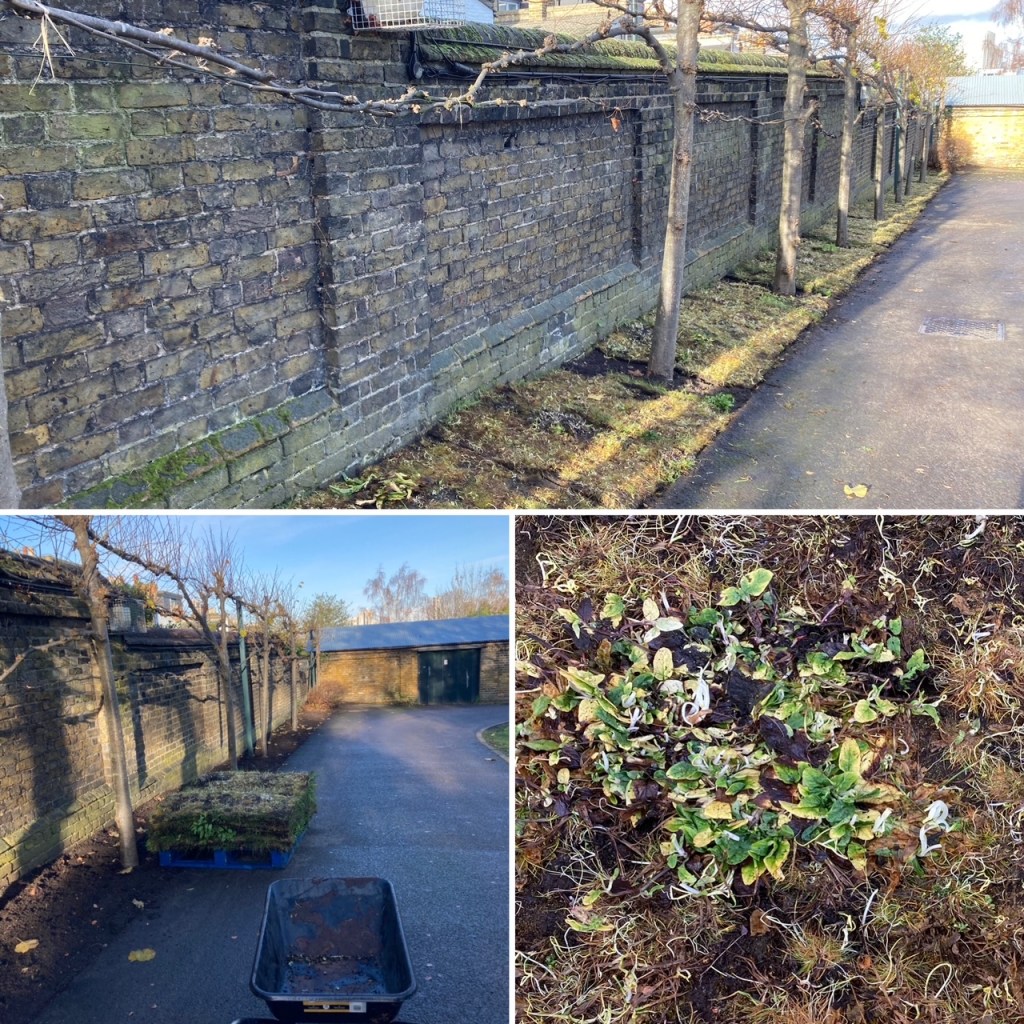
25 September Starting to plant things instead of just weeding and pulling up. This picture shows newly planted clumps of lilyturf (Liriope muscari) looking happy under the Tree of Heaven. The lilyturf was kindly donated by a CABAHS member.
We are ordering 2,000 bulbs of Narcissus ‘Tete a Tete’ and Thalia, for some spring colour, these should arrive in a week or so. Lots of planting to do!
28 September A lesson and/or debate on how to plant a shrub! These are the Pittosporum “Tom Thumb” being planted.
A suggestion made by Anna has prompted me to think what we can learn from random gardening mistakes, or shall we say, unplanned activity.
I use a lot of salad vegetables and always have a variety of leaves growing to use as a base for additional ingredients. I sow a selection in various seed trays, which I then prick out and later plant into the garden. A few years ago, at the tail end of the summer, I sowed seeds into their seed trays as usual. For whatever reason, I failed to prick out and then felt it was too late to do anything much with them, so I was left with several seed trays full of fresh young seedlings. And I left them. But what happened then was that they provided me with a steady supply of cut-and-come-again salad leaves (the kind you pay a fortune for in bags in supermarkets) to enjoy through the winter. Ever since then, I use this method to provide me with small young and tasty salad leaves, throughout both the summer and winter. I do this with Mizuna, Endive, Rapa da Foglia (turnip greens), mustard, rocket as well as the usual lettuce varieties which we grow. I am sure it works equally well with chard and beetroot and members will have their own varieties to suggest here. Obviously the mild winters we have been experiencing do help, I am not sure what a sharp frost would do. Ultimately, the plants will become very rootbound, but growth in the winter slows down, so this takes a while to happen.
Trays of seedlings sown 5 September.
The usefulness of this method is also that you could do this on your kitchen windowsill, balcony, or whatever space is available.
CABAHS members enjoyed visiting Great Comp Garden on 21 and 25 September 2020. The garden is looking so good at this time of year, it really is Salvia heaven.
I sowed these Zinnia seeds directly into the ground in June and replanted the thinnings and ended up with two rows. This is the first time I have ever grown Zinnias. It was old seed and I probably bought the packet at our plant sale a year or two ago for the going rate of 20p!
I reckon my success is down to beginner’s luck and the Poundland compost!!!! I have very light soil so I also added the ash from the bonfires and chicken manure pellets before I planted up the plot. As they are adjacent to my tomato plants I made sure they were watered nearly every day to encourage a good root system. Yet information online says they only need watering every five to seven days. I was warned not to get water on their leaves as they are prone to folliar diseases. They are growing adjacent to the boundary fence and I’ve had to support them when the high winds came.
There are doubles and singles, in various shades of pink and yellow. The bees love them and they are long lasting as cut flowers. They are the first plants I look at when I arrive at my allotment plot and I coo over them! Margaret grows rich, strong orange Zinnias which knock my Zinnias aside and they are simply stunning. Definitely a plant to try again next year.
The winner of 2020’s competition was Tim, with an enormous harvest weighing 3lbs 13 oz! The prized packet of crisps was donated to the food bank instead of being presented to Tim as meetings were suspended. Close runner-up was Peter with a yield of 3lbs 8 3/4 oz. Peter’s consolation was that he had a well deserved bangers & mash supper. Thank you to everyone who competed and sent in their photos!
Hole Park is in Kent somewhere between Benenden and Rolveden but I warn you it is not well signposted and we drove past two entrances without seeing them, so beware! It’s not a garden for specialist plants but if you want to see a beautiful garden set in parklands with lovely views then do visit. It has 16 acres of formal gardens with woodland walks and with a manor house dating from 1720 surrounded by 150 acres of parkland.
There are yew hedges, a walled garden (although short on plants here) the Egg Pond and a Vineyard. Then there is the so called Millenium garden, which could rival Great Dixter’s sunken garden, if there were more plants in the surrounding beds and so on. The Woodland walk is famed for its bluebells in late spring.
The house is not open to the public as it is currently occupied but the owners are on hand to give advice and information. There’s a stableyard with a small cafe doing light lunches and tea and coffee and they sell their own jam and Hole Park honey. And best of all, there weren’t hordes of visitors either and the staff were friendly.
If you want a nice peaceful relaxing visit in lovely surroundings, I recommend a visit to Hole Park!
Hole Park is about 1 hr 15 mins from Greenwich and is open Weds & Thurs plus some Sundays in October. Sat Nav TN17 4JA. It is open for the NGS on 11 October. Tickets £8 (the Gardeners World 2 for1 tickets work). Also keep an eye on their Events page, they host plant fairs occasionally.
As I look around my garden I am very conscious of the origin of many of my plants. I have a bright pink phlox which was originally in my mother’s garden and which comes up faithfully year after year – highly scented but rather susceptible to disease and needs to be cosseted a little. And then there are the Salvias, many of which are from Terry, but Jezebel and Phyllis’ Fancy are from Pat.
Phyllis Fancy
Over the years a number of plants have been bought from the plant sales held in Jillian’s wonderful garden when it was opened to visitors and have now become mainstays in my own.
I now have a small collection of Acers, but my first one came from an open garden in Beckenham Hill. The couple gardened on a steep slope covering a vast area, at the bottom of which was a railway track. He was an acer expert and grew many rare varieties, some of which he propagated himself. The garden was always a pleasure to view and my love of Acers began here. Sadly, I no longer have my original purchase, although it lived to a good age and the couple sold their house some years ago and moved away. I remember him saying that they would need a single large furniture van just to transport the plants!
I have long cultivated the beautiful Pelargonium Sidoides, but at one of our Autumn Shows, Harry showed a variety with a slightly different colour – paler and more crimson than mine, he gave me two pieces immediately and I successfully rooted these to produce my own plants. This year at the Old Pond Garden sale, Jean offered a pelargonium with a leaf which looked very much like Frank Headley but with a frilly pink and white flower – I think she called it Apple Blossom. I bought this and have made two cuttings which I hope will give me more plants of this unusual variety. On a recent visit to Great Dixter, I fell in love with P. Concolour Lace. Kathy had some to spare and I have bought one from her.
And so it goes on: the gardening stories and memories which we make with each other.
Our star speaker from last year, Nick Bailey, has a very informative blog on his website: ‘New Ways with Spring Bulbs‘. Worth a read before ordering hundreds of bulbs from those enticing catalogues!
We had a lovely relaxing day at Hall Place on 9 September 2020. It has been maintained very well considering lockdown issues. This “tropical” display near the main entrance was particularly colourful, with cannas, castor oil plants, dahlias and sunflowers. The topiary “beasts” looked very smart and the long borders were interesting for ideas as they were laid out by colour. After a picnic lunch, visiting the small but very good quality plant centre finished off an excellent day.
At the end of August, my hostas are looking a bit ragged. They have had a tough year. Forced into early growth by a warm spring, a frost scorched the young leaves of many of the plants, particularly the green leaved varieties, which seem particularly susceptible to a late frost. Overcoming this early obstacle, the hostas forged on to produce lots of leaf and looked absolutely splendid in May. Strong winds then battered the leaves and here the larger leaved varieties suffered most. With foliage that was still comparatively young and tender they had not built up enough resistance to withstand the winds that barrelled down the side of my house. At one point they were all listing to one side like sailors who had been on ship for too long. Sum and Substance with leaves the size of elephant’s ears really struggled. A month of very hot temperatures has now left them looking very sad indeed. In a south facing walled garden they have basically been inside an oven and baked. Of course, hostas should not be grown in these conditions and in most years they have managed relatively well, but this year has done for them. Additionally, these stressed plants are also more susceptible to the depredations of slugs and snails. For the first time, they have been given a liquid seaweed feed. I’m hoping this will cheer them up a bit.
Vija
Ed: Here’s a clip of Vija’s garden at the recent Open Gardens event. Hostas definitely looking a bit cheered up!