On Saturday 11th February Jean and I spent a very pleasant day at RHS Wisley. This was the last day of the Iris and Cyclamen Show held in the Hilltop event hall.
The displays were beautiful. So uplifting to see so many spring colours after a long, cold winter. We were amazed at the variety in size and pattern of cyclamen leaves, all in perfect condition of course.
The Iris Fields of Hall Road, Wenhaston IP19 9HF were selling small pots of irises to which we both succumbed!
Ruth Cornett, the owner of the Eltham Gatehouse situated adjacent to the historic Eltham Palace and part of its history, gave an excellent and informative account of how she has renovated the Gatehouse garden which along with the house was neglected and semi-derelict when she and her husband bought it in 1998. Having previously lived in a North London flat and from a rural Irish background, she was desperate to have a house and garden and set about renovating and restoring the garden in 2015. Ruth showed us pictures of before and after.
Eltham Palace is a medieval house with a long history. At one time a Bishop’s Palace and a Tudor hunting lodge, it was bought by members of the American Courtauld family in 1933. They renovated the Palace and added an Art Deco extension, then handing it over to the Royal Army Educational Corps in 1945. Its head resided in the Gatehouse. When the army left in 1992 the Gatehouse was left empty and the garden was abandoned.
Our February meeting on Monday 20th, comprised our AGM, with the usual election of officers and presentation of the Annual Report, followed by a talk by Ruth Cornett on the work she has done on her Eltham Palace Gatehouse garden and her passion for roses.
Show Table Winners 2022 The Show Table cup is presented to the member who has garnered the most points on the monthly Show Table, over the past year. We have not been able to present the cup for the previous two years due to Covid, so we are delighted to be able to revive this tradition that has been running since 1955! This year, we had Joint Winners, namely Annie and Terry. Second place went to Pat K and Third to Anastasia. Well done all.
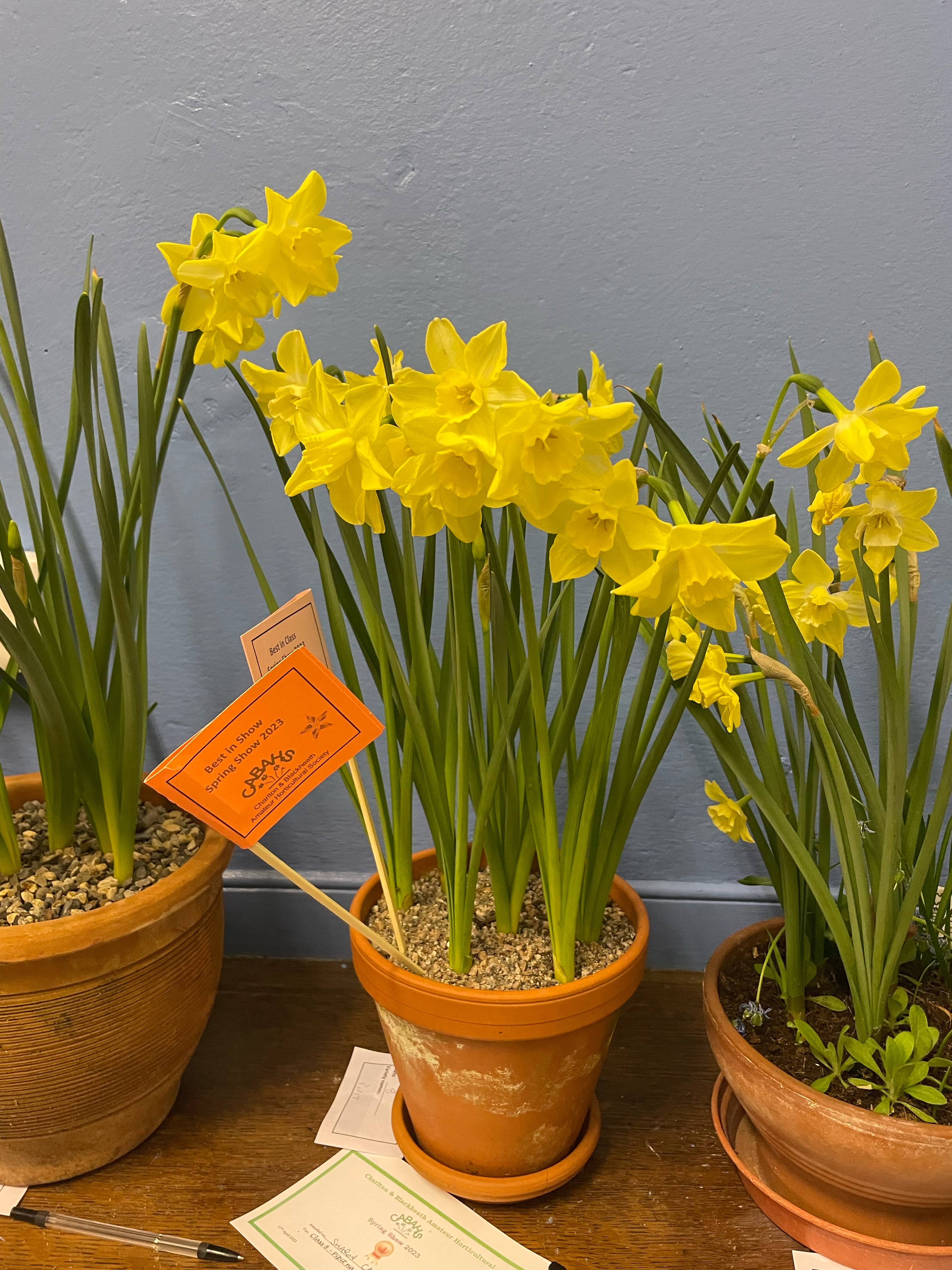
For the coming year, we have introduced an additional award, “Best on the Table” given to the best display each month. This time it was Sian’s turn, with her wonderful aromatic display of Mimosa.
In a previous life when I worked for garden charity Thrive*, I was involved in replanting the Old English Garden in Battersea Park and last week I and a former colleague went back to see how it is looking now, some 10 years later.
Although it has a similar feel and look to the Old Pond Garden, it is only walled on one side, but it does still have a large pond in the middle, which is full of water lilies in the summer – spot the heron !
Much of the funding was provided by Jo Malone London (JML) and many of the plants are those used in their fragrances including lilies, rhubarb, pomegranate, jasmine and, of course, roses. Some replanting has been done in the intervening period and it continues to be well maintained and supported by JML, volunteers and Thrive gardeners.
Friends of Great Dixter were invited to a post- Christmas event at the end of January to join Fergus Garrett, students and staff. Warm spiced home-made apple juice and biscuits were available for refreshment and the archives were open for those who had not already seen them. We were welcomed into the Great Hall where a huge fire crackled and students created a ladder from chestnut poles gathered from the surrounding area. Outside, Fergus demonstrated how, using a traditional A-frame and tools, chestnut poles could almost perfectly be split ready for use. Of course, the highlight was being able to look around the gardens at a time when they are not usually open to the public. For those who have watched Fergus’ lectures on successional planting, the practice was evident in the canes laid out on the soil. Fergus’ favourite giant fennels were already unfurling and the gardens were positively covered with Galanthus atkinsii, both of which are clearly visible in the photograph above. An added bonus was that the day was sunny and moderately mild. What a treat.
At the beginning of the Covid19 pandemic, with a new garden inherited from someone who had focused on gardening with concrete and weed suppressing membrane, I took advantage of the RHS Members’ Seed Scheme. I selected 15 packets of seed from their list of varieties collected from RHS Gardens, including annuals, herbaceous perennials and rare shrubs, and I paid my £10. Some were more successful than others but I was sufficiently encouraged to try it again this year. You have until the end of February to join this year’s scheme….
As a former allotmenteer, I’m used to growing plants from seeds. Over the years, I developed preferences for unusual varieties and for seeds that are open pollinated (non-hybrid) so you can collect and sow your own seed in future years. How should I choose flower seeds and which seed suppliers should I use? I came across a recent article in Gardens Illustrated about seed suppliers. This reassured me by referring to some of the suppliers I have used for vegetable seeds but shows what a massive choice there is, for both flower and vegetable seeds.
Must be careful not to let the seedlings get out of control!!
Just before Christmas I posed a question for everyone, asking what you think make Charlton House Gardens unique. I had a good number of replies, and I’m pleased to report that most of you DO think they are unique! But I have had a real challenge trying to consolidate them into a single idea.
Here are just a few extracts from your replies:
“The gardens are rooted in their sense of time and place, where you can imagine them as Jacobean gardens but where you can also see modern day planting. There is a passion and desire to keep these gardens relevant for future generations.”
“The House is an architectural gem, whose early inhabitants played a significant role in the revolutions of the seventeenth century; today, the gardens are an oasis of beauty and peace in the midst of the urban sprawl of London.”
“The gardens are small but contain as diverse and exciting planting as you might expect from a much larger space.”
“The gardens are public but very community focused, beloved of local gardeners creating fabulous displays and running special events.”
“Not unique, but certainly rare, in that they still have the atmosphere of the Jacobean age. Planting with a “nod” to the Jacobean era.”
“An unexpected historic oasis in a desert of modern housing”
“They play to a sense of history and yet have a contemporary design adapted to change of climate.”
“Unique because they are community-run but following professional design principles.”
So, at then end of all that, let’s go with:
Charlton House Gardens: an historic oasis of beauty and peace in the midst of the urban sprawl of London, where local volunteer gardeners work together to ensure the gardens stay beloved and relevant for future generations.
Anne Barnard from Rose Cottage Plants, a nursery that has won several RHS medals, following on from her successful talk last year on dahlias, gave an informative and useful talk on some of her favourite perennials. She also brought some bulbs for sale which were snapped up.
Although the nursery is known nowadays for specialising in dahlias, when it first started some 25 years ago, they specialised in perennials. Starting her nursery came from her involvement in the National Gardens Scheme.
Anne Barnard talking about perennialsSt Thomas ChurchTerry with lottery ticketsSettling into a new venueTerry selling lottery tickets
In her presentation, Anne referred to and described a large number and wide range of perennials and the conditions they need to grow well, as well as showing a range of perennials that partner well together. Some of the perennials she mentioned are listed here and some of them her nursery sells. They also sell bulbs.
As a Garden Volunteer at Charlton House Gardens, I was recently asked to explain what makes the walled gardens and estate “unique”. The question was born of a genuine desire to understand and perhaps help the gardens become better known. Of course, it’s one of those questions that you go away and carry on thinking about.. and wonder what you should have said.
I asked our regular Volunteers what they thought (they keep on coming back, so they must love it for some reason!)
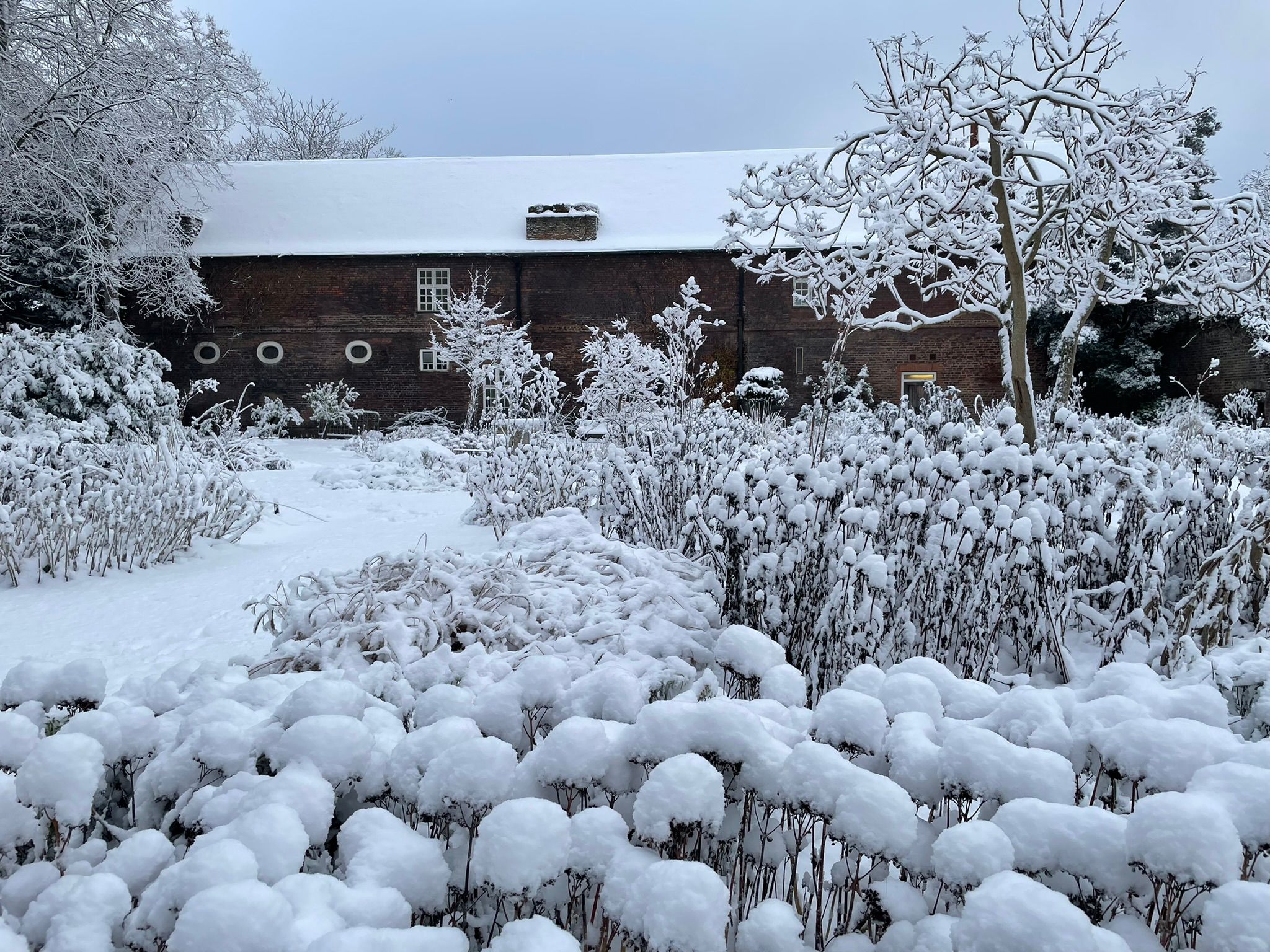
Peace Garden, Winter 2022, by Head Gardener Jason Sylvan
Lots of great ideas came up around biodiversity and pollinators and sustainability. But you could argue that every garden is unique – what makes this particular combination of place and plants so special? We kept coming back to community spirit – particularly as the gardens have had only a tiny amount of external funding – the majority of their transformation has come from community fund raising and effort, and crucially, the use of a professional garden designer.
A good point was made that if you compare Charlton House Gardens with, say, Greenwich Royal Park, Charlton attracts mostly local people and not your average tourist – so there is an great feeling of ownership and responsibility. They may attract the discerning tourist in future (we certainly hope they do) but for now they are in “our” Trust.
We often call the Old Pond Garden the “Secret Garden”, after Frances Hodgson Burnett’s childrens story, but one Volunteer suggested the Lost Gardens of Charlton (Heligan) might be a better comparison now, as we re-discover and re-imagine the original spaces.
What do YOU think? Send in your ideas of why Charlton House Gardens are unique, we would love to hear from you (anyone, not just members) to cabahshortisoc@gmail.com. We will encapsulate your ideas into one “unique” statement in the New Year – and hopefully answer that question.
Old Pond Garden, Winter 2022, by Head Gardener Jason Sylvan