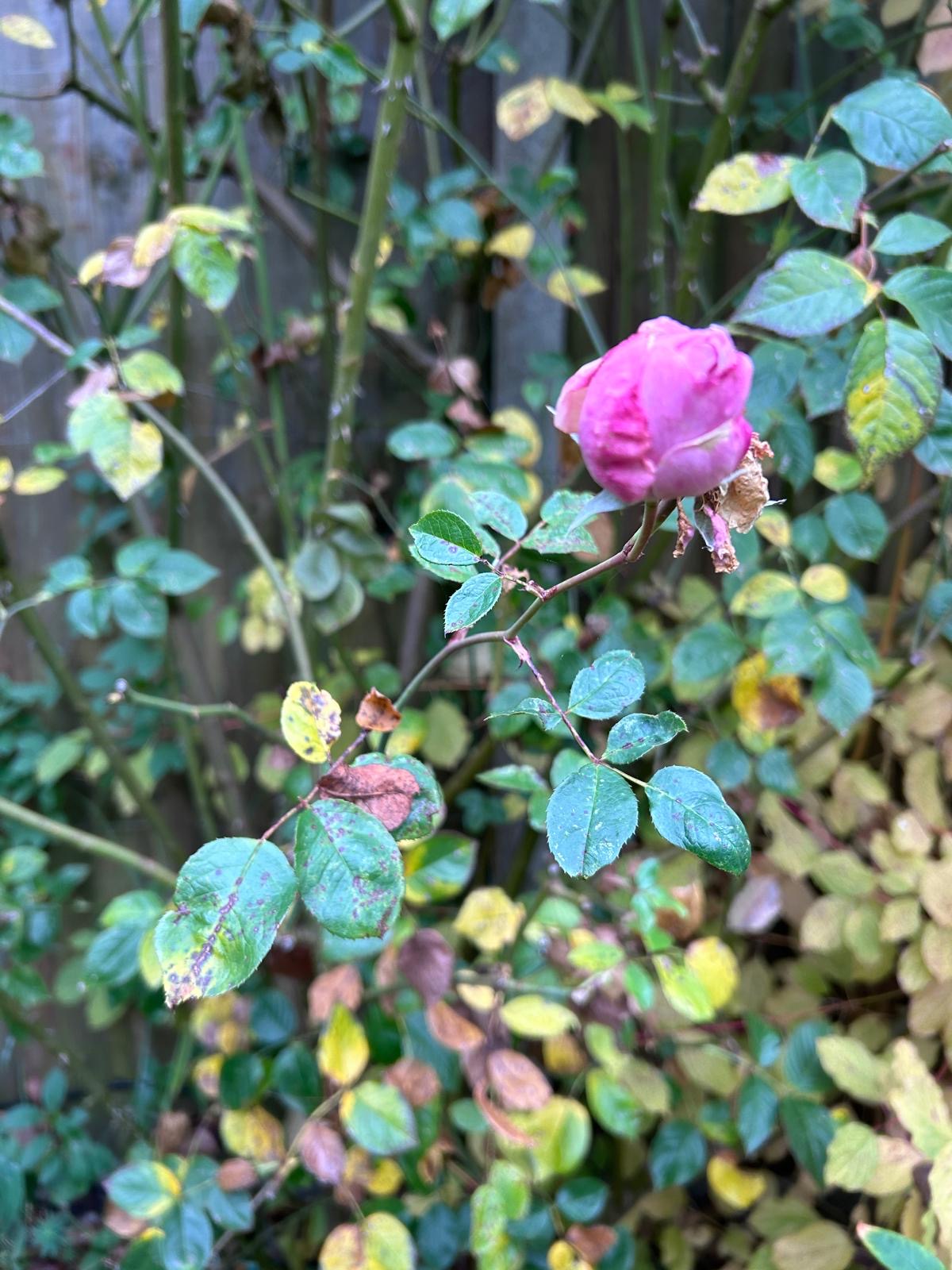
1. Check for blackspot on roses and make sure to remove the leaves by checking the bush itself and below it. But don’t add to the compost heap.
Blackspot on roses
2. If you have to, this is the best time to move trees and shrubs, but have your planting hole ready, and dig up with all the root ball and replant quickly, watering well until settled.
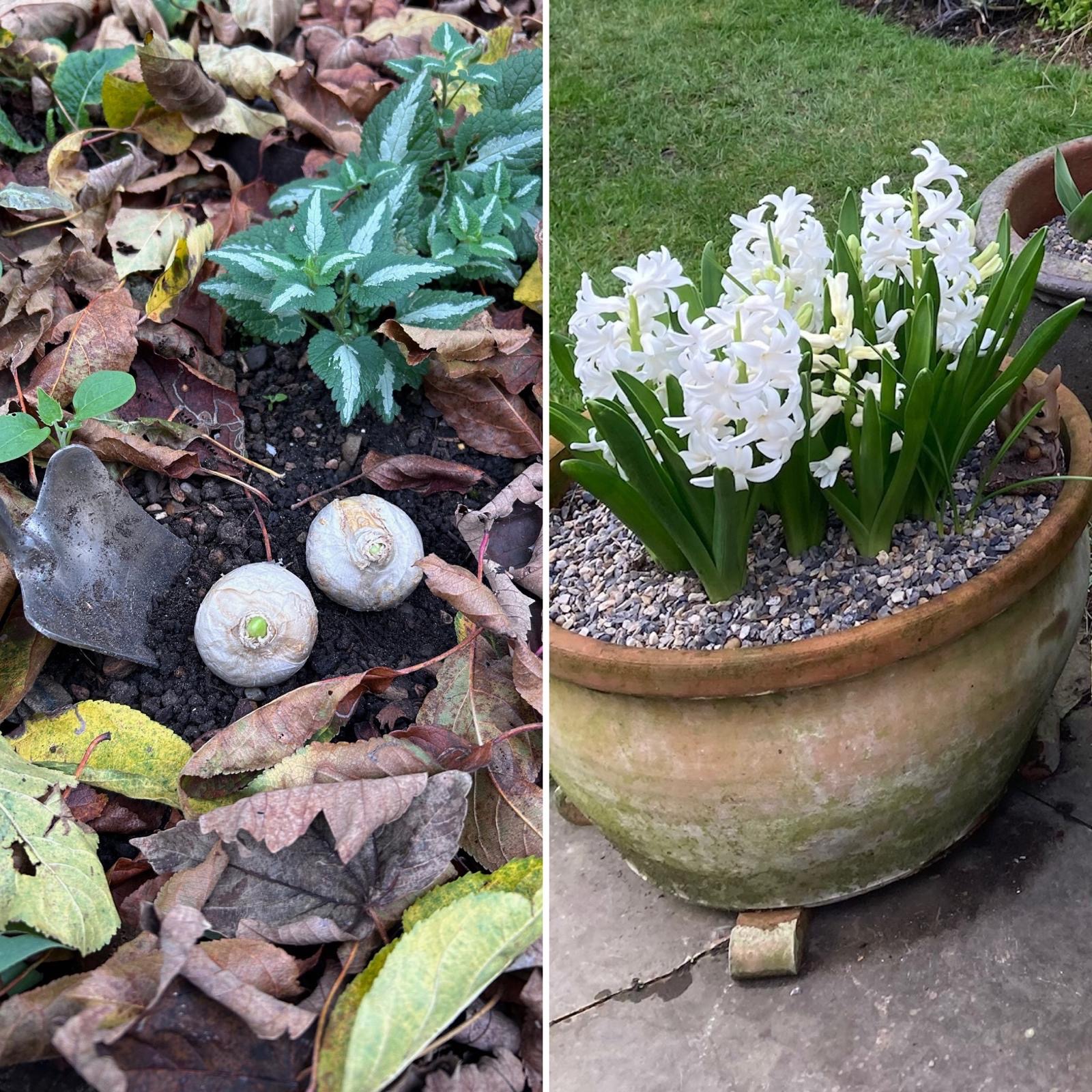
3. Plant your tulips and hyacinths now. either in the ground or in pots – but protect from squirrels.
Plant tulips and hyacinths
4. If you sowed sweet peas last month. harden them off now and it’s still not too late to get some going for an early crop.
You may have spotted that the Charlton House Mulberry has just featured at Number 8 in the list of 20 Greatest Trees of Britain (the Telegraph) – what a well deserved honour!
I confess to being a bit of a Mulberry tree fan, having planted one in our garden in Westcombe Park just over 35 years ago. Our tree was a favourite retreat for my kids when they were growing up since, like all Mulberries, it has a very climbable branch structure and wonderful leaf canopy. Even Jerry our Jack Russell can climb up it when he has the momentum to chase squirrels!
Morus nigra trunkGreen canopyJerry
Last year I bought my grandson a lovely children’s book about an old tree standing through the ages (What did the Tree See, by Charlotte Guillain) and reading it led me to ponder what our venerable Mulberry Tree at Charlton House might have been witness to over its 400 plus years?
The story would start in 1607, around the time the House was being built, when King James required landowners to purchase and plant 10,000 Mulberry trees between them, to start his ill-fated silk industry. When Sir Adam Newton bought the “Manor of Charlton”, it included six orchards, 260 acres of land, 100 acres of meadow, 200 acres of pasture and 200 acres of wood – so he certainly had space to please the King by planting a whole field of Mulberries. A pity that the wrong kind of trees were planted for silkworms and the climate was too cold for them to thrive. At Charlton House we know that “a few trees” remained by 1845 but our beautiful and venerable one is all that remains today.
We welcomed back Tim Ingram who has a passion for alpines, and is a member of the Alpine Garden Society. He gave us a talk on the evolution of Copton Ash, his garden in Faversham, Kent where he also has a specialist nursery. He also brought with him a selection of alpine and perennial plants for sale. He illustrated his talk with a series of photographs showing the development of his garden over the years and seasons.
Copton Ash fruit plantings Spring 1979Copton Ash getting wild, May 2024
Tim’s garden is a large and mature family-run garden, about one and a half acres in size, which has been in existence for nearly fifty years. He comes from a family of avid gardeners and so was brought up with a keen interest in plants and gardening. His father worked at Brogdale (home of the National Fruit Collection): his mother too a keen gardener: his grandfather was into market gardening. Tim first worked in academic science in London, specialising in plant hormones. He and his wife returned full time to Copton Ash in the late 1980s when they soon started a nursery.
It wasn’t all that “fair” this year, in fact it was fairly wet, but we had such a great day! So many volunteers and visitors turned out to support this traditional event, thank you so much everyone. As well as a huge number of plants for sale, we also had fun with the Gargoyle Trail in the Gardens, which were specially dressed up and Haunted for the day!
Ghostly entranceGareth the Gargoyle
Inside Charlton House there were lots of craft and artisan stalls, Frilly’s was open and there were food stalls on the back lawn. The Heritage Hub featured the Ottoman stone and some interesting watercolours of Charlton House over the years. Local community groups had stalls in the Grand Salon and St Luke’s was open for tower tours. Spotlight Dance group and the Morris Dancers were on show as well.
The Morning VolunteersA good startA lot of plants!
The gardens looked beautifully Autumnal and we had over 85 children and their families charging about looking for bats, gargoyles, pumpkins and spiders!
Off to Splat a SlugBATSWitches and eyeball brewSkeleton in Tree of HeavenIs it real?Look who’s behind you!On the huntGhostly Door knockerThe five witches!
Highlight of the day was the Splat the Slug game, all ages had a go!
1. Watch out for Cabbage White caterpillar on your Nasturtium: at our allotments they appear to be the new delicacy which they are devastating and they look like the only butterflies that are thriving.
2. Make sure to plant lots of butterfly-friendly plants next year like Sweet Rocket, Scabious, Honesty and others. The butterfly count showed that butterfly numbers are very much down this year and we desperately need them. Please ask me for Honesty seeds if you want some.
Only our second foray into the world of London in Bloom (part of RHS Britain in Bloom) and we have achieved a coveted Gold award!
Last year, we only entered the Walled Gardens category, but this year – since we now cover most areas of the whole estate – two categories were entered: the competitive “Our Community” and also the RHS “It’s Your Neighbourhood”. Although these look for gardening excellence, they also cover community involvement.
Thursday volunteers and Jason with our awards
The judges visited on a very hot day in mid June and had already been to several local gardens including Charlton Station and Orchard when they arrived at the gates of Charlton House. On reflection, it was a great idea to show them around the estate in reverse order – we did the Meadow and Wilderness, followed by the Glade and Long Garden, then finishing with the jewel that is the Walled Gardens. Following that route they saw the progression of work and Jason was able to explain his ideas for each different area.
They loved the Glade, with its mounds made of green waste and excess soil, demonstrating how nothing goes to waste and the creativity of making a flat area more interesting. Remember this?
Making the first moundStamping the topsoil downWeeding and making more mounds
The best words in the report were reserved for the Old Pond Garden – the judges report says “Jason, working with the volunteers, has restored the walled garden quite possibly to something that is better than the original walled garden.” Wow! They go on to say ”Jason truly understands the secrets of good design and plant combinations, and makes an excellent Head Gardener. We see the harmony of working with volunteers, who have been able to put many of Jason’s thoughts, with his expert guidance, into reality.” What an accolade!
Salvia ‘Amistad’, in less than 20 years, has become a much-loved cultivar throughout the world. and is known as the ‘friendship sage’. It was discovered in a tray of salvias at a plant sale in Argentina in 2005 by Dr Rolando Uria, and he decided to name it ‘Amistad’, meaning ‘friendship’ in Spanish.
There is much to love about this plant, in that its 1.5m high, bushy, rounded habit is ideal for planting schemes, guaranteeing a display of purple flower spires, with highly aromatic foliage, from mid-summer until the frosts in October-November. It’s not 100% hardy, so I have lost it a couple of times over the years but it’s always worth repurchasing. The young growths are adored by slugs and snails, so during wet weather in spring it can be difficult to get going.
I have noticed, however, that in London’s parks, Salvia ‘Amistad’ really thrives and can be seen growing happily and well-established in May, beneath London Planes in much drier soils, where the mature trees are protecting the plants during the winter months. And the drier soils obviously do not attract the slugs during early spring growth.
We hope you enjoy walking around the walled gardens at Charlton House! This month, look out for:
New England Aster (Symphyotrichum novae-belgii ‘Violetta’)
‘Violetta’ is a spectacular New England aster, which for a couple of months from late summer, bears a prolific display of violet-purple daisies. A naturally tall plant, it provides a regal purple splash of colour – long after many other perennials have finished flowering. Our plants are originally a donation from CABAHS member Anne.
Michaelmas daisy (Aster x frikartii ‘Monch’)
A bushy perennial with clusters of yellow-centred, lavender-blue daisies that flower right through the Autumn, it is very attractive to pollinators. One of the most reliable and popular Michaelmas daisies (so called because they flower at the time of the feast of Michaelmas on 29 September), it was bred by a Swiss nurseryman called Frikart and named ‘Monch’ after a Swiss mountain.
Before the 1920’s, the ten acres of land at Canford Cliffs was heathland. But along came a man with vision, one Thomas William Simpson, and, with the help of his head gardener Mr Middleton, a magical garden was created.
Mr Simpson was a businessman and entrepreneur (margarine) and having visited many countries, knew exactly what he wanted. Influenced by the gardens and architecture of Italy, Japan and the UK Arts and Crafts movement, he and his gardener set about creating a series of gardens, starting with the Italianate gardens, then a necklace of paths and ponds which connected finally to his Japanese Garden, thus turning his vision into reality, right up until WW2.
The garden sadly fell into neglect following the conflict, but in the 1950’s and 60’s, a new owner set about restoring it, planting the magnificent trees we see today – their maturity and majesty makes this garden quite a magical place to explore.
The Italianate GardenThe steps leading down to the Italianate GardenBacchus, God of Wine, sheltering beneath the temple
Upon entry into the garden, I came into the Roman Garden, passed through the Grotto and into the very impressive Grand Italianate Garden, the focal point being the rectangular formal pond and beyond, the statue of Bacchus, the Roman God of Wine, sheltering within a temple at the far end of the garden. This sheltered, south-facing, formal garden is a relaxing place to sit and admire its many features. This garden then leads into Palm Court, a formal garden with its row of impressive Chusan palms.
Jason Sylvan, Head Gardener at Charlton House, has designed the Old Pond Garden to be as attractive to wildlife as possible. Because we talk about monitoring moths, he asked if we could check how many moths are visiting the garden. We should have tried this in the warmer months when there are more plants in full flower but we had missed that for this year so we gave it a shot on a warmer dry night in September to test out a strategy.
As we wrote in an earlier post, we have been monitoring moths for the Garden Moth Scheme since 2013 in Newcastle-upon-Tyne and since 2019 in Blackheath. The moth trap is a box with a light (our type gives off no heat), and below the light are two panels of see-through Perspex, one each side and shallowly angled down, with a slot/gap between them. The moths ‘funnel’ into the box, and it’s difficult (but not impossible) to get out. Inside are egg-trays, which provide resting places.
Why do moths fly towards the light? Until recently, the correct answer has been that nobody knows, but researchers in Sweden found the answer: for aeons, light at night was above and dark was below, so moths orientated themselves to fly with their backs to the light above. In artificial light – fires, candles, street lamps – they still try to fly with their backs to the light, circling round and round, and sometimes become disorientated.
The trap is placed before sunset, and collected at sunrise the next day. So an early start.