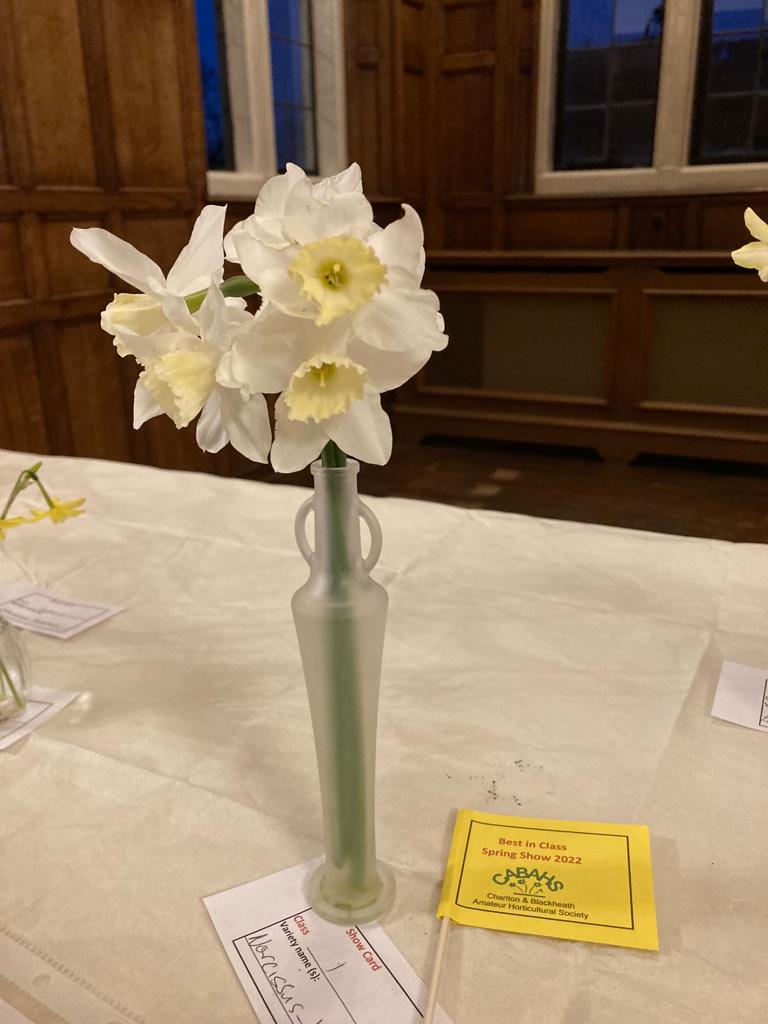
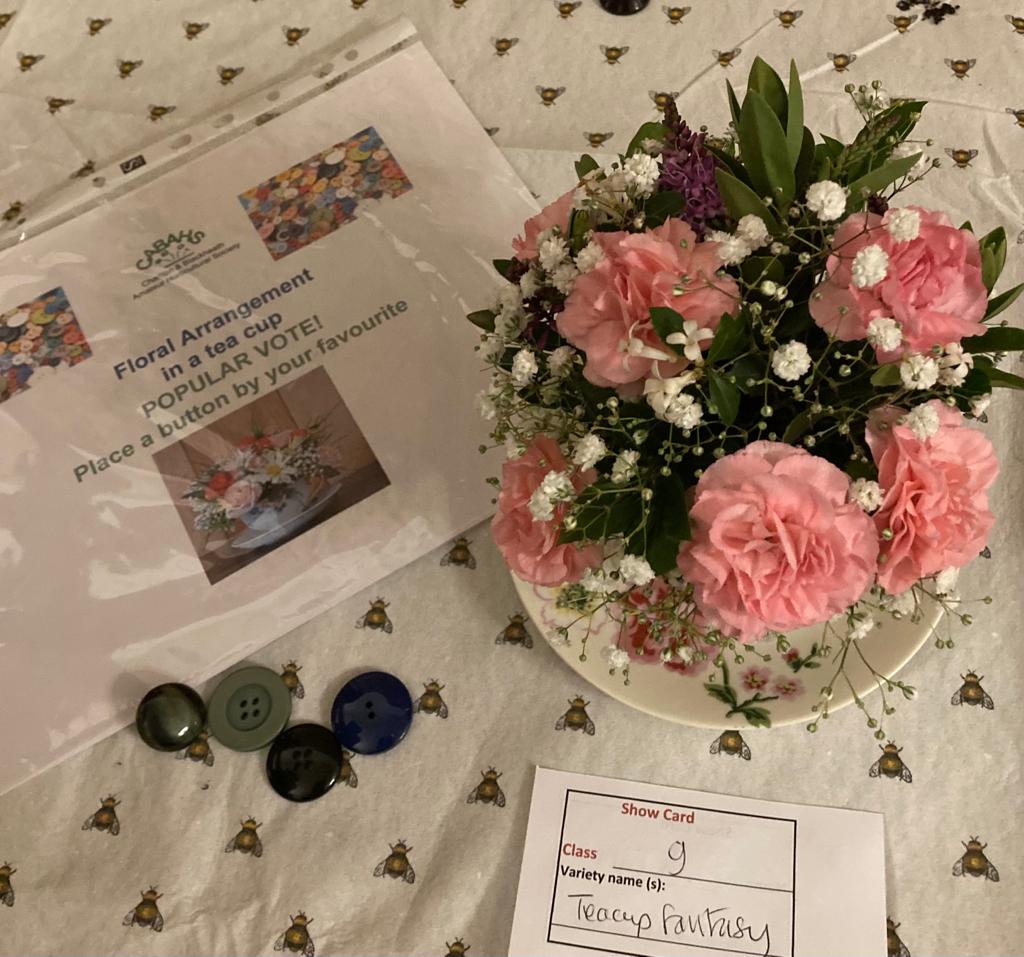
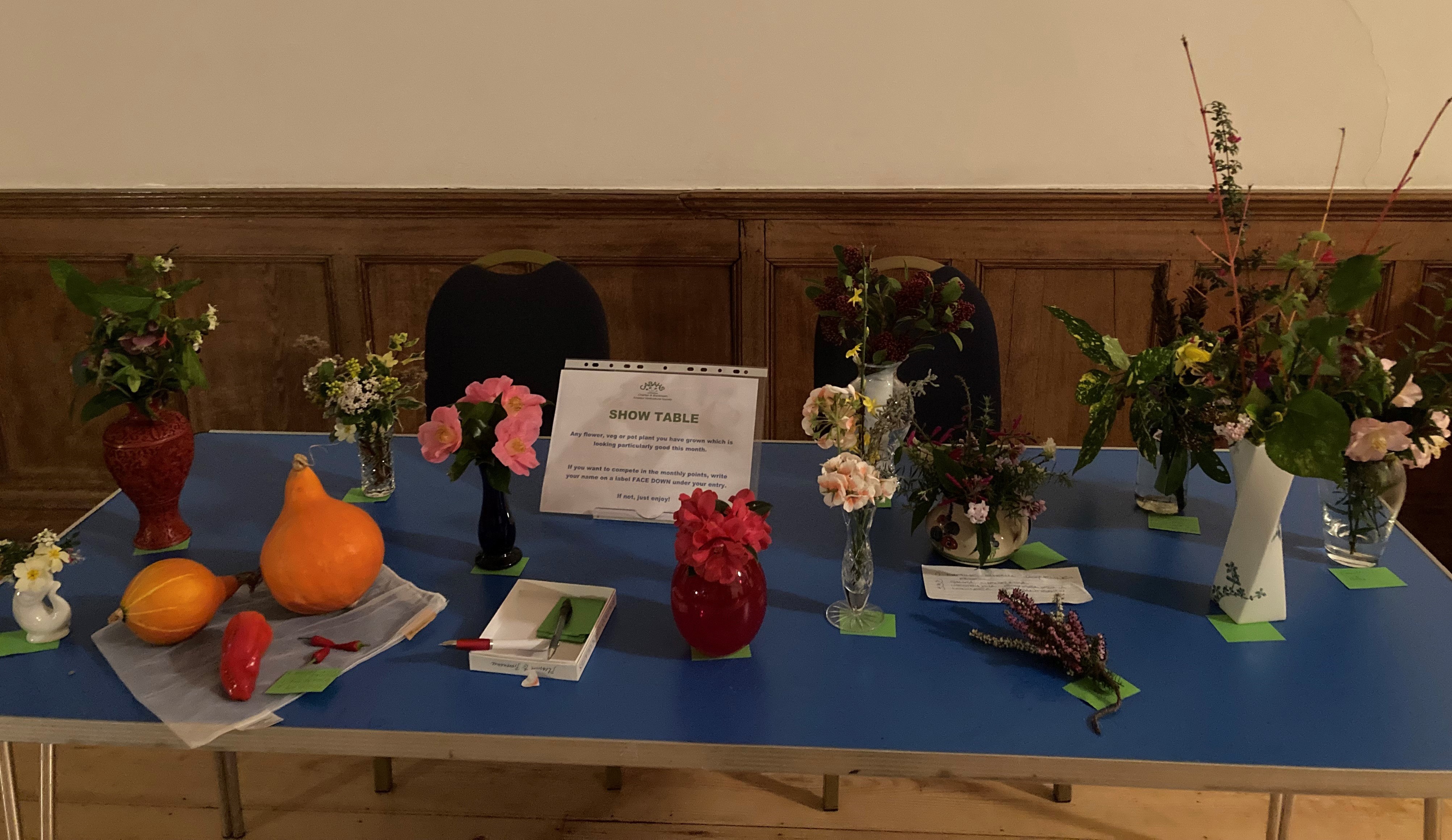
A proper Show Table again, at last! We had a very respectable 18 entries this month. Who would have believed November could be this colourful?
Category: Meetings
The society meets monthly at Charlton House. The meetings are friendly gatherings, with refreshments and a raffle. Normally there is either a Talk, a Show or a Members evening (see Programme of events). Members can bring in plants and flowers that are performing well in their own gardens to be displayed on the informal Show Table.
October 2021: Dr Mark Spencer on ‘Murder Most Florid’
The guest speaker for October was Dr Mark Spencer who gave a fascinating glimpse into his experience of working as a forensic botanist. It became clear that forensic botanists are a rare find throughout the UK and the world.
He explained that from being brought up within a rural farming background in Warwickshire, he studied at the Royal Botanic Gardens, Kew. However he realised he did not want to pursue horticulture as a job and moved onto studying Botany culminating in a Doctorate looking at the evolution of fungi. While working at the Natural History Museum where he had become an expert on various aspects of botany, he was approached by a Police department asking whether he could help work out how long a body had been in a canal.
He has now worked alongside numerous police forces and an array of other experts such as soil scientists, experts in the study of pollen and forensic entomologists (study of insects) to assist in missing person searches, assessing how long human remains had been in-situ and linking suspects to crime scenes.
As a forensic botanist, Dr Mark Spencer looks for useful evidence using his knowledge of the rhythm, structure and behaviour of plants within their eco-systems. This can range from observation and interpretation of how vegetation is growing at a scene being investigated, to a microscopic identification of fragments of foliage found on clothing, to looking at the stomach contents and understanding the botany within a person’s digestive tract.
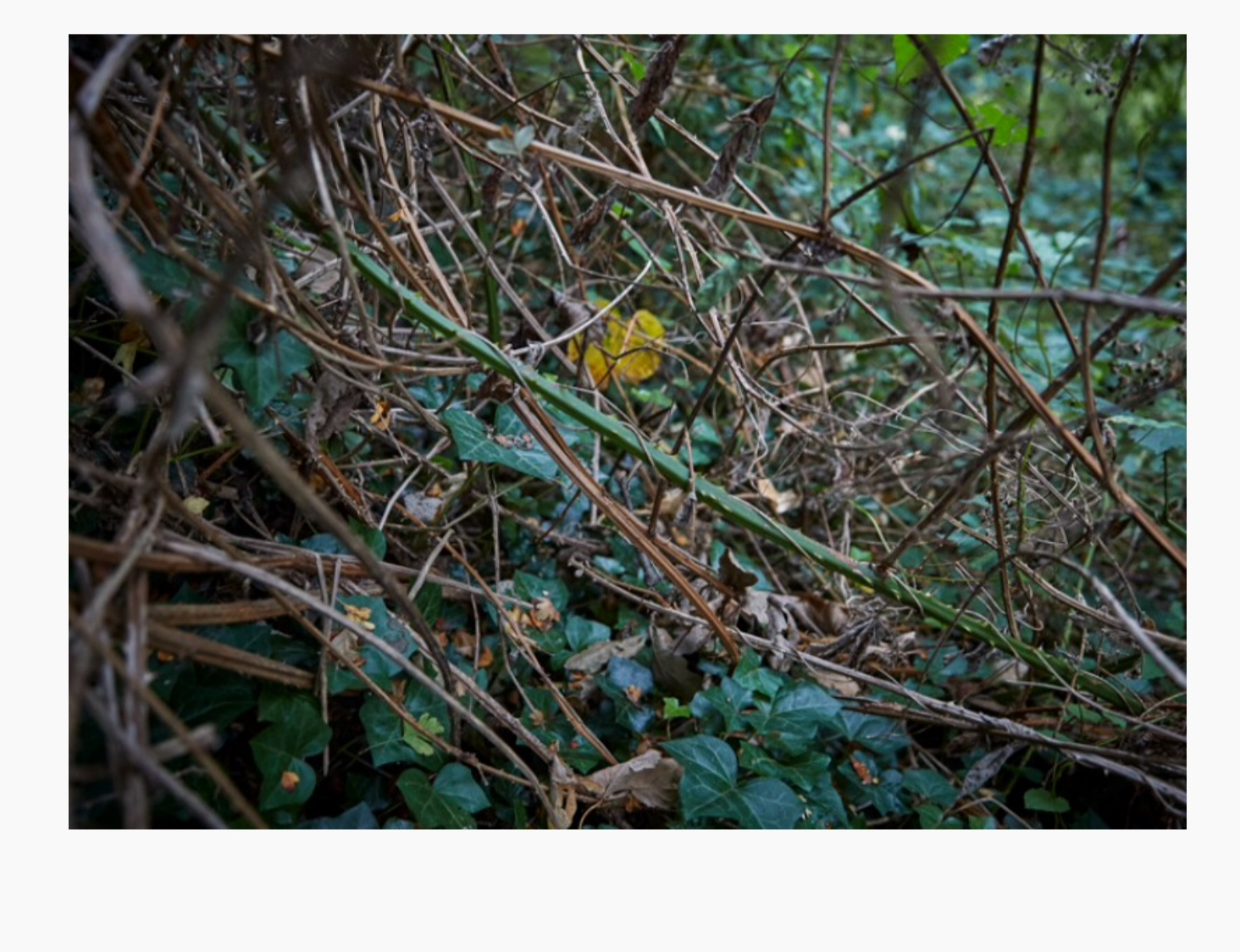
He explained how the roots of plants can help provide understanding of how long ago human activity occurred at the scene. Brambles (Rubus fruticosis) can be very useful tools for estimating how long bodies had been lying in woodlands or hedgerows through the knowledge of how they grow at different stages, when they send out side shoots and number of stems produced. I have a feeling that my walks through Oxleas Woods, which are full of brambles, will never be quite the same again!
Sharon
Dr Mark Spencer is an experienced and internationally respected botanist. His expertise covers many disciplines including forensic botany, the plants of North-west Europe, invasive species and the history of botanical science. He works globally as a writer, public speaker and television presenter and has appeared on BBC Radio 4’s The Infinite Monkey Cage. He is also Hon. Botany Curator of the Linnean Society of London. Dr Spencer’s website gives a detailed description of his range of expertise.
Autumn Flower, Fruit and Vegetable Display 2021
This was held on Monday 20 September in the Long Gallery of Charlton House. As one of many new members of the Society since meetings were forced to stop by COVID-19, it was my first indoor meeting!
It was a very impressive event with a total of 66 entries and I didn’t envy our guest judge, Joe Woodcock, his task. But Joe made it clear how impressed he was with all the entries, providing an encouraging commentary on the horticultural skills demonstrated, and explained why he selected the winning entry in each class.


The classes and winners were as follows:
1. Vase with single stem of any flowering plant – Viv P
2. Bowl of mixed flowers – Margaret T
3. Five Fuchsia blooms – Ruth Y
4. Ornamental pot plant – Pat K
5. A display of fruit and vegetables – Mandy & Brownie
6. A display of herbs – Ruth Y
7. Floral arrangement in a teacup – Anna L
8a. Potato Competition – Pam D
8b. Sunflower head competition – Annie H
Joe selected as Best in Show Margaret T’s wonderful display of varieties of dahlia in Class 2. Class 7 the Floral Arrangement was selected by popular vote (using buttons) and the Potato Competition was weighed by the trusty scales of Hugh P.
Joe was kind enough to answer a few gardening questions at the end of proceedings, and tea, coffee and biscuits were provided to round off the evening.
We counted 56 attendees. Everyone seemed to enjoy the event and be grateful to be able to meet up in person again. Long may that continue!
Lynda
August 2021: Amateur Gardeners Question Time “GQT”
Our amateur “GQT” was attended by over 50 members and OPG volunteers and was held outside, in the Peace Garden behind Charlton House. Our president, Sir Nicolas Bevan, introduced the panel experts – guest panellist Joe Woodcock, plus Vija Vilcins and Pat Kane. It was an exceptional meeting. As Sir Nicolas said, this was the first time members have met face-to-face since the beginning of the pandemic. To celebrate this it was also a social event with wine and nibbles provided – and appreciated!
Questions and Answers
Q1
Stella B: I would be grateful for some suggestions for a small or medium sized tree for my back garden. It’s a ’coming along’ garden begun a couple of years ago. There are now 3 apple trees (2 half standards and one espalier), so not another fruit tree. I really need it for some screening (it’s a terrace house) so maybe 12-15ft full grown? Not too wide a spread.
Q1 ANSWERS:
a) Joe:
i) Although Stella was not keen on fruit trees the crab apple would be a good tree. e.g. Malus ‘Red Sentinel’ with its wonderful golden leaves.
ii) Japanese maples (Acers) e.g. Senkaki with its yellow leaves in summer and its beautiful golden tints in autumn when its leaves become tinged with pink. Or Acer palmatum ‘Garnet’, a low growing acer.
iii) Rowans such us Sorbus acuparia and Sorbus ‘Joseph Rock’, yellow flowers with superb autumn colour.
iv) The Handkerchief Tree (Davidia involucrata). But maybe too large if the garden is small.
v) The Fox Glove Tree (Paulownia tomentosa). Because it grows into a large tree, buy it young and coppice it. It will then grow into a low growing shrub with very large leaves.
b) Pat:
i) The Paper Bark maple ( Acer griseum) and the Snake Bark Maple(Acer capillipes).
ii) Amelanchier lamarkii.
iii) Prunus ‘Snow Showers’ which hangs down.
c) Viya:
i) Amelanchier.
ii) Cornus canadensis.
iii) Cercis canadensis ‘Forest Pansy’ with burgundy leaf.
Q2
Chris B: I was given a Geoff Hamilton rose at the end of May and it flowered beautifully, but there have been very few flowers since then. It is supposed to be a repeat flowerer. Is there anything I can do to encourage more roses?
Q2 ANSWERS:
a) Joe:
It’s a modern shrub rose. If bought in a pot it needs time to establish. The roots need tweaking out before planting and it needs time to acclimatise to the soil and develop the energy for flowering and will very likely flower better next year when it has had time to acclimatise. In spring give it a mulch and feed it with Tomorite.
b) Viya:
Referring to roses in pots she said she had kept an Emma Hamilton rose in a pot and it needed a regular feed because the soil gradually lost its nutrients.
Q3
Pat K: I’ve got scale insects on the trunk of my Viburnum bodnantense Dawn. It’s planted in a pot as no room in the garden. The best way to get rid of it without any chemicals, please?
Q3 ANSWERS:
a) Joe:
Using cotton buds with methylated spirit, and squish them! Systemic fertilisers have been mostly withdrawn nowadays. Ants may form nearby which harvest them, but they are harmless.
b) Viya:
She said she has used a fingernail scrub. A labour of love. But they didn’t come back.
Q4
Carolyn H: My clematis (several varieties) are covered in black fly this year. The flowers are also being eaten. Are these two problems related? Is it a particular problem this year? How can I prevent it happening in future. Three questions actually!
Q4 ANSWERS:
a) Joe:
He said that his clematis were the best they have ever been this year! But the black fly problem may be due to the weather conditions this year. Use a hosepipe to wash them off or squash them with your fingers. If you use chemicals use a fatty acid one not a systemic . They may have been eaten by slugs and snails. Well known ways of getting rid of these include using egg shells, beer traps and wool. Also there is the book ‘50 ways to Kill a Slug’ by Sarah Ford.
b) Pat:
Go out at night with a torch and pick them off.
Q5
Kathy A: Do you have any suggestions or rules for how to space perennial plants out in a herbaceous border? I always start off ok but by about now everything looks squashed and lots of fighting for space going on. I was always told not to leave bare soil between plants as then you get weeds, but I don’t seem to be able to find that happy medium.
Q5 ANSWER:
a) Joe: I do the same. I suggest you cut back the thuggish plants in summer and make space for others. If it is a new border plant in odd numbers e.g. 3, 5, 7 etc. Fergus Garrett at Great Dixter has produced a video showing how to space out plants.
Q6
Melanie A: I would appreciate some suggestions for plants to go in a shared space. This is the scenario: our houses are fortunate to share a fairly large open space for which the householders are jointly responsible. We keep maintenance costs to the minimum by doing much of the work ourselves. Some of the trees planted many years ago by some householders help shield us from the horrors beyond, but they cast a lot of shadows. It would be great to have some thoughts on how to put some items of interest in this space, something that can’t be mistaken for lawn by enthusiastic mowers.
Q6 ANSWERS:
a) Joe:
In shaded areas plant Mahonia, Camellia, Elaeagnus and in damp shade ferns e.g Dryopteris wallichiana and Dryopteris filix-mas. Also plant in groups: Epimedium , Pachysandra terminalis, Pulmonaria ‘Sisinghurst White’. Foxgloves (Digitalis) and Japanese anemones(e.g.Honore Joubert) to show up in the shade. Spring bulbs like Tulip Red Riding Hood and Tete-a-tete.
b) Viya:
Miscanthus which initially only needs minimal watering just to get it going. Also Nandina domestica and Hydrangea ‘Vanilla Phrase’.
Q7
Angela B: Have you any suggestions for getting rid of pond duck weed?
Q7 ANSWER:
a) Joe: You can never get rid of duck weed. But use waders and a metal rake to clear it. Do leave it on the side for a day so that any organisms in it that need to live in the pond can return to it. Also, if new, place your pond near a bit of shade. Put in oxygenators and pond plants that will help maintain a balance such as irises and marsh marigolds(Caltha palustris). Try to maintain at least one third cover with lilies and marginals. Also a fountain would be useful.
Q8
Anne R: I have a Sorbus (Rowan) which I think is Sorbus ulleungenis ‘Olympic Flame’. It’s about 8 years old and still quite small and every year some of its growth dies back. It’s in a north-by-northwest garden, so it gets some sun, on heavy clay but well drained. Am I doing something wrong or is it the wrong tree for the space. I know I’m not the only person with a die-back problem I saw a Sorbus in Greenwich Park recently with the same problem.
Q8 ANSWER:
Joe: The rooting of Sorbus is vulnerable to extremes of environmental conditions. It doesn’t like heavy wet soil in winter and cracked soil in summer. Take a garden fork and lift and reduce compaction around the roots. Waggle the fork in the roots (“terra vent”). Mulch in winter. Monitor the tree and cut out dead wood.
Angela
July 2021: Dusty Gedge on roof gardens
Dusty Gedge was welcomed to the meeting. Dusty is a professional photographer and green structure and nature conservationist. He is President of the European Federation of Green Roof and Wall Associations. He said he was pleased to talk to CABAHS as he was local, Lewisham and Blackheath based, and had done a lot of work in the area. He said he is not a gardener but is involved in plants and soil.
Dusty made the point that green roofs and roof gardens have a local history, firstly showing a photograph of the 1997-built sustainable green roof on the now demolished Sainsburys on the Peninsular, followed by one of the 2019-built IKEA roof garden. In fact, Greenwich and Lewisham have the second and third most green roofs in London. Nowadays in England, including the City of London, it is planning policy that all tall buildings should have green roofs.
Dusty said that nowadays green roofs are becoming numerous. He showed photographs of a wide variety of them from Europe and the UK. From roofs in parts of Europe where traditionally turf and sedums were used to modern schemes, including nearer to home such as the roof garden at the National Theatre. He said there were 4 types of green roof (intensive, semi-intensive, biodiverse and extensive) and discussed the environment, conditions and maintenance needed for the various types to flourish.
Green roofs and roof gardens are taking soil and plants into the cities. He referred to ‘plumbing with plants’ using soil and vegetation as they store water, helping to ameliorate floods. They also help in heatwaves and the green space they provide fosters health, wellbeing and social cohesion.
He discussed two projects, the Museum of Home and Design which balances diversity with formal garden design using mediterranean and native plants and then IKEA with its four different sections. He said he would be happy next year to take CABAHS members on a tour of IKEA’s roof garden.
Afterwards, Dusty took questions and was asked by a member (who is also a surveyor) about infrastructure needed to support the roof and prevent leaks. He agreed that is an issue and said there were many structural strategies existing to prevent this happening. Another asked what would be the effect of wind on tall buildings. Dusty pointed out that the roofs of tall buildings were generally less windy than at ground level due to the funnel effect. He also reassured members that he collects local wildflower seeds in a sustainable way.
Angela
Dusty Gedge is a green infrastructure professional, public speaker, photographer, nature conservationist and social media influencer. He is President of the European Federation of Green Roof and Wall Associations and a recognised international speaker on green roofs, green infrastructure and biodiversity.
Dusty gave several links to useful websites and a podcast, below. He said members are welcome to contact him for advice.
June 2021: Graham Dear on managing Greenwich Park and the impact of Covid-19
Graham Dear was welcomed to our meeting. He said he was pleased to talk to some fellow gardeners, though he hadn’t gardened himself for many years, as he had moved from being Manager of Greenwich Park to heading up the Greenwich Park Revealed Project (GPRP). This is a 4-year project aimed at revealing, restoring, protecting and sharing the park’s unique heritage now and for future generations.
Graham said the pandemic had had a profound impact on Greenwich Park and the way it is managed. From March 2020 all recreational activities and events in all the Royal Parks ground to a halt, which resulted in an overall revenue loss of £20million, some 50 percent of annual spend. In Greenwich, the Pavilion Café, boating lake, tennis courts and even the rose garden had to be closed as its gates needed pushing and touching. There was no income from bandstand concerts, filming or car park fees or catering. The park was also unable to get insurance to cover events in 2021.
It had a particularly devastating impact on the GPRP which originally had had a £10m budget allocated to it. £4.5m was funded by the Heritage Fund which had already begun to be implemented. Graham said he was faced with the challenge of making economies due to the loss of park revenue. He aimed to save £2m, so the GPRP budget has been cut to £8m. The cuts included the Nursery Yard reorganisation and the Sustainable Learning Centre.
Not all was bad though. Closing the through road and avenues was beneficial to pedestrians. Although the park no longer had tourists, there was a massive increase in local visitors to the park – who often arrived by bike or on foot – and used it for exercise and recreation.
Rubbish was an issue but the staff coped well with the challenge and more bins are now a feature of the park!
Visitors were naturally more spaced out because of social distancing needs. An informal poll showed they were much younger as well. Ethnic diversity also increased by 5 percent.
Graham then went on to discuss the revised plans they had for the park and showed a range of slides to illustrate the programme. He said the GPRP had now begun again.
- They plan to preserve, renovate and manage the avenues of trees which have been decimated by diseases, pests and squirrel damage. The horse chestnuts are riddled with bleeding canker and the sweet chestnuts by ink stain disease.
- The area around the grand ascent giant steps and parterre banks is to be renovated. Recreating a series of grass steps on the hill leading to the Royal Observatory following the original 17th century design.
- The viewing space in front of the area around the statue of General Wolfe is to be increased and opened up. A café will open in the space behind.
- The Old Wilderness and deer park community facilities will be enhanced including a new classroom. The deer herd is to be sent on holiday to Richmond Park for 2 years.
- Vanbrugh Yard: The area in the SE corner of the park is to be reorganised. There will be a cafe aimed at taking pressure off the Pavilion Café. The boundaries of nursery yard, will be shifted and opened up to the public. It will feature a new glass house, kitchen garden, wildlife orchard, volunteer room and public toilet facilities.
- The seating in One Tree Hill will be improved.
- Car parking at the pedestrian entrance at Blackheath Gate will be removed and the pedestrian entrance will be improved.
- The Victorian bandstand is to be improved and a power supply for community events installed.
- The wildlife habitat is to be increased and mowing will use a meadow cut rather than an amenities regime.
- The Victorian drinking fountains to be reinstated.
- Two self-seeded mature trees are to be removed from Flamstead House to improve the view.
Finally, he discussed the park’s engagement with the wider community, including training schemes that were being introduced such as three year apprentices and cultural events such as the Tramshed and dance. Graham then answered members questions, and was thanked for such an interesting talk.
Angela
Graham Dear is Manager for Greenwich Park. His management has overseen Greenwich Park Revealed, ‘an exciting multi million pound project to conserve and to enhance Greenwich Park’s historic and natural heritage, putting the community at its very heart’.
May 2021 – Joe Beale on the Changing management of Blackheath, Greenwich & Charlton
Our May talk on Zoom was presented by local naturalist Joe Beale. He discussed the changing management of the local area, including Charlton Park, Greenwich and Blackheath and the impact this is having on local plants as well as lichens and animals.
He discussed the approach to take to habitat management – that there were lots of things worth fighting for. He discussed the need to carry out research and ecological surveys, the need for a conservation action plan and to take conservation action appropriate to the conservation site. Also the necessity to work in collaboration with local residents, communities, landowners, specialists and the local council. He commended the support given by Greenwich Parks and Open Spaces and its willingness to assist.
Joe began by showing a photograph of the Vanbrugh Pits in 1983 when vegetation there was scarce, but rich in bio-diversity, and now, when it is dense with brambles and Holm Oak which are killing off the flora and fauna. He pointed to the need for pursuing in management a middle path there, including getting rid of the Holm Oak, Cherry and Turkey Oak (as well as the dogs mess!).
Key diverse wild life plants in this area he suggested were species that needed low nutrient soil e.g. blackthorn plantain and lichens such as Cetraria aculeata and Chaldonia furcata. He said 29 types of butterfly had been found on the Greenwich Park side of Blackheath in 2010 which was about half of the UK total and 173 species of bees and wasps.
Also found in acid grassland and sandy soil are sheeps sorrel (Rumex acetosella), birds foot (Ornithopus perpusillus), spurry (Spergularia rubra ) and lichen (Cetraria aculeata).
Blackheath and the Greenwich Park side of it is well known for plants and clovers which thrive on soil of of low nutrient value. Such as hare’s foot clover (Trifolium arvense), knotted clover (Trifolium striatum), woolly clover (Trifolium tomentosum,) and clustered clover ( Trifolium glomeratum).
Wildlife included gorse( Ulex europaeus) for the whinchat birds, ragwort visited by 43 bees and wasps, the burnet and cinnabar moths and small copper butterflies.
Joe said sympathetic mowing was crucial in particular the need to remove the hay to promote biodiversity as it was nutrient rich. Always have wildness at heart. Leave the edges of sites, leave verges and banks and mow in rotation. Expose earth and deadwood. Consider the food, plants, shelter, nesting and breeding needs of key wildlife.
He described the increase in biodiversity in verges in Blackheath since it has had relaxed mowing as well as Charlton’s Maryon Park. He also referred to the Wildlife Meadow which is being constructed in Charlton Park. The policy there of not sowing wild flowers, just digging the area over and seeing what grows. He pointed out the value of cemeteries in promoting biodiversity. He mentioned that cemeteries such as Charlton cemetery are expected to be neat and tidy, but, in fact are bustling with wild life and like Charlton they should have an area left to encourage biodiversity.
To help promote and encourage more biodiversity Greenwich Park has also taken a more relaxed approach to mowing and is allowing grass to grow in some areas as well as setting up biodiversity friendly habitats. This policy has been incorporated into its multimillion pound Heritage funded renovation programme. Many CABAHS members are already keen promoters of biodiversity and wildlife. Hopefully Joe’s enthusiastic talk will encourage the rest to consider the needs of biodiversity and wildlife in their own gardens.
Angela
Joe Beale is a naturalist who, in addition to carrying out surveys of local wildlife, giving talks and writing, also offers guided walks. He is across social media platforms with an active Twitter account, updating people on what to see in our area.
April 2021 – Adam Pascoe on creating a garden for all seasons
Our recent Zoom talk featured Adam Pasco, horticultural journalist and editor of Gardeners World magazine for many years, who provided ten tips and ideas on how to create a garden for all seasons that would provide garden interest and colour throughout the year. He used as a backdrop and example his own beautiful back garden in Peterborough which he had created over the last 30 years. A garden that we amateur gardeners could relate to and achieve.
1) CHOOSE PLANTS WITH STRUCTURE AND FORM: Adam suggested as examples, the Wedding Cake Tree – Cornus controversa variegata, Hydrangea paniculata, Cardoon – Cynara cardunculus.
2) PICK PLANTS THAT HAVE A LONG SEASON OF INTEREST: He suggested putting the perennial Spanish Dagger – Yucca Gloriosa variegata in a large pot and surrounding it with annual bedding plants which could be changed each season.
3) USE PLANTS AND COMBINATIONS FOR CONTINUITY OF COLOUR: For example Phlomis russeliana (AGM) and Nepeta racemosa.
4) ADD FEATURES AND FOCAL POINTS: He gave examples such as seated areas with benches, painted wooden fences, paths, arches and water features. He gave East Rushton Old Vicarage garden, Barnsdale Gardens, and Old Wallerton Hall as examples.
5) CREATE STUNNING SEASONAL DISPLAYS: So that you have a display in each season. He gave the red border at Hidcote as an example of a summer display.
6) ADD VALUE ACROSS ALL SEASONS: Also design your garden so that it looks good all the year round. Focus on one area that looks good for one season. Adam suggested Camellia ‘Garden Glory’ Feb – March, dwarf Rhododendron ‘Snipe’ Feb – March, Camellia ‘Contribution’ Mid March-April, Skimmia x confusa ‘Kew Green’ (AGM) – April, Lithodora ‘Heavenly Blue’ – Spring through summer, Azalea ‘Sheila’ – May, Rhododendron ‘Yakushimanum’ – May, Rhododendrum ‘Surrey Heath’ – May, Kalmia latifolia -Early June, Clematis ‘Oh La La’, Boulevard Series, Hydrangea -Summer into Autumn, Taxus baccata ‘Standishi’ (AGM) -Year round, Tibetan Cherry Prunus serrula.
7) EXCITE THE SENSES: He suggested sensory plants such as Nemesia ‘Wisley Vanilla’ and Lilium ‘Pink Romance’.
8) GROW SOMETHING DIFFERENT: He suggested Sophora ‘Sun King’ (AGM), Hollyleaf Sweetspire, Itea ilicifolia (AGM), Phygelius ‘Moonraker’ and Ptilotus ‘Joey’ for a sunny patio pot.
9) PLANTS THAT ATTRACT WILDLIFE: He suggested Alstromeria initicancha ‘Sunshine’ and Cotoneaster horizontalis for berries.
10) HAVE A STAR PLANT FOR EVERY MONTH:
EARLY SPRING: Plant Narcissus ‘Tete- a- Tete’, Camellia x Williamsii ‘Saint Ewe’ (AGM) and Summer Snowflake ‘Leucojum aestivum (AGM) with Brunnera Jack Frost (AGM).
MID SPRING: Star Magnolia – Magnolia stellata, ornamental fruit and trees e.g Self fertile Pear ‘Concorde’ (AGM), Epimedium x Perralchicum ‘Frohnleiten’.
LATE SPRING: Rhododendron ‘Yakushimanum’ (AGM), Perennial Wallflower Erysimum ‘Bowle’s Mauve’, Clematis koreana ‘Amber’.
EARLY SUMMER: Roses including ‘Gertrude Jekyll’ and ‘The One and Only’, Allium ‘Globemaster’ (AGM). Annual climbers e.g. Sweet Peas, Thungbergia alata ‘Superstar Orange’, Spanish Flag – ‘Ipomoea lobata’, Cup and Saucer Vine – Cobaea scandens.
MID SUMMER: Astranta major ‘Roma’ (AGM), Echinacea magnus, Lavender Fathead ‘Pretty Polly’, ‘Willow Vale’, L. Viridis.
LATE SUMMER: Crocosmia ‘Lucifer’ (AGM), Rudbeckia ‘Goldstrum’ (AGM), Sedum Thundercloud’, ‘Purple Emperor’ (AGM), ‘Rose Carpet’, Sedum takesimense ‘Atlantis’.
FOLIAGE FAVOURITES THROUGHOUT THE SEASONS: Acer shirasawanum ‘Aureum’ (AGM), Euphorbia ‘Ascot Rainbow’ (AGM), Brunnera ‘Jack Frost’ (AGM), Persicaria ‘Red Dragon’, Physocarpus ‘Diabolo’ (AGM), Elder – Sambucus ‘Black Lace’ (AGM), Viola ‘Heartthrob’, Acer palmatum ‘Seiryu’.
EARLY AUTUMN: Perennial Sunflower – Helianthus ‘Lemon Queen’ (AGM), Aster x Frikarti ‘Monch’ (AGM), Japanese Anemones ‘Pretty Lady Susan’ ‘Honore Joubert’ (AGM), Prinz Heinrich ‘Pamina’ (AGM) and ‘September Charm’ (AGM).
MID AUTUMN: Autumn colour- Stag’s Horn Sumach – Rhus typhina, ‘Kashmir’, Rowan – Sorbus ‘Cashmiriana’ (AGM).
LATE AUTUMN: Crab Apple – Malus ‘Red Sentinel’ (AGM), Skimmia japonica ‘Pabella’ (female for berries).
EARLY WINTER: Silver Birch – Betula ‘Silver Shadow’ (AGM).
EVERGREEN FORM AND COLOUR FOR ALL SEASONS: Japanese Sedge – Carex ‘Evergold’, Helleborus argutifolius (AGM), Skimmia ‘Kew Green’ (AGM) (male), Chamaecyparis ‘Boulevard’ (AGM), Choiysia ‘Aztec Pearl’ (AGM), Choisya ternate ‘Sundance’ (AGM), Hebe ‘Margaret’ (AGM), Evergreen Fern – Soft Shield Fern Polytsichum setiferum (AGM).
MID WINTER: Mahonia x Media ‘Winter Sun’ (AGM), Daphne bholua ‘Jacqueline Postill’ (AGM), Winter Aconite – Eranthis Hyemalis (AGM),
LATE WINTER: Crocus ‘Tricolor’ (AGM), Snowdrop – Galanthus nivalis (AGM).
Finally, Adam suggested garden jobs for April: it is a good time to transplant and split Agapanthas. Also he recommended buying seeping hosepipes, and that timers could be attached to taps. A time too for testing old seeds to see if they are worth using. Take a few, soak in water overnight, dry them and cover them with cling film. Check after a couple of days to see how many have germinated.
Angela
Adam Pasco launched the BBC Gardeners’ World magazine in 1991 and edited it for 22 years, he currently edits the Waitrose magazine, and has worked alongside gardening icons Geoff Hamilton, Geoffrey Smith and Alan Titchmarsh; he also lectures, is a renowned photographer and runs his own media company, adampascomedia.com
March 2021 – David Marsh on ‘Elephants in the Garden’
At our recent Zoom talk, Dr David Marsh, a garden historian, gave a detailed account of the history of elephants in gardens focusing primarily on menageries and then on large scale mechanical elephants. His interest in elephants was stimulated by a visit to a café at the grade I listed Chiswick House and gardens where he noticed a coaster had an elephant depicted on it.
The earliest mention of a menagerie in the UK is in 1199 in the grounds of Woodstock Manor situated on the site of the present day Blenheim Palace.
The monarchs over the centuries were very keen on menageries and elephants. Elephants were often given as gifts. Henry 111 was given an elephant in 1255 by the French King which cost £24.14s.3p to feed over a period of 9 months. A colossal sum at the time. So too were Henry VIII and Elizabeth I. James I was especially attracted to menageries. He was given one by the King of Spain.
Henry VIII set up a menagerie in the Tower of London where an area was set aside for it. Over the centuries the menagerie became a tourist attraction. A viewing platform was erected in 1597. The animals were sometimes baited to entertain tourists. In the 18th century the entrance fee was 3p, or if you could not afford it a cat or dog to feed to the lions.
Elephants over the centuries were often fed and housed inappropriately. One was fed wine. Not surprisingly some did not live very long. Henry VIII’s elephant only lived 2 years.
By the mid eighteen century menageries became must have features found in many country estates. There were estimated to be as many as 40 at one point. Though rare that they had elephants. One well known elephant was Sadi who was given to the Duke of Devonshire at Chiswick House by the Marquis of Hastings of India fame as a present. He even introduced her to the Russian Czar. The animals in menageries became increasingly varied and exotic. A reflection of the expanding British empire overseas.
By the early 19th century menageries had also become commercial enterprises. The Exeter Exchange was set up in the Strand near Somerset House in 1815. One elephant there, Chunee was taught tricks. She was hired out to theatres, but eventually had to be killed as she became too dangerous.
The early nineteenth century was the heyday and also the swansong of menageries. The tide turned on Chunee’s death and a more humane and educational approach was introduced during the 19th century. George IV had a menagerie set up at Windsor using a more enlightened approach.
In 1826 the Linnean Society spear headed by its members, Sir Joseph Banks, Humphry Davy and the Stamford Raffles founded the present day London Zoo in Regents Park where the animals were provided with more spacious accommodation within beautiful gardens. In the 1830s William 1V closed the Tower menagerie and its animals were moved to Regents Park. It did not have an elephant so the new zoo quickly bought two.
The Exeter Menagerie was moved to a site in the Walworth Rd by its owner Edward Cross. He situated it in a large beautifully designed and laid out garden. It became a major tourist attraction.
Dr Marsh then moved on to mechanical elephants They were first mentioned by Jules Verne in 1880 and started to be manufactured at the beginning of the twentieth century. Frank Smith and then in the 1940s and 50s, Frank Stuart , developed and manufactured and sold world wide large scale mechanical elephants. They became major tourist attractions. They were also used for advertising purposes, including by Chipperfields Circus. One in Australia called Nellie played a central part in the annual Adelaide Christmas Parade. One huge automaton in Nante took 20-30 passengers and shot water from its trunk. Some still exist. One is in the Bewley Motor Museum. One was even sold on Ebay in 2011 for £1,600. Another featured in Jeremy Clarkson’s Top Gear!
Dr David Marsh is a garden historian, lecturer and writer, as well as a trustee of the Gardens Trust, a charity dedicated to the conservation of our historic parks, gardens and designed landscapes. He is an expert on garden history and co-convener of the History of Gardens and Designed Landscapes seminars at Institute of Historical Research, London University. A brief introduction to his talks can be found at gardenhistorytalks.com and he also writes a weekly blog for the Gardens Trust.
February 2021: Dr Catherine Horwood on Beth Chatto
Many of us who are avid and long-time fans of Beth Chatto’s garden and her Unusual Plants Nursery will always remember that she won 10 consecutive Gold Medals at the Chelsea flower show. Her legacy is a garden she created which is unlike any other in the UK and abroad: it is unique.
Dr Catherine Horwood, Beth Chatto’s authorised biographer, introduced Beth Chatto to members and guests via last Monday evening’s Zoom meeting.
The talk was about Beth Chatto’s personal life and the influences that led to the garden’s creation. We learned that she happily gardened alongside her parents and had her own garden patch of cottage garden flowers. And we know that her hobby as a flower arranger as a young woman hugely influenced her interest in plant forms, textures and colours.
Dr Horwood described Beth Chatto as ‘tough’ and ‘steely’, and she must have been extremely determined from a young age, as she trained as a teacher during WW2, instead of taking the usual route of joining the Forces. An advantageous marriage to a fruit farmer, Andrew Chatto, with a life-long interest in plant ecology, set the stage for the purchase of land at Elmstead Market and the garden that followed.
But why did Beth Chatto design the garden the way she did? We know she was influenced by the terrain and various soil conditions, in addition to a natural spring at the lower level. How did her design of a ‘necklace of ponds’ separated by very narrow water channels come about? We know she was influenced by her friend and mentor, Cedric Morris in those early days and Beth Chatto acknowledges the huge debt to her husband at the start of her book, ‘The Dry Garden’, in which she states: “Without Andrew neither my garden nor a book would have been possible”.

Anna
Dr Catherine Horwood is an English journalist, author and social historian who has written extensively on horticulture and garden design and is the authorised biographer of Beth Chatto. A keen gardener for over thirty years, Catherine has created three gardens that have been open through the National Gardens Scheme and was for many years an organiser for the NGS. Her Facebook page gives you links to her other work on women gardeners, growing houseplants and you can check out her blog on growing vegetables. Her book on Beth Chatto won European Garden Book of the Year in 2020.