Colour in the garden

Begonia ‘Glowing Embers’
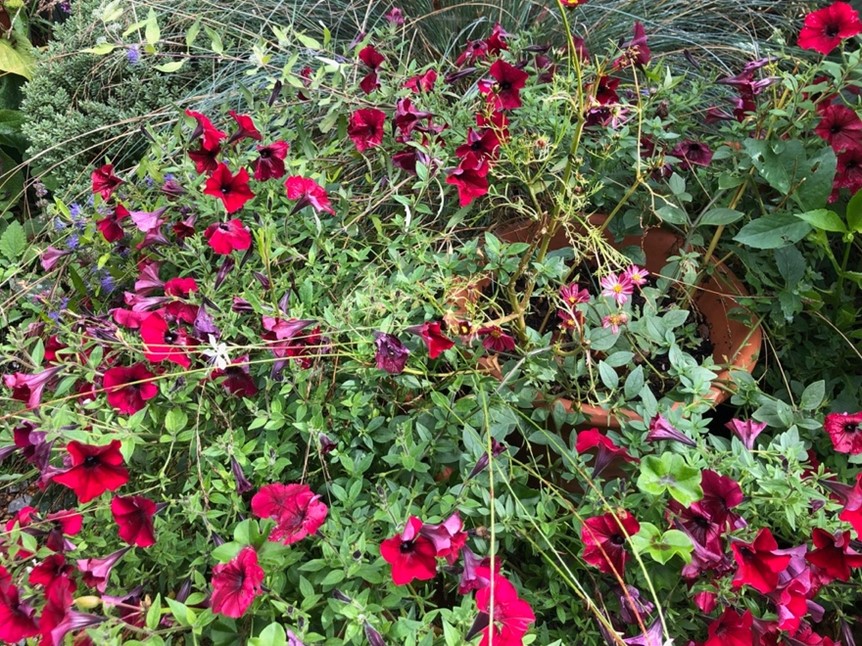
Petunia ‘Tidal Wave Red Velour’

During this blistering summer a number of people have commented on the colour in my garden (such as it is). I think this is down to a very few plants. (For those of you not enamoured with Sarah Raven, look away now). The top photograph is of Begonia ‘Glowing Embers’. These have flowered continuously all through the summer and I think the contrast of the leaf and flower is lovely. Although often grown as an annual, I have found that if I keep them in a sheltered and frost-free place over the winter they will flower again year-on-year. But be patient! The little stone-like tubers look thoroughly lifeless for a long time and, just when you might think they were totally dead, little green shoots appear.

The bottom photograph is of Petunia ‘Tidal Wave Red Velour’. These were originally plants in pots with cosmos and coleus, the latter two turned up their toes leaving only the petunia to inhabit the pot. It is only one plant and this too has continued to flower continuously through the summer. The pots have only been watered with waste water and have had no additional feed.

Both of these hard workers have come from Sarah Raven and, no, I don’t get a discount!

Vija

Perch Hill

Thinking we would take advantage of the extra days made available for visits to Perch Hill, we chose the one for container planting. However, on the day it was the dahlias that stole the show and which we will remember!

Although rain was not forecast, we arrived to a little bit of a mizzle and a very grey sky – in the photographs this has tended to deaden the exuberant colours. We were knocked out by Penhill Watermelon, Geri Scott and the delicious Apricot Desire, but it would be impossible to choose one favourite out of all the lovely colours. Although some are critical of the Sarah Raven enterprise, there is no question that the gardens are beautifully styled. Of course, plants are labelled so that anything you see you will find on their website, but it is a commercial business. In fact, it is good to find a label so that you can identify what you are looking at! Salvias are everywhere, edging the herbaceous borders, in pots as well as mixed through the beds. These are such versatile plants.

Dahlias at Perch Hill
Continue reading Perch Hill

Being a ‘good’ gardener

People today garden for a whole host of reasons – as a hobby, a delight in horticulture generally, exercise, well-being and being out of doors, to grow their own produce – but, historically at least, gardening has also been seen as a highly moral activity.

By the end of the 19th century the garden was advocated as a way of keeping the working classes away from the public house, where they could be usefully engaged in a more wholesome and productive activity. William Hogarth’s cartoons of ‘Beer Street’ and ‘Gin Lane’ are visual reminders of the conditions which were a cause of concern.

William Hogarth's cartoon of Beer Street and Gin Lane (1751)
Beer Street and Gin Lane (1751)

John Claudius Loudon (1783 – 1843) championed the creation of public parks to improve both the mental and physical health of working people, so that ‘the pale mechanic and exhausted factory operative might inhale the freshening breeze and some portion of recovered health’.[1] It was Joseph Strutt who picked up on these ideas and put Loudon’s vision into practice to create the Derby Arboretum in 1840. Strutt was very clear on the rationale behind this work: to wean people away from the ‘brutalising pleasures’ they might seek elsewhere and to offer them a new form of ‘rational enjoyment’. In Edinburgh recreation in a park was thought to be a solution for drunkenness and in the Midlands it was thought to lead to a decrease in crime rates.

‘In 1919 the Conservative MP for Chelmsford was reconciled to spending money on housing by the thought that good garden plots would ensure that when the man of the house got home at night “he will find not only a healthy family, but healthy occupation outside where they can go and work together as a family”’.[2] A well maintained garden was also viewed as an indication of a well maintained (and thus moral household). As late as the 1920s and 1930s inspectors were employed to visit the gardens of council estates to ensure that they were being kept tidy.

Vija

[1] Loudon, J.C. (1822) Encyclopaedia of Gardening.

[2] Floud, R. (2019) An Economic History of the English Garden, Penguin Books, p247.

Funky Hostas

Photo of Hostas taken in the Spring!
Photo taken in the Spring!

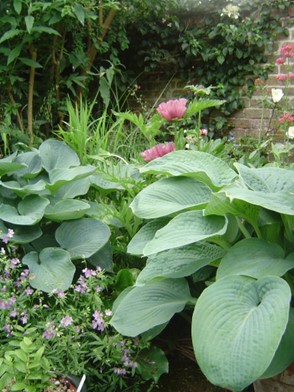
I love hostas, but they have a reputation for being difficult, not least because of their attractiveness to slugs and snails. They are commonly thought to do best in moist partial shade, but this shockingly dry year has been a surprise. As Chris Beardshaw points out, there are several that do well in dry shade, the sieboldiana types in particular. Although many of mine in direct sunshine for most of the day have scorched this year, there are also several that have done surprisingly well in quite dry and sunny conditions.

Hostas were originally named in honour of the Austrian botanist Nichloas Host, but in 1817 the name Funkia was used by a German botanist in honour of botanist Heinrich Funk. The name Funkia remained in use for some time and there are a number of horticultural texts written over this period which refer to Funkias. In 1905 Hosta was reinstated as the genus name by the International Botanical Congress.

I quite like the name Funkia. It makes me think of the plants secretly having a good time after I have gone to bed.

Vija

August blog 1

‘Rubens Peale with a Geranium’, painted by his brother, Rembrandt Peale, 1801. National Gallery of Art, Washington, USA – Patrons’ Permanent Fund
‘Rubens Peale with a Geranium’, painted by his brother, Rembrandt Peale, 1801. National Gallery of Art, Washington, USA – Credit: Patrons’ Permanent Fund

I found this photo posted on the blog of Garden History Girl. It’s one of the blogs I have at some stage signed up to and now get regular posts. It is worth checking out (overlook the name) and this one contains some fascinating information on pelargoniums / geraniums and snippets of plant history. If you have never been clear on what are pelargoniums or geraniums, this is the one to look at! And there are some lovely pictures too!

Vija

Plant Sale and Community Day at Charlton House on Sunday May 22nd

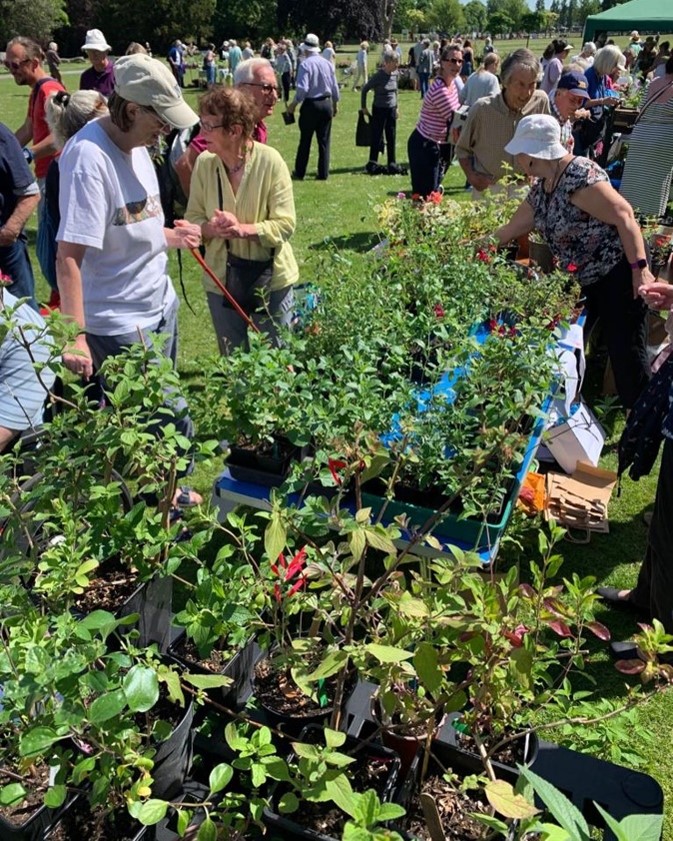
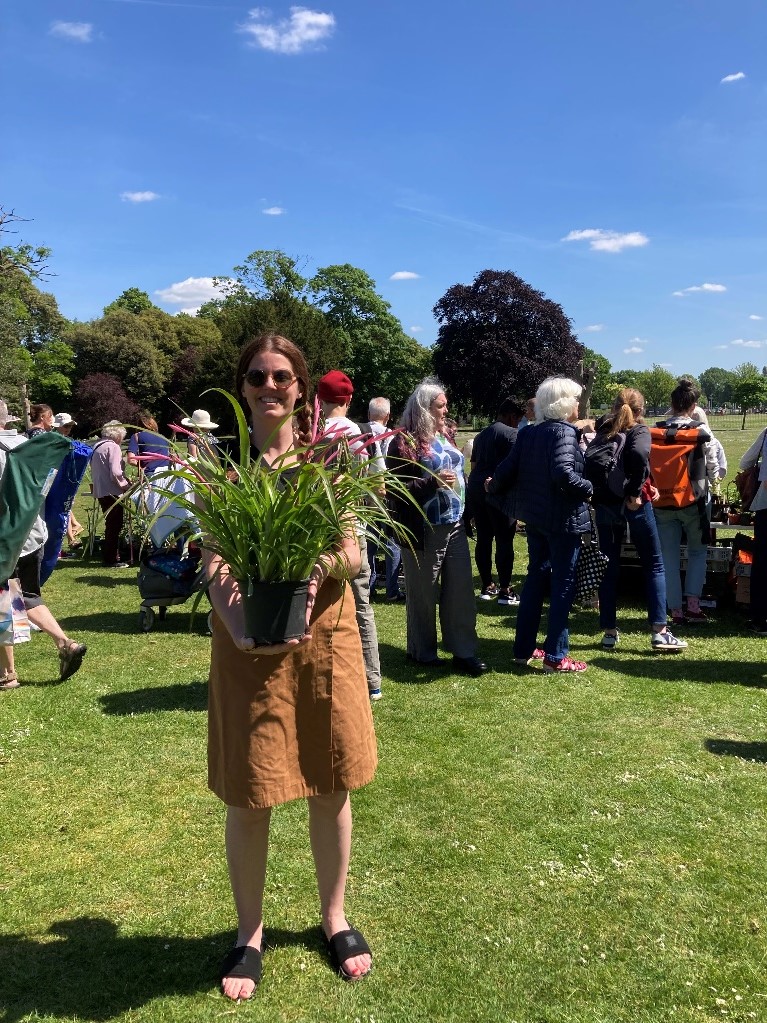
Thank you to everyone who came to our Plant Sale and Community Day at Charlton House on Sunday May 22nd, what a fabulous day, sunny and successful!  Plants were either donated by members or grown on by the Volunteers in the Old Pond Garden. We were slightly staggered by how popular our plants were, and we had pretty well sold out by 1pm, which was amazing. Everyone was very generous, either buying plants or donating for our home made lavender bags, or the Discovery Trail.

Our Community event was shared with Charlton Community Garden, who ran the “Pot up a plant” stall, Blackheath Flower Arranging club, Friends of Greenwich Park, The Charlton Society, Montessori Moments, Greenwich Music School and the Charlton Toy Library. And of course the Greenwich & Blackheath WI cake stall.

We were very pleased to be part of the Trusts “Sustainability Sunday”, it was certainly lively and great to see so much going on. The Producers Market was on the Front Lawn, there were tours of the House, talks about Heritage and garden tours with our very own Head Gardener, Jason Sylvan. Frilly’s café was open and the Old Library had items from the Greenwich Archive on display as well as installations by local artists Fiona Veacock and CraftA, and other childrens activities.

Funds raised from plant sales will go to the Greenwich & Bexley Community Hospice, our Speaker programme and the Walled Gardens revival. Thank you all!

Kathy

Harrogate Flower Show and Harlow Carr

Late April is a great time to remind yourself that spring happens outside of London, and I had the joy of meeting a group of friends in Yorkshire for the Harrogate Flower Show.  This is quite a major show, running over 4 days, but it’s not run by the RHS and it has quite different emphases.  It does, though, have lots of exhibitors and we enjoyed a full day there, in brilliant sunshine.

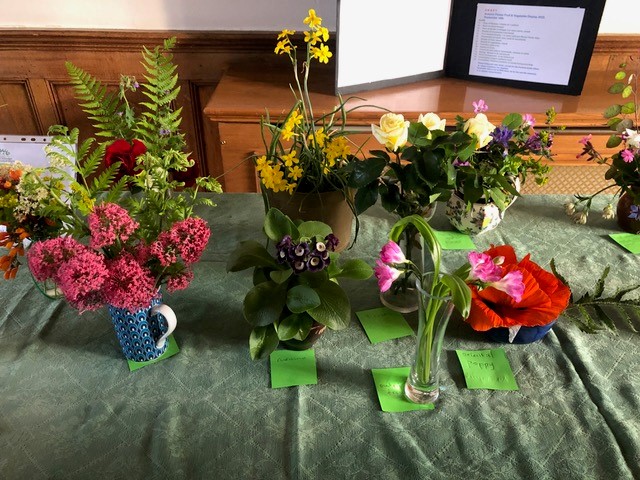
First off, we looked at the flower arranging, clearly a major component with several training colleges nearby.  There were lots of competition categories, from big set pieces to carefully chosen themes.  We admired long-horned cows fashioned from garlands of flowers, and saw a heavy emphasis on arum lilies, which featured on the Best In Show winner, for instance. 

By contrast, the show gardens were a very minor element of the event.  They were small, commercially-sponsored but not carefully themed, and quite underwhelming.  And they had very few people looking at them. 

The area for various Societies was dominated by the Daffodil Society Northern Group, where competitors were vying for prizes in nearly 100 categories.  The variety of blooms was extraordinary, with a strong emphasis on precision and newly-developed cultivars.  Among others, the Yorkshire Bonsai Society was also showing beautiful specimens, as were the National Auricula and Primula Society, the National Dahlia Society, and the West Yorkshire Hardy Plant Society, which won a Premier Gold award for its spectacular display. 

Continue reading Harrogate Flower Show and Harlow Carr