Kathy A’s Japanese anemones (probably variety “Serenade”) are the tallest they have ever been this year. Even the usual white ones, Honorine Jobert, are phenomenally tall. Is it the rain? Have other members experienced this?

Kathy A’s Japanese anemones (probably variety “Serenade”) are the tallest they have ever been this year. Even the usual white ones, Honorine Jobert, are phenomenally tall. Is it the rain? Have other members experienced this?
Our amateur “GQT” was attended by over 50 members and OPG volunteers and was held outside, in the Peace Garden behind Charlton House. Our president, Sir Nicolas Bevan, introduced the panel experts – guest panellist Joe Woodcock, plus Vija Vilcins and Pat Kane. It was an exceptional meeting. As Sir Nicolas said, this was the first time members have met face-to-face since the beginning of the pandemic. To celebrate this it was also a social event with wine and nibbles provided – and appreciated!
Q1
Stella B: I would be grateful for some suggestions for a small or medium sized tree for my back garden. It’s a ’coming along’ garden begun a couple of years ago. There are now 3 apple trees (2 half standards and one espalier), so not another fruit tree. I really need it for some screening (it’s a terrace house) so maybe 12-15ft full grown? Not too wide a spread.
Q1 ANSWERS:
a) Joe:
i) Although Stella was not keen on fruit trees the crab apple would be a good tree. e.g. Malus ‘Red Sentinel’ with its wonderful golden leaves.
ii) Japanese maples (Acers) e.g. Senkaki with its yellow leaves in summer and its beautiful golden tints in autumn when its leaves become tinged with pink. Or Acer palmatum ‘Garnet’, a low growing acer.
iii) Rowans such us Sorbus acuparia and Sorbus ‘Joseph Rock’, yellow flowers with superb autumn colour.
iv) The Handkerchief Tree (Davidia involucrata). But maybe too large if the garden is small.
v) The Fox Glove Tree (Paulownia tomentosa). Because it grows into a large tree, buy it young and coppice it. It will then grow into a low growing shrub with very large leaves.
b) Pat:
i) The Paper Bark maple ( Acer griseum) and the Snake Bark Maple(Acer capillipes).
ii) Amelanchier lamarkii.
iii) Prunus ‘Snow Showers’ which hangs down.
c) Viya:
i) Amelanchier.
ii) Cornus canadensis.
iii) Cercis canadensis ‘Forest Pansy’ with burgundy leaf.
Q2
Chris B: I was given a Geoff Hamilton rose at the end of May and it flowered beautifully, but there have been very few flowers since then. It is supposed to be a repeat flowerer. Is there anything I can do to encourage more roses?
Q2 ANSWERS:
a) Joe:
It’s a modern shrub rose. If bought in a pot it needs time to establish. The roots need tweaking out before planting and it needs time to acclimatise to the soil and develop the energy for flowering and will very likely flower better next year when it has had time to acclimatise. In spring give it a mulch and feed it with Tomorite.
b) Viya:
Referring to roses in pots she said she had kept an Emma Hamilton rose in a pot and it needed a regular feed because the soil gradually lost its nutrients.
Q3
Pat K: I’ve got scale insects on the trunk of my Viburnum bodnantense Dawn. It’s planted in a pot as no room in the garden. The best way to get rid of it without any chemicals, please?
Q3 ANSWERS:
a) Joe:
Using cotton buds with methylated spirit, and squish them! Systemic fertilisers have been mostly withdrawn nowadays. Ants may form nearby which harvest them, but they are harmless.
b) Viya:
She said she has used a fingernail scrub. A labour of love. But they didn’t come back.
Q4
Carolyn H: My clematis (several varieties) are covered in black fly this year. The flowers are also being eaten. Are these two problems related? Is it a particular problem this year? How can I prevent it happening in future. Three questions actually!
Q4 ANSWERS:
a) Joe:
He said that his clematis were the best they have ever been this year! But the black fly problem may be due to the weather conditions this year. Use a hosepipe to wash them off or squash them with your fingers. If you use chemicals use a fatty acid one not a systemic . They may have been eaten by slugs and snails. Well known ways of getting rid of these include using egg shells, beer traps and wool. Also there is the book ‘50 ways to Kill a Slug’ by Sarah Ford.
b) Pat:
Go out at night with a torch and pick them off.
Q5
Kathy A: Do you have any suggestions or rules for how to space perennial plants out in a herbaceous border? I always start off ok but by about now everything looks squashed and lots of fighting for space going on. I was always told not to leave bare soil between plants as then you get weeds, but I don’t seem to be able to find that happy medium.
Q5 ANSWER:
a) Joe: I do the same. I suggest you cut back the thuggish plants in summer and make space for others. If it is a new border plant in odd numbers e.g. 3, 5, 7 etc. Fergus Garrett at Great Dixter has produced a video showing how to space out plants.
Q6
Melanie A: I would appreciate some suggestions for plants to go in a shared space. This is the scenario: our houses are fortunate to share a fairly large open space for which the householders are jointly responsible. We keep maintenance costs to the minimum by doing much of the work ourselves. Some of the trees planted many years ago by some householders help shield us from the horrors beyond, but they cast a lot of shadows. It would be great to have some thoughts on how to put some items of interest in this space, something that can’t be mistaken for lawn by enthusiastic mowers.
Q6 ANSWERS:
a) Joe:
In shaded areas plant Mahonia, Camellia, Elaeagnus and in damp shade ferns e.g Dryopteris wallichiana and Dryopteris filix-mas. Also plant in groups: Epimedium , Pachysandra terminalis, Pulmonaria ‘Sisinghurst White’. Foxgloves (Digitalis) and Japanese anemones(e.g.Honore Joubert) to show up in the shade. Spring bulbs like Tulip Red Riding Hood and Tete-a-tete.
b) Viya:
Miscanthus which initially only needs minimal watering just to get it going. Also Nandina domestica and Hydrangea ‘Vanilla Phrase’.
Q7
Angela B: Have you any suggestions for getting rid of pond duck weed?
Q7 ANSWER:
a) Joe: You can never get rid of duck weed. But use waders and a metal rake to clear it. Do leave it on the side for a day so that any organisms in it that need to live in the pond can return to it. Also, if new, place your pond near a bit of shade. Put in oxygenators and pond plants that will help maintain a balance such as irises and marsh marigolds(Caltha palustris). Try to maintain at least one third cover with lilies and marginals. Also a fountain would be useful.
Q8
Anne R: I have a Sorbus (Rowan) which I think is Sorbus ulleungenis ‘Olympic Flame’. It’s about 8 years old and still quite small and every year some of its growth dies back. It’s in a north-by-northwest garden, so it gets some sun, on heavy clay but well drained. Am I doing something wrong or is it the wrong tree for the space. I know I’m not the only person with a die-back problem I saw a Sorbus in Greenwich Park recently with the same problem.
Q8 ANSWER:
Joe: The rooting of Sorbus is vulnerable to extremes of environmental conditions. It doesn’t like heavy wet soil in winter and cracked soil in summer. Take a garden fork and lift and reduce compaction around the roots. Waggle the fork in the roots (“terra vent”). Mulch in winter. Monitor the tree and cut out dead wood.
Angela
The Bank Holiday weekend was enlivened with a play “Family Tree” performed in the gardens, as part of the Greenwich & Docklands International Festival. Based on the life of Henrietta Lacks, it certainly lit up the garden!

A very tall flowering plant which is just coming out in the garden has been catching the attention of visitors and volunteers alike. It is Vernonia arkansana ‘Mammuth’ and was featured this week on Gardeners World when Nick Bailey visited Knoll Gardens. Very appropriate as we bought our own Vernonia from Knoll Gardens back in May!
Together 21: Volunteers were in the garden for the borough’s Together 21 Festival. Very sad for visitors that it was such a drizzly day, but at least the garden liked all the water. Spirits not dampened but umbrellas were up!

This is our bargain plant of the month – a Lysimachia clethroides specimen bought for £10 at Members’ recent trip to RHS Hyde Hall, and now split into 23 new plantlets. Filled up the whole corner of one bed, we are just so thrifty!


Since my recent spinal surgery I have been frustratingly incapacitated. However who would not be cheered-up and consoled by a view like mine? From a prone position on my living room sofa I look out, through a huge glass sliding door, onto a beautiful panorama of colourful flowers. I had worked so hard in spring to prepare the garden knowing that my operation would put me out of action for a while.

Looking from the sofa my eyes encounter the patio first, which is packed with pots of pelargoniums, lilies, geraniums, dahlias, fuchsias and a huge hanging basket overflowing with lemon -scented begonias. As I write I lament the denuding of our lemon tree outside the window, which bore 18 ripe, juicy lemons in early summer. I can’t complain, however, as my husband and I have enjoyed the fruits of its bounty in the form of 36 gin and tonics on many warm summers evenings!!
Soft grey patio pavers slope down from the patio onto a small lawn, it’s curved edges lined, on every side, with colourful flower beds. Although I have been cursing the snails, which have been devouring most of the annuals that I grew in the spring, they have at least left abundant golden rudbeckia and fluffy blue ageratum which tumble merrily onto the lawn.

It’s a real delight to take a morning stroll (or hobble) around the borders to discover what has come into flower each new day. I have been thrilled with my new Alstroemeria ‘Indian Summer ‘ that are in full bloom right now. Hugh and I were so impressed when we spotted them growing on Wisley’s trial beds, that I came home to order them that very evening.
Beyond the alstroemeria, Geranium ‘Rozanne’ never fails to impress with masses of rich blue flowers from June to October. They create an excellent foil for Rudbeckia and blue spires of Perovskia beyond. I’m so proud to have grown 6 different colours of Phlox this year. My latest addition, called Phlox ‘Blue Paradise’ is an incredible purplish blue. It’s just wonderful!

Towering flame orange Tithonia (Mexican Sunflowers), Cosmos ‘Purity’, Helianthus ‘Lemon Queen’ and evening primrose all add excitement and height at the back of the borders. Fortunately each bed is so jam-packed that there is not much room for weeds!
The only problem is… it’s snail & slug heaven! I have been shocked to find that this year’s snails must be a super-breed with jaws strong enough to eat through the hairy tough stems of sunflowers( all of them!!)
A tantalising glimpse of a brick-paved area and vegetable patch can be seen through an arch beyond the lawn. Today Hugh re-potted his banana tree and it can now be seen waving it’s huge leaves behind the bird bath in the middle of the brick circle. I can just about glimpse the scarlet flowers on the runner bean canes in our miniature veg plot on the far side of the brick circle, reminding me to ask Hugh to keep picking the veg for dinner each day. The enormous cucumbers (‘Swing’ F1) have been a real surprise this year. I grew them up a vertical support for them just before going into hospital and so many have grown in a few weeks just from one plant in one pot!


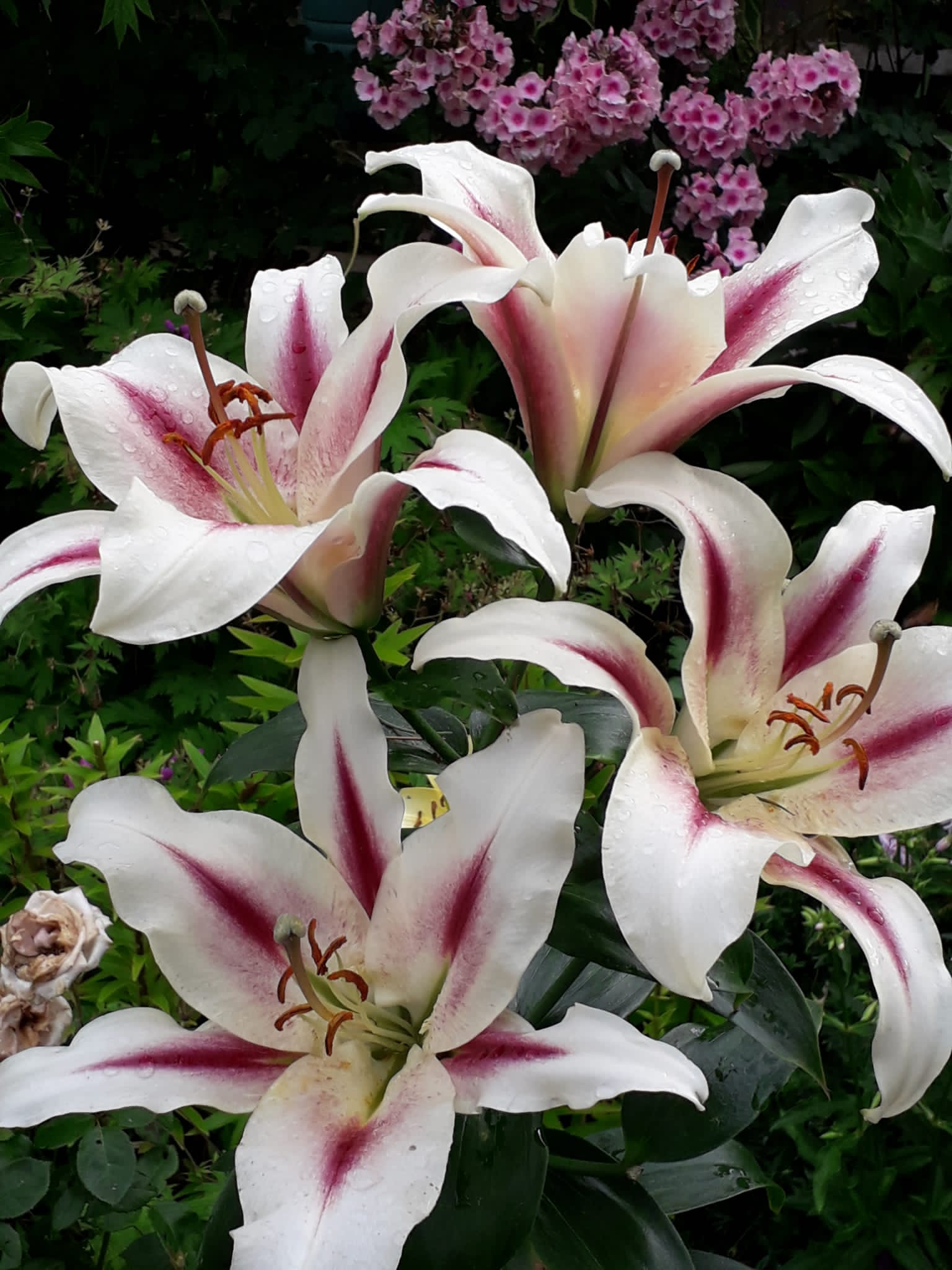

Well, I could carry on like this for ever. I haven’t even mentioned my new shade border with 4 newly purchased, remarkable clematis. (the best has turned out to be one called ‘Pernille’) My enthusiasm for my garden never wanes! Unfortunately the same cannot be said of my stamina which is being curtailed by too many painkillers currently.
Although I could not join you all in Charlton House garden for the first real live meeting since Covid struck, I will be thinking of you all and hoping that the evening goes well.
Recovery from my op can take months but I am determined to bounce back in record time so wish me luck. Anyway how could I fail to recover quickly when I can see the biggest incentive outside my window?
Viv
Supporting plants in a timely manner has been one of members’ New Year’s resolutions on more than one occasion. I remember one reading: to support plants before they fall over!
But how to do it in a way that is both attractive and unobtrusive? In addition to which, you have to find the right materials. I have long been an admirer of the ‘birch halos’ used by Sarah Raven and at Great Dixter, for example, but had never attempted to create one.

This year I managed to find myself a pile of birch twigs and, inspired by the clear instructions in Arthur Parkinson’s book The Flower Yard, I had a go.
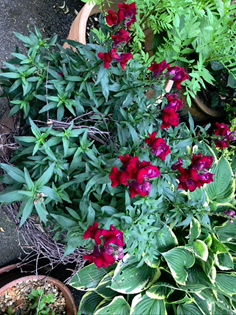
As you can see from the Antirrhinums, although not quite on the same level of skill, my efforts are doing the job and don’t look too bad!
I wonder what other attractive supports members have found for themselves?
Vija
Self-drive/car share trip to the Flower Show at RHS Hyde Hall on 4 August 2021. A lovely day, with lots of quality plant stalls. A difficult journey home due to traffic, but it didn’t spoil the day!



CABAHS member Jean R thinks her garden is out of control! She says:
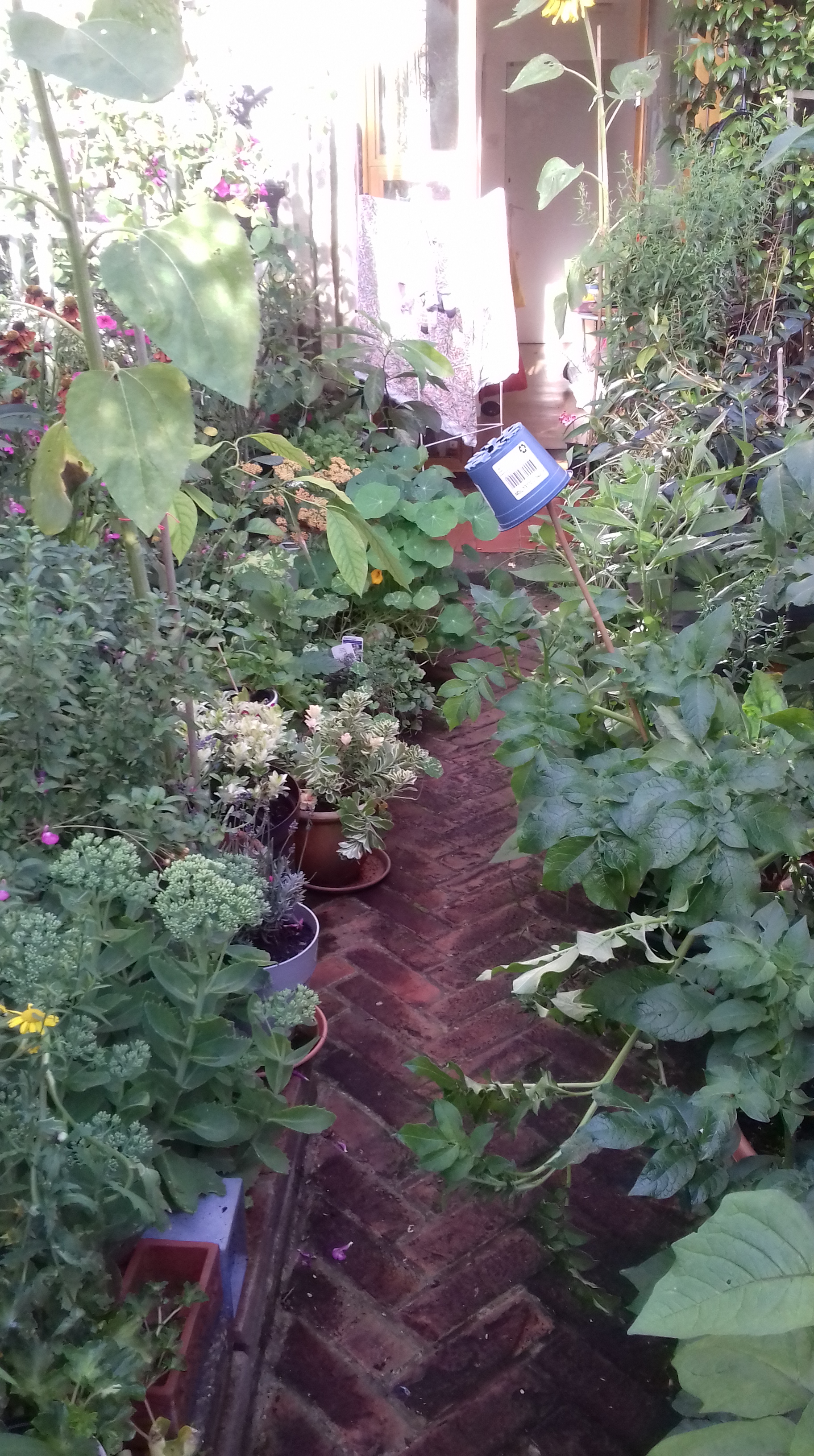
I’m a true amateur gardener and have watched aghast as nasturtiums, chinese lanterns and the leaf cutting bee have almost destroyed all my carefully laid out spring plans! In fact I love those bees, but do they really need so much leaf to line their nests? I also love nasturtiums and Chinese lanterns, but how dare they spread so prolifically!
Then to cap it all, intrepid visitors searching for my garden path find that only a sideways crab-like advance is possible to reach my front door! You can spot my front garden in Vanbrugh Park if you are passing by…….


Dusty Gedge was welcomed to the meeting. Dusty is a professional photographer and green structure and nature conservationist. He is President of the European Federation of Green Roof and Wall Associations. He said he was pleased to talk to CABAHS as he was local, Lewisham and Blackheath based, and had done a lot of work in the area. He said he is not a gardener but is involved in plants and soil.
Dusty made the point that green roofs and roof gardens have a local history, firstly showing a photograph of the 1997-built sustainable green roof on the now demolished Sainsburys on the Peninsular, followed by one of the 2019-built IKEA roof garden. In fact, Greenwich and Lewisham have the second and third most green roofs in London. Nowadays in England, including the City of London, it is planning policy that all tall buildings should have green roofs.
Dusty said that nowadays green roofs are becoming numerous. He showed photographs of a wide variety of them from Europe and the UK. From roofs in parts of Europe where traditionally turf and sedums were used to modern schemes, including nearer to home such as the roof garden at the National Theatre. He said there were 4 types of green roof (intensive, semi-intensive, biodiverse and extensive) and discussed the environment, conditions and maintenance needed for the various types to flourish.
Green roofs and roof gardens are taking soil and plants into the cities. He referred to ‘plumbing with plants’ using soil and vegetation as they store water, helping to ameliorate floods. They also help in heatwaves and the green space they provide fosters health, wellbeing and social cohesion.
He discussed two projects, the Museum of Home and Design which balances diversity with formal garden design using mediterranean and native plants and then IKEA with its four different sections. He said he would be happy next year to take CABAHS members on a tour of IKEA’s roof garden.
Afterwards, Dusty took questions and was asked by a member (who is also a surveyor) about infrastructure needed to support the roof and prevent leaks. He agreed that is an issue and said there were many structural strategies existing to prevent this happening. Another asked what would be the effect of wind on tall buildings. Dusty pointed out that the roofs of tall buildings were generally less windy than at ground level due to the funnel effect. He also reassured members that he collects local wildflower seeds in a sustainable way.
Angela
Dusty Gedge is a green infrastructure professional, public speaker, photographer, nature conservationist and social media influencer. He is President of the European Federation of Green Roof and Wall Associations and a recognised international speaker on green roofs, green infrastructure and biodiversity.
Dusty gave several links to useful websites and a podcast, below. He said members are welcome to contact him for advice.
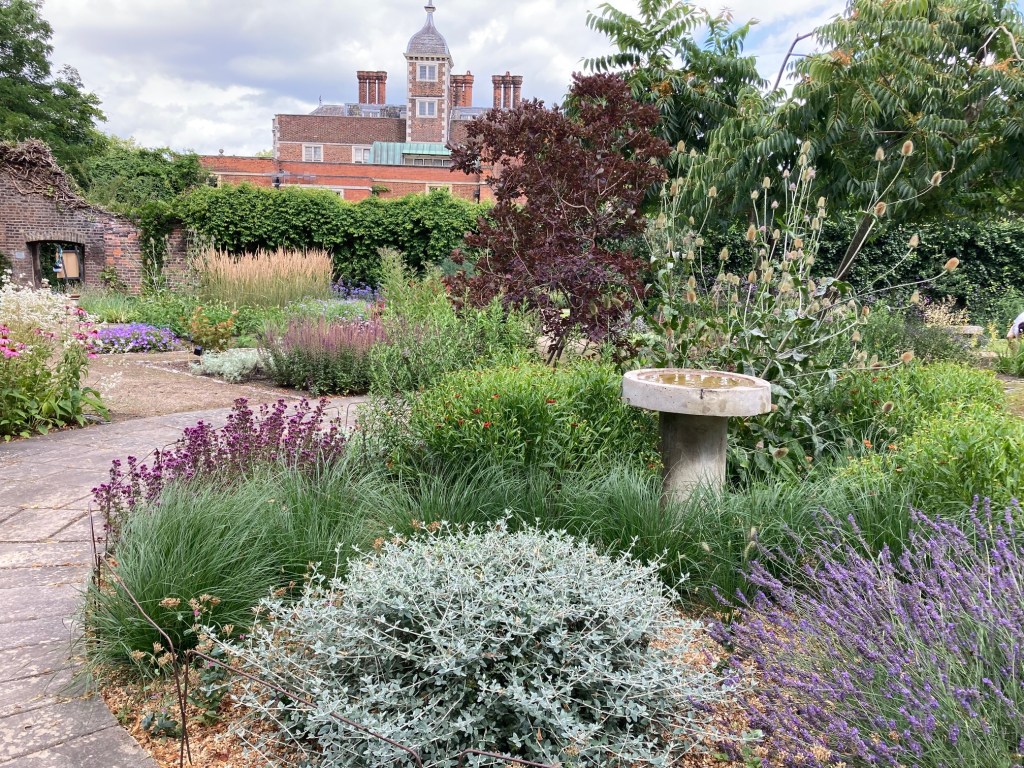
The garden is getting into it’s summer swing now, so much is in flower. It is amazing how complete it looks for a “first year”. Penstemon Garnet is just going on and on and on!

This is the view in July from the CABAHS 70th Anniversary bench:

A recent initiative – Star Plant of the Week. No contest: it was the teasels this week, they are gigantic, and covered in bees.

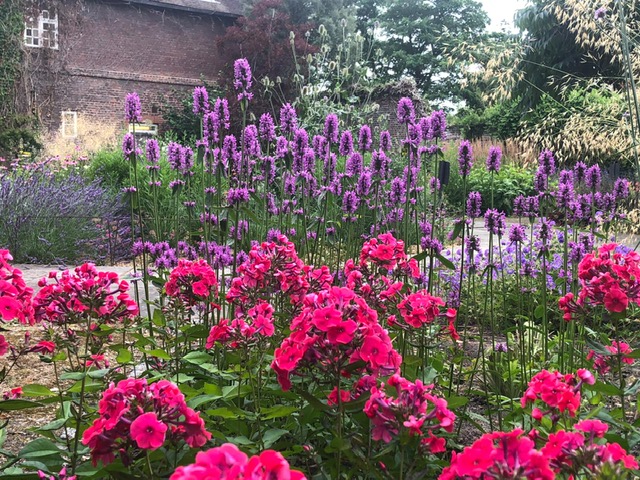
Betony and Phlox demonstrating The Clash!
And now it’s the turn of the Echinacea purpurea “Magnus”, with white Erigeron annuus frothing at the back and a yellow Patrinia photo-bombing in the front.

A selection of photos of Ruth & Matthew’s beautiful garden ‘The Gatehouse’. CABAHS members attended a lovely open evening, wandering around their garden recently, with donations in aid of the Hospice.



 Charlton and Blackheath Amateur Horticultural Society