Bankers and biodiversity

The City of London might not be the first place that you would look to understand how nature conservancy developed in this country.  The Wildlife Trusts, the umbrella organisation for local groups that care for their environment, makes it clear that they owe their existence to the Society for the Promotion of Nature Reserves, for which Charles Rothschild, a partner in the merchant bank of N M Rothschild & Sons, was the catalyst.

I thought about him during Joe Beale’s excellent talk on Zoom to the CABAHS meeting on 17 May. Members learned a lot about biodiversity in the area of Greenwich Park, Blackheath and Charlton.  We also learned how important it is for people to work together.  Joe didn’t just mean small groups of concerned individuals, although those are crucial.  He meant engaging with local councils and other bodies to make sure everyone’s interests and concerns are understood.   

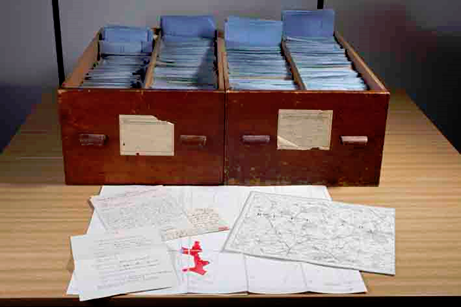
"Worthy of Preservation" - responses to Charles Rothschild's questionaires

This is what Charles Rothschild did.  He sent out questionnaires to local natural history societies, asking for nominations for sites that could be nature reserves:  sites that were ‘worthy of preservation’.  On the basis of these returns, the newly-created Society for the Protection of Nature Reserves published a list – Rothschild’s List – and sought government intervention to protect the sites.  Here is the list, published in 1915.     

https://www.wildlifetrusts.org/about-us/rothschilds-list

Joe also brought home the importance of keeping records over time so that measurements of improvement and, sadly, deterioration have value.  In the link above The Wildlife Trusts also presents an analysis of the condition of Rothschild’s Reserves, 100 years on.   

This document features a pie chart of habitats, 2% of which are pavements.  I wonder if our very own Terry might well be responsible for some of that, based on what he told us he was up to at the end of his road! 

Charles Rothschild was an extraordinary man by any measure of means.  His collection of fleas, now the national collection of fleas in the Natural History Museum, was lovingly catalogued by his daughter, Miriam, who was herself a powerful advocate for nature, advising the Prince of Wales on the creation of his garden at Highgrove.

One of his fans is sports- and nature-writer Simon Barnes, whose book, Prophet and Loss: Time and the Rothschild List is available on Kindle for only £2.37.  If members were to buy the book (profits to The Wildlife Trusts) they could buy a cake from the WI at the CABAHS community day at Charlton House on 30 May and still have change from a fiver! 

Melanie      

Members’ gardens, March 2021

Look who has been visiting in Sharon’s garden in Shooters Hill? She says she is so pleased she left part of her garden for the wildlife, and this is her reward! He’s been hibernating in a leaf pile and came out to enjoy the sunshine today. He has been scrubbing around in Sharon’s garden and then wandering through the beech hedge into her neighbours. Oh the advantages of a Wildlife corridor, we should all make one!

Shown below is Angela’s beautiful Clivia in full bloom. Angela says this one is a division from her main plant, and is one of her favourite indoor plants as it needs so little care and attention.

Is today the day?

I have had a worrying time recently, and have bored my husband half to death with my constant observations along the lines of “I wonder if one has arrived yet?” and “Perhaps today is the day”.

As we are awaiting the appearance of our first grandchild, you might think that’s the reason for my anxiety? Well of course that’s very important, but in fact the problem has been that for the first time in 30 years, the toads have not arrived in our pond.

I have been pondering (ha! pond-ering) whether it is the new fence that has stopped them or whether I have been too tidy in the shrubbery and whether I should not have got rid of the overgrown irises at the pond edges. To try to make amends, I have crawled along the new fence and created nice deep tunnels underneath (to the interest of my two terriers and the annoyance of my husband, who has no engineering knowledge and thinks this will weaken his expensive fence).

My neighbours on the other side have known me for a long time, so they have already assured me they will put any lost toads they find through the hole by our shed so they can find their way home.

Toads can travel up to 2 km to come back to the pond they grew up in to spawn, so imagine how many fences and what obstacles we humans put in their way on that journey? They live about 10-12 years, so in theory you should get more coming back each year.  I am afraid my little band has been dwindling in recent years, and I worry that the new fence may just make them give up and change their permanent address to a pond down the road.

Luckily, I am able to tell you that today there has been movement in the pond! It’s not heaving, like Monty’s pond on Gardeners World, but there are definitely a few happy toads in there, making their “chirrup” noises and sounding pleased (relieved?) to be home. No spawn yet, but I expect a happy ending to this story, any day now.

Kathy

Local wildlife in Paula’s garden

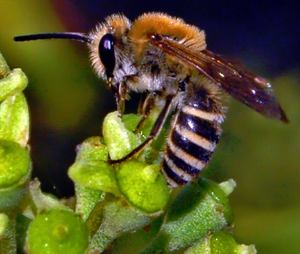
CABAHS Committee member Paula has been grateful for the distraction of wildlife-watching during the lockdown, and has been reading up about it. Paula’s garden style is “not manicured” but she does like to keep things under control – things such as ivy. She says that ivy can cover a multitude of sins and like it or not, it certainly helps out the local wildlife. Plus it is evergreen and makes a lovely backdrop about now, when everything else has lost its colour. She was intrigued to learn that there is an Ivy Bee, one to watch out for this year. The Wildlife Trust says that ivy bees are recent arrivals to the UK, being first recorded in 2001 and slowly spreading North. They look like honey bees and feed mainly on ivy nectar. There doesn’t seem to be anything bad known about them so at the moment they are welcome!

Paula has also been bird watching and says another “new” arrival to our gardens is the Collared Dove, a less bulky version of the native Wood Pigeon.

They are normally seen in pairs (a good Valentine omen maybe!) and come to bird feeding stations sometimes. They are not native but arrived from the Middle East in the 1950’s – a bit like the Green Parakeets that are now all over the South East, although not such a pest. They are mainly seed and berry eaters and if they raise a brood successfully they often return to the same nest site.

If you would like to find out more, try these links:

https://www.wildlondon.org.uk/wildlife-explorer/invertebrates/bees-and-wasps/ivy-bee

https://www.rspb.org.uk/birds-and-wildlife/wildlife-guides/bird-a-z/collared-dove/

Paula


A robin for Christmas

John Sturgis has recently written an article in the Spectator, much after my own heart. He says he has two birds on the go, one in the garden, one at the allotment, both real beauties — and both robins.

With much of the nation still working from home, robins have become more familiar than ever. Most species of garden birds are horribly in decline, but the robin has stubbornly stuck around in great numbers.

While those other great survivors, magpies and pigeons, are brash and ungainly, the robin is a delicate little gem: magpie song is shrill, pigeon dumbly repetitive, but robin chirrups are a delight. They’re bold, too. Other garden birds flap away when we appear, but not robins. In fact, they approach — as inquisitive as a kitten.

The robin has a territory that ‘can be as small as a half acre’ so where I live I must share my robin with several neighbours. But one always appears as soon as I venture out of the back door, for human activity is their cue. My robin particularly likes it when I use my daisy grubber on the lawn. The stabbing activity seems to prompt all the worms near the daisy to come to the surface, in case I stab them too, I suppose. But there she comes, Mrs Robin following my every footstep, darting around where I have just been, feasting on the worms leaving their cover.

I say ‘she’ but frankly I don’t know. No doubt your Chris Packham types would be able to gender a robin from half an acre away, but to the untrained amateur, male and female are very much interchangeable.

Sturgis points out that robins frequently come up in literature and songs – John Donne’s Robin Redbreast, or The Secret Garden, or Rockin Robin of the Jackson 5. And, of course, the robin is the Boy Wonder’s spirit bird in Batman. Imagine trying to pitch that set-up today. ‘I like this Bat guy – very dark and cool. What are we doing for the kid? A scorpion? Eagle?’ ‘No, we thought a robin.’ Yet it works, accentuating the character’s chirpy loyalty.

But their definitive place is on Christmas cards. They’ve somehow smuggled themselves into the greeting card nativity scene, apparent survivors, along with holly, ivy and mistletoe, of pre-Christian winter festivals, one of the few flashes of colour in the bleak midwinter.

So just go outside with a trowel or daisy grubber and she will soon appear. And despite the Christmas connotation, she’ll still be there in the bleaker days of January and February. Because robins are very much for enhancing life, not just for Christmas!

Kathy

Butterflies and sunflowers

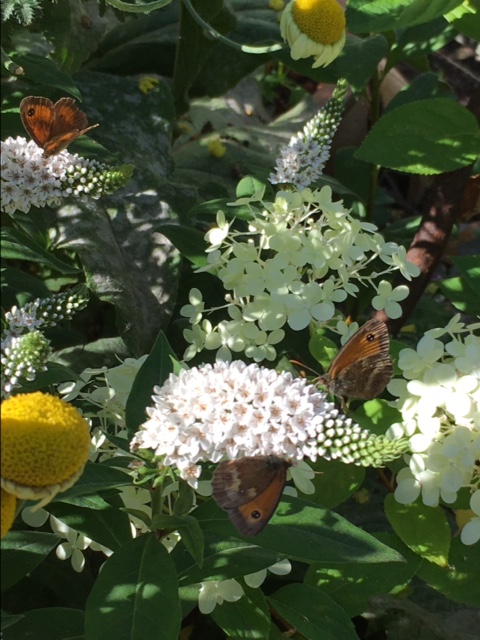
SC gatekeeper and Lysimachia

Beautiful picture of Gatekeeper butterflies enjoying Sharon’s garden. Lysimachia clethroides is grown here with Anthemis “Cally Cream” near a Hydrangea Limelight in a pot.

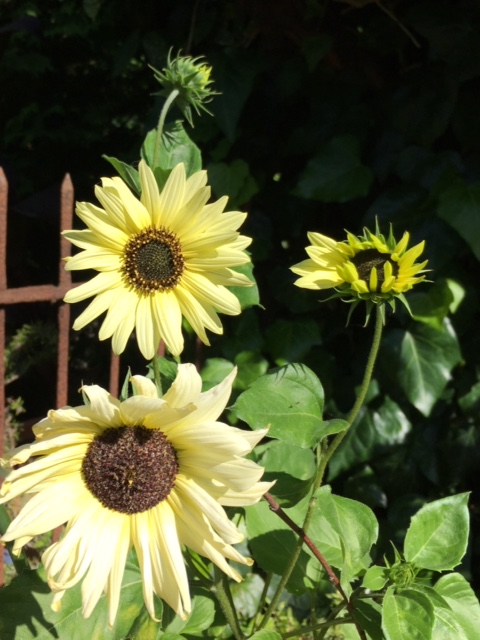
SC Vanilla Ice

These are Sunflowers, Helianthuis debilis “Vanilla Ice” growing daintily in Sharon’s garden, producing new flowers continually as she deadheads them.

A neglected patch

Retirement four years ago. Time stretched, or I thought it would. The bottom of my garden was an area where rubble collected, unwanted household items had been left and bonfires lit. It was in desperate need of a clear up and a change of use although to what I had no ideas. Nettles and weeds thrived and tall trees belonging to neighbours and the MOD who own the land at the back ensured there was shade for most of the day apart from an hour or so. One year on it remained untouched as there proved too many fun things to do.
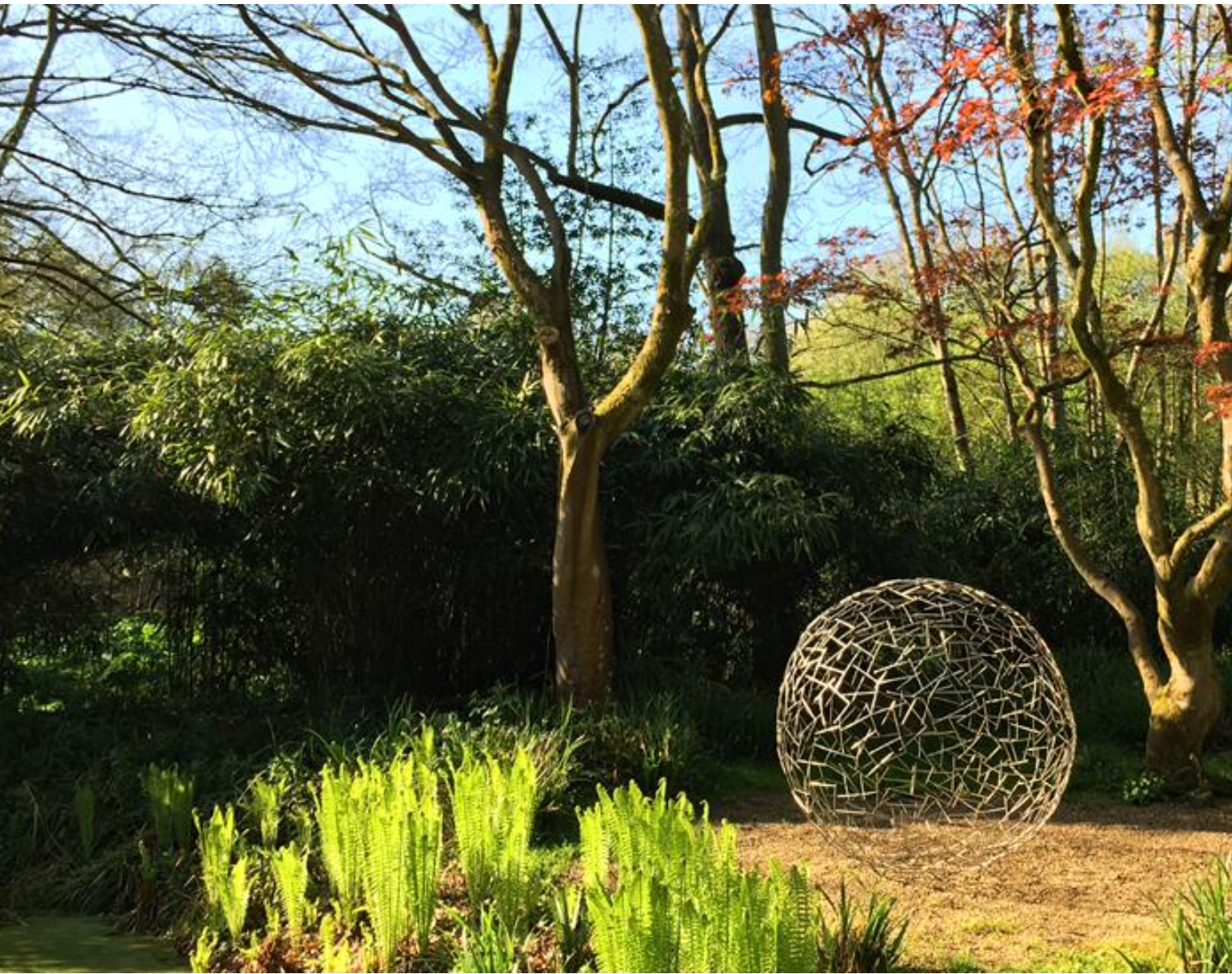
A visit to the Hannah Peschar Sculpture Garden in Surrey spurred me on to make a start.
SC Hannah Peschar
Much of this magical woodland garden is in shade and shuttlecock ferns were in abundance. I loved their structure and vibrant green. I had not grown ferns before and felt that they at least may like my shady patch. The hard work began.
Picking up the obvious rubbish, carrying it up the garden, through the house, up a steep flight of stairs, into the car, onto the recycling centre – halcyon days! – was just the beginning. When I dug into the ground, I realised there were layers of broken bricks and glass underneath. It was heavy labour and took weeks to clear. The reverse journey, but now from the garden centre, brought in bags of compost, rotted horse manure and chipped bark.
I had no particular vision of the final outcome but by now just wanted to plant something. Half of the area had been dug over. Ferns along with a few other shade tolerant plants such as astrantia and hardy geraniums were planted.
SC Garden 1
By June 2018 I had dug up the remaining rubble and added more plants – foxgloves, aquilegia, thalictrum delavayi to give height and the nettles were left for butterfly eggs. Other wildflower/ plants that had found there way in and settled were allowed to remain as good for pollinators. I now have a large clump of greater stitchwort (also known as gentlemans shirt buttons – love that name) and cow parsley. Hellebores were put in later that year.
SC Garden 2
Bronze fennel was planted last year which grew to such a height it needed staking. I found an obelisk which does the trick. As the area is fairly bare in early spring, I had put in loads of aconite bulbs. None of these survived as the local squirrels found them irresistible. A few English bluebells and snowdrops did grow and more will be planted in Autumn.

Time stretches now. I sit and enjoy watching bees, early butterflies, neighbouring cats, toads, ignoring the gaping holes where the fox has squashed the gentlemens’ shirt buttons and hoping the hedgehog recently spotted in a garden two doors away will wander into mine.
SC Garden 5

SC Garden Hogg

Sharon

Musings in the garden

When I moved into my present house, there was already an established garden. Of course I wanted to make it my own so I started to remove the Rockery. Large white stones on a sloping bed were taken away and I prepared to level the ground. I soon realised why it had been a rockery, it was to conceal a rubbish dump of builder’s rubble and concrete slabs! I’ve replanted the area- with a new rockery!

Having put myself into self isolation for 3 weeks now, I can see a pattern evolving with the wildlife in my garden. About the same time each morning, two squirrels chase each other from one side of the garden to the other. A blackbird keeps watch from the same branch all day after collecting nesting material from the lawn. A family of foxes visits around 4pm to dig for worms. The birds singing as I garden are a constant delight and I’m starting to distinguish the robin from the chaffinch, some soothing benefits from enforced isolation!

Jenny

Go wild gardening

CABAHS Committee member Paula, reminds us that even the smallest urban garden can attract and help wildlife. She suggests you can select a small space in a patch of lawn to sow wild flowers as well as well-known plants. Plants such as Echinacea, Foxgloves, Hollyhocks and Lavender – there is a huge choice to pick from, or how about letting the grass grow and think of the time you will save in not mowing! It will attract insects, bees and who knows what else will show up. Check out the RHS tips for creating a wildlife garden

Has your ‘wild bit’ attracted any unusual wildlife? Let us know!

In praise of… earwigs!

I have not been an earwig lover for all of my life. As a child, I remember my father making a nightly check on his prize dahlias and coming back into the kitchen with earwigs crawling out of the turn ups of his trousers. My mother’s predictable reaction meant that I thought earwigs were definitely not insects one was meant to love. Now years later, in my own garden, I can see the results that a small earwig population have on my own favourite Dahlias, Verrone’s Obsidian, and it’s extremely annoying. But this Christmas my husband gave me a book – “The Garden Jungle” by Dave Goulson and it has rather opened my eyes to the trials and tribulations of this little insect.

Goulson points out that earwigs are easily eradicated by sprays, and because they don’t fly and only produce one generation a year, they don’t re-colonise very quickly once they have gone. I haven’t used pesticide sprays for some years, with the exception of a drench for vine weevil in my containers, so I know I do have earwigs in the garden, although not in the numbers I remember as a child.

earwig

Earwigs are overwhelmingly beneficial insects, they feed voraciously on aphids, as well as munching on the occasional petal. In orchards where earwigs have been sprayed out of existence, trees are infested with three times as many woolly aphids as those with a good earwig population. It is generally the case that beneficial predators of a crop pest breed more slowly than the pests they feed on.  Aphids, in particular, breed spectacularly fast, giving birth to live young which themselves have developing offspring inside them when they are born. In contrast, Mrs Earwig produces maybe 50 offspring a year, laying creamy eggs in a burrow in the ground towards the end of winter. She tenderly cares for the eggs, guarding, cleaning and turning them and looks after the young brood (nymphs) until they moult and gradually become independent. Then she turns them out of the burrow and they must look after themselves, foraging at night and hiding in the day in any crevice (or dahlia) they can find. They must do this all Summer and Autumn dodging predators while they grow, until winter comes and they find a mate and it all starts again.

The fierce looking pincers are actually quite feeble and incapable of doing harm to a human, they are used by the earwig in defence against predators such as ground beetles, and also in mating. The “wig” part of their name comes from an old word for “wiggle” and they definitely never burrow into ears!

We should certainly see earwigs as our friends in the garden, just as we now do ladybirds and lacewings. I have decided that a nibbled petal here and there is a small price to pay for all the good they do.

Kathy