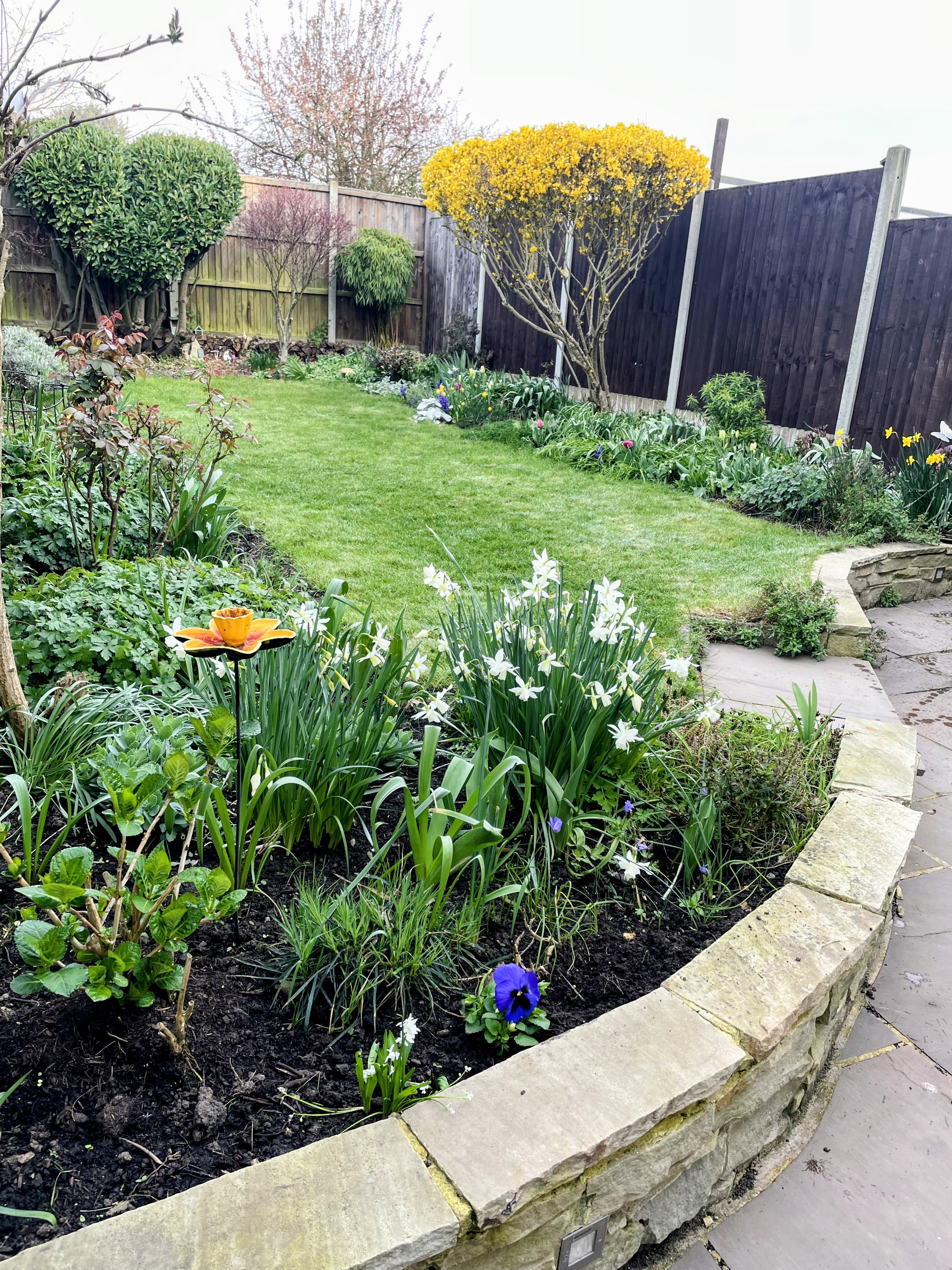
Technically, a small garden is considered to be one that is approximately 100m2 (33 x 33ft) or less. While the average UK garden is apparently about twice that size (225m2 – almost a tennis court), and most new build etc gardens are about half the size of ‘small’ (50m2), we are based in London and what really defines a small garden is probably more a matter of opinion and perception than exact dimensions. To complicate the topic further, many larger gardens are divided into smaller spaces or ‘rooms’, which will often have features and considerations in common with smaller gardens.
Not too far away (and on the 54 bus route from Charlton and Blackheath!) lies a ‘new’ old park: Beckenham Place Park. The name can be confusing – it lies on the border between the London Boroughs of Bromley and Lewisham, but is run by Lewisham Council. It is larger than you might think, at 96 hectares (well over 200 acres), and stretches from Beckenham Hill railway station in the north to Ravensbourne railway station in the south, west into Beckenham ‘proper’ and east toward Bromley.
Beloved of dogwalkers, wild swimmers, park runners, bluebell spotters and vintage shoppers, since Heritage Lottery Funding was awarded in 2016 there have been many changes and a huge increase in community use. Old features of the 18th century estate have been brought back, playgrounds added and the 1762 mansion (which was formerly a golf club house with a small visitor centre) is now home to artists’ studios, a café, a vintage shop and hosts multiple events.
We welcomed back Tim Ingram who has a passion for alpines, and is a member of the Alpine Garden Society. He gave us a talk on the evolution of Copton Ash, his garden in Faversham, Kent where he also has a specialist nursery. He also brought with him a selection of alpine and perennial plants for sale. He illustrated his talk with a series of photographs showing the development of his garden over the years and seasons.
Copton Ash fruit plantings Spring 1979Copton Ash getting wild, May 2024
Tim’s garden is a large and mature family-run garden, about one and a half acres in size, which has been in existence for nearly fifty years. He comes from a family of avid gardeners and so was brought up with a keen interest in plants and gardening. His father worked at Brogdale (home of the National Fruit Collection): his mother too a keen gardener: his grandfather was into market gardening. Tim first worked in academic science in London, specialising in plant hormones. He and his wife returned full time to Copton Ash in the late 1980s when they soon started a nursery.
1. Watch out for Cabbage White caterpillar on your Nasturtium: at our allotments they appear to be the new delicacy which they are devastating and they look like the only butterflies that are thriving.
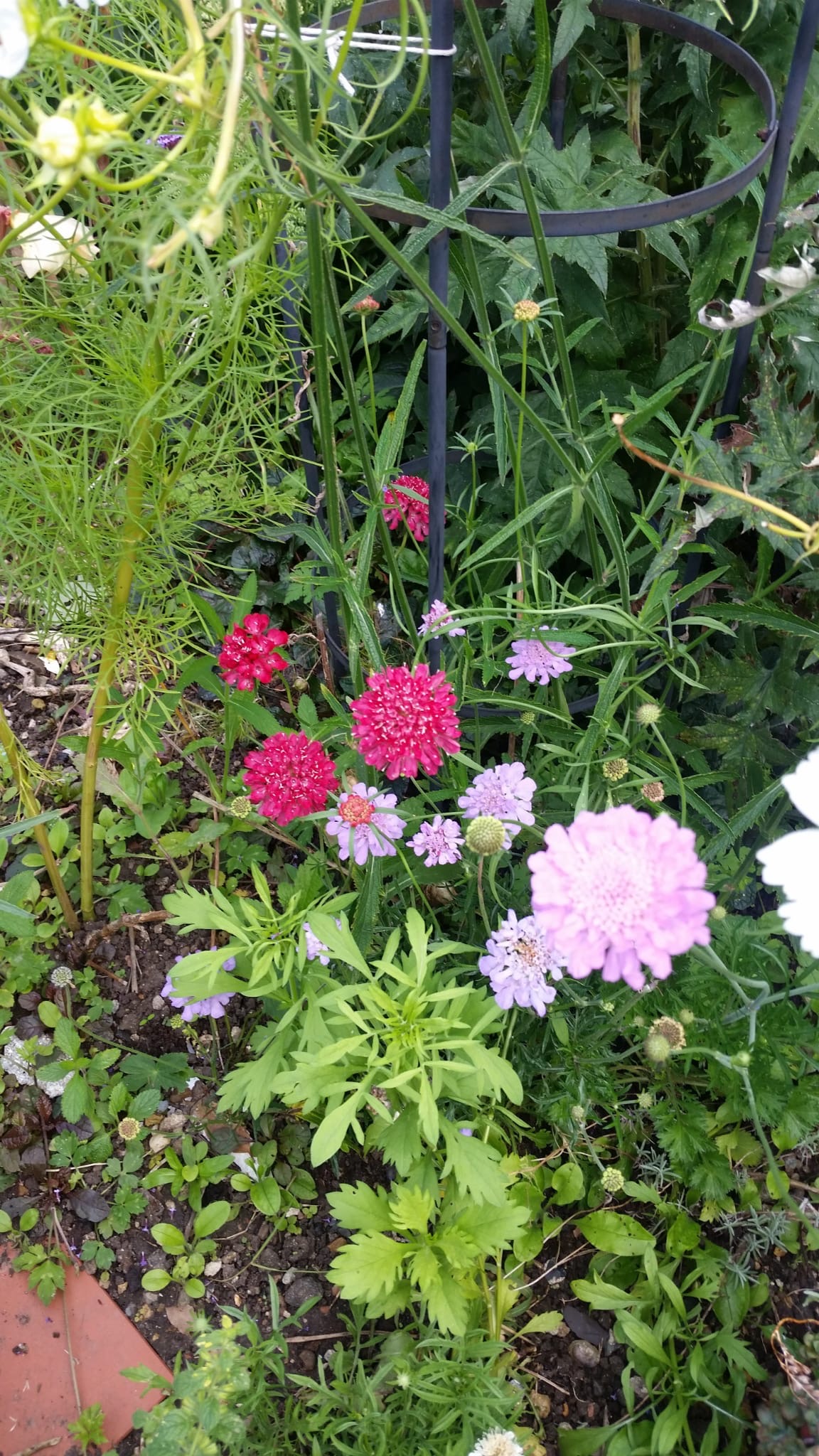
2. Make sure to plant lots of butterfly-friendly plants next year like Sweet Rocket, Scabious, Honesty and others. The butterfly count showed that butterfly numbers are very much down this year and we desperately need them. Please ask me for Honesty seeds if you want some.
Jason Sylvan, Head Gardener at Charlton House, has designed the Old Pond Garden to be as attractive to wildlife as possible. Because we talk about monitoring moths, he asked if we could check how many moths are visiting the garden. We should have tried this in the warmer months when there are more plants in full flower but we had missed that for this year so we gave it a shot on a warmer dry night in September to test out a strategy.
As we wrote in an earlier post, we have been monitoring moths for the Garden Moth Scheme since 2013 in Newcastle-upon-Tyne and since 2019 in Blackheath. The moth trap is a box with a light (our type gives off no heat), and below the light are two panels of see-through Perspex, one each side and shallowly angled down, with a slot/gap between them. The moths ‘funnel’ into the box, and it’s difficult (but not impossible) to get out. Inside are egg-trays, which provide resting places.
Why do moths fly towards the light? Until recently, the correct answer has been that nobody knows, but researchers in Sweden found the answer: for aeons, light at night was above and dark was below, so moths orientated themselves to fly with their backs to the light above. In artificial light – fires, candles, street lamps – they still try to fly with their backs to the light, circling round and round, and sometimes become disorientated.
The trap is placed before sunset, and collected at sunrise the next day. So an early start.
28 Marsden Road SE15 4EE, Open Sunday to Thursday inclusive, 10.30 to 16.30. No charge
We are members of the London Wildlife Trust, which runs the Centre for Wildlife Gardening (CWG), but it was word-of-mouth from a volunteer at Christchurch Community Garden that made us aware. We visited on London Marathon Day, passing through a crowded Blackheath Station on our way to Peckham Rye Station.
Marsden Road itself is remarkable: its houses all along have designer ironwork gates & railings on wildlife themes, and each lamppost has a ‘squirrel’ high above. These, and the wildlife-themed iron gates to CWG, were designed by Heather Burrell: bollards at the entrance and within were designed by Antony Gormley: a gable-end has a large mural of a Goshawk.
During September 2023 I revisited the newly-built Wellbeing Garden, located at the rear of University Hospital, Lewisham.
There have been some exciting changes and the most notable is the large, beautifully-built, pergola that pulls the whole garden together. The pergola not only provides shelter but acts as a meeting place for various classes, including the Gardening Club. Some of the structure’s uprights are decorated with painted terracotta tiles, showcasing talented and creative individuals.
The planting in the garden had matured, and, being autumn, the grasses were in their prime, growing alongside the flowering stars of pink Tulbaghia violacea. I noticed a Snow Drop tree (Halesia diptera) and an additional small tree, Heptacodium miconioides, a species I had never seen before. The tree was displaying clusters of prominent, white, flowers with an intoxicating perfume, so, for me, this was an exciting find.
One very warm and sunny Sunday in June, CABAHS members were invited to come and visit our member Juli’s garden in Plumstead – which she generously opened specially for us, in aid of the Greenwich & Bexley Community Hospice. Juli’s garden is in the middle of a dense housing estate, but it is pretty easy to spot by the large banana tree sprouting over the top of her wall. Her garden beautifully demonstrates what can be done in a small space with some greenery, lots of care, and a sense of humour!
Juli in her garden
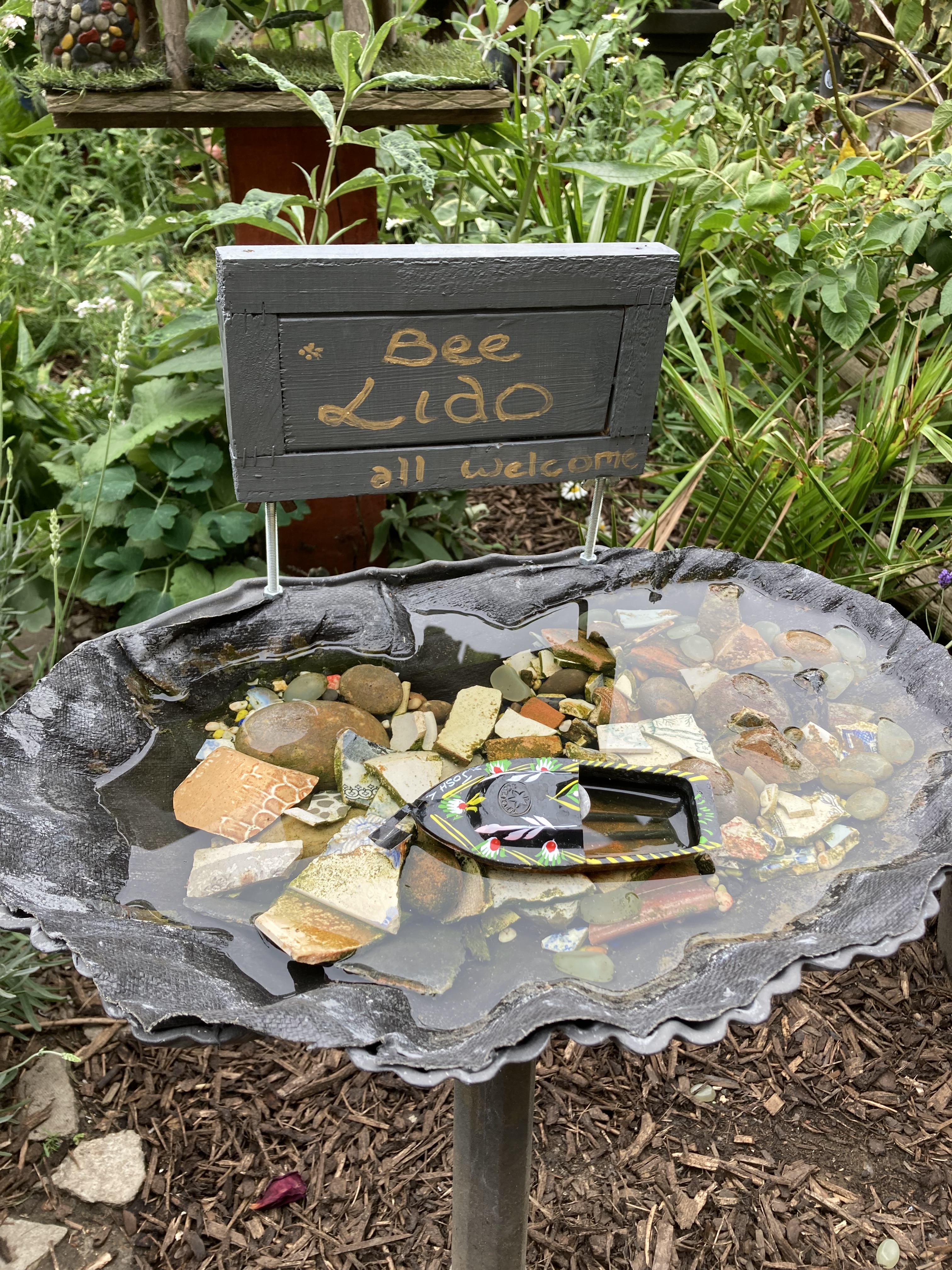
After the banana, the first things you notice are the Bee Lido and the fish pond, and I also liked the healthy looking lavender – which was a Charlton House reject that has been nursed back to full flower. Juli’s plant range includes her beloved roses, many perennials and even fruit trees. There are so many fun details, it takes much longer to properly appreciate than you would expect!
Thought for wildlife is everywhere in this garden, including Juli’s collection of friendly Bunnies – who were the stars at our Easter “Bunnies in the Beds” event.
Inspired by Melanie’s wonderful talk to members about the various Rothschild gardens, Sharon & I accompanied her on a trip to see the restoration project at Gunnersbury Park. We had our volunteer project at Charlton House & Gardens firmly in mind throughout the day, and were pleased to find parallels – albeit on a much grander scale there! Gunnersbury was bought by Ealing & Acton council in 1925 (Charlton was bought by Greenwich Council in the 1920s) and used as a public park in much the same way that Charlton Park has been.
In 2018 the “Large Mansion” was restored using Heritage Lottery and other funding and opened as a Museum housing the borough archive. Major parts of the park were included in the funding, the Orangery, lake and orchards for example. The Friends of Gunnersbury Park were instrumental in the restoration effort, and volunteers clearly play a large part in the day-to-day running.
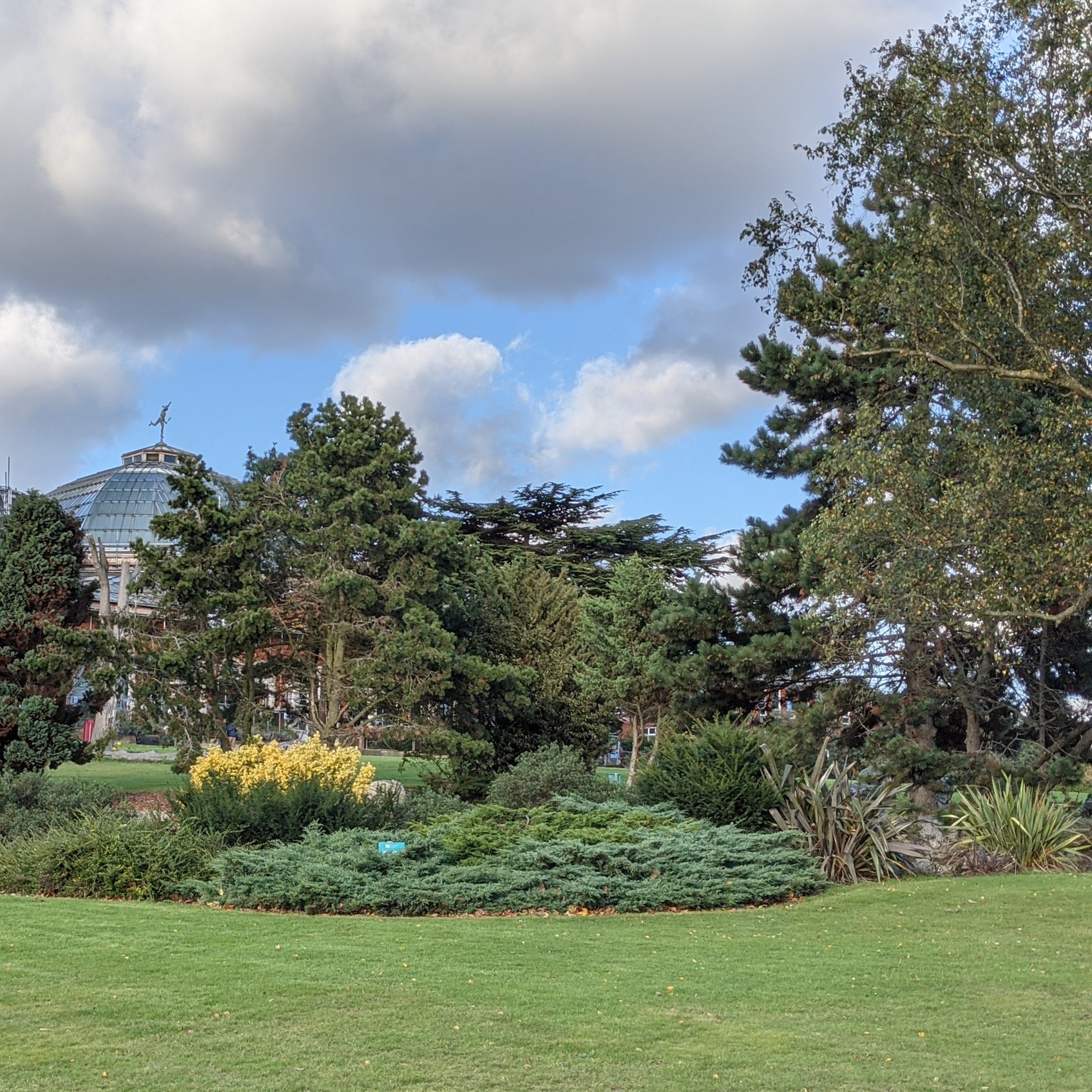
On Thursday I joined a tour of Avery Hill Park with the Mottingham Horticultural Society, who had extended an invitation to CABAHS members. It was a beautiful, crisp, sunny afternoon and the park looked gorgeous. Our guide John, from the Friends of Avery Hill Park, told us about the history and prehistory of the park before leading us around the extensive area.
Autumn tree colour in Avery Hill ParkThe Avery Hill Winter Garden, viewed from the park
Some members may be familiar with the Winter Garden, a glasshouse currently undergoing renovation work (therefore closed) and about to pass from the hands of the University of Greenwich back to the local council. I look forward to seeing it after renovation is complete!
Recently cut meadow area and former hedgerow (with dozens of cross country runners!)
There are two main areas of the park, historically and now. The more manicured, grassed parkland associated with Avery Hill Mansion (which is currently being converted into a school), and former farmland, with field boundaries and drainage ditches. The Friends are working to make the latter areas more wildlife-friendly by negotiating a meadow-style mowing regime (ie: cutting only twice a year, removing the mowings once seed has dropped, and sowing wildflower seeds) with some mown paths. Even after just a year, it’s possible to see that the range of plant species is extensive. The increase in butterfly numbers and activity in summer 2021 was notable. It is hoped that a general increase in biodiversity will also encourage an increase in bat numbers, which have declined in recent years.
Looking toward Great Stony Acre – field boundary trees and drainage ditch
The former field boundaries are still visible, and what would have been hedgerow has grown into rows of trees and scrub, which is excellent for wildlife. A new mixed hedgerow has been planted where one had disappeared, and the drainage ditches have been cleared by volunteers. Another historical feature which lives on through the Friends is the old field names, such as Henley’s Meadow, Little Stony Acre, Grey’s Field and Great Stony Acre. The latter is being planted with native tree species – oak, hornbeam, birch, hawthorn and field maple. Around 1500 trees have been planted over a five year period, and there are plans for a natural drainage pond in the centre as the area is at the bottom of a slope, is mostly heavy clay and becomes very boggy in winter.
Young trees in Great Stony Acre
It was a very enjoyable afternoon and I appreciated the chance to visit the Park with a knowledgeable guide.
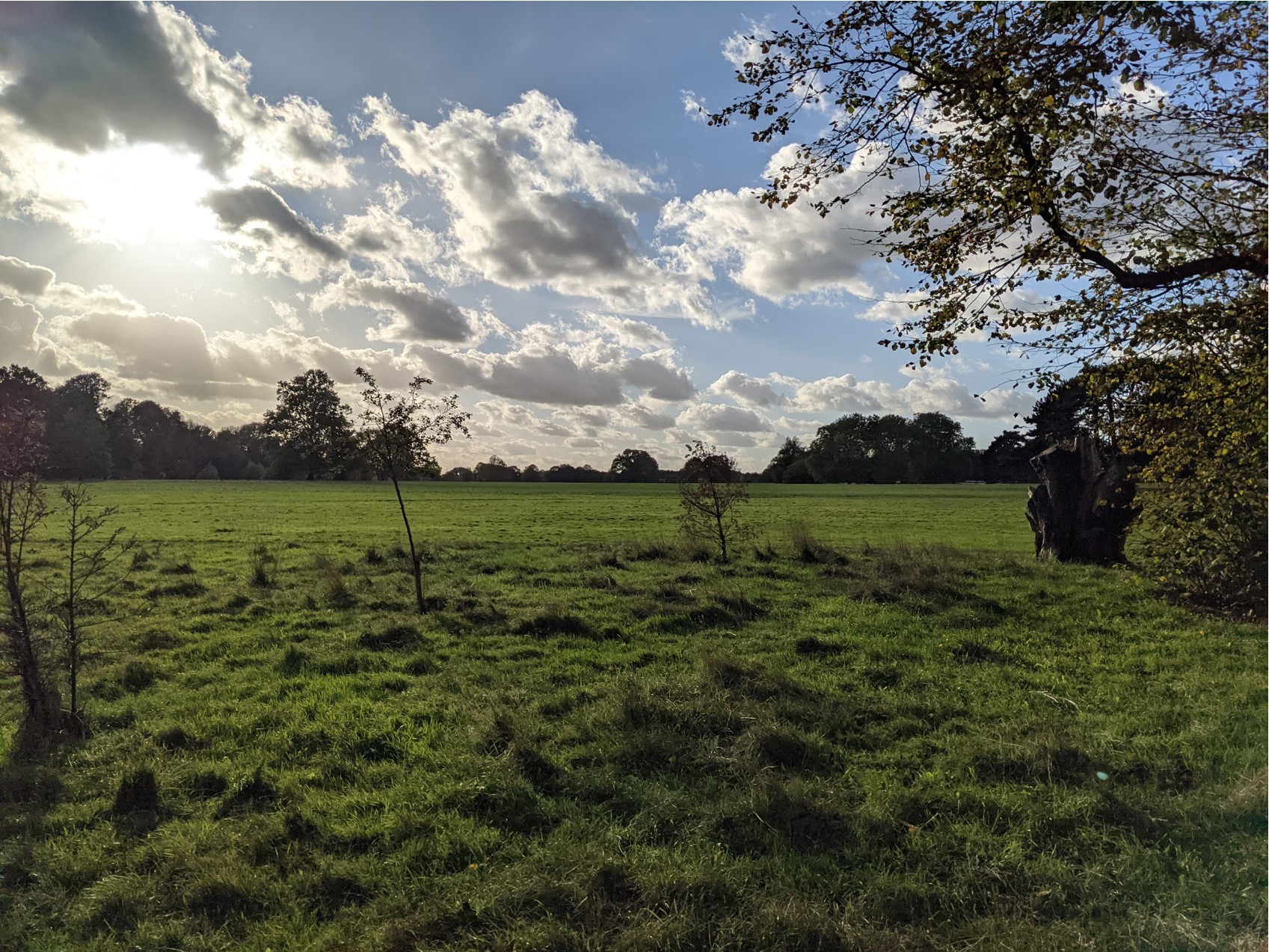
Looking across Avery Hill Park, late afternoon October 2021








 Charlton and Blackheath Amateur Horticultural Society