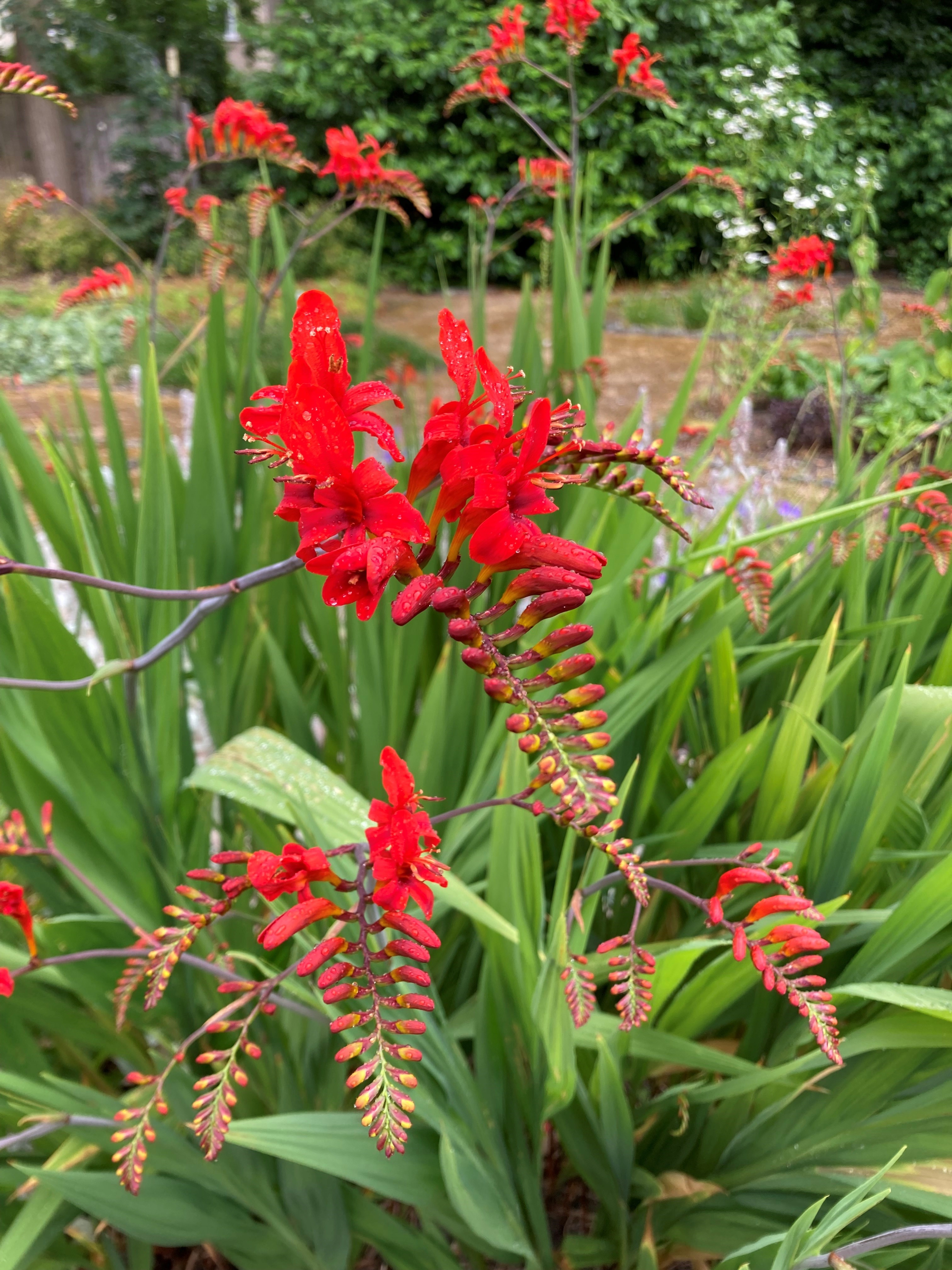
Although at its peak in July, this has been out since May and is one of the longest-flowering plants in the Old Pond Garden. At the moment we really love it for it’s drought tolerance – no need to water this one! It has dainty, tubular flowers which insects with long tongues like bumblebees can enjoy, and it provides both pollen and nectar for visiting insects. Prefers a sunny spot but will do well in part shade too, so you can spot it in several of the beds. It is a semi-evergreen, only losing it’s leaves in the very depths of winter.
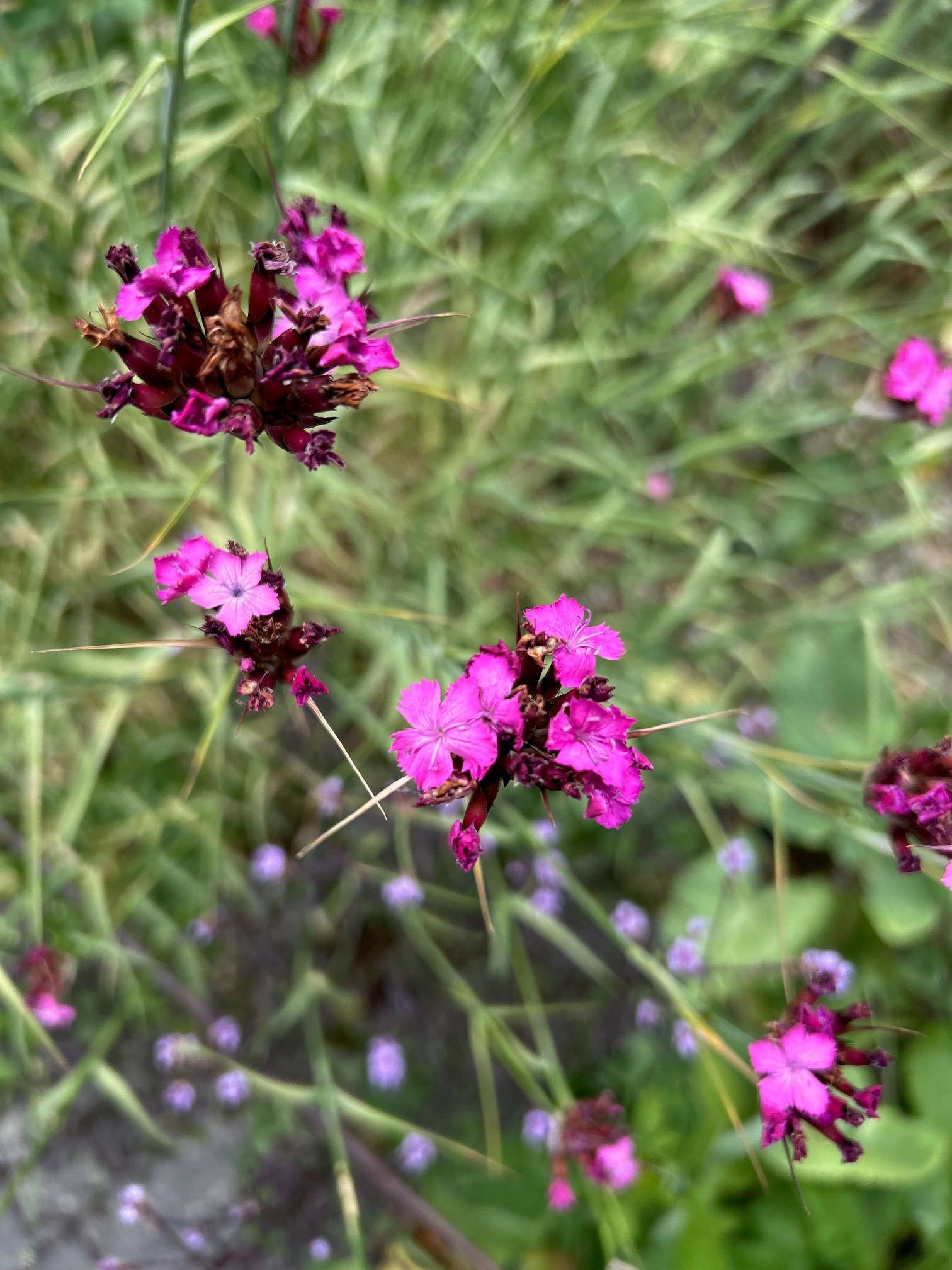
Dianthus carthusianorum – Carthusian Pink
Another lovely drought-tolerant plant that we don’t have to water! It must be in full sun to flower well, so it just loves the gravel garden in the central bed of the Old Pond Garden. It’s a perennial, forming bigger clumps each year and giving that great “pop” of colour. A gentle self-seeder and long season in flower.
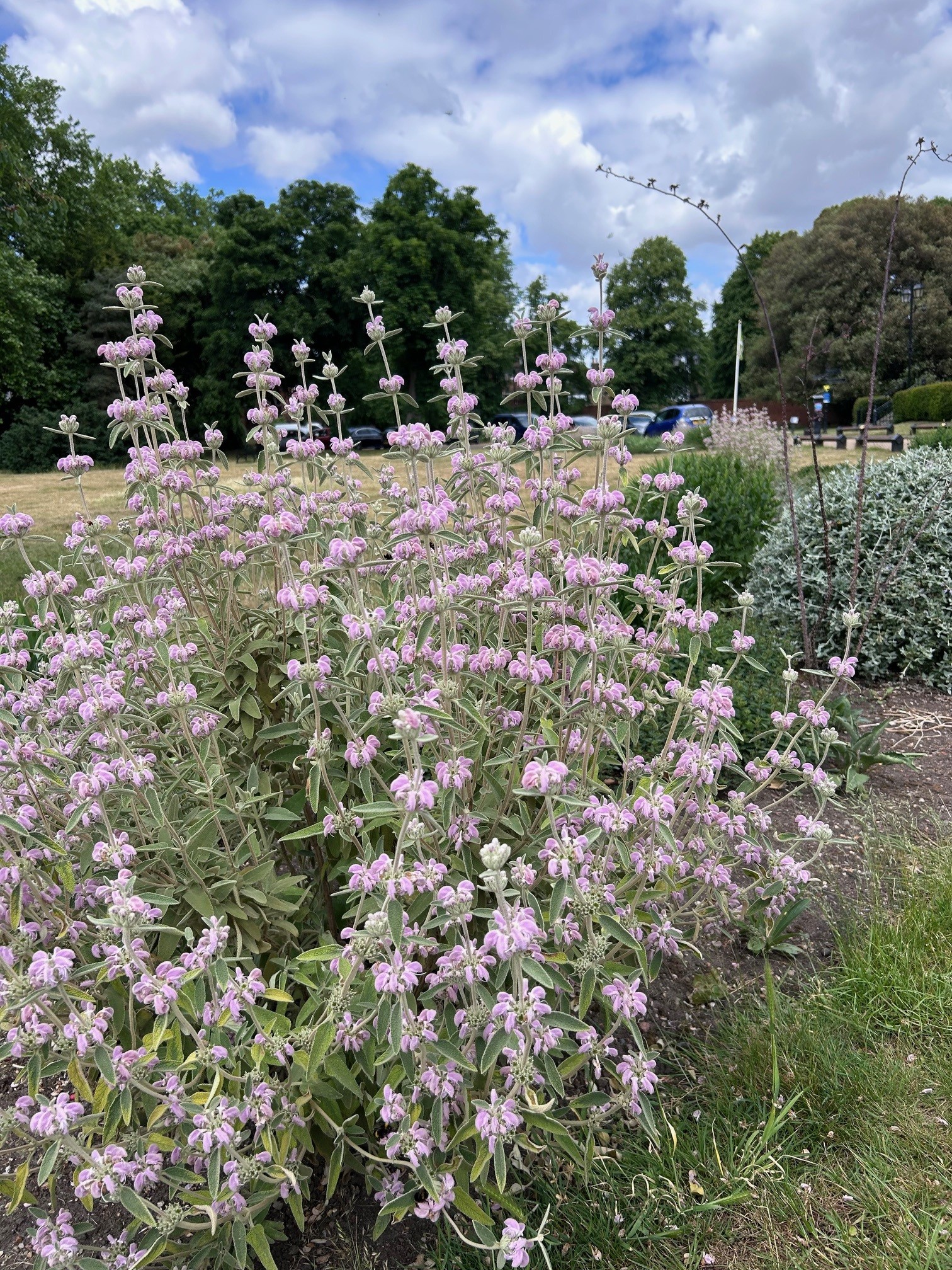
This is an evergreen shrub in the mint & sage family, native to Spain, which has lovely woolly grey-green leaves (touch them!). The hooded pale lilac flowers are beloved of pollinators, especially bumble bees. The ones in the front beds at Charlton House are humming with buff tailed bumble bees.
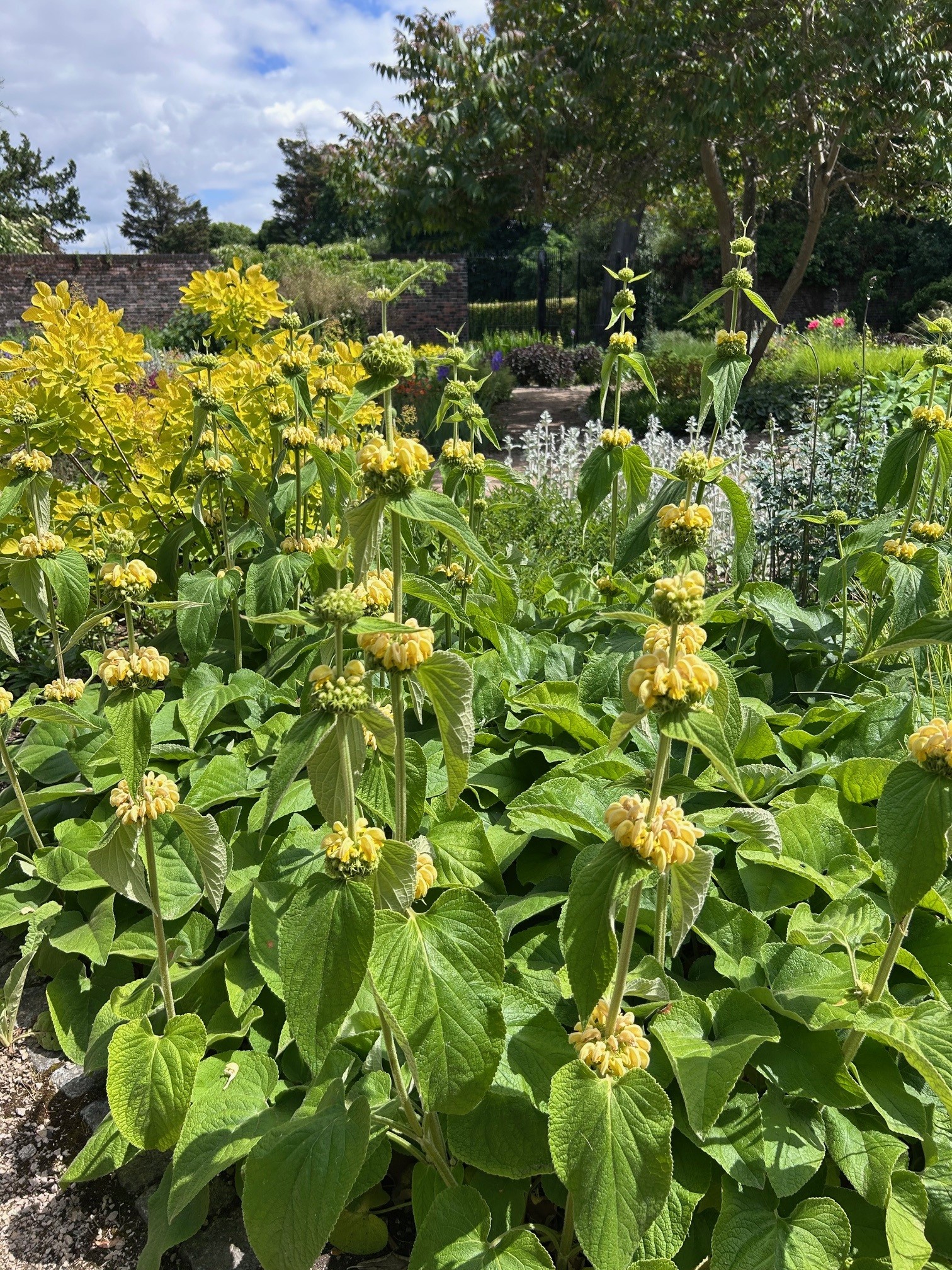
Phlomis russeliana – Turkish sage
Another one in the mint & sage family, but this is not a shrub, it is a herbaceous perennial (so it drops it’s leaves in Autumn but comes back the next year). The name ‘Phlomis’ comes from the Greek word meaning ‘flame’. Heart shaped leaves of some species were used as lamp wicks in ancient times. The stiff upright stems carry yellow flowers, which look good as seed heads and provide shelter for insects in winter. It gently self-seeds – we have been potting them up so look out for them in a future plant sale!
A member of the hedgerow cranesbill family, seen commonly in roadside verges – but what a star! It was named after Mr Bill Wallis, a passionate plantsman, who chanced upon the original seedling sporting electric violet flowers instead of the common pink hue. It is a low sprawling perennial which shows its vivid purple flowers from late Spring until late Autumn. Lovely ground cover for sun or shade. Resistant to drought and avoided by snails – what’s not to like!
Tiarella ‘Spring Symphony’ – Foam Flower
Enjoy a symphony of colour with this extraordinary Tiarella! A charming, shade loving relative of the Heuchera. In spring, slender stems rise above the leaves and hold a mass of pink and white starry flowers, giving a frothy effect – hence the common name the Foam Flower.
This variety has an Award of Garden Merit from the RHS and it copes in the difficult dry shade conditions under the Lime trees in the Old Pond Garden.
We hope you enjoy a spring walk around the walled gardens at Charlton House! Look out for:
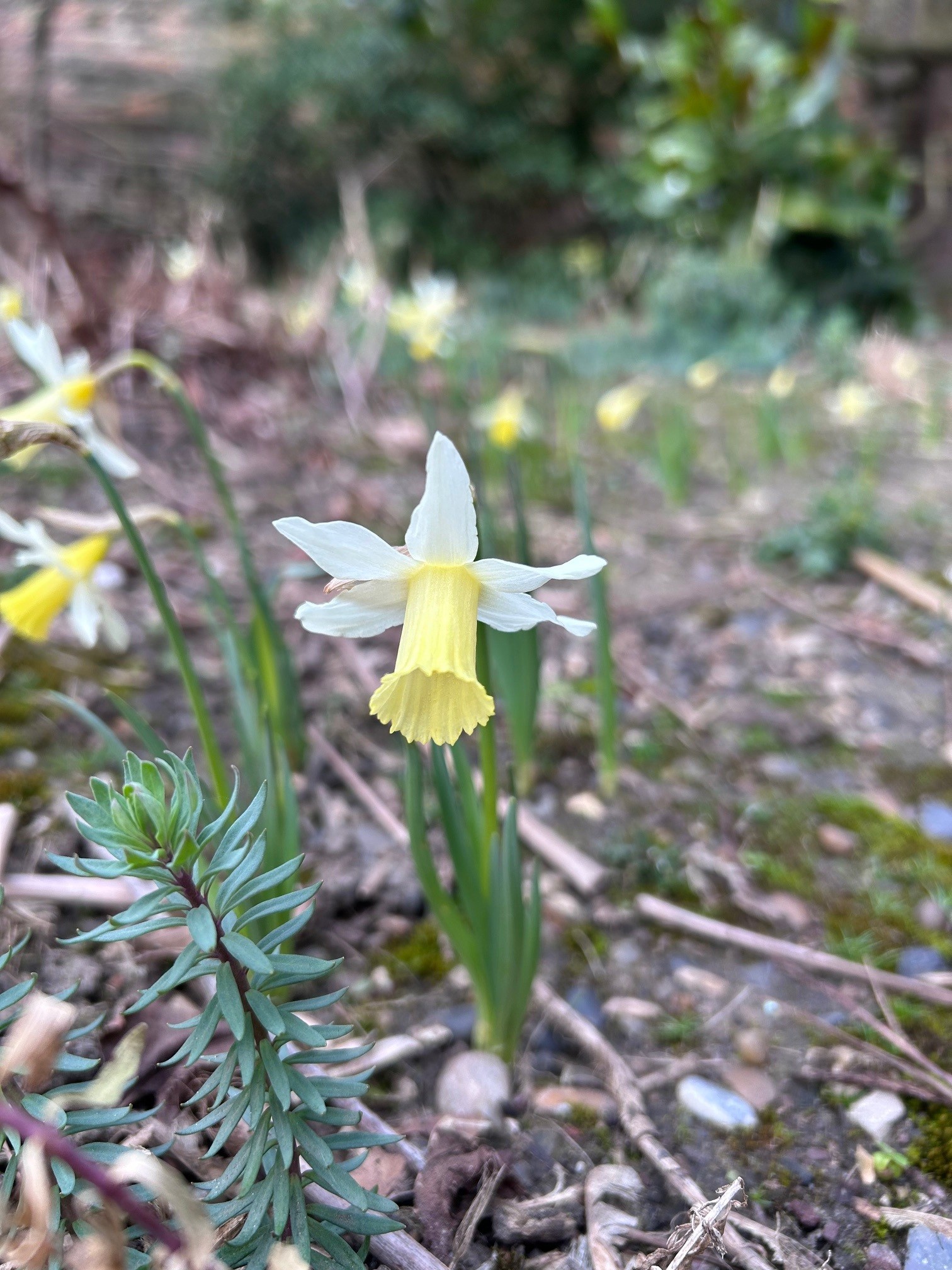
Daffodil (Narcissus ‘Elke’)
A fragrant, small and early-flowering daffodil, you can spot Narcissis ‘Elke’ in the Peace Garden. It has pale petals and a creamy yellow trumpet. The name ‘Elka’ is apparently from a combination of the names of two ‘lady daffodil growers’: Elizabeth and Kate.
Wood spurge (Euphorbia amygdaloides var. robbiae)
Wood spurge is in the Euphorbia family, so take care! If the stems are broken, they gush with a thick milky latex substance that can cause blisters on skin. They are handsome perennial plants, shade loving, with zingy lime-green flowers in late Spring and rosettes of glossy dark green leaves. Another name for this plant is ‘Mrs Robb’s Bonnet’ – we would like to see the hat that inspired that name!
We hope you enjoy walking around the walled gardens at Charlton House! This month, look out for:
New England Aster (Symphyotrichum novae-belgii ‘Violetta’)
‘Violetta’ is a spectacular New England aster, which for a couple of months from late summer, bears a prolific display of violet-purple daisies. A naturally tall plant, it provides a regal purple splash of colour – long after many other perennials have finished flowering. Our plants are originally a donation from CABAHS member Anne.
Michaelmas daisy (Aster x frikartii ‘Monch’)
A bushy perennial with clusters of yellow-centred, lavender-blue daisies that flower right through the Autumn, it is very attractive to pollinators. One of the most reliable and popular Michaelmas daisies (so called because they flower at the time of the feast of Michaelmas on 29 September), it was bred by a Swiss nurseryman called Frikart and named ‘Monch’ after a Swiss mountain.
We hope you enjoy walking around the walled gardens at Charlton House! This month, look out for:
Night moth Salvia (Salvia nachtvlinder)
With velvety plum-purple flowers, this Salvia is attractive to moths and other pollinating insects and flowers over a long period – well into late Autumn. It has deliciously blackcurrant-scented leaves and is said to protect roses against black spot when it is planted under them. A large clump is now happy in the Peace Garden.
Michaelmas daisy (Aster x frikartii ‘Monch’)
A bushy perennial with clusters of yellow-centred, lavender-blue daisies that flower right through the Autumn, it is very attractive to pollinators. One of the most reliable and popular Michaelmas daisies (so called because they flower at the time of the feast of Michaelmas on 29 September), it was bred by a Swiss nurseryman called Frikart and named ‘Monch’ after a Swiss mountain.
If you go down to the Old Pond Garden this Saturday, you’re sure of a big surprise. For every teddy that ever there was, will gather there together because, today’s the biggest floral count ever!
If you have ever wondered which month is the most floriferous in the Old Pond Garden, I’m guessing it’s July. We are expecting lots of visitors this Saturday July 20th, 11-3, for the Teddy Bears Picnic, and they are in for a treat (as well as a picnic) as we have counted over 30 plants out in full flower. Can you spot them all? We will have an info board out so you can match names and flowers, while the kids are charging about finding the hidden Teddies. Works for all ages.
The Teddy Bear trail will be in the Old Pond Garden and there will be lots of photo-ops for you and your teddy with the lovely garden backdrop. See you there, better come in disguise!
We hope you are enjoying a walk around the walled gardens at Charlton House! This month, look out for:
Turkish sage (Phlomis russeliana)
A herbaceous perennial in the Mint family, native to Syria and Turkey. The name ‘Phlomis’ comes from the Greek word meaning ‘flame’. Heart shaped leaves of some species were used as lamp wicks in ancient times. The stiff upright stems carry yellow flowers, which look good as seed heads in winter and provide shelter in winter.
Woodland sage or Balkan Clary (Salvia nemorosa ‘Caradonna’)
A bee magnet because it offers both nectar and pollen, this a hardy herbaceous perennial with dazzling violet flowers. Susceptible to slugs and snails sadly, but luckily we don’t get too many of those in the Old Pond Garden.
Catchfly (Silene armeria ‘Electra’)
Blue-grey leaves and hot pink flowers for weeks on end. An annual which self-seeds prolifically. It is called catchfly because there is a sticky area on the stems just below the flowers, which greenfly and small insects get stuck to. Feel it gently with your fingers!
Enjoy a symphony of colour with this extraordinary Tiarella! A charming, shade loving relative of the Heuchera. In spring, slender stems rise above the leaves and hold a mass of pink and white starry flowers, giving a frothy effect – hence the common name the Foam Flower.
This variety has an Award of Garden Merit from the RHS and it copes in the difficult dry shade conditions under the Lime trees in the Old Pond Garden.
We hope you enjoy a spring walk around the walled gardens at Charlton House! Look out for:
Forsythia
Forsythia is in the olive family, renowned for its vibrant yellow flowers which appear in spring, long before the leaves unfurl. The one by the Charlton House stables is quite old and we are not sure of the exact variety. We pruned it back hard a year ago and it seems to have loved it!
Cherry laurel (Prunus laurocerasus)
A ‘background’ evergreen plant most of the year, but quite striking when the white candle flowers appear in Spring. Although we call it a laurel, it actually isn’t – it’s in the cherry family! We know that an early resident of Charlton House, Elizabeth Puckering, introduced cherry laurels to the gardens. She was friendly with the diarist John Evelyn, who lived in Deptford at the time, and exchanged cuttings with him in around 1654.
Daffodil (Narcissus ‘Thalia’)
A fragrant and vigorous trumpet daffodil which is now in it’s third year in the walled gardens, so has formed some nice big clumps. It starts off creamy yellow and fades to white, and is sometimes referred to as an orchid daffodil. For fans of BBC Gardener’s World on TV, you might recognise it from Monty Don’s writing garden!
Brunnera has lovely heart-shaped, silvery-veined leaves that look as if frost has touched them. The leaves light up shady areas of the garden. It has long lasting, bright blue flowers that look very much like forget-me-nots, and which provide lots of nectar and pollen for visiting bees.
Wood spurge (Euphorbia amygdaloides var. robbiae)
Wood spurge is in the Euphorbia family, so take care! If the stems are broken, they gush with a thick milky latex substance that can cause blisters on skin. They are handsome perennial plants, shade loving, with zingy lime-green flowers in late Spring and rosettes of glossy dark green leaves. Another name for this plant is ‘Mrs Robb’s Bonnet’ – we would like to see the hat that inspired that name!
Still going strong, winter into spring!
Lenten rose (Helleborus orientalis)
The Lenten Rose is a perennial flowering plant and is part of the Buttercup family, so not a rose at all! Its common name comes from the fact it usually flowers between Ash Wednesday and Easter – the period known as Lent. Hellebores (Lenten roses) can be white,
Primrose (Primula vulgaris)
We grow the English or ‘common’ primrose in the walled gardens, which is the natural pale yellow one that gives its name to the colour Primrose. It is often one of the earliest plants to flower in Spring (the Latin word ‘prima’ means first). Early butterflies like the Brimstone benefit from its nectar. Plants will hybridise (cross) very easily with the garden bedding Primulas that come in lots of different bright colours, so seedlings can come up a surprising colour!