An alarming article in Gardeners World magazine… taste your courgettes!

An alarming article in Gardeners World magazine… taste your courgettes!
As Vija’s previous blog (‘Shout out for self-seeders‘) mentions, this is the time of year when self-seeders pop up in the borders. If they are valued border plants but you just have too many, before you whip them out please think about potting some up for a future CABAHS plant sale. Although it looks like we can’t have full meetings for a while yet, we are aiming at holding a plant stall at Charlton House, probably at the end of July or early August. Just remember it’s important to identify and label any potted-up specimens very clearly, especially if it’s one that tends to be a “bit vigorous”! If you aren’t sure, do send a picture in, we have lots of expertise among our membership!

Other top self-seeders are Verbena bonariensis and Astrantia:


Viv
I have recently watched two online Lectures from Fergus Garrett. These are replacing the events which had been planned at Great Dixter. More are planned. The second lecture was on the subject of self seeders in the garden. Of course, Great Dixter uses these extensively and it was interesting to see how self seeding is managed by the team there and how much they value the contribution the self seeders make to the herbaceous borders.
I have never planted Valerian, but it pops up in random spots and this year makes a lovely splash of colour combined with Salvia ‘Jezebel’, and a Californian poppy. Forget-me-nots I have to be careful with as they are smotherers. But primroses are a joy (apart from when they get into the lawn). Tanicetum (tansy) and the grass Milium effusum (wood millet) make a lovely splash of colour in late spring and Erigeron karavinskianus (Mexican fleabane) makes itself at home in many inhospitable corners. Although I allow a large number of Pulmonaria (Lungwort) to provide an early food source for bees, these can be a problem if I am not ruthless, so they have to be thinned out when they finish flowering.


Part of my garden includes a gravel path and a number of plants have self seeded there very generously over the years. Many of these I take out and pot on to be used in my own garden, or give away or bring to the sales table. On occasion, this has even included Phlomis and Clematis. Spotting the gems before I tread on them takes care!
In my garden, as in all gardens, there are some plants which seem not to like where they have been planted and have made their way to anothe r spot where they feel far more comfortable. I am thinking in particular of the Plume Poppy, Macleaya microcarpa. It has completely ceased to exist in its original spot and is now doing very well a good 5 metres further along the border. In fact, it actually looks better there. Once again, I am reminded of the maxim that plants will grow well if you provide them with the conditions which they need to succeed. Alternatively, it seems they find these for themselves.
For more Fergus Garrett lectures, see: https://www.greatdixter.co.uk/whats-on/events/online-lectures-2020/
Vija
A friend of mine, quite keen on gardening, but a recent convert to properly growing due to the current situation, recently sent me a photograph of some seedlings she had received via mail order and which she had pricked out into trays. She was very proud of herself! For some reason, pricking out of seedlings I find one of the most relaxing gardening tasks. I am sure that this will differ from person to person, but there is something about the orderliness of this basic task which I find very rewarding. It also has a clearly defined beginning and end and does not require huge amounts of effort.
Some gardening jobs such as cutting back buddleia or reducing the size of an overgrown phormium can seem overwhelming by comparison. At the moment I am looking at a fig (Brown Turkey) which began life in a pot and was then moved into the part of my garden where I grow salad vegetables. It has taken off here and is clearly in its element. However, it is really getting much too big and is a complete bully, threatening to overwhelm everything else. It needs to come out. I have also realised why they do so well at the roadsides in Italy and France: there is a network of roots that stretches out well beyond the plant itself , creating a dense mat just below the surface of the soil and making it difficult for anything else to survive. While I consider precisely how I am going to remove the fig, I opt to prick out more seedlings…
“Tomatoes and Cyclamen” was painted in 1935 by Eric Ravilious.

Like the pricking out of seedlings and potting on, this painting of arrayed pots in a greenhouse brings immense satisfaction. The beauty and neatness remind me of the greenhouses at West Dean. It is something I will never achieve and can only aspire to!
What gardening tasks do you find most relaxing? Let us know! cabahshortisoc@gmail.com
Vija
The answer is NO, of course! This is a real “good do-er” of a plant and it’s in full bloom everywhere at the moment. The Latin name is Lunaria annua, but it is called Honesty, Moonwort, or Money plant. The “Moon” tag refers to the shape of the seed pods, and also the “Money” tag, because the seed cases look like silver coins. You can eat the young leaves in salad (it tastes a bit cabbage-y) and the seeds make a mustard substitute. Even the peeled roots can be eaten, and there is research into whether a fatty acid from the seeds can be used medicinally for Multiple Sclerosis.

I inherited Honesty 30 years ago, and the “common” (pretty garish) purple one comes back every year from seeds. I picked up some seeds of “Corfu Blue” from Anna last year, who in turn got them from Margaret, via the Plant Sales Table – there’s a CABAHS Membership advantage for you, working at its best! Corfu Blue are a much paler colour, rather easier on the eye. You can really see the difference in this photo:

Anna has grown the most beautiful one with purple stems this year, we must try to get seeds from her..!

I know you can get white versions too, and if you grow any others, please send in a picture, you really cannot have too much honesty!
Kathy A
On my kitchen table lies a medium-sized envelope crammed full of Eccremocarpus scaber seeds and their pods. Sitting at my kitchen table I can see clearly the lemon flowers from one variety and the pink flowers from the other variety sunning themselves happily on the roof of the pergola.
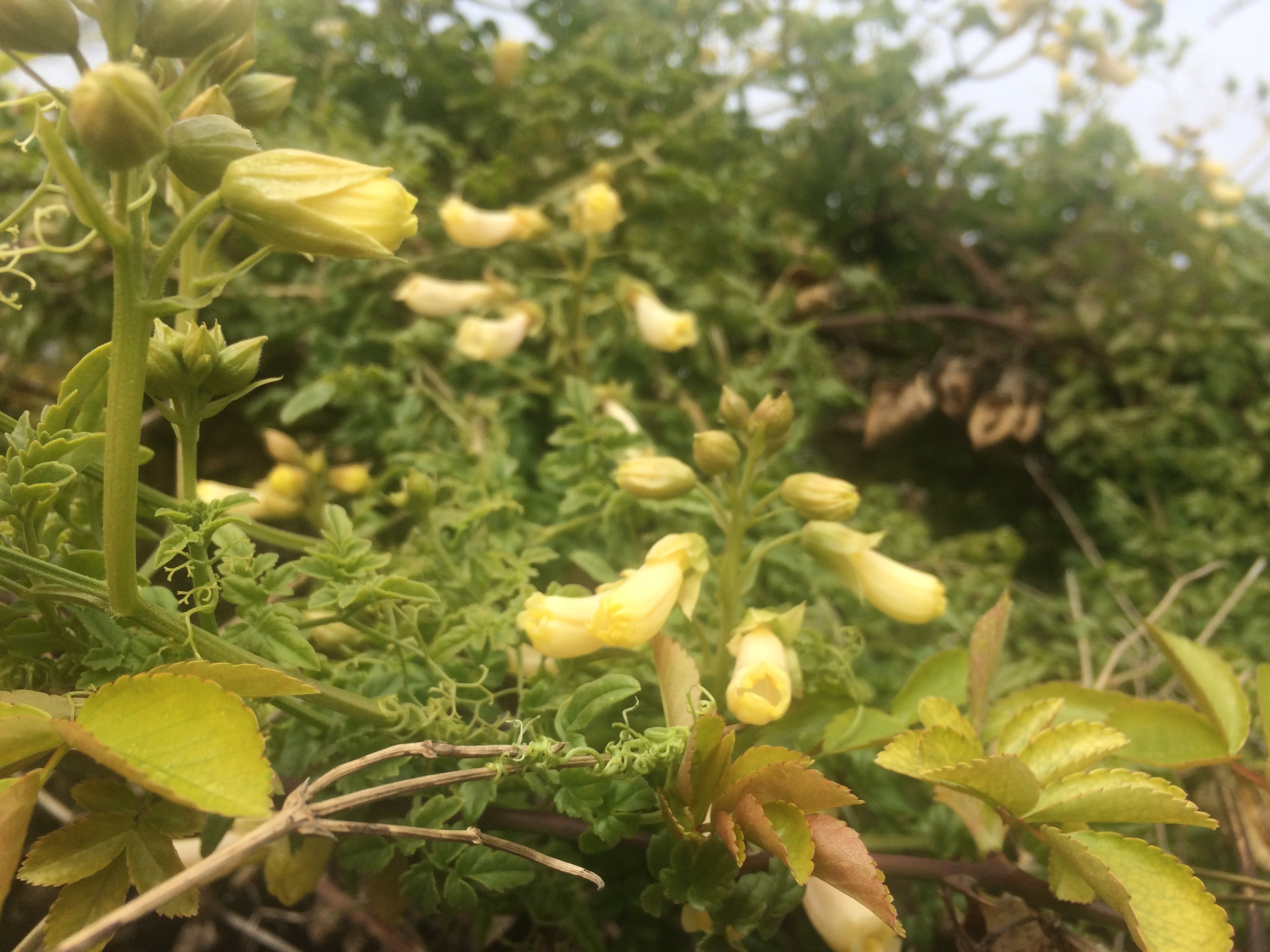
I am fairly new to growing Eccremocarpus and was first given a seedling of the orange-coloured variety a few years ago and another seedling last year which I planted on my south-facing fence. The seedling did not take kindly to the clay soil and hardly flowered. Unsurprisingly, it didn’t survive the winter.
However, two years ago at a rare plant fair I bought two seedlings – a pink flowering variety and a lemon flowering variety. Not having much confidence in their survival I planted both in a slightly raised bed on the rear boundary east-facing wall, which the pergola abuts. On this wall are two mature, variegated Trachelospermum jasminoides. The raised bed is extremely narrow and has received small top-ups of compost from time to time. However, I did not rate their survival due to the competition from the neighbouring climbers and the very dry conditions. How wrong I was: the Eccremocarpus seedlings just love their location; the protection the Trachelospermum provides them; the dry soil with added compost; and the baking that the flowers receive from the sun at the top of the pergola.

Eccremocarpus scaber is also known as the Chilean glory-flower or the Chilean glory creeper and was first documented in 1794. It flowers from September to May in the Southern Hemisphere. In New Zealand it is regarded as a pest. And I can see why: the envelope of seed pods on the kitchen table and the dozens of pods still remaining on the pergola to be collected is a testament to its reputation!
But I am not going to allow these climbers to reproduce again. Although they started flowering in early March last year they stopped flowering in early June and I was mystified. I was told to look for seed pods and there they were, their lanterns hanging beneath the mass of foliage. So this year I am going to religiously remove all developing seed pods so that these climbers can flower all summer.
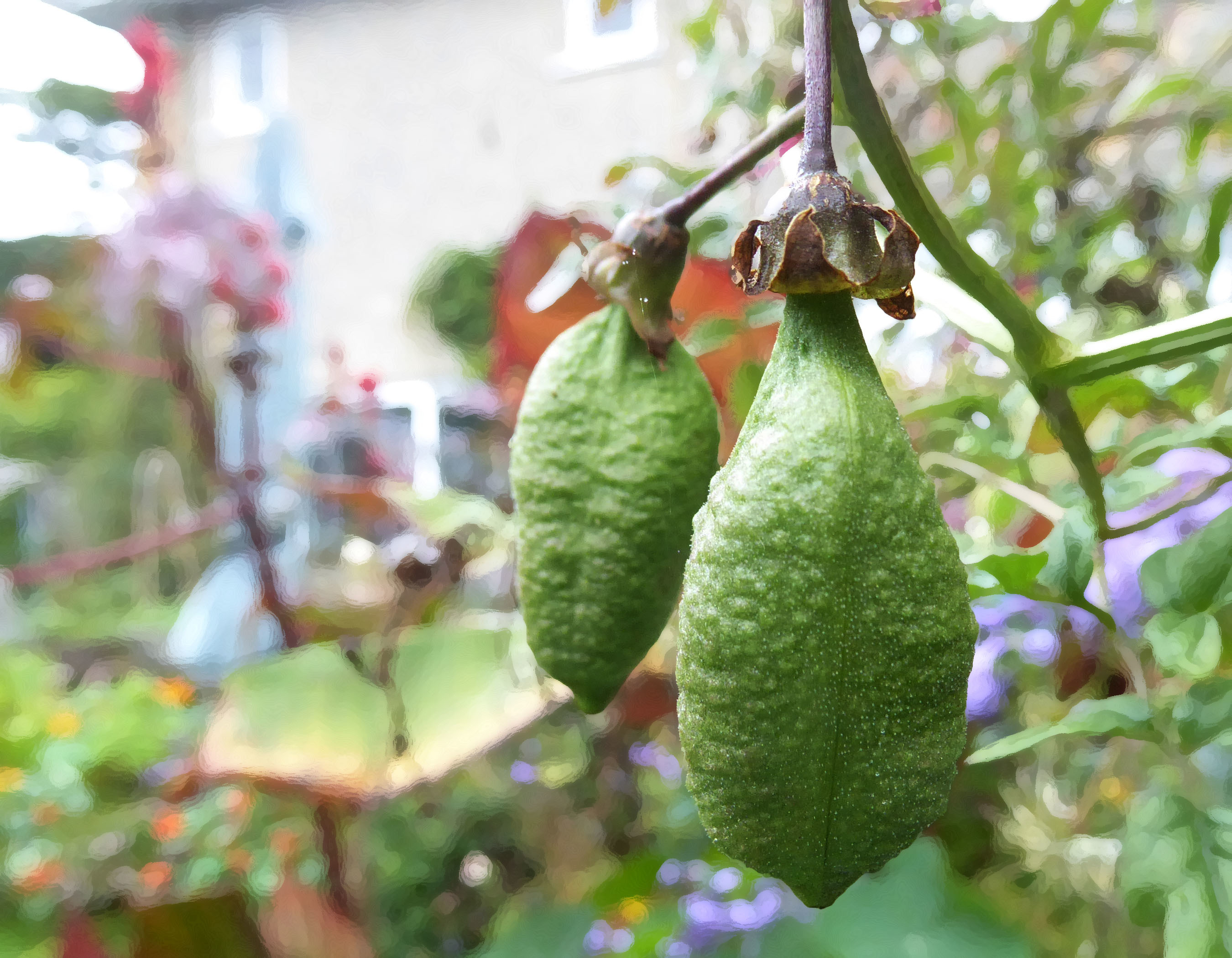 Eccremocarpus is regarded as a perennial species but due to the UK climate they are generally grown as an exotic annual. The foliage is light green and it uses its tendrils to hook onto anything for support. I had difficulty in remembering and pronouncing the name, Eccremocarpus, but I got there in the end! I love the colours of these tubular flowers, that sparkle like jewels in the sun. They provide me with a lot of pleasure. If you grow the orange variety, you could marry it with Thunbergia, Ipomoea or Nasturtium, all of which have orange flowers.
I will be providing a huge number of free packets of seeds in the next few weeks for anyone who has the right conditions: a protected area in their garden that is light, sandy, well-drained but fertile; or a sunny plot on their windowsill or balcony.
Anna L
 Charlton and Blackheath Amateur Horticultural Society