Time to pot up those Dahlia tubers in 3 litre pots, making sure the tubers have an ‘eye’ which will shoot. Cover in compost, allowing the stem to rest at the surface, then label and water and keep somewhere reasonably light and frost free (greenhouse or windowsill) until they start growing.
Potting up dahlias
2. Now is the time I start sowing sweetpeas: five seeds to a 3 inch pot and keep on a light windowsill or greenhouse until they germinate. You can try sowing directly into the soil which I think works well for some.
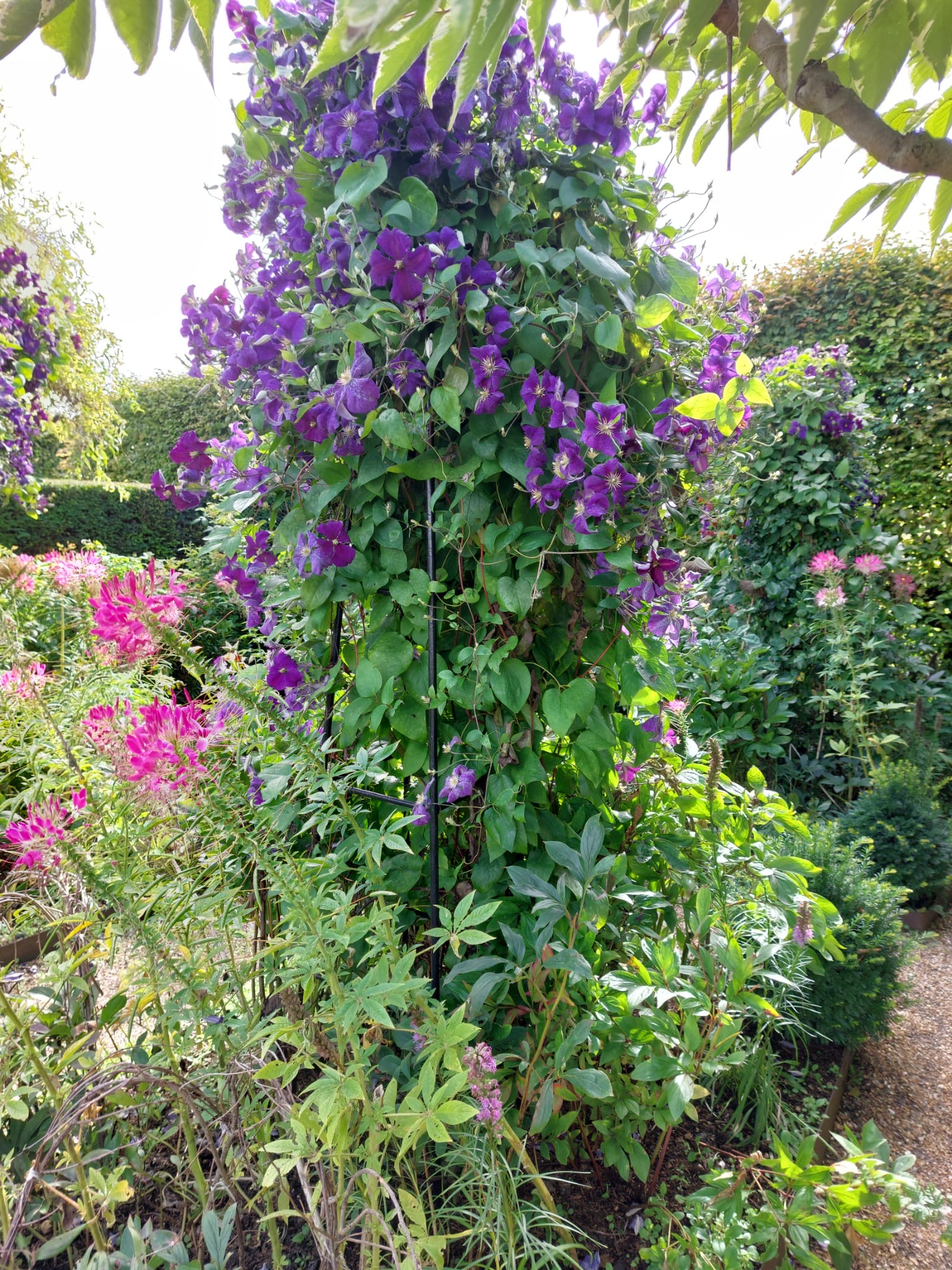
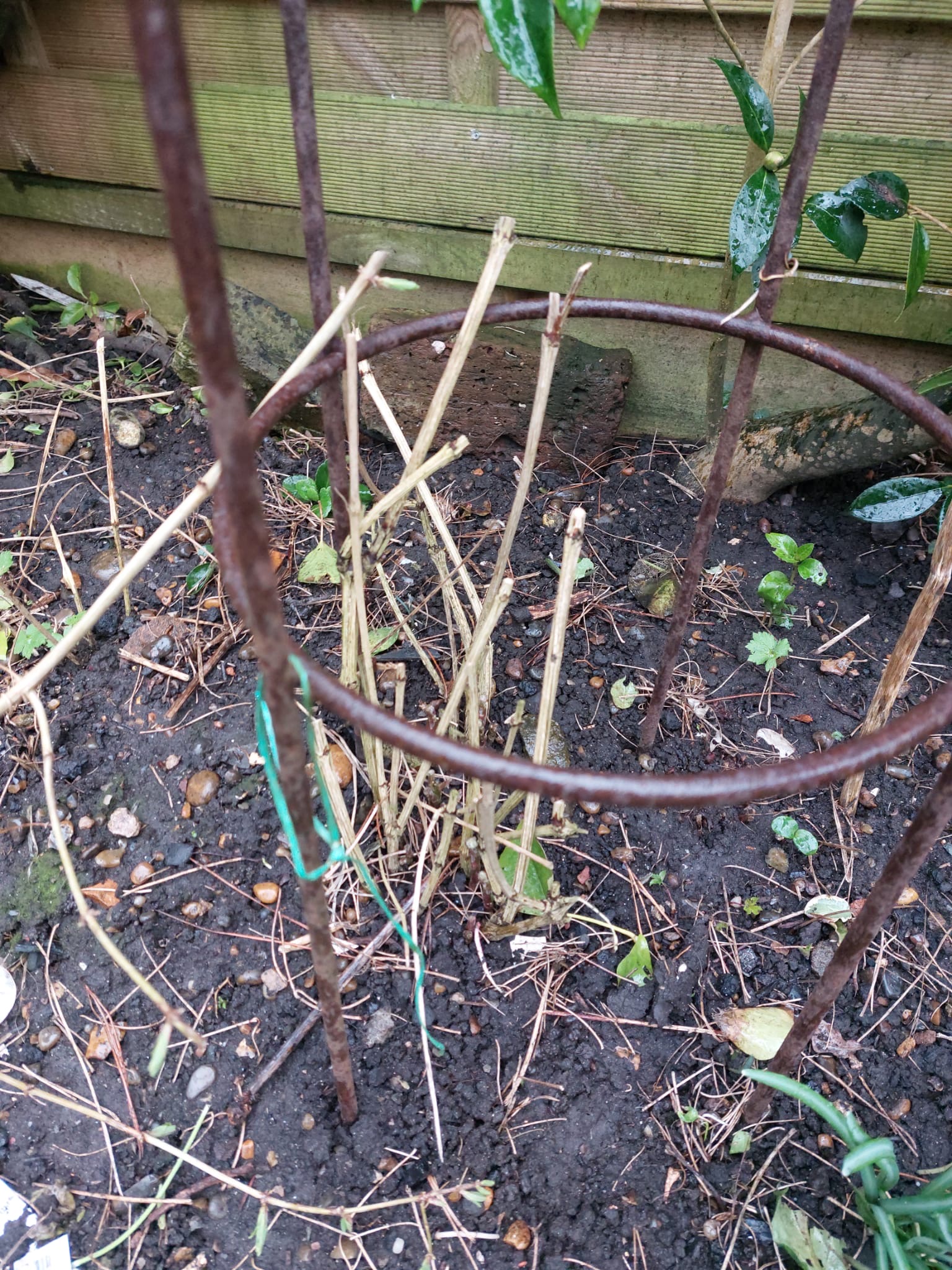
1. It’s time to cut back those late-flowering clematis…the viticella small-flowered types and the ones flowering after June. All that rain last year made mine grow rampantly so cut back hard to just above a bud, 6 to 12 inches from the ground, and give them a feed and a mulch.
Late flowering viticella ClematisClematis viticella – two varietiesClematis cut down to 12 inches
2. You can also cut back some of the slightly early-flowering types like jackmanii varieties and Comtesse de Bouchard, but it’s best to check individual varieties or you’ll lose all your flowers for this year. Other varieties such as early varieties like Montana should be trimmed back after they flower in Spring, unless overgrown – when they require drastic action and you’ll be sacrificing the flowers for a year or two. Anyway, please check.
3. If the ground is frozen or too wet then don’t be tempted to walk on it for fear of damaging the structure. Seems impossible at the moment to get much done!
Our first meeting of 2025 was very well attended. The speaker and the topic obviously attracted a good audience. The Show Table received a good selection of displays, with Jean’s a worthy winner of Best on the Table.
Our speaker, Fergus Garrett, the highly influential plantsman and horticulturalist, has been Head Gardener at the internationally acclaimed Great Dixter Garden in Northiam, East Sussex since 1993 and is the CEO of the Great Dixter Charitable Trust. He gave an excellent, wide-ranging talk on how to keep our gardens looking vibrant and spectacular all the year round. He explained how to plant for a long flowering season with plants co-existing in one place, but performing at different times. He used photographs of the spectacular gardens at Great Dixter to illustrate his points. He said Great Dixter had the advantage of scale and greenhouses but it is possible to scale down what they do at Great Dixter and use their scheme in our own gardens with minimal labour.
He particularly used the magnificent long border at Great Dixter as an example of how to plan a long flowering season. How to use structural under-planting, interlaying and interplanting with bulbs, self-sowers, perennials, clumps of bedding plants and climbers.
We welcomed back Tim Ingram who has a passion for alpines, and is a member of the Alpine Garden Society. He gave us a talk on the evolution of Copton Ash, his garden in Faversham, Kent where he also has a specialist nursery. He also brought with him a selection of alpine and perennial plants for sale. He illustrated his talk with a series of photographs showing the development of his garden over the years and seasons.
Copton Ash fruit plantings Spring 1979Copton Ash getting wild, May 2024
Tim’s garden is a large and mature family-run garden, about one and a half acres in size, which has been in existence for nearly fifty years. He comes from a family of avid gardeners and so was brought up with a keen interest in plants and gardening. His father worked at Brogdale (home of the National Fruit Collection): his mother too a keen gardener: his grandfather was into market gardening. Tim first worked in academic science in London, specialising in plant hormones. He and his wife returned full time to Copton Ash in the late 1980s when they soon started a nursery.
1. Start ordering your bulbs now as all the bulb catalogues are arriving – though prices don’t stop going up!
2. Start planting bulbs when they arrive but save your tulips until later as they are prone to virus and rotting, and to theft by squirrels.
3. Divide large established clumps of perennials by cutting back first, then splitting either by hand or with two forks back to back. Delay if soil is heavy or too wet.
Order Spring BulbsSplit established clumps of perennials
4. Replace tired summer bedding in pots and replant for winter and replenish with fresh compost.
We might complain about all the rain we have had over the last few months but the plants have just loved, loved, loved it!
So, for the first time ever, I can celebrate, as my Angel’s Fishing Rod (beautiful name) is due to send up at least four flowering stems after many years and I put this down to the extensive rain we have endured this past winter and spring.
At Sissinghurst Gardens recently, I spotted two Dieramas in flower – the maturer pink-flowering specimen in the sheltered Rose garden, in a front-of-border, corner position where two paths meet, and a smaller, delicate-blush-mauve-flowering specimen growing in a south-facing border, situated in front of a tall brick wall – both looking absolutely gorgeous.
On a gloriously sunny day in May, a visit was paid to the garden at King John’s Nursery. This ‘naturalistic’ garden is set within a beautiful landscape of ancient trees and meadows. We were given a laminated map of the garden layout and proceeded through the old honeysuckle-clad, wrought-iron gate to the garden beyond. This led us to the first garden room, beautifully planted in soft-pinks, the focal point being a circular, brick-built pond, fed by an imaginative water-gully. This led us into the gravel garden room, consisting of sun-loving and tender plants displayed to great effect on a slab-table, an artefact that many of us would love to possess for our own gardens!
Honeysuckle-clad wrought iron gate entrance to the gardenFirst garden room, planted with soft-pink flowersPond and water feature in the first garden roomSecond garden room featuring sun-loving and tender plants on the slab-table
From there we entered a magical place – a charming meadow with mauve-blue spires of camassias threading through and rising above the grasses, a stunning contrast to the shades of green all around. White-flowered camassias were in bud, ready to take over and bloom in the next week or so. In one corner of the meadow sat a toadstool circle, an enchanting addition for children to let their imaginations run wild. We exit beneath the clipped hedge archway into a larger meadow which includes an herbaceous long border, consisting of many taller plants such as grasses and flowering angelica. We follow the path around, to a shaded woodland dell and admire the luminosity of the rhododendron’s stunning white flowers by a gateway entrance, cow-parsley billowing alongside solomon’s seal and pass beneath the 350-year-old oak tree. Amongst the grasses, glistening in the sun, wild orchids are to be admired. We sat on the bench to absorb the idyllic setting before us, noticing glimpses of an old apple orchard beyond the boundary.
I have just spent a very happy week at Duloe Manor, a complex of self-catering holiday apartments and cottages near Looe in Cornwall. The main house was built in the 1690s for the Rectors of the local church. The whole complex is set in lush gardens of around three acres: a few mixed beds contained lovely combinations of saxifrages, irises and other familiar perennials while in less formal areas, swathes of wild garlic provided backdrops for beautiful pink campions as well as English bluebells in full bloom. In the car park several banks of pale yellow primroses remained stubbornly but delightfully in flower! Majestic rhododendrons provided splashes of magenta and purple.
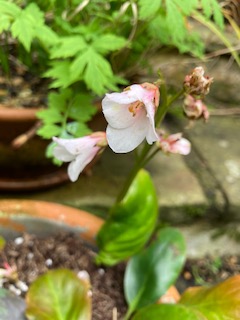
I have a choice plant in my garden which, amazingly, I have managed to keep alive all these years and it’s all thanks to Margaret T, who kindly gave me an off-shoot such a long time ago.
To make sure it was protected, I planted this bergenia in a pot on the shady side of the steps, so that the plant would stand out and not get damaged. It flowers every winter and has been flowering all through February this year and the elegant white, nodding flowers are still hanging on, fading to a shade of blush-pink. The rhizomes have outgrown the pot now so I will be thrilled if I can return the favour and offer Margaret T an off-shoot of this beautiful plant. Plants are difficult to obtain but I understand seed might be available on the market.
The botanists and growers regard this species as the most elegant of all the Bergenias and I can see why, as this compact plant with its rosette of neat, oval, apple-green, shiny leaves enhances the dainty flowers, which are held aloft on elegant, often blush-pink stems.
Seed was first collected from the limestone cliffs in Sichuan in the Himalayan mountains in 1935 and again in 1982 by Roy Lancaster who introduced the species to the UK. Cambridge Botanic Garden website mentions that Bergenia emeiensis can be seen growing in their Alpine House and that they are also trialling the species in their woodland area. The plant used to be regarded as tender but I regard it as a hardy perennial in my small courtyard garden which, like many London gardens, has its own micro-climate. Even so, I do, unfortunately, sometimes lose plants during colder winters but this species has not yet been damaged and so it’s a great treat to be able to admire this handsome specimen from my kitchen window.
Tom Stanier, the Horticultural Team Lead at Greenwich Park, gave a talk about his life as a gardener at the Park and a behind-the-scenes look at working there in these challenging times. He described how he came into gardening, his training and work at the Park and some of the Park infrastructure, policies and projects. It was great to hear from someone with hands-on experience there.
He said he felt a connection with Charlton House as he had been married there in 2018. His interest in gardening really took off in 2017 when he moved into a flat in Lewisham with his partner and began to grow plants on his balcony and indoors. He had a radical rethink of his life in 2018. Having a child particularly refocused his life on his choice of a future career. Having been in retail for ten years, he decided he wanted to work out of doors and do something flexible and tangible. He successfully applied for the 2 year Royal Parks Apprenticeship Scheme which is part practical and part college-based course and chose to work at Greenwich Park as he thought it was more interesting. He completed an RHS Certificate and has since taken over leadership of the Horticultural Team at the Park, working closely with the head gardener.








 Charlton and Blackheath Amateur Horticultural Society