1. Border irises are really doing their thing now and the show can be brief but make sure to keep the soil around their roots free of weeds so their rhizomes can bake a bit in the sun.
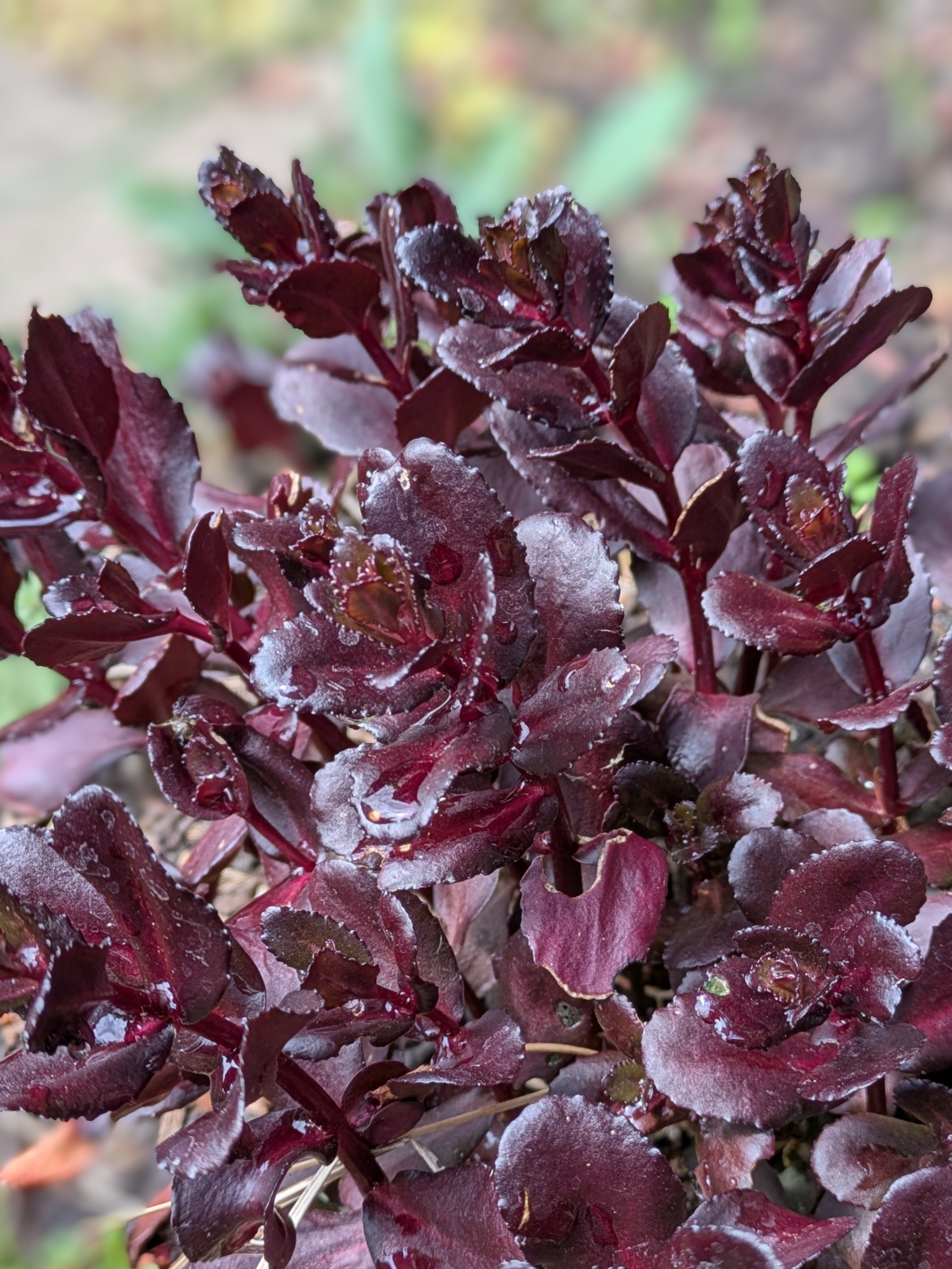
2. Time to Chelsea chop your tall perennials to stop them flopping later or to extend flowering. Good candidates are Phlox, Penstemon, Helianthus, Sedum/Hylotelephium – and I include vigorous Clematis too. You can either do the whole plant at once or just some stems to extend flowering, although it may result in smaller flowers.
3. Deadhead displays of pot plants like Violas to keep them flowering and stop them going to seed. Remember to give them a feed to keep the display going.
Jason Sylvan, Head Gardener at Charlton House, has designed the Old Pond Garden to be as attractive to wildlife as possible. Because we talk about monitoring moths, he asked if we could check how many moths are visiting the garden. We should have tried this in the warmer months when there are more plants in full flower but we had missed that for this year so we gave it a shot on a warmer dry night in September to test out a strategy.
As we wrote in an earlier post, we have been monitoring moths for the Garden Moth Scheme since 2013 in Newcastle-upon-Tyne and since 2019 in Blackheath. The moth trap is a box with a light (our type gives off no heat), and below the light are two panels of see-through Perspex, one each side and shallowly angled down, with a slot/gap between them. The moths ‘funnel’ into the box, and it’s difficult (but not impossible) to get out. Inside are egg-trays, which provide resting places.
Why do moths fly towards the light? Until recently, the correct answer has been that nobody knows, but researchers in Sweden found the answer: for aeons, light at night was above and dark was below, so moths orientated themselves to fly with their backs to the light above. In artificial light – fires, candles, street lamps – they still try to fly with their backs to the light, circling round and round, and sometimes become disorientated.
The trap is placed before sunset, and collected at sunrise the next day. So an early start.
Dave Goulson, Professor of Biological Sciences at the University of Sussex specialising in the ecology and conservation of insects, and author of several books*, gave a talk about the dramatic insect decline worldwide. He outlined some of actions required on a National and International scale to reverse this apocalypse and what we as gardeners can do.
When he was a boy, he started collecting caterpillars (in his lunchbox) and his interest in insects became a life long passion when one of them pupated into a Cinnabar Moth. He explained that insects evolved over 480 million years ago and there are now around one million known species worldwide. They were the first creatures to fly and sing and many have complex inventive ways to camouflage themselves or mimic others. Examples of some ‘weird and wonderful’ insects were shared with us such as the Shield Bug from Thailand whose back very much looks like the face of Elvis.
The horrifying statistics on insect decline were shown, particularly over the last 30 to 40 years. Studies show that the decline is around 75%. He has researched the Shrill Carder Bee which was common across Southern England pre-1960 but by the year 2000 the populations of this bee had greatly decreased and there were only about six populations left. Since 2000, the population which inhabited the Salisbury Levels has become extinct.
1. It’s a good time to take softwood cuttings of both tender and hardy perennials such as pelargoniums, anthemis and penstemons. Place in a shady spot until roots begin to form.
2. Put plant supports in place to stop things flopping and make them yourself from shrubby prunings or just push prunings in the soil around the plant.
3. I’ve Chelsea chopped my phlox today and also done a few clematis as they are far too tall and leggy after all the rain we’ve had.
A couple of months ago, we noticed the damage that was being done to the fig tree in the Old Pond Garden and realised that most other fig trees in the area were in a similar state. What was happening?
We were discussing it at a volunteer session one day and Pat T indicated that she had spotted the same kind of damage on her fig tree and had contacted the RHS for advice. The RHS confirmed our suspicion that the cause is a micro-moth called Choreutis nemorana. It is being referred to as the fig-tree skeletonizer moth or fig leaf roller – for rather obvious reasons! This species is widespread in the Mediterranean and North Africa where there will be more fig trees but more natural predators too.
It was recorded in Belgium in 2009 and the first record for Britain was in 2014 in London. Since then it has spread to East Anglia, Kent and the Isle of Wight.
To understand what is happening to the fig tree, we must follow the life-cycle of the moth. The adult moth lays whitish eggs in batches on top of the leaf. The larvae or caterpillars then hatch, begin eating the leaf but just the tender bits, not the ribs (hence one of its names). They also spin silk to create a protective web or cocoon, under which they continue to eat the leaf until they pupate. There are two generations with adults flying in July and again in the autumn. The second generation over-winters in sheltered places. The caterpillar grows to about 15mm long and the moth has a wingspan of between 16 and 20mm. For more information and photos of the different stages check here.
Kathy’s post about Gardening for the Bees was interesting – particularly because I love honey! But it made me want to encourage a similar interest in Moths. There are at least 2,500 species of moths in Britain and very few will eat your clothes!
Joe and I have been monitoring moths for the Garden Moth Scheme since 2013 when we were invited to enter a raffle for a moth trap. We think we were tricked! One of our fellow Volunteer Rangers at Jesmond Dene in Newcastle is a GMS Regional Coordinator and he was looking for new recruits! We didn’t win the raffle but he lent us a trap and a book and, as they say, the rest is history. We transferred to the South East Branch when we moved south and now we even continue through the Winter Moth Scheme…
The moth trap is a simple box with a light above it. The light attracts the moths and they end up in the box below with lots of egg trays to rest in. They are not harmed. In the morning, we open the box and identify and count the different species, taking photos of unusual ones. How different are our moth records here and in the North? For the last full year we were in Newcastle (2018), we recorded 290 moths of 61 species. Last year here, we recorded 844 moths of 143 species. Moths that hadn’t reached the North at that time were the Jersey Tiger and Box Tree Moths and we get more migrants here – some moths fly over the Channel!



 Charlton and Blackheath Amateur Horticultural Society