The English landscape

I recently attended a lecture (on Zoom of course!) about Thomas Gainsborough and his connection to the English landscape. Many people will be familiar with his portraits, but the landscapes in the background are not always commented on so widely, unless it is the painting of Mr. and Mrs. Andrews, which seems to be the subject of a huge range of interpretations (not all repeatable in a horticultural blog perhaps).
Heart of Oak - Royal Navy Anthem
Heart of Oak – Royal Navy Anthem

The 18th century was a period of great upheaval – the South Sea Bubble burst in 1720 triggering a financial panic; in 1721 the country had its first prime minister in Sir Robert Walpole; in 1739 Britain declared war on Spain; in 1745 Bonnie Prince Charlie landed in Scotland to claim the British throne; in 1756 the Seven Years war between Britain and France began; there was unrest both in America and at home and throughout this period, there was a Hanoverian king. It is all too easy to forget that two of the great names associated with landscape architecture, William Kent and Lancelot Brown, were working against this background, with Brown finding little favour with the ordinary person by uprooting and moving whole villages when they stood in the way of his designs.

It is also no coincidence that Brown, Kent and their peers were creating landscapes which came to be seen as quintessentially English. Reacting against the formality of the classic gardens which were inspired by those on the continent and France in particular, they designed gardens that were intended to reflect the ‘sinuous curves’ of the English countryside. Ironically, Brown, who never travelled outside the shores of his home island, was inspired by the paintings of French artists such as Poussin.
Nicolas Poussin Landscape with Figures c1646

In the background of Gainsborough’s paintings, this same concern with the natural is evident. Even in his most famous portraits, for example the one of Georgiana, Duchess of Devonshire and the actress Perdita. Both show an English landscape populated by English trees, most commonly the oak.
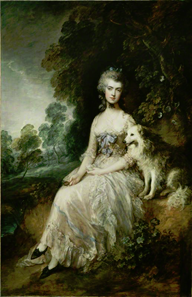
Apparently, as Gainsborough was not a ‘plein air’ artist, in order to remind himself of the shape of the oak he would arrange stems of sprouting broccoli in front of his easel!

This tension between what is an English garden and what is from mainland Europe has influenced garden design throughout history.

With the RHS encouraging people to plant a tree in their Roots for Remembrance, a nationwide memorial initiative, it seems an appropriate time to think about the role of the oak in English landscape culture.

Vija

Living in Greenwich – Tales through Time

The Royal Greenwich Heritage Trust has just launched an online exhibition from the borough museum archive, including a place where residents can record their personal experience of living through the pandemic. Most of the featured ‘tales’ are from Charlton, but the idea is to collect stories from all over the Borough.

There are currently no stories about gardening! Why not submit a story about your experience? https://tales.greenwichheritage.org/

Jane Loudon (Part II)

Title page, Jane Webb Loudon's Practical Instruction in Gardening for Ladies, Armstrong Brown Libraries

As she sought to improve her horticultural knowledge, Jane Loudon had found the gardening manuals of the day were targeted at those who already had a solid level of horticultural understanding –   there were no entry-level manuals, for which she saw a need and potential interest and so began to write them herself.  She set to writing them as she herself learned: Instructions in Gardening for Ladies; The Ladies’ Flower Garden; The Ladies’ Companion to the Flower Garden; Botany for Ladies; The Lady’s Magazine of Gardening.  These became standard books of reference, and attained a large circulation, making gardening an accessible pastime for women, who were often excluded from planting practices.

Like Mary Wollstonecraft, another keen reformer, Jane Loudon was acutely aware of her position. Mary Poovey’s book, The Proper Lady and the Woman Writer (1984) and Alexis Easeley’s First Person Anonymous (2004) explore the challenges female authors faced in a late eighteenth and early nineteenth century society which emphasised the proprieties of the Proper Lady and the accommodations which women writers made.  They also point out why many prominent female writers chose to publish anonymously, as it provided effective cover for exploring a variety of conventionally ‘masculine’ issues’.

Despite its associations with virtuous endeavour and the home, the garden also provided opportunities for women to negotiate between domestic space and the larger world. Jane Loudon was not alone in publishing for women, although most focused on botany – a far less ‘practical’ activity than gardening. And it is clear on reading Jane Loudon’s work, that she is actually encouraging women to get outside in the garden and to engage in some gardening activity – the reader is advised on how best to dig, the most suitable types of implement, as well as on soil quality, compost and plants themselves. Her work is encyclopaedic. Not quite advocating the throwing away of dresses, she treads a careful line between decorum, education and reform.  For many years she has languished in the shadow of her husband, but her work deserves to be read on its own merits and for the contribution it makes to the study of the history of women in the garden.

For anyone interested in reading a little more about Jane Loudon, Bea Howe’s book, ‘Lady With Green Fingers’ is a very readable account of her life. Bea Howe herself ( a ‘fringe ‘member of the Bloomsbury Group) was born in Chislehurst.

Bea Howe, painted by Duncan Grant, 1925

Vija

Suburbian writers and Jane Loudon

I have recently finished reading Sarah Bilston’s book  ‘The Promise of the Suburbs’. This is a very readable study of the history and development of the suburbs and their representation in literature. Rather than being the incredibly boring places often demonised in popular culture and variously vilified as boring, conventional and unimaginative (Bilston’s introductory chapter is titled ‘The “Horror” of Suburbia’) Bilston shows how they provided opportunities for female professionalism and new ideas about modernity.

The massive expansion of the suburbs during the Victorian period enabled an increasing role for the middle class people who were to occupy them. Central to this were ideas of taste. Visions of landscape gardens and spacious country home interiors were not appropriate to these smaller scale domestic environments and a new market developed for advice texts. With the removal of the paper tax, the end of the 18th century and the beginning of the 19th century saw a burgeoning of journals of all kinds and many of these were written and contributed to by women. This was the period of Mary Wollstonecraft, George Eliot and Jane Austen when middle class women were finding a voice and journals provided an opportunity to share ideas, in many cases anonymously if these were particularly controversial. [1] Bilston includes a chapter on Jane Loudon (b. 1807, d.1858), a name which, until fairly recently, I was unfamiliar with. More popular than Mrs. Beeton in her day and writing at the same time, selling huge numbers of books in print, as a female gardener writing for people in the suburbs, she didn’t stand a chance and, for the most part, has disappeared from view, receiving scant attention in the scholarly discussions of horticulture.


Jane Wells Webb Loudon was born on 19 August 1807 and died on 13 July 1858. After the death of her mother in 1819, she travelled in Europe for a year with her father, clearly a far-sighted man with regard to a suitable education for girls, but who lost his business to excessive speculation. He died penniless in 1824, when Jane Webb was only 17, forcing her into a position where she had to financially support herself. Already quite a prolific writer, she wrote ‘The Mummy; Or a Tale of the Twenty-second Century’ which was published anonymously in 1827 and has been seen as an early forerunner of science fiction. (Mary Shelley had written Frankenstein in 1818, but The Mummy is a very different narrative).

Through this she came to the attention of John Claudius Loudon, who, on meeting, was surprised to find that she was a woman.

Although much older than she (he was 47) and well established with a reputation in horticulture, the two were married seven months later. Jane Loudon makes it clear in her diaries that, knowing nothing whatsoever about plants, she was determined to make up her knowledge deficit. She studied botany (at the time this was considered a suitable subject for girls and women ) under John Lindley and worked closely alongside her husband. By the 1840s she was publishing horticultural journals and books in her own right, supporting her husband’s work and his family (his sisters lived next door) and continued to do so for the rest of her life – John Claudius died in 1843, leaving her to bring up and to financially support their 10 year old daughter single-handedly. She died age 50 in the family home in Bayswater.

Vija

[1] See work such as ‘The Proper Lady and the Woman Writer’ by Mary Poovey and Alexis Easely’s ‘First Person Anonymous’.

The second week in October

Before I turn to the second week in October, I should explain that the first week in October saw me, by and large, cowering indoors, hoping to avoid the rain.  I felt shamed into turning my attention to several ‘projects’ that I had earmarked for myself when lockdown began, err, just over six months ago. 

One of these projects was to put some order into several piles of books that I have been accumulating and I saved that one till last, as a sort of reward to myself.  It’s possible to do a fair amount of sitting down and indulge in a little light reading to help the project along.  When I was almost done I unearthed (no pun intended) a great little collection of old and new books about gardening that a friend had presented to me when I took on my allotment. 

One was a charming reprint of a book containing sensible advice for the novice WWII allotment-holder, including how to dig efficiently without straining your back – why didn’t I pay more attention?! – and a list of necessary tools to see you through:

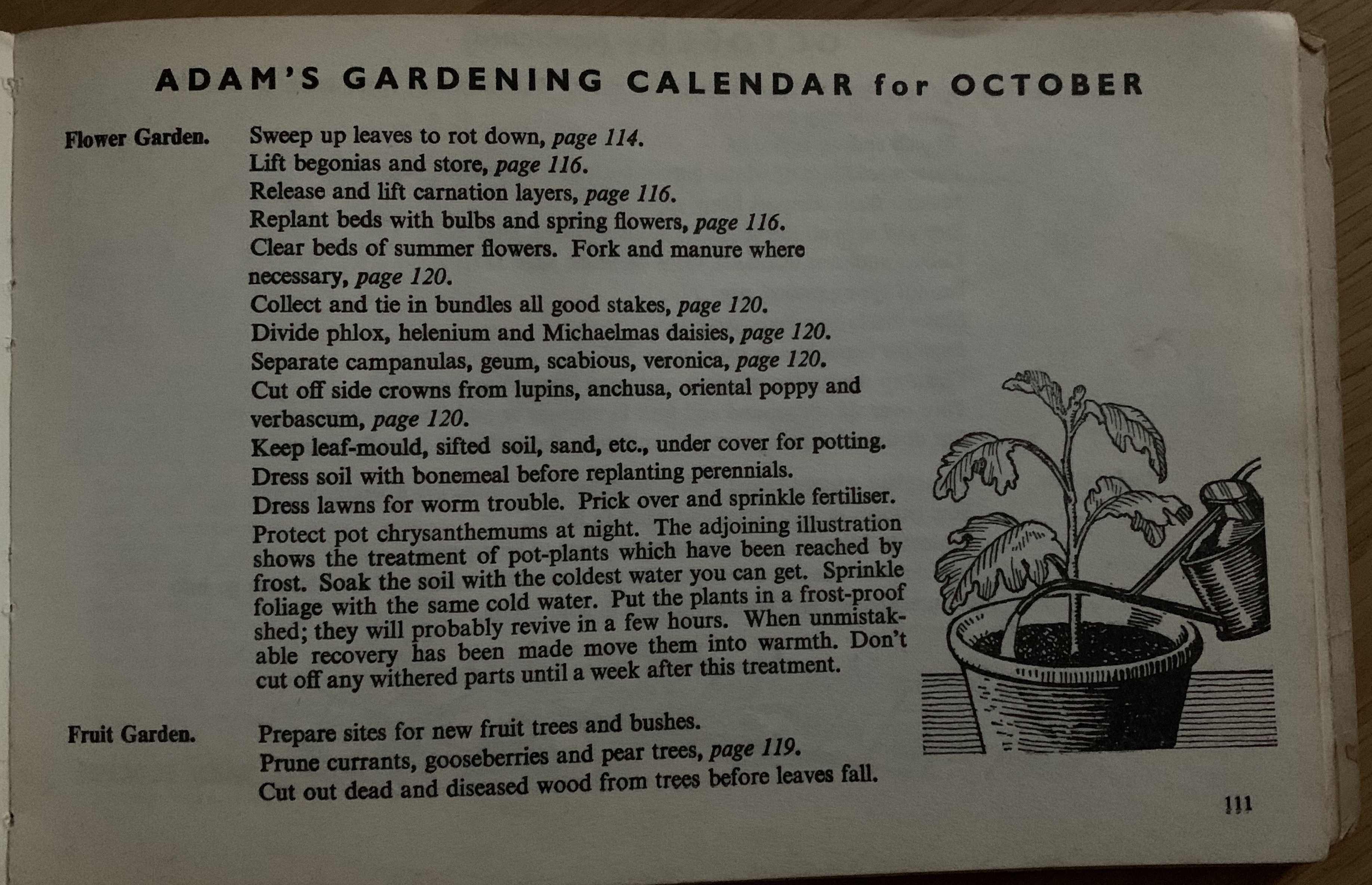
Adam the Gardener, a Sunday Express publication from around 1954, presents the gardener’s year, what to do and when, with illustrations of Adam in action.  He never looks very happy and I fear he hadn’t got the advice about digging techniques.  I thought I would see what Adam had to say about jobs to be done in the garden in the second week in October.  Here’s what I found! 

Melanie

March 2020 – Russell Bowes on ‘Dig For Victory’

As we had quite a small turnout on Monday (understandably!) I thought you might like to know a little about Russell’s great talk. Russell started his talk with some facts, such as that when war broke out in 1939, nearly 80% of Britain’s food was imported. Imports were by ship and German blockades threatened supplies almost immediately.

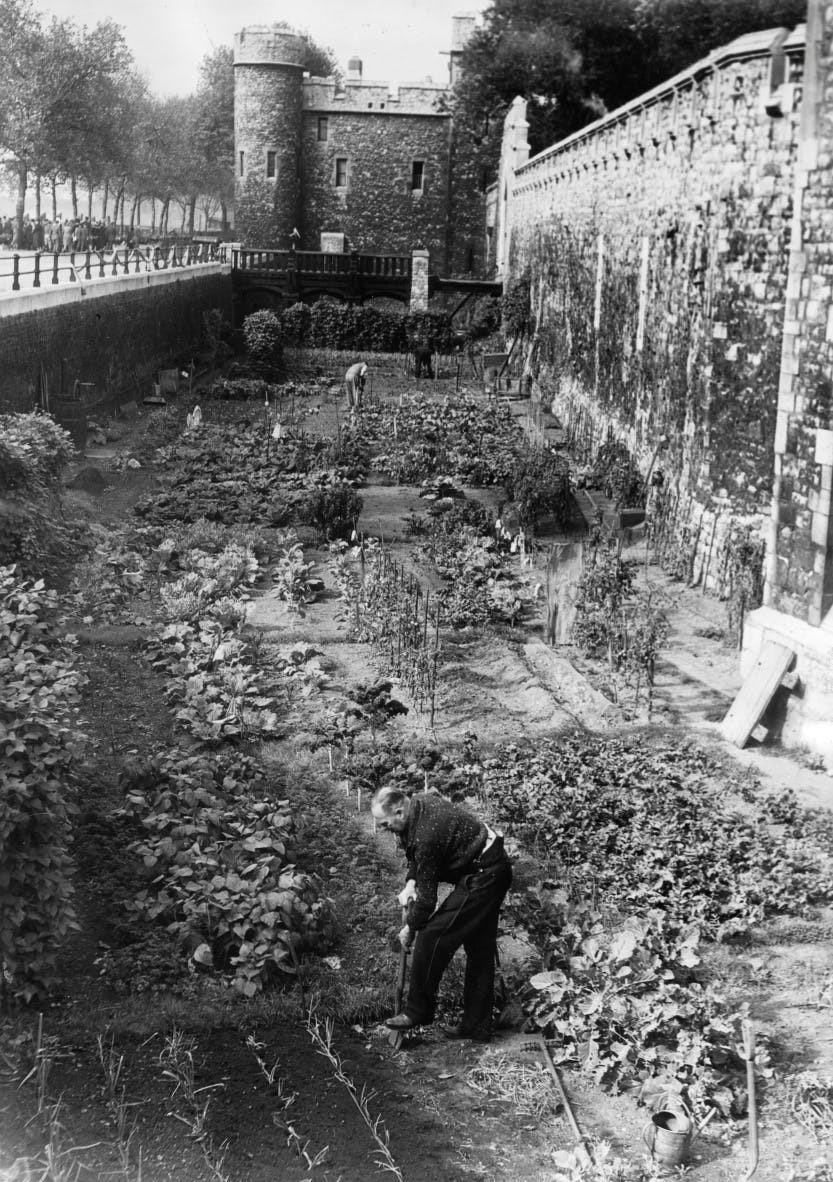
A “Dig for Victory” campaign was started and people were urged to use any spare land to grow vegetables – this included parks, golf clubs and even the moat at the Tower of London:

Tower of London allotments

The campaign featured lots of posters, this one was interesting because as Russell pointed out, the man is using the wrong foot. In fact the photo was taken using a mannequin’s dummy leg!

Dig for Vic poster

Much of the campaign’s success, which was overseen by the Ministry of Agriculture, was thanks to the Royal Horticultural Society’s role in teaching men and women across the country how to grow vegetables year round.

Another way of increasing food production was down to the War Agricultural Executive committees which were formed in Autumn 1939 and given expansive powers over farmers and landowners in the United Kingdom. After performing surveys of rural land in their county, each Committee was given the power to serve orders to farmers “requiring work to be done, or, in cases of default, to take possession of the land”. Committees could decide, on a farmer’s behalf, which crops should be planted in which fields, so as to best increase the production of foodstuffs in their areas.

Russell told us about the Womens Land Army too. This started in WW1 but was re-established shortly before the outbreak of the Second World War, in June 1939. It was finally disbanded in 1950. At its peak in 1943 over 80,000 women worked as ‘land girls’. They came from a wide range of backgrounds including towns and cities as well as the countryside.

He included lots of anecdotes about how dedicated the girls were, telling a story about one girl who turned up late with plaster in her hair, and asked the farmer not to mark her as late because she got there as soon as she could. Her house had been bombed that night! Another walked miles through waist-high snow to get to her farm and then apologised for being late.

Russell told us that one of the most missed vegetables was the humble onion. As they were nearly all grown in France, there were shortages immediately. One time, the post office received a parcel of onions where the address label was missing, so it went to lost property. They had 38 people turn up to claim it was theirs!

There were children’s campaigns too. Doctor Carrot popularised the myth that carrots could make you see in the dark.

Dr Carrot

We also heard about Cecil Middleton, who was really the first “celebrity gardener” on radio. He broadcast in Britain during the 30’s and 40’s, especially in relation to the “Dig for Victory” campaign. He was very knowledgeable but his programme went out on Sunday afternoons, and he had a soothing voice, so his main claim to fame was that he sent people to sleep after their Sunday lunch!

We thanked Russell for his entertaining talk and asked him to judge the Show Table and call the raffle. (We should really have had a loo roll as a raffle prize..!) It was a good evening, especially as we are going to have a bit of a break in meetings now. Take care everyone, stay well!


Russell Bowes is a freelance garden historian, garden tour guide and researcher.