Fresh off a flight from America, Fergus Garrett addressed approximately 300 people seated on hay bales in the Plant Fair Field, in one of the regular Friends events held at Great Dixter. He had returned that morning from a 20 day stay, lecturing and touring, with some of the stay devoted to Chanticleer. Fergus drew comparisons between the gardening practice there and at Great Dixter. At Chanticleer they artificially oxygenate their compost heaps to accelerate the process, whereas at Dixter these are left to decompose naturally. He also drew attention to how little water is used at Dixter – at most, the Long Border has been watered three times this year – but at Chanticleer watering is a regular feature of garden maintenance.
Led by members of the garden team, the Behind the Scenes tours of Great Dixter provide an opportunity to explore the garden and meadows to examine the plants which are putting on a display at particular times of the year, offering an insight into the work that makes this happen. Limited to a maximum of 25 people, they allow visitors to have a good view of the plants.
A tour of the gardens in February was always going to be a little hit and miss in terms of the weather, but we were fortunate enough to arrive just as the rain stopped, so were able to enjoy the tour without getting soaked through!
As we enter through the front meadow, the area is full of Crocus tommasinianus, Crocus flavus and various forms of Crocus chrysanthus. Of course there are snowdrops everywhere. Our guides introduced us to the wide range that are cultivated here, from the common (but no less lovely) Galanthus nivalis, to G. Atkinsii and G. S. Arnott which are all doing fabulously well, as well as the less common G. Diggory and G. Washfield Colesbourne. We all peered at the diminutive G. Wendy’s Gold in a corner, sheltered by a wall and still tiny enough that if it wasn’t pointed out, you might walk past it! Some of the differences between the types are so small: those with an upturned tepal and look like little helicopters, while G. Diggory is plump and round.
Our first meeting of 2025 was very well attended. The speaker and the topic obviously attracted a good audience. The Show Table received a good selection of displays, with Jean’s a worthy winner of Best on the Table.
Our speaker, Fergus Garrett, the highly influential plantsman and horticulturalist, has been Head Gardener at the internationally acclaimed Great Dixter Garden in Northiam, East Sussex since 1993 and is the CEO of the Great Dixter Charitable Trust. He gave an excellent, wide-ranging talk on how to keep our gardens looking vibrant and spectacular all the year round. He explained how to plant for a long flowering season with plants co-existing in one place, but performing at different times. He used photographs of the spectacular gardens at Great Dixter to illustrate his points. He said Great Dixter had the advantage of scale and greenhouses but it is possible to scale down what they do at Great Dixter and use their scheme in our own gardens with minimal labour.
He particularly used the magnificent long border at Great Dixter as an example of how to plan a long flowering season. How to use structural under-planting, interlaying and interplanting with bulbs, self-sowers, perennials, clumps of bedding plants and climbers.
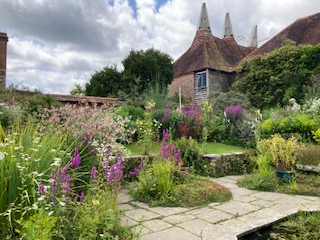
Christopher Lloyd loved colour, and as I stand on the upper pathway of the Sunk Garden, here at Great Dixter, I notice the pops of colour from the spires of pink-purple Lythrum and terracotta-orange Crocosmia all around me.
Designed by Nathaniel Lloyd, Christopher Lloyd’s father, after WW1, this south-facing and sheltered sunken garden is enclosed by two barns, a magnificent yew hedge and a wall on the southern boundary, thus creating its own micro-climate and the plants love it!
Throughout the year Great Dixter hold various events for their Friends membership. So, on yet another dismal July evening this year, Pat and I drove to Sussex. The evening began with drinks and canapes and a talk from Fergus which should have been held on the front lawn but, due to the inclement weather, was inside in the Great Hall. Three boxes of plants from the nursery, designed for dry, wet and shady aspects of the garden, were raffled at £5.00 a ticket. Surprisingly, as Fergus was talking, the sun came out and what could have been a wet evening turned into a very pleasant one. Although the colour of the sky in the photo demonstrates it was still fairly cloudy!
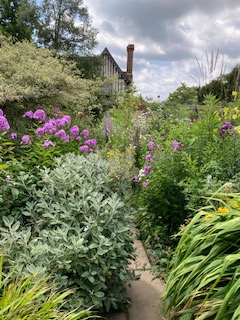
We had arrived slightly early, so were already able to explore the garden which is always full of surprises. The phlox were particularly beautiful and Pat and I were trying to note varieties for our own gardens! Following Fergus’ talk, which was generally about the work of Great Dixter and collaborative projects that were ongoing including one with Hastings council, we divided up into groups according to our chosen tour/talk. Each one of these was conducted by one of the students at Great Dixter. Pat and I had opted for the Long Border and Jungle Garden (although we popped out of the latter and into the Nursery!). The students are articulate and engaging and certainly know their material. Having watched Fergus’ lectures on the Long Border, it was interesting to see this in practice and explained to us by Andrew Wiley, one of the Chanticleer Scholars. A particularly interesting stand of Salvia Indigo Spires was a huge clump of individual cuttings rather than one big plant. Also in use was a lovely creamy apricot Cosmos (Cosmos bipinnatus Apricotta) – a colour which we have seen a lot in other gardens this year and can be picked out in the photo (one to be ordered for sowing next year!). We always leave these gardens full of ideas and plans!
Friends of Great Dixter were invited to a post- Christmas event at the end of January to join Fergus Garrett, students and staff. Warm spiced home-made apple juice and biscuits were available for refreshment and the archives were open for those who had not already seen them. We were welcomed into the Great Hall where a huge fire crackled and students created a ladder from chestnut poles gathered from the surrounding area. Outside, Fergus demonstrated how, using a traditional A-frame and tools, chestnut poles could almost perfectly be split ready for use. Of course, the highlight was being able to look around the gardens at a time when they are not usually open to the public. For those who have watched Fergus’ lectures on successional planting, the practice was evident in the canes laid out on the soil. Fergus’ favourite giant fennels were already unfurling and the gardens were positively covered with Galanthus atkinsii, both of which are clearly visible in the photograph above. An added bonus was that the day was sunny and moderately mild. What a treat.
As you will see from our website What’s On, there are a lot of virtual garden tours now taking place online, but for those members who like to smell the plants and feel the breeze, this isn’t quite the same! Great excitement then as Pat and I decided to visit Great Dixter – for both of us it was the first garden visit of the year.
We had wondered quite how social distancing would work at Great Dixter, mindful of the narrow paths and tight spaces. However, the one way system in operation and the limitation on the number of visitors at any one time proved very effective. The only area currently out of bounds was the vegetable garden. Covid-19 is a truly devastating disease and it is hard to see any good in the current situation, but reductions in visitor numbers in galleries and in gardens does mean that you can take your time and appreciate things better.
We marvelled at the huge Fennel, which Fergus Garrett loves, scattered throughout the gardens.
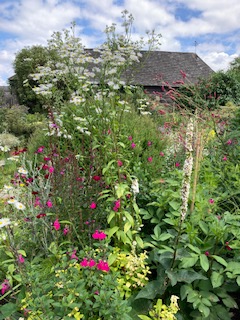
The glory of the varieties of Phlox which seem to be in abundance everywhere. We mourned the loss of the name Aster (now the unpronounceable Symphyotrichium). I fell in love with the Pelargonium Concolor Lace.
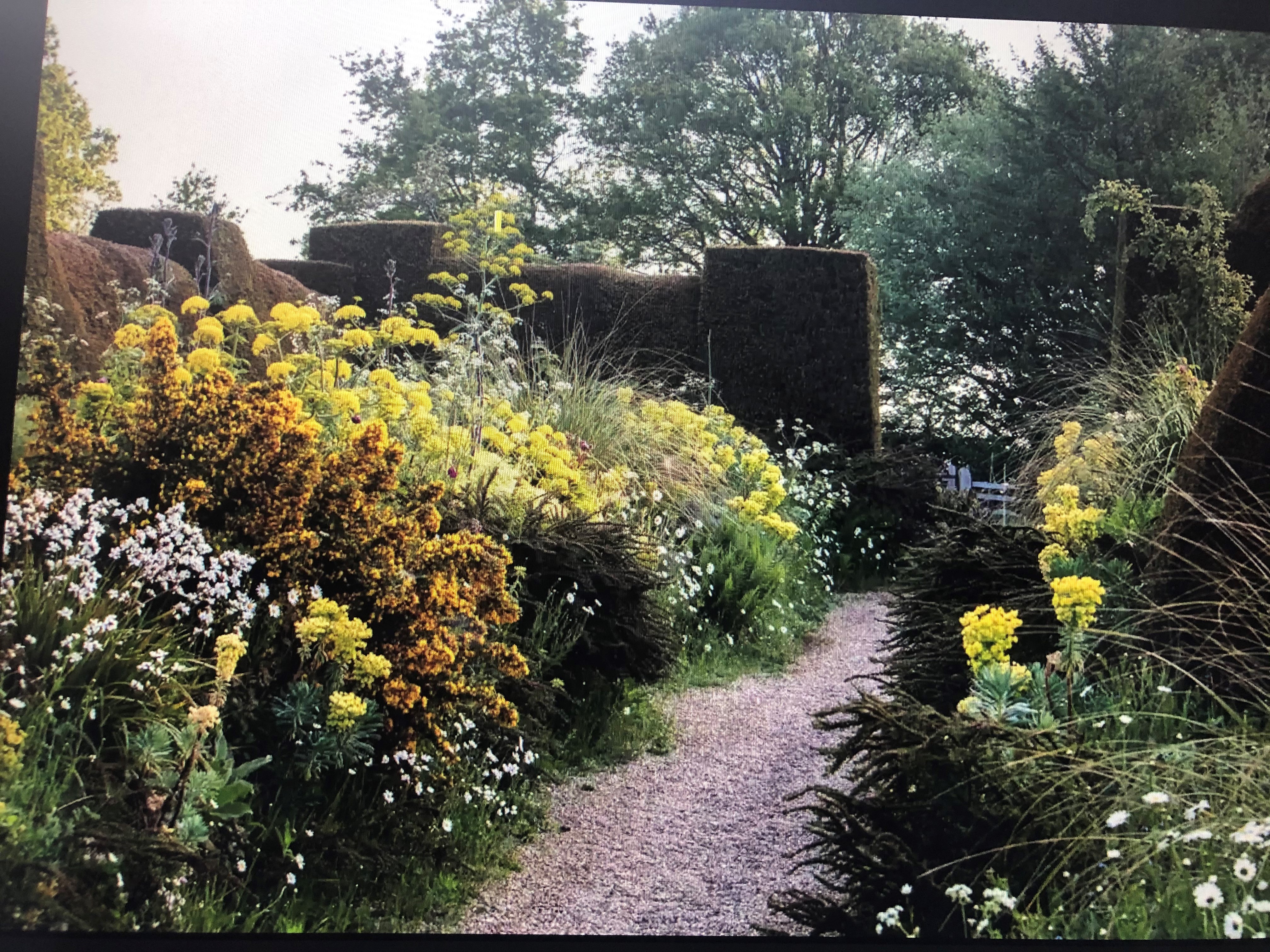
We discovered a beautifully unusual double burgundy coloured Antirrhinum, but couldn’t find seeds for it. And, of course, we bought some plants! Both Pat and I have gardens already crammed with plants, but have a similar approach to gardening which is that there is always room for one more! In my garden, at least, this results in an undisciplined profusion. I look with envy at spaces which are carefully laid out (like the Chelsea garden below) and where every plant has its place, but this is something I can only aspire to!












 Charlton and Blackheath Amateur Horticultural Society