Pat’s 10 jobs for November 2025

1. You can start planting tulips now, either in pots or in the ground. The deeper they are planted in the ground the more chance there is of them reappearing next year – but do protect them well from squirrels who love to eat them.

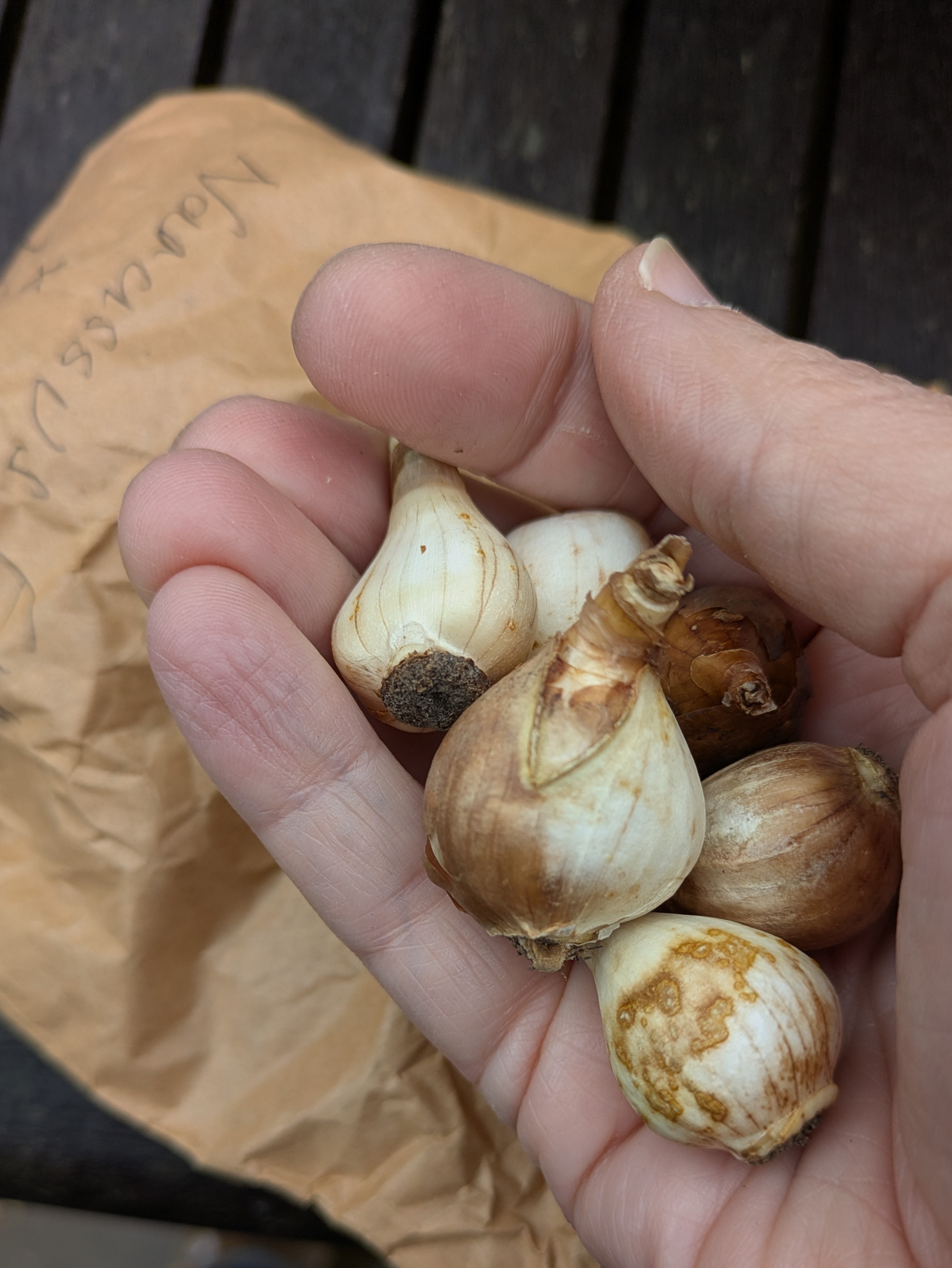
2. It’s not too late to plant Narcissus and other bulbs like Allium, but again as deep as you can if planting in the ground as squirrels do love to lunch on Allium.

Continue reading Pat’s 10 jobs for November 2025

Pat’s Jobs for June

What a strange spring this has been as everything has grown so tall ….but then some things especially vegetables have hardly grown at all and are struggling as there has been little warmth.

Anyway we soldier on….

1. Divide spring flowering bulbs as soon as foliage fades. My own stock has diminished and badly need splitting.

2. Prune ornamental cherries when flowering has finished making as few cuts as possible as they have difficulty healing.

3. Tie in shoots on sweetpeas which are finally growing  and revelling in the cool conditions. 

4. Cut early flowering hardy geraniums to the ground when they finish as they have a tendency to seed everywhere…unless you want them to of course.

Continue reading Pat’s Jobs for June

The View from my Window

The small patio is shielded from the sun, in a south facing garden, by an Acer palmatum ‘Katsura’.  The tree caught my eye while on a trip to Kent.  Must have one of those I thought.  The sapling was bought and is now well mature.  Some of the limbs show signs of viral attack, but it soldiers on. 

Early to leaf, in February, the leaves are green and red.  It produces sap, which attracts the aphids. With the aphids, the small birds make regular visits to eat the goodies. The birds include Blue, Great and Coal Tits, Robin and Goldfinches.  The Dunnocks also pay a visit, foraging in the growth below, together with a variety of bees including the distinctive yellow faced variety. Soon after, it will produce a vast amount of blossom, and after that very small sycamore-like seeds.  In time and onto autumn, the leaves go from yellow to orange and then fall, covering all the surrounding ground.

Continue reading The View from my Window

Local wildlife in Paula’s garden

CABAHS Committee member Paula has been grateful for the distraction of wildlife-watching during the lockdown, and has been reading up about it. Paula’s garden style is “not manicured” but she does like to keep things under control – things such as ivy. She says that ivy can cover a multitude of sins and like it or not, it certainly helps out the local wildlife. Plus it is evergreen and makes a lovely backdrop about now, when everything else has lost its colour. She was intrigued to learn that there is an Ivy Bee, one to watch out for this year. The Wildlife Trust says that ivy bees are recent arrivals to the UK, being first recorded in 2001 and slowly spreading North. They look like honey bees and feed mainly on ivy nectar. There doesn’t seem to be anything bad known about them so at the moment they are welcome!

Paula has also been bird watching and says another “new” arrival to our gardens is the Collared Dove, a less bulky version of the native Wood Pigeon.

They are normally seen in pairs (a good Valentine omen maybe!) and come to bird feeding stations sometimes. They are not native but arrived from the Middle East in the 1950’s – a bit like the Green Parakeets that are now all over the South East, although not such a pest. They are mainly seed and berry eaters and if they raise a brood successfully they often return to the same nest site.

If you would like to find out more, try these links:

https://www.wildlondon.org.uk/wildlife-explorer/invertebrates/bees-and-wasps/ivy-bee

https://www.rspb.org.uk/birds-and-wildlife/wildlife-guides/bird-a-z/collared-dove/

Paula


A robin for Christmas

John Sturgis has recently written an article in the Spectator, much after my own heart. He says he has two birds on the go, one in the garden, one at the allotment, both real beauties — and both robins.

With much of the nation still working from home, robins have become more familiar than ever. Most species of garden birds are horribly in decline, but the robin has stubbornly stuck around in great numbers.

While those other great survivors, magpies and pigeons, are brash and ungainly, the robin is a delicate little gem: magpie song is shrill, pigeon dumbly repetitive, but robin chirrups are a delight. They’re bold, too. Other garden birds flap away when we appear, but not robins. In fact, they approach — as inquisitive as a kitten.

The robin has a territory that ‘can be as small as a half acre’ so where I live I must share my robin with several neighbours. But one always appears as soon as I venture out of the back door, for human activity is their cue. My robin particularly likes it when I use my daisy grubber on the lawn. The stabbing activity seems to prompt all the worms near the daisy to come to the surface, in case I stab them too, I suppose. But there she comes, Mrs Robin following my every footstep, darting around where I have just been, feasting on the worms leaving their cover.

I say ‘she’ but frankly I don’t know. No doubt your Chris Packham types would be able to gender a robin from half an acre away, but to the untrained amateur, male and female are very much interchangeable.

Sturgis points out that robins frequently come up in literature and songs – John Donne’s Robin Redbreast, or The Secret Garden, or Rockin Robin of the Jackson 5. And, of course, the robin is the Boy Wonder’s spirit bird in Batman. Imagine trying to pitch that set-up today. ‘I like this Bat guy – very dark and cool. What are we doing for the kid? A scorpion? Eagle?’ ‘No, we thought a robin.’ Yet it works, accentuating the character’s chirpy loyalty.

But their definitive place is on Christmas cards. They’ve somehow smuggled themselves into the greeting card nativity scene, apparent survivors, along with holly, ivy and mistletoe, of pre-Christian winter festivals, one of the few flashes of colour in the bleak midwinter.

So just go outside with a trowel or daisy grubber and she will soon appear. And despite the Christmas connotation, she’ll still be there in the bleaker days of January and February. Because robins are very much for enhancing life, not just for Christmas!

Kathy