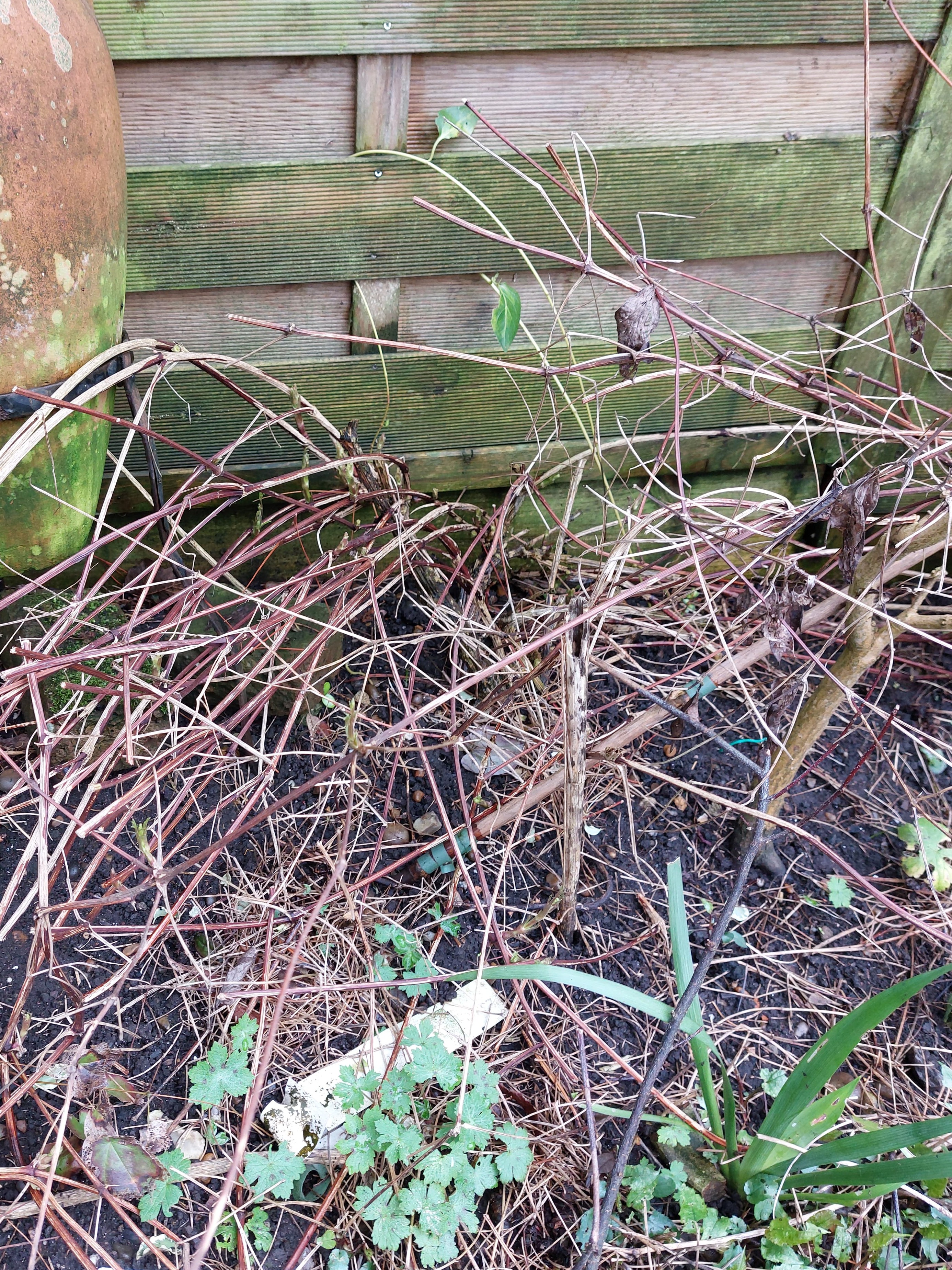
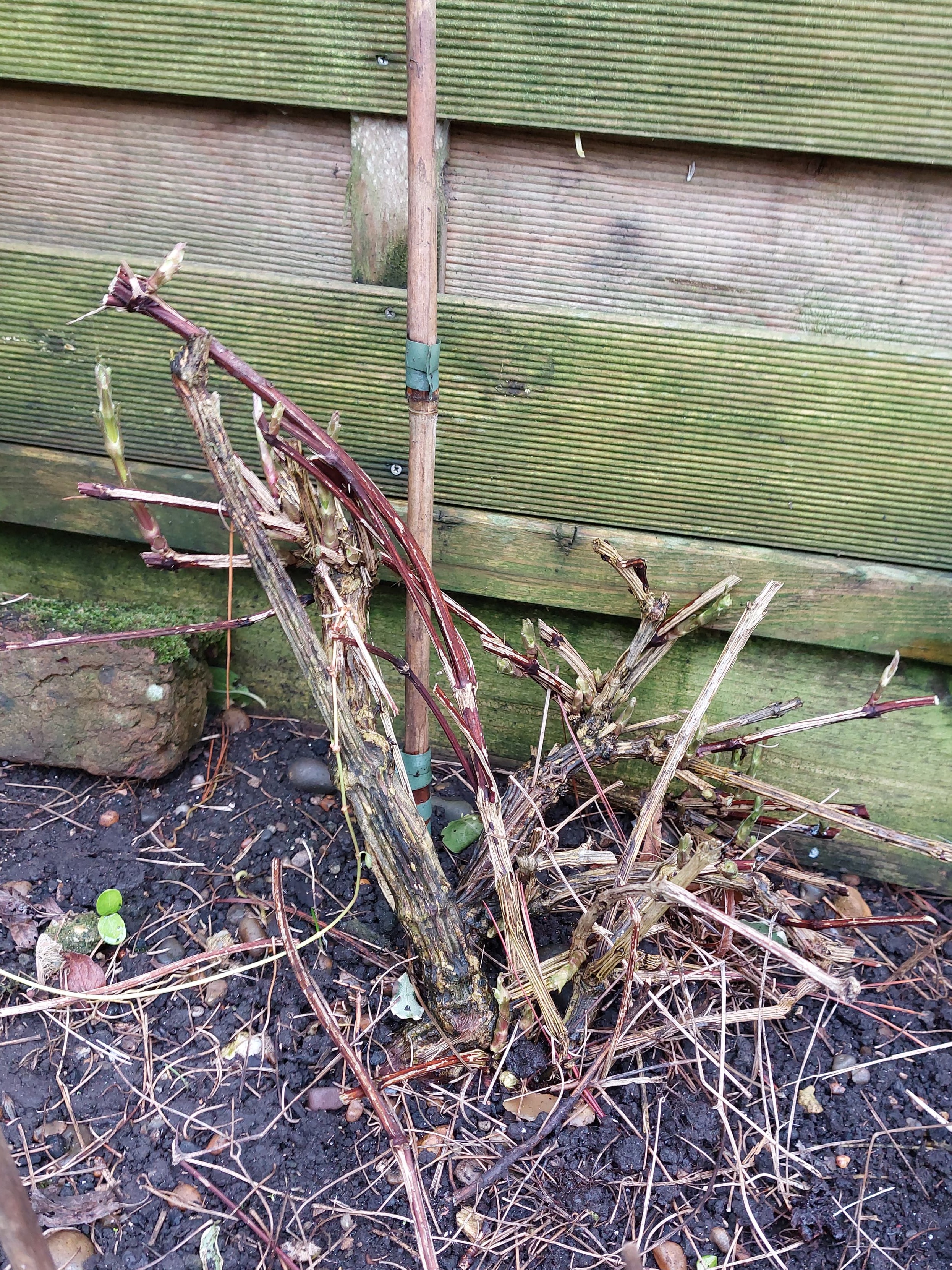
1. It’s time to prune your Group 3 Clematis (the Viticella and Jackmanii type) to tackle tangled growth at the base so they can grow away strongly. Take all growth back hard to about 6 to 12 inches above the ground, cutting above a leaf joint. Then give them a feed and a mulch. It seems drastic but they respond well and will grow quickly. If it’s a fairly new plant check around the base for slugs which can quickly eat any weak new growth.
Clematis viticella ‘Betty Corning’ before and after a hard prune
2. Cut back all spent foliage on grasses making sure not to snip emerging shoots. And look out for any seedlings to pot up for our plant sales table if you don’t want them!
Led by members of the garden team, the Behind the Scenes tours of Great Dixter provide an opportunity to explore the garden and meadows to examine the plants which are putting on a display at particular times of the year, offering an insight into the work that makes this happen. Limited to a maximum of 25 people, they allow visitors to have a good view of the plants.
A tour of the gardens in February was always going to be a little hit and miss in terms of the weather, but we were fortunate enough to arrive just as the rain stopped, so were able to enjoy the tour without getting soaked through!
As we enter through the front meadow, the area is full of Crocus tommasinianus, Crocus flavus and various forms of Crocus chrysanthus. Of course there are snowdrops everywhere. Our guides introduced us to the wide range that are cultivated here, from the common (but no less lovely) Galanthus nivalis, to G. Atkinsii and G. S. Arnott which are all doing fabulously well, as well as the less common G. Diggory and G. Washfield Colesbourne. We all peered at the diminutive G. Wendy’s Gold in a corner, sheltered by a wall and still tiny enough that if it wasn’t pointed out, you might walk past it! Some of the differences between the types are so small: those with an upturned tepal and look like little helicopters, while G. Diggory is plump and round.
If you wish to see the snowdrops now, I can highly recommend the Royal Botanic Gardens Kew. The gardens are easy to reach via the District Line to Kew Station. The woodland garden (near the Princess Diana Conservatory) has meandering paths beneath the trees, where an array of snowdrops, aconites, hellebores and mauve-coloured crocuses (the shade of colour I’ve only ever seen at Kew) are displayed to a wonderful effect. Visiting on a beautiful sunny day makes the gardens appear even more delightful.
The magnificent sandstone rock garden nearby, which mimics mountainous regions, is an important feature of the gardens, and here and there, in mostly sunny locations, could be found very choice, small clumps of snowdrops which are labelled for the visitor. I would love to have any of these growing in my garden and I thought you might too.
Galanthus ‘John Gray’: This early-flowering snowdrop is regarded as very choice indeed, which was seemingly found in the Suffolk garden of the late John Gray. I was captivated by the shades of lime-green on the inner segments.
As Anna writes in the latest Newsletter, January and February are the months for snowdrops.
Galanthus nivalis – common snowdrop
Joe Sharman, the owner of Monksilver Nursery and who has come to be known as ‘Mr. Snowdrop’ has produced a variety called ‘Golden Tears’, described as ‘A narrow-flowered yellow pterugiform with a very large mark and bright yellow ovary. Very beautiful and distinct.’ The bulb apparently sold for £1,850.
A few years ago, I visited the Snowdrop Sensation weekend at Great Comp where a number of specialist snowdrop growers had stands. Some very beautiful varieties were selling for £100/£100 a bulb. I thought this a bit of a stretch and compromised, buying one for £10.00. I have watched this like a hawk each year, willing it to grow. There would be a great many tears and gnashing of teeth if I bought a more expensive bulb and lost it. I cannot imagine what one would do with a bulb worth £1,850.


 Charlton and Blackheath Amateur Horticultural Society