In all the years I have been visiting Sissinghurst Castle, I have never seen the White Garden look so lush; it was a ‘sea of white fluffiness’ and its loveliness took one’s breath away.
The White Garden is an enclosed garden, laid out in a formal pattern, with clipped borders of box framing brick herringbone pathways, punctuated by box cubes. These features provide structure and act as a framework and a contrast to the white flowers and grey foliage within their boundaries.
The focal point is the central gazebo, which is covered by the highly fragrant white rambler rose (Rosa mulliganii) – now finished flowering but later in the year produces rose hips. Beneath sits a maroon-coloured waist-high urn (1930s), planted with Thumbergia alata (a cream-coloured Black-eyed Susan).
1. Prune hardy fuchsias now both in pots and in the ground to promote new growth and to prevent the plants from becoming too woody.
2. Plant out pot grown sweet peas now making sure to pinch out the shoots to promote bushy plants. You can also sow directly in the ground now if you didn’t sow earlier but watch out for slugs munching new seedlings.
3. Someone said the other day that they hadn’t cut back their clematis but I don’t think its too late as the growth on them is phenomenal. It just means they will flower a bit later but then that extends the season.
Pat’s unpruned clematis already at the top of the arch!Pat’s cosmos seedlings – germinated in under a weekPat’s Cosmos flowers
Throughout the year Great Dixter hold various events for their Friends membership. So, on yet another dismal July evening this year, Pat and I drove to Sussex. The evening began with drinks and canapes and a talk from Fergus which should have been held on the front lawn but, due to the inclement weather, was inside in the Great Hall. Three boxes of plants from the nursery, designed for dry, wet and shady aspects of the garden, were raffled at £5.00 a ticket. Surprisingly, as Fergus was talking, the sun came out and what could have been a wet evening turned into a very pleasant one. Although the colour of the sky in the photo demonstrates it was still fairly cloudy!
We had arrived slightly early, so were already able to explore the garden which is always full of surprises. The phlox were particularly beautiful and Pat and I were trying to note varieties for our own gardens! Following Fergus’ talk, which was generally about the work of Great Dixter and collaborative projects that were ongoing including one with Hastings council, we divided up into groups according to our chosen tour/talk. Each one of these was conducted by one of the students at Great Dixter. Pat and I had opted for the Long Border and Jungle Garden (although we popped out of the latter and into the Nursery!). The students are articulate and engaging and certainly know their material. Having watched Fergus’ lectures on the Long Border, it was interesting to see this in practice and explained to us by Andrew Wiley, one of the Chanticleer Scholars. A particularly interesting stand of Salvia Indigo Spires was a huge clump of individual cuttings rather than one big plant. Also in use was a lovely creamy apricot Cosmos (Cosmos bipinnatus Apricotta) – a colour which we have seen a lot in other gardens this year and can be picked out in the photo (one to be ordered for sowing next year!). We always leave these gardens full of ideas and plans!
Annie has harvested her garlic and it’s done very well this year. I expect these would have been part of her Autumn Show entry, never mind, next year..
Cutting back lavender is this month’s job. Kathy was a bit mystified by these structures revealed when the lavender was cut back. They look a bit like Nigella seed cases! But Mr Google says that they are the nests of the Wasp Spider, a fearsome looking spider which is spreading to the South East of England from the continent. It is actually quite harmless, and mimics the wasp so that predators leave it alone.
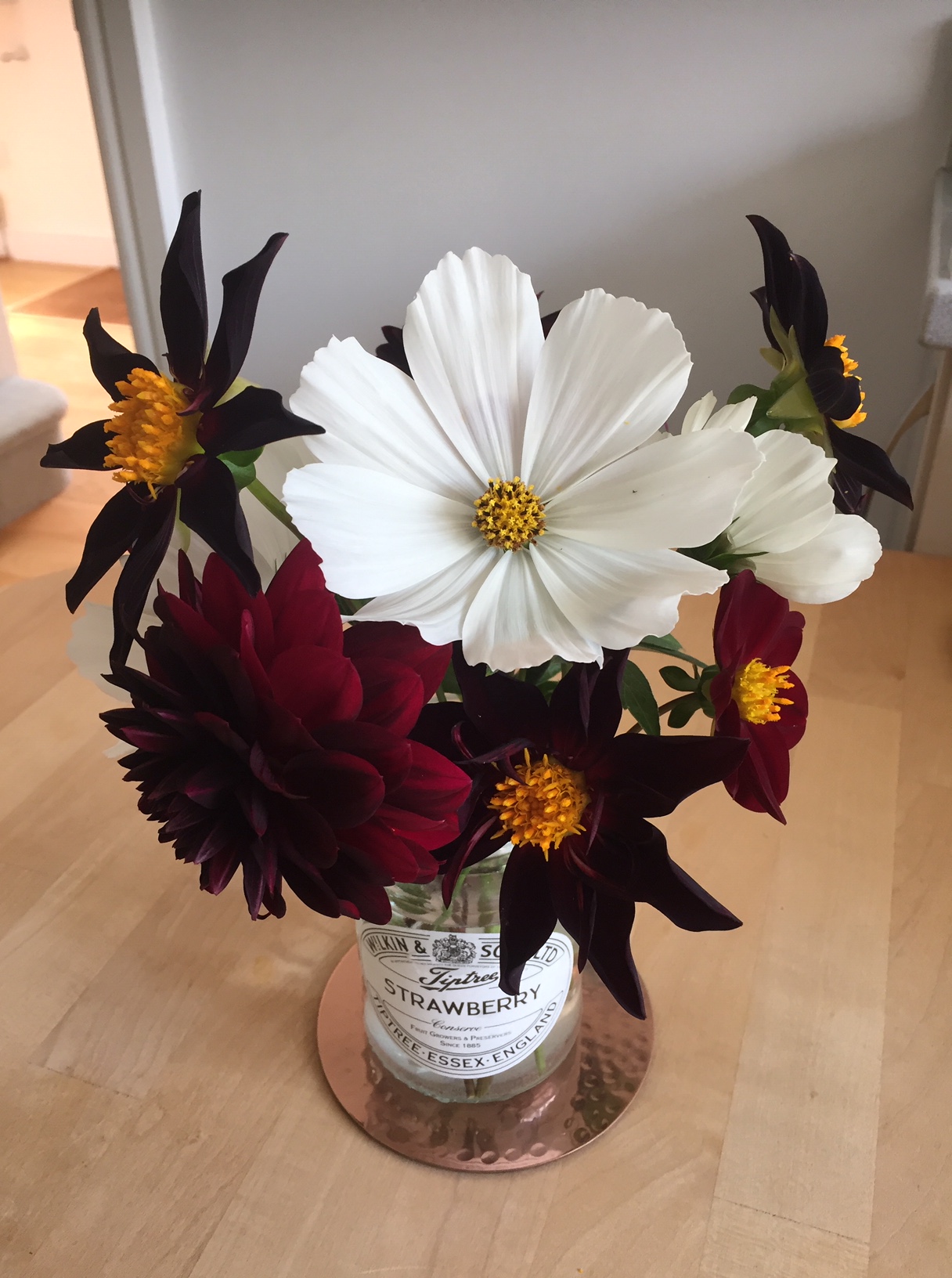
A lovely selection of Cosmos and Dahlias, definitely September’s flowers. These are Cosmos Purity, Dahlias Verrone’s Obsidian, Mexican Star and Bishop of Auckland. (Plus an unknown beautiful double red one).




 Charlton and Blackheath Amateur Horticultural Society