This month we welcomed Ruth Cornett, one of our own members, who talked to us about Flowers in Art, building on some of the themes she had developed in an earlier presentation.
Ruth demonstrated that, over the years, artists have used flowers in their work to indicate and symbolise a range of meanings, from simple decoration to literary references. Depending on the context, flowers have been used to deliver a hidden message, promote certain ideas, to educate, to convey a Christian story or describe the cycle of life. Ruth’s presentation used one or two paintings to illustrate each of these themes.
Charles II of England being given the first pineapple grown in England by his royal gardener, John Rose Hendrick Danckerts, 1675
28 Marsden Road SE15 4EE, Open Sunday to Thursday inclusive, 10.30 to 16.30. No charge
We are members of the London Wildlife Trust, which runs the Centre for Wildlife Gardening (CWG), but it was word-of-mouth from a volunteer at Christchurch Community Garden that made us aware. We visited on London Marathon Day, passing through a crowded Blackheath Station on our way to Peckham Rye Station.
Marsden Road itself is remarkable: its houses all along have designer ironwork gates & railings on wildlife themes, and each lamppost has a ‘squirrel’ high above. These, and the wildlife-themed iron gates to CWG, were designed by Heather Burrell: bollards at the entrance and within were designed by Antony Gormley: a gable-end has a large mural of a Goshawk.
Audience at January 2024 TalkChair Stella introducing Ruth
Ruth Cornett is a senior director of Heritage and Taxation at Christies and has previously given a talk to CABAHS about her garden at Eltham Palace Gatehouse. This talk focused on flowers in art. She said all gardeners in the way they visually create their gardens are artists, but not all artists are gardeners. Rather than describe the history of flower painting, she focused on how artists used flowers and plants to express themes – how through their paintings they send messages and use symbols and allegories. For example, paintings may comment on a name, be used for propaganda, as a tool for study, to make literary references, be used for educational purposes or to symbolise Christian stories. She illustrated these themes using famous artists from the Renaissance to the present day such as Rubens, Durer, Van Dyke, Murillo and in modern times Ravilious and Hockney.
For example, Ruth pointed out that Botticelli’s Primavera (1478-1502) is an allegory celebrating spring. The Laurel tree in the background of Georgione’s portrait of a new wife, Laura (1506) is a pun on her name and emphasis on her being a strong, loyal determined woman. The portrait of Edward V1 by Scrots (c.1540) is a good example of how paintings were used for propaganda purposes by the powerful. In this picture, the sun shines and looks down on Edward and the plants are growing towards him, whilst the Tudor rose in his hand shows that the Tudor Dynasty is moving forward. Ruth points to Durer’s The Great Piece of Turf (1503) a seemingly unordered collection of wild plants used to represent nature as an example of using paintings for study. Literary references can be seen in Millais’ Ophelia (1851), a character in Shakespeare’s Hamlet, where she is depicted in a naturalistic setting lying dead in a river covered in flowers – a painting which took him several months to create its content and structure. Before photography, paintings and prints were used for educational purposes and Ruth cites the Hortus Elthamensis Seu Plantarum Rariorum by Dillenius (1732) which obtained its plant specimens from the area around Eltham. A Christian story can be seen in Van Dyck’s (1613) table set with bread and wine which were used to represent symbols of Christ and wealth.
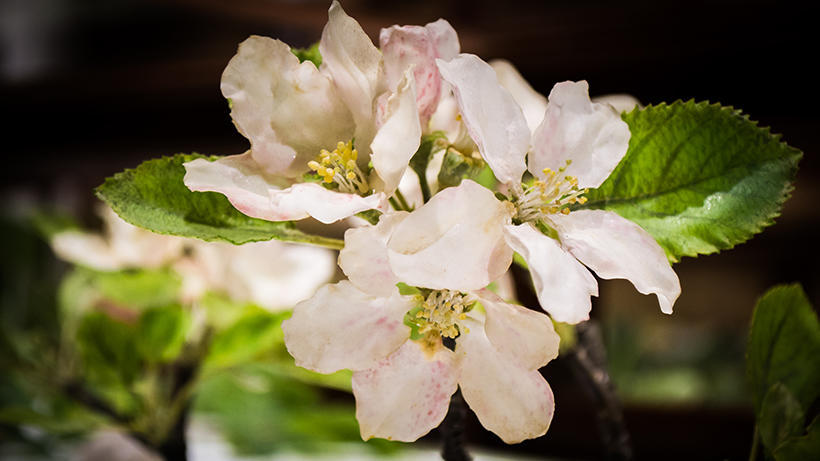
Have you ever heard of the Harvard Museum’s collection of glass flowers? This is a huge collection of over 4,300 flowers from some 780 species. The models were made because one of the professors wanted life-like models for teaching botany, and only paper mache or wax models were available at the time. Could you ever guess this picture shows a glass model of apple blossom?
The website has a wonderful video about the collection, look for the Exhibit video ‘Harvard restores its famous glass flowers’.


 Charlton and Blackheath Amateur Horticultural Society