This is now a regular and popular event in which our panel answer questions sent through in advance from members, some with illustrations or examples sent in plastic bags. The panel this year consisted of our very own CABAHS committee member and all-round plant guru Pat K, our President Sir Nicolas Bevan and horticulturalist and teacher Joe Woodcock. Sir Nicolas invited advice and contributions from the audience too, saying that in a room full of gardeners, the panel did not “have the monopoly on wisdom”. We did our best!
Our esteemed panel: Pat, Nicolas and Joe
Last year we were all overwhelmed by slugs and snails, this year’s scourge is aphids! The first question related to a particularly damaging infestation on Buddleja, which seemed to have caused a virus. Several people, including Joe, have experienced the same this year. He was able to tell us that it is likely to be a specific species, the Melon-cotton aphid, which the RHS are monitoring (you can report cases to the RHS here).
1. Plant out Dahlias in a sunny spot in fertile soil adding some compost to the planting hole. I have to surround mine with Strulch on my allotment to protect them from the hundreds of slugs and snails lurking all around.
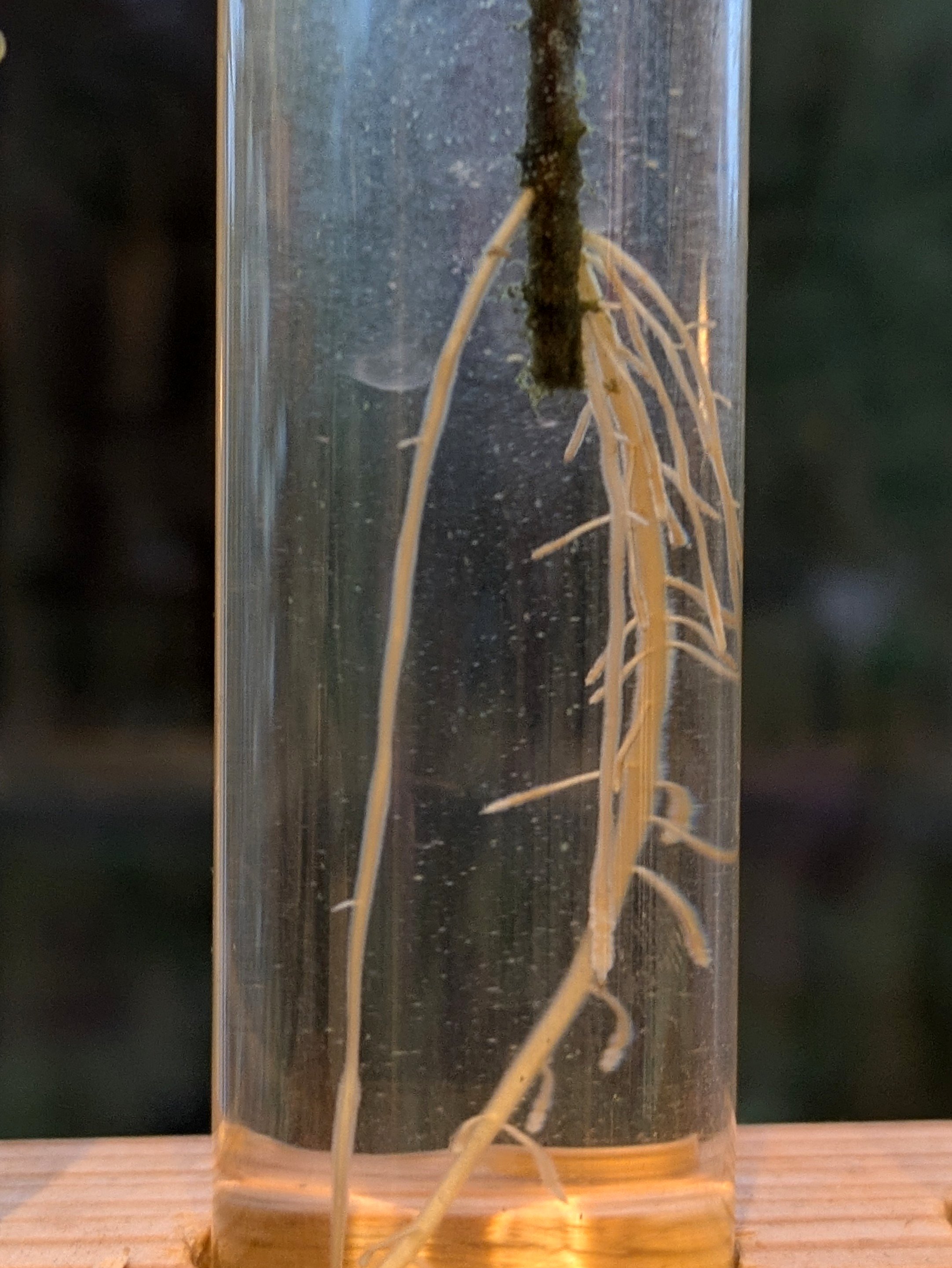
2. Take softwood cuttings now of Anthemis, Salvia, Verbena, Penstemon and Fuchsia. Cut below a leaf node and dibble around the edge of a pot. Salvias will also grow fine roots in water to give them a head start.
3. Look out for hellebore seedlings around the base of your favourite plant. The resulting plants may not resemble the parent but they could be even better.
What a struggle it has been to protect the shoots of these two clematis from sustained attacks by the usual culprits this year! Not only did I use a garlic spray (one clove of garlic simmered in water) but I also liberally (and continually) sprinkled spent coffee grounds around the base of the plants. Although they were saved, I did lose other clematis: scented C ‘Betty Corning’, C ‘Rising Star’ and C ‘Wedding Day’ – all absolutely lovely and such a loss that I will need to repurchase them.
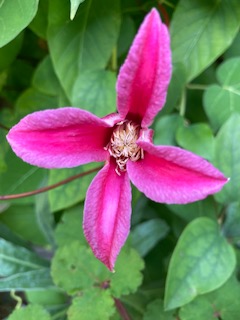
Clematis ‘Princess Diana’ This clematis is definitely one of my ‘top five’. The tulip-shaped flower is an unusual shade of bright pink, with beautifully striped markings both inside and outside of the petals (sepals). This variety (texensis) was introduced by a British breeder to honour the Princess of Wales in 1984 and has deservedly been given the RHS Award of Garden Merit.
As to be expected ‘Princess Diana’ came into flower late – in July, rather than June – and has been flowering continually, with eight flowers and a few buds on the vine at present.
An entertaining and informative evening was had at this year’s Gardeners Question Time. As usual, it enabled members to get advice on their gardening problems, and to air their gardening frustrations. Chaired by Sir Nicolas Bevan, the CABAHS President, the panel also comprised Tom Brown, the Greenwich Park’s Head Gardener, and Pat Kane, a long standing CABAHS member.
Most of the questions were sent in by members beforehand. They covered a broad range of gardening areas and problems: growing hollyhocks; aphid control; tree size; cistus, salvia and sisyrinchium pruning; how to grow dahlias; what killed my rose; problems with apple trees and rambling roses; how to encourage children to get involved in gardening; recommending a fertiliser for yew hedges; the cause of curly cucumbers; dealing with self seeding; and problems with bamboo.
The small patio is shielded from the sun, in a south facing garden, by an Acer palmatum ‘Katsura’. The tree caught my eye while on a trip to Kent. Must have one of those I thought. The sapling was bought and is now well mature. Some of the limbs show signs of viral attack, but it soldiers on.
Early to leaf, in February, the leaves are green and red. It produces sap, which attracts the aphids. With the aphids, the small birds make regular visits to eat the goodies. The birds include Blue, Great and Coal Tits, Robin and Goldfinches. The Dunnocks also pay a visit, foraging in the growth below, together with a variety of bees including the distinctive yellow faced variety. Soon after, it will produce a vast amount of blossom, and after that very small sycamore-like seeds. In time and onto autumn, the leaves go from yellow to orange and then fall, covering all the surrounding ground.
I have not been an earwig lover for all of my life. As a child, I remember my father making a nightly check on his prize dahlias and coming back into the kitchen with earwigs crawling out of the turn ups of his trousers. My mother’s predictable reaction meant that I thought earwigs were definitely not insects one was meant to love. Now years later, in my own garden, I can see the results that a small earwig population have on my own favourite Dahlias, Verrone’s Obsidian, and it’s extremely annoying. But this Christmas my husband gave me a book – “The Garden Jungle” by Dave Goulson and it has rather opened my eyes to the trials and tribulations of this little insect.
Goulson points out that earwigs are easily eradicated by sprays, and because they don’t fly and only produce one generation a year, they don’t re-colonise very quickly once they have gone. I haven’t used pesticide sprays for some years, with the exception of a drench for vine weevil in my containers, so I know I do have earwigs in the garden, although not in the numbers I remember as a child.
Earwigs are overwhelmingly beneficial insects, they feed voraciously on aphids, as well as munching on the occasional petal. In orchards where earwigs have been sprayed out of existence, trees are infested with three times as many woolly aphids as those with a good earwig population. It is generally the case that beneficial predators of a crop pest breed more slowly than the pests they feed on. Aphids, in particular, breed spectacularly fast, giving birth to live young which themselves have developing offspring inside them when they are born. In contrast, Mrs Earwig produces maybe 50 offspring a year, laying creamy eggs in a burrow in the ground towards the end of winter. She tenderly cares for the eggs, guarding, cleaning and turning them and looks after the young brood (nymphs) until they moult and gradually become independent. Then she turns them out of the burrow and they must look after themselves, foraging at night and hiding in the day in any crevice (or dahlia) they can find. They must do this all Summer and Autumn dodging predators while they grow, until winter comes and they find a mate and it all starts again.
The fierce looking pincers are actually quite feeble and incapable of doing harm to a human, they are used by the earwig in defence against predators such as ground beetles, and also in mating. The “wig” part of their name comes from an old word for “wiggle” and they definitely never burrow into ears!
We should certainly see earwigs as our friends in the garden, just as we now do ladybirds and lacewings. I have decided that a nibbled petal here and there is a small price to pay for all the good they do.





 Charlton and Blackheath Amateur Horticultural Society