4 January While taking down the Christmas wreaths, we spotted all these in flower in the garden. The Sarcoccca (sweet box, bottom left corner) smells wonderful.
19 January Doing a weekly check in, here is the most beautiful Lenten rose, Helleborus orientalis, in the Sensory Garden. Not a rose at all, it is a member of the buttercup family.
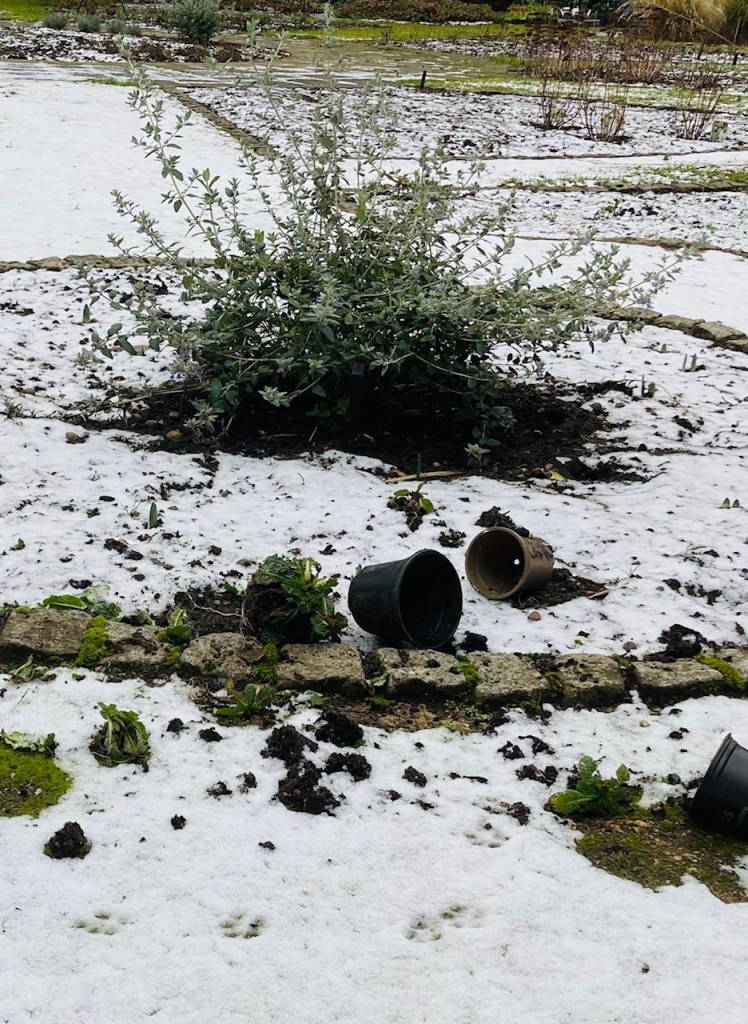
26 January Another check in visit, snow still lying on the ground today, there are surprising frost pockets in this garden, although it is all clear by the walls.
Foxy footprints giving away the culprit! Our teasels have all been teased to bits, we wish Mr Fox would just go back to chewing the plant labels..
I hadn’t really thought about a New Year’s resolution for 2021, apart from the one that most of us have in the forefront of our minds at the moment: test negative, stay positive. (Sent to me in a Christmas card by a friend). But as we get closer to the end of January, to move forward into the year without one seems a bit neglectful.
I was therefore interested to read about the drive to encourage people to save seed and to encourage seed saving communities to develop. One of the few upsides of the lockdowns over the past year has been a huge boost in demand for seed. The argument is that this “grow your own” revolution re-diversifies seed crops and provides more security for not only our seed supplies, but food in general.
Josie Cowgill, one of the women who works with the Stroud Community Seed Bank in Gloucestershire sums up the impact of seed-saving in the context of 2020: “It’s difficult times we are living in. We have got a pandemic, we’ve got climate change, we’ve got biodiversity loss, habitat loss and economic collapse as well. It might feel quite small, just saving beans and growing your own food, but actually I think it is really fundamental. By doing something infinitesimally small like this tiny little gesture in a tiny little group, in a tiny little country somewhere, you are working towards something that makes you feel more hopeful. It’s a positive step. I’m not saying this is a magic wand or a cure-all, but it’s a positive step.”
Former ‘Bake Off’ winner Nancy Birtwhistle claims we have been ‘brainwashed’ into believing we need harsh chemicals to clean our homes. In an interview with her, what caught my attention was the amount of plant-based materials she used. It sounds miraculous, but she swears by ivy as a laundry detergent (about 60g, cut up and put in a muslin bag, then put in the drum). “It excites me so much; my husband thinks I’m crackers. I knew in the depths of my memory something about ivy and saponin [a natural foaming detergent], so I Googled it. Conkers have it as well.” (Although we should remember that ivy can be a skin irritant for some people.) In the autumn, she collects conkers and boils them up to create a creamy laundry liquid. (Nancy Birtwhistle’s book Clean & Green is published on 21 January by Pan Macmillan £12.99).I’m prepared to give this one a try, but have visions of a ‘green’ wash in a way I did not intend.
Graham began his talk by pointing out the impact of leaving the European Union on the movement of plants. He then went on to discuss a range of plants, using the categories of desert, jungle and Mediterranean as classifications.
Plantbase Nursery in East Sussex (image credit: Plantbase/Graham Blunt)
His talk was peppered with anecdotes, often drawn from his own experience. One which appealed to many was the Sonchus fructicosus, a plant which he described as a ‘dandelion on steroids’. The seed had apparently stuck to Graham’s trousers when he was travelling and came home to England with him. He had gone on to cultivate it and recommended it as an excellent mid-storey jungle plant, which is significantly hardy.
The talk was full of useful tips, for example, that cannas and ginger plants need to be planted into soil that is warm, it is not just the top of the plant that needs to be in sun.
A number of members asked questions and expressed an interest in visiting the nursery, which also offers some of its plants by mail order.
Graham Blunt runs Plantbase, a unique nursery in East Sussex specialising in unusual plants.
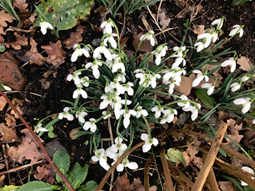
Winter aconites and snowdrops looking happy in Vija’s garden. (For once, an example of some flowers that are blooming at the right time of year!)
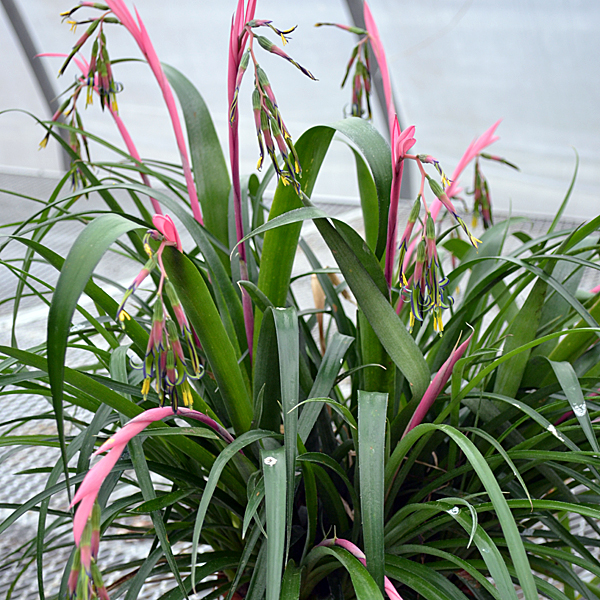
Something to look forward to: Jillian has lots of babies off her Billbergia nutans, which she has potted up for sale to members, for when we can finally meet again. It’s common name is Queen’s Tears or Friendship Plant. She thinks the small plants should be big enough to flower this year. This isn’t a picture of her own plant, but something to aspire to! A challenge..
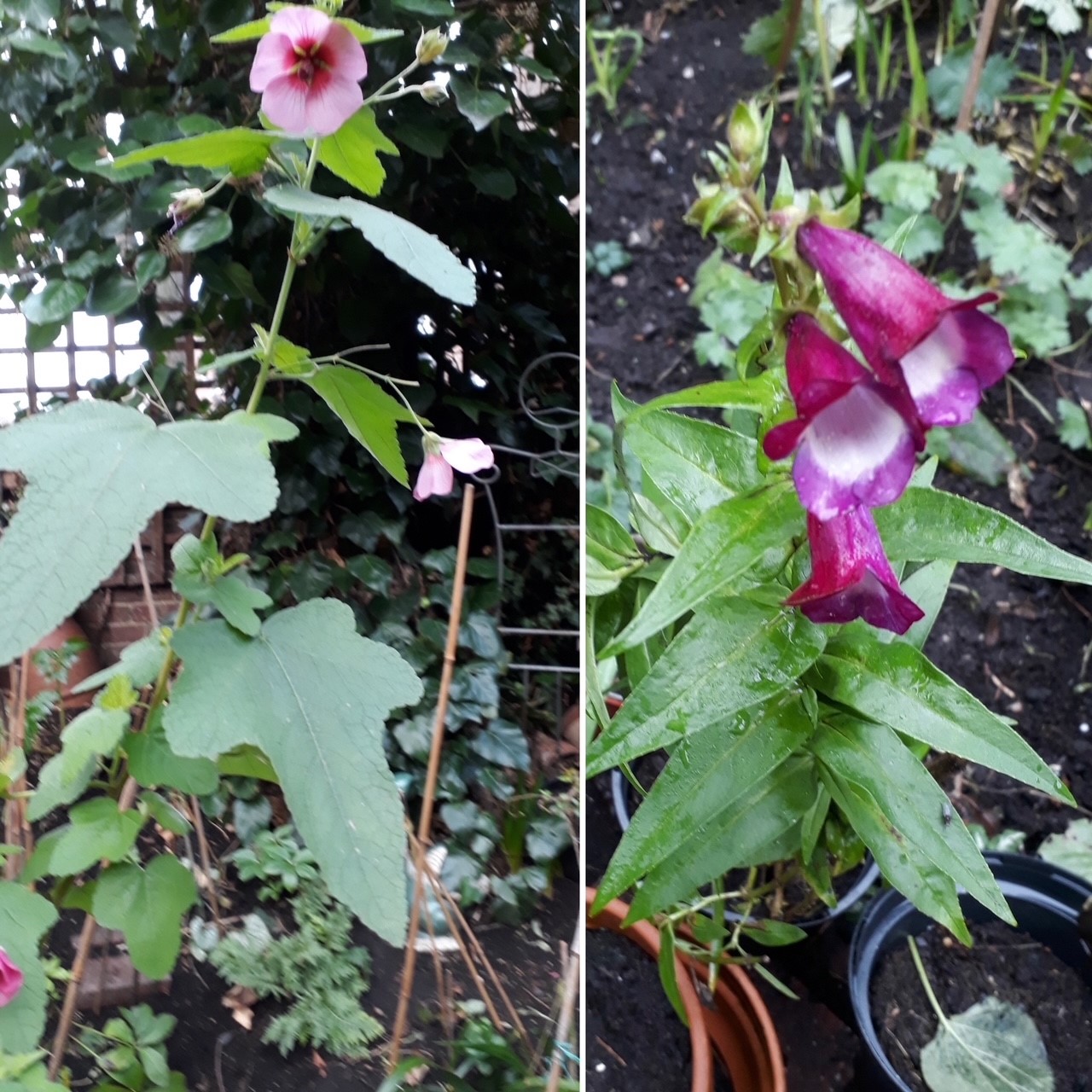
Some unusual flowers out in Angela’s garden – here is a Penstemon thinking it’s still summer, and the Anisodontea, African Mallow, has ignored the recent frosts and carried on.
Maggie has been out and about on her daily walks, and says that the daffodils down near the O2 are all coming out. A lovely sign of Spring, and a good walk along the Thames side.
The photo below might remind us all to ensure there are gaps under the fences in our gardens. There is a trend to use concrete gravel boards at the base of new fences, and while they are wonderfully sturdy and long-lasting, spare a thought for the wildlife! Frogs and toads need to travel between gardens and water sources. It’s really easy to push a trowel under the gravel board and make a little underpass for them, it makes all the difference.
Happy Dahlias, in bed for the winter, covered with a lovely blanket of Christmas tree branches!
What’s in flower in YOUR garden? All these in Kathy’s garden on January 3rd 2021, they don’t seem to know it’s winter. Although it’s a bit tatty, there is even a blue Lobelia flower, what’s that about? If you have more, send them in to feature here.
Clockwise from top left: Hellebore, Mexican fleabane, Cobea Cup & Saucer, Clematis Wisley Cream, Bergenia, Geranium “Pino”, Rose Bonica, Fuchsia Hawshead, Geranium Regal
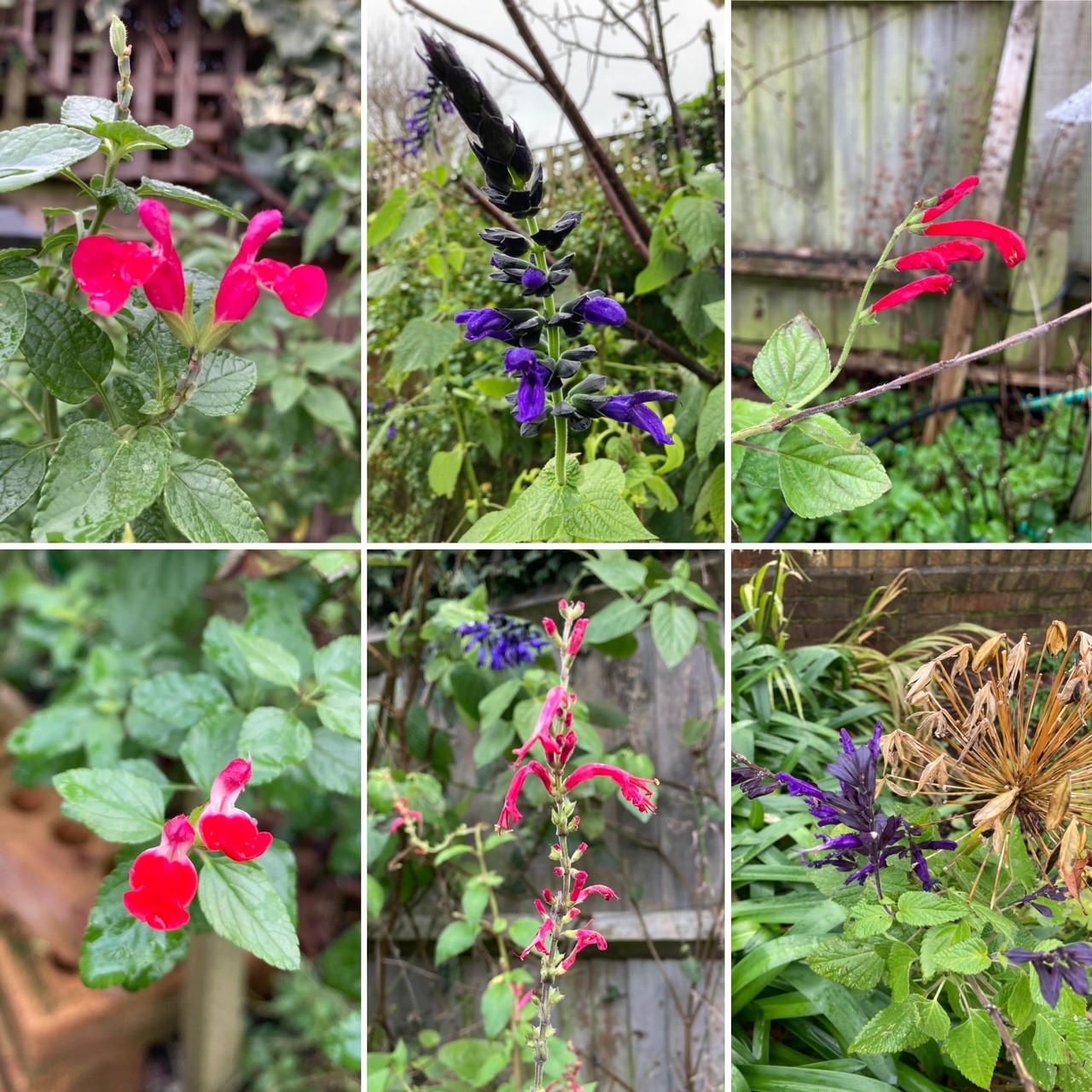
Salvias: Neon, Black & Blue, Tangerine, Hotlips, Pineapple and Amistad
Teucrium, Wallflower, Parahebe, Lobelia and Primrose
This year, for the first time, I decided to put up a Christmas light curtain along the back windows of my house, never thinking that it would be such a difficult job! Having finally got the things up, with a good deal of foul language, I have felt reluctant to take them down. As well as the candles and lights around the house they have provided a welcome point of light in a rather dim January.
Imagine my delight when I heard a representative from English Heritage talking about Candlemas on the radio recently. Apparently, a tradition preceding the one which instructs us to take down Christmas decorations on the twelfth night, this allows for decorations to remain until Candlemas – the second day of February, which means that my lights can stay put for some time yet!
And snowdrops are also known as Candlemas Bells as they bloom so early in the year, and often before February 2nd. At one time it was believed that it was bad luck to bring these flowers into the house before Candlemas, but an opposing view has it that they are believed to purify the home. According to folklore, an angel helped these Candlemas Bells to bloom and pointed them out as a sign of hope to Eve and the flower is thus often seen as a sign of hope for the world.
It seems to me that everything comes together quite neatly: lights, illumination, snowdrops and hope. I think I will continue with this tradition!
Beginning 2021 on a philosophical note – Voltaire said that it is necessary to cultivate your garden. Andrew Marvell said that green thoughts come from any green shade. More recently, Marc Hamer in his latest book ‘Seed to Dust’ uses his cultivation of someone else’s garden as a catalyst for a range of philosophical meditations. His chapters begin with a gardening task but lead onto thoughts about life itself and his part in it.
I was reminded of ‘Plot 29’, Allan Jenkins’ book about the healing power of gardening, in which he gives an often heartbreaking portrayal of the violence and neglect of children, growing into an adult who seeks solace in tending a London allotment.
In their book ‘The Meaning of Gardens’ , Mark Francis and Randolph Hester argue that gardens have meanings and go on to explore six categories of meaning: faith, power, ordering, cultural expression, personal expression and healing, each of which can operate at a social or an individual level. Jane Brown’s wonderful book ‘The Pursuit of Paradise’ aptly sums up the meaning of gardens for many of us: the desire to create something which may be not only useful, but a pleasure to be in.
‘Gardening is boring and messy. Plus, it often results in despair’.
This headline rather caught my eye. What follows is a ‘debate’ between two people, one who espouses the values embodied in the headline, while the other puts an opposing argument. The two views are summarised in the table below.
Boring and messy
Rewarding
You need stuff like compost, tools and special gloves
Fresh fruit and vegetables are a joy to eat.
You have to go to the nursery and buy plants then bring them home and plant them
You can grow better and more varieties than you can buy
You have to prune – things don’t survive on their own
You are part of your environment
A puppy will destroy a weekend’s work in minutes
Plants want to grow – if you pay attention, they will do that for you.
A storm will wreak destruction
You can garden for nature, for the bees
Fluctuations in weather will kill plants
Having read the article, I did think there are a lot more rewards!
I wonder to what extent disappointment in gardening is sometimes promoted by gardening programmes, particularly of the quick fix kind. I actually find Monty Don running his fingers through his garden soil rather disheartening. Mine is never like that! In September I took over a second plot adjoining my own on my allotment site. A young family had taken this on in the spring, clearly full of very good intentions. The plot already has ‘good bones’ – a fruit cage, solid shed, greenhouse (some panes missing) and is divided into neat beds separated by paths. But the soil is pretty heavy clay and digging it is a lot of effort, basically manual labour. After several visits and some hard work the young family did not return. I wonder whether the ‘good bones’ of the plot had misled the couple into thinking this was going to be an easy job.
This has, however, been to my benefit. At the end of a horrid 2020, I am looking forward to working on this new plot in the new year. There are currant and blueberry bushes already planted which just need nurturing and I am already thinking that I will plant wigwams of runner beans with an understorey of French beans and perhaps squashes in one of the beds.
A Christmas card I received has written inside it: ‘Think positive; test negative’. Onwards and upwards.
One of our regular volunteers, Anne R has written an article for the Westcombe News, all about her experiences of volunteering at the Old Pond Garden. It’s a great advert for us, and will hopefully encourage even more people to come along and help, especially if we are to expand into the Long Borders as well!
Charlton Champion post
The Charlton Champion has recently posted about the Christmas wreaths on the gates at the Old Pond Garden. There’s still a couple of days to take a walk there if you haven’t seen them. Read the full post here:
One of my presents this Christmas was a fun book called “How to eat your Christmas Tree” by Julia Georgallis. As you would expect for a book with such a title, there are some bonkers ideas in it – but there is a serious message behind it and some quite intriguing recipes too.
The statistics are quite sobering: the author calculates that if we DIDN’T cut down one years worth of Christmas trees, the carbon emissions saved would be the equivalent of banning all global air travel traffic for a year, or taking all the cars in the United Kingdom off the road for the next five years.
On a much lighter note, here are a couple of her recipes:
Christmas Tree Tea!
Apparently pine, fir and spruce contain a lot of vitamin C, although pine produces quite a weak tea. If you have a go, make sure you wash all the needles thoroughly. (And never use Yew, obviously.)
Ingredients: A handful of pine, fir or spruce needles / Juice of a lemon / 30ml (1fl oz or 2 Tbsp) Honey
Method: Brew the needles in a teapot for 6 minutes. Add a dash of lemon juice and 2 teaspoons of honey to each cup. Pour over the brewed tree tea and serve.
Christmas Tree Cordial
This tastes a bit like grapefruit juice according to the author!
Ingredients: Juice of 10 lemons, zest of 4 / 2 litres water / 700g caster sugar / 400g spruce and/or fir needles (you can also use some of the branches for flavour)
Method: Sterilise a 2l glass bottle. Bring the ingredients to the boil over medium-high heat, turn down low and simmer for 2 hours. Strain through a fine mesh strainer, a few times, to make sure no needles are left and pour into the sterilised bottle. Keeps for 2 weeks in the fridge.
Christmas Tree Mimosa
Ingredients: 70 ml Christmas tree cordial (above)/ 140 ml prosecco / Ice cubes and lemon
Method: Combine in a cocktail shaker, pour into a cold glass and serve!
Like Francis Griffiths and Elsie Wright, as a child I believed there were fairies at the bottom of my garden. Unlike Francis and Elsie, I didn’t take this any further. The story of the Cottingley Fairies went on to become one of the greatest hoaxes of the twentieth century.
When Elsie’s mother showed the photographs to the local Theosophical Society, it set in motion a chain of events that led Sir Arthur Conan Doyle to conclude that the photographs were authentic.
Then in 1920, when Conan Doyle wrote an article on fairy life, fairy fever gripped the nation.
But there are other reasons to go to the bottom of your garden!
In one of the December entries in his book The Ivington Diaries, Monty Don writes that, in order to feed his chickens, he has to walk right to the end of the garden and back, ‘which means that whatever the weather … I am obliged to have a good look at things’. There is no doubt that, in the depths of winter, having to get from one end of your garden is quite an education. You can make all kind of assessments in terms of use of space and structure, when everything is so bare.
And there are, of course, additional benefits. The scent of the Viburnum bodnantense at the end of my garden is astonishing. It knocks me out every time. Perhaps even more so in winter when there is less competition. I think I should have it closer to the house, or perhaps I should get another one.
But I do like the idea of a little cluster of fairies whispering somewhere under the still green leaves of my nasturtiums at the bottom of my garden!












 Charlton and Blackheath Amateur Horticultural Society