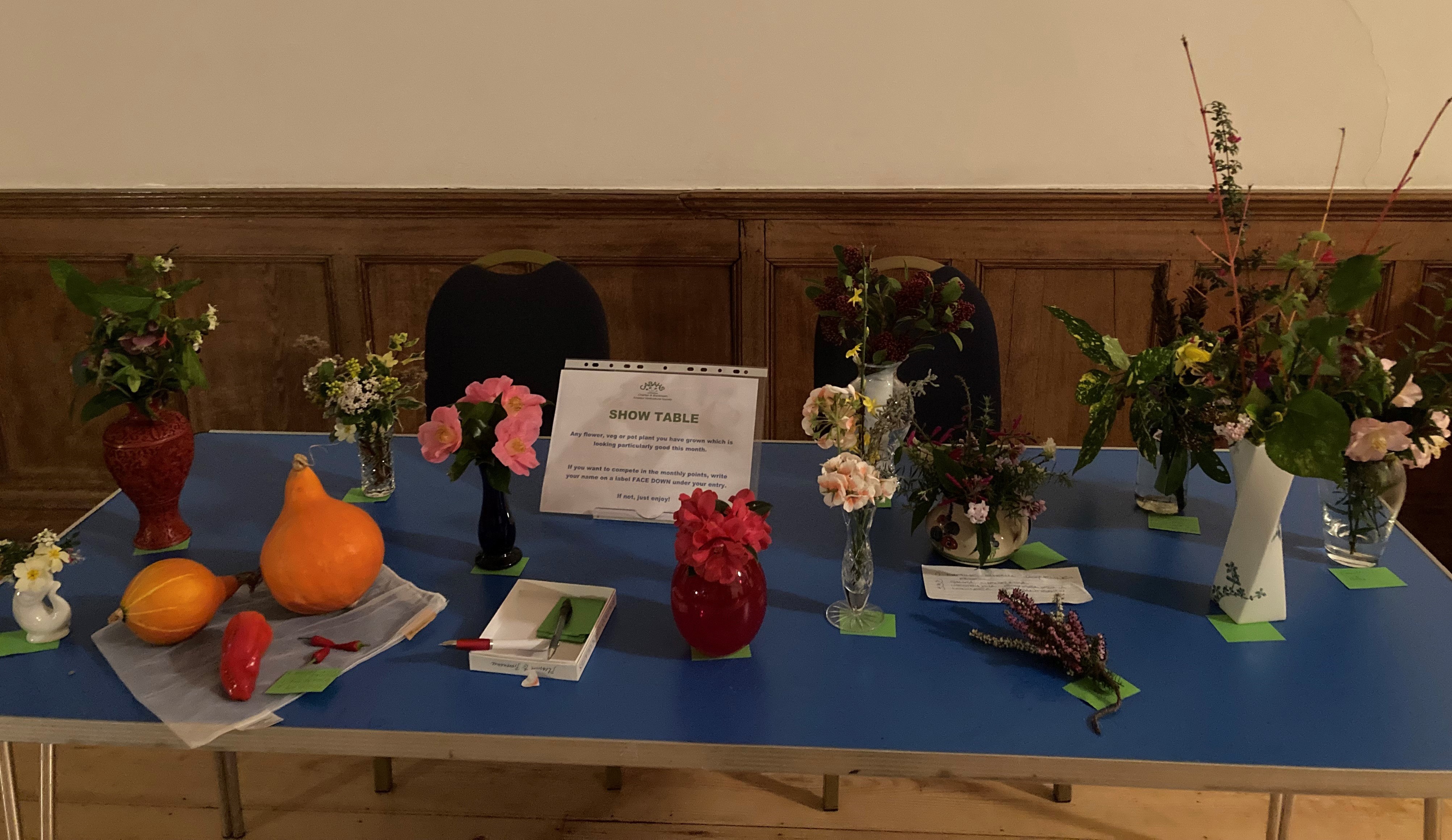
On the latest RHS gardening update I have just read that, according to Sally Nex, the more plants you grow the more carbon your garden can store away, which is therefore another way of helping to create a more sustainable environment.
This suits my gardening philosophy just fine!
I am so often tempted at plant fairs to buy another addition for my garden, but often without any clear idea of where the plant will go. (And how wonderful to be able to buy plants at the Chelsea Flower Show this year!) Now the idea of packing yet more in makes me feel positively heroic!
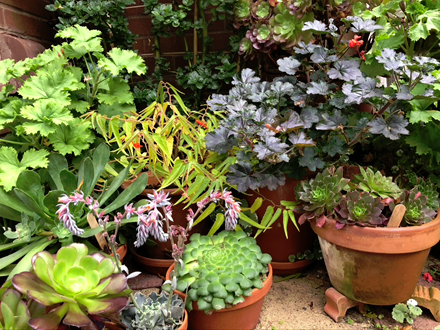
An example of the ‘always room for one more’ school of gardening outside the back door.
A rainy start to October! Autumnal tones everywhere now. The bees are still out in force though.
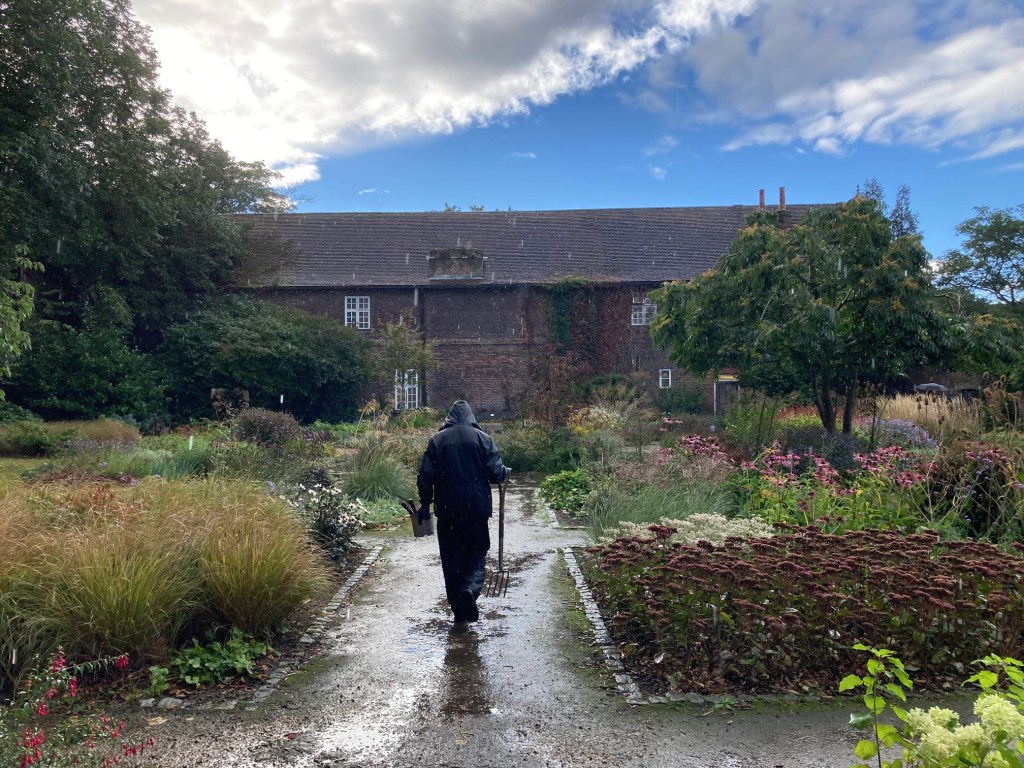
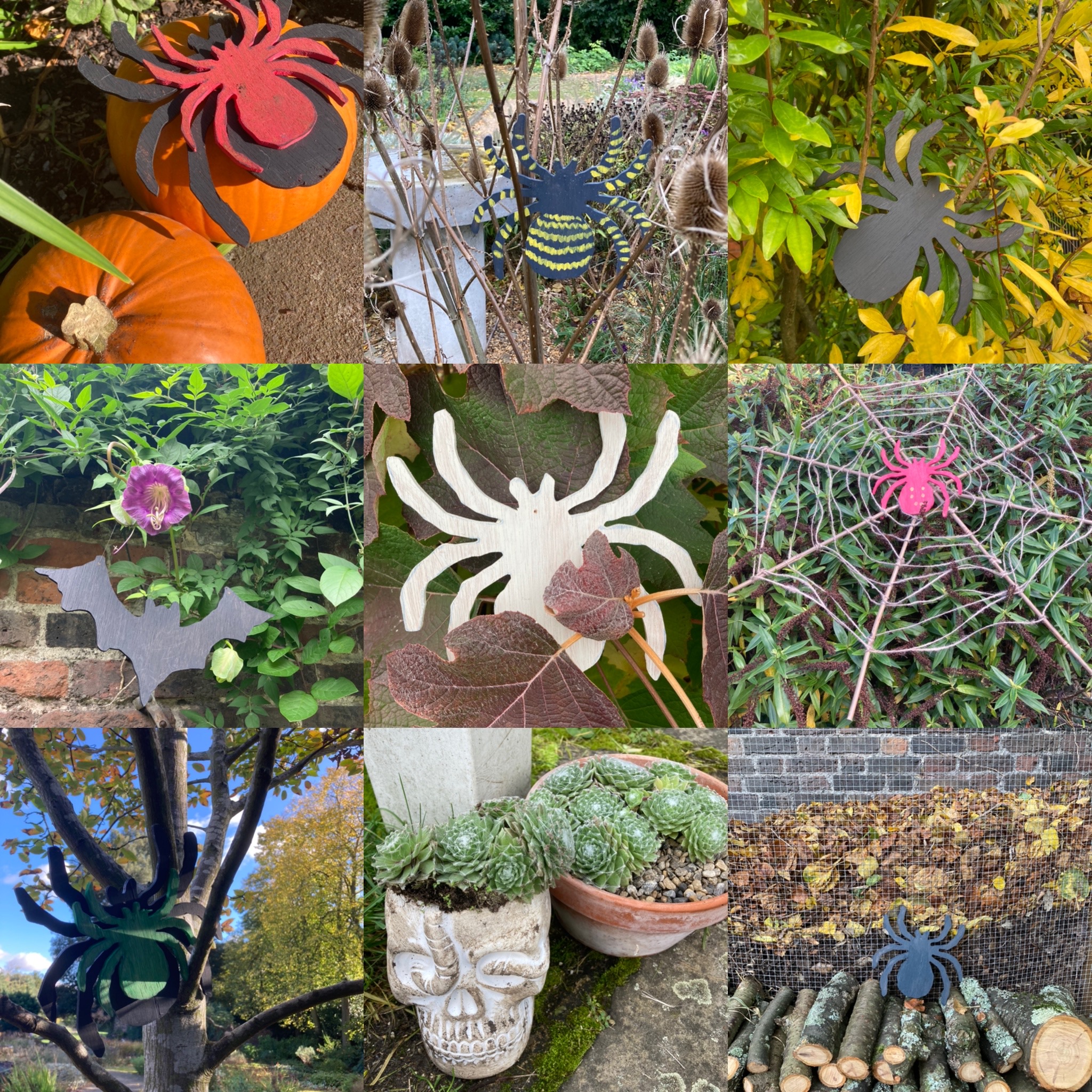
Our Halloween Spooky Spiders Trail went down well with Charlton House Explorers this half term. There were 10 spooks to find around the garden, and it kept them all busy after their Ghosts and Gargoyles session in the Long Gallery. We had 140 children through the gardens over the two days, phew. Great fun, although we didn’t do much gardening this week!
The guest speaker for October was Dr Mark Spencer who gave a fascinating glimpse into his experience of working as a forensic botanist. It became clear that forensic botanists are a rare find throughout the UK and the world.
He explained that from being brought up within a rural farming background in Warwickshire, he studied at the Royal Botanic Gardens, Kew. However he realised he did not want to pursue horticulture as a job and moved onto studying Botany culminating in a Doctorate looking at the evolution of fungi. While working at the Natural History Museum where he had become an expert on various aspects of botany, he was approached by a Police department asking whether he could help work out how long a body had been in a canal.
He has now worked alongside numerous police forces and an array of other experts such as soil scientists, experts in the study of pollen and forensic entomologists (study of insects) to assist in missing person searches, assessing how long human remains had been in-situ and linking suspects to crime scenes.
As a forensic botanist, Dr Mark Spencer looks for useful evidence using his knowledge of the rhythm, structure and behaviour of plants within their eco-systems. This can range from observation and interpretation of how vegetation is growing at a scene being investigated, to a microscopic identification of fragments of foliage found on clothing, to looking at the stomach contents and understanding the botany within a person’s digestive tract.
He explained how the roots of plants can help provide understanding of how long ago human activity occurred at the scene. Brambles (Rubus fruticosis) can be very useful tools for estimating how long bodies had been lying in woodlands or hedgerows through the knowledge of how they grow at different stages, when they send out side shoots and number of stems produced. I have a feeling that my walks through Oxleas Woods, which are full of brambles, will never be quite the same again!
Sharon
Dr Mark Spencer is an experienced and internationally respected botanist. His expertise covers many disciplines including forensic botany, the plants of North-west Europe, invasive species and the history of botanical science. He works globally as a writer, public speaker and television presenter and has appeared on BBC Radio 4’s The Infinite Monkey Cage. He is also Hon. Botany Curator of the Linnean Society of London. Dr Spencer’s website gives a detailed description of his range of expertise.
Clockwise from top left: lady’s mantle, cucamelon, Virginia creeper, ornamental grape vine and dogwood, chillies, Japanese blood grass – or – Alchemilla mollis, Melothria scabra (cucamelon), Parthenocissus quinquefolia, Vitis vinifera ‘Purpurea’ and Cornus alba ‘Sibirica’, Capsicum annuum ‘Cayenne’ (chilli), Imperata cylindrica
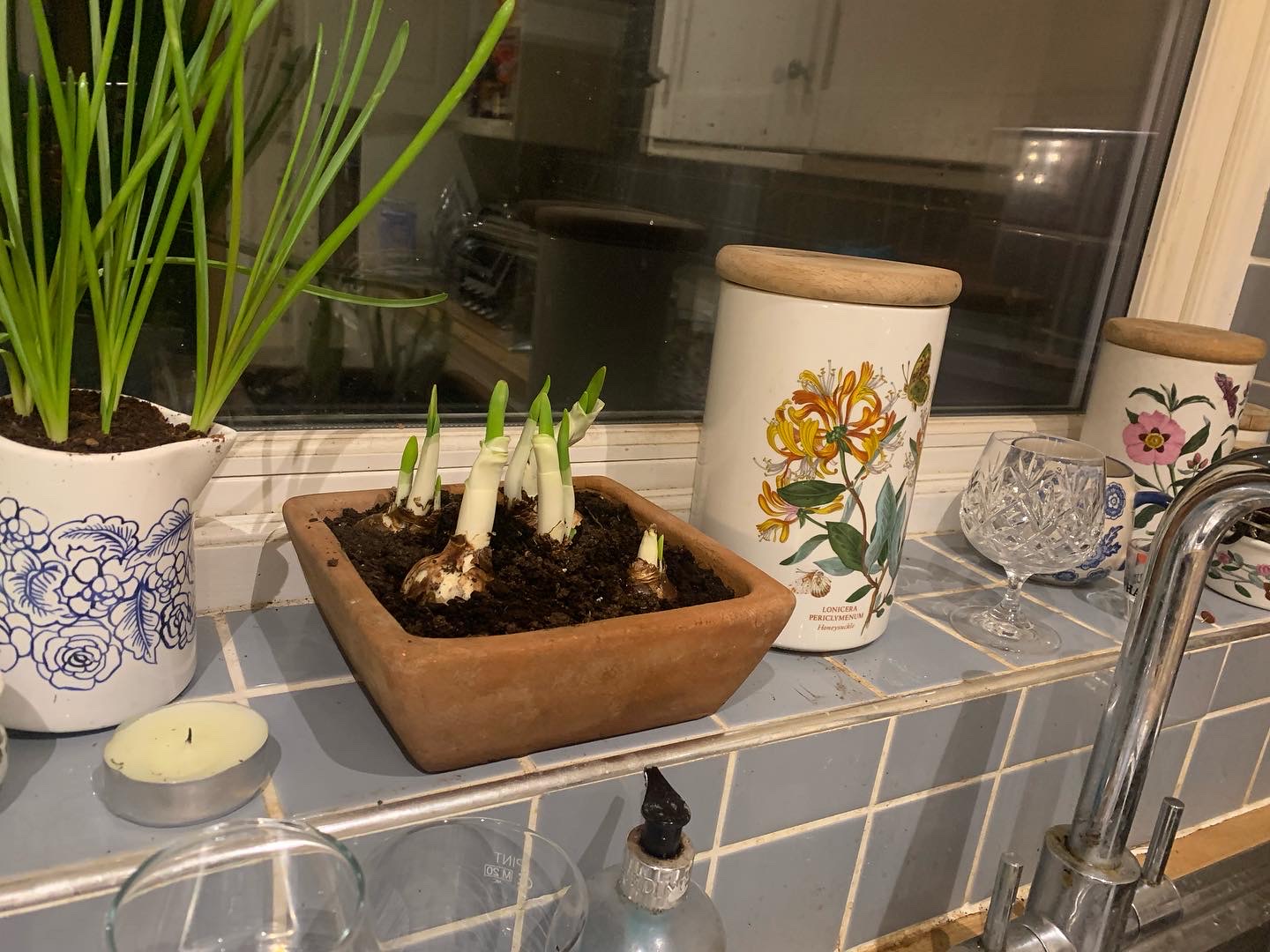
Late in 2020 Ali H set herself a challenge: to take one photo a day in her garden for a year, and post it on Instagram. Her purpose was mainly to notice and appreciate how the plants develop and change, also to have a record of what is there and when (she’s always surprised to look back and see the bulbs in flower, or a covering of snow!). She tried not to set too many other conditions as she knew she wouldn’t get round to doing it otherwise – so they don’t have to be ‘good’ photos, they don’t have to be plants in flower, they don’t have to be anything other than a photo of a plant in her garden – including fruit and vegetable crops. She likes individual plants and looking at things close up, so that’s what they tend to be – but occasionally there’s a view or a combination. Here are a few photos from September (above) and October (below). Ali’s not sure what 2022’s challenge will be. She might just carry on!
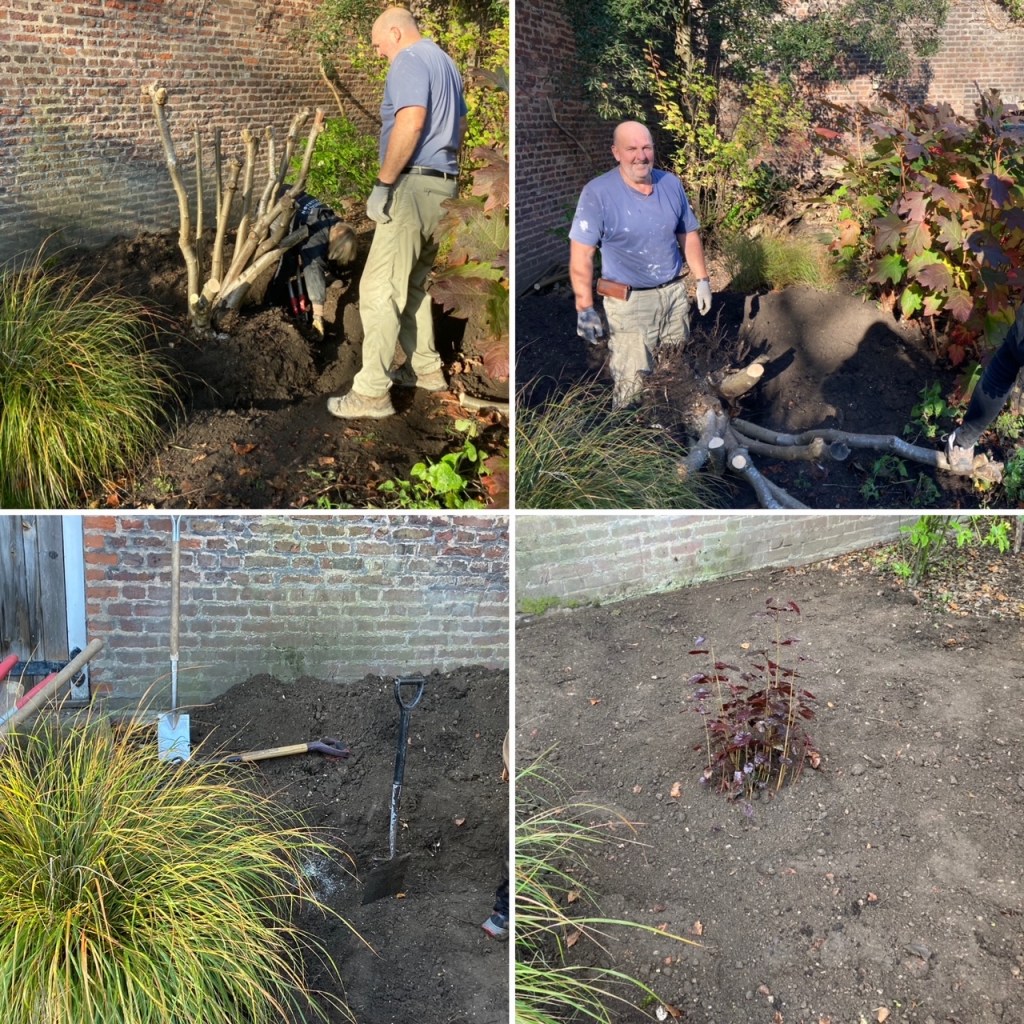
Clockwise from top left: dogwood, cabbage palm, myrtle, oak-leaved hydrangea, Persicaria, maidenhair fern – or –Cornus alba ‘Sibirica’, Cordyline australis, Myrtus communis, Hydrangea quercifolia ‘Burgundy’, Persicaria microcephala ‘Red Dragon’, Adiantum venustum
On Thursday I joined a tour of Avery Hill Park with the Mottingham Horticultural Society, who had extended an invitation to CABAHS members. It was a beautiful, crisp, sunny afternoon and the park looked gorgeous. Our guide John, from the Friends of Avery Hill Park, told us about the history and prehistory of the park before leading us around the extensive area.
Autumn tree colour in Avery Hill ParkThe Avery Hill Winter Garden, viewed from the park
Some members may be familiar with the Winter Garden, a glasshouse currently undergoing renovation work (therefore closed) and about to pass from the hands of the University of Greenwich back to the local council. I look forward to seeing it after renovation is complete!
Recently cut meadow area and former hedgerow (with dozens of cross country runners!)
There are two main areas of the park, historically and now. The more manicured, grassed parkland associated with Avery Hill Mansion (which is currently being converted into a school), and former farmland, with field boundaries and drainage ditches. The Friends are working to make the latter areas more wildlife-friendly by negotiating a meadow-style mowing regime (ie: cutting only twice a year, removing the mowings once seed has dropped, and sowing wildflower seeds) with some mown paths. Even after just a year, it’s possible to see that the range of plant species is extensive. The increase in butterfly numbers and activity in summer 2021 was notable. It is hoped that a general increase in biodiversity will also encourage an increase in bat numbers, which have declined in recent years.
Looking toward Great Stony Acre – field boundary trees and drainage ditch
The former field boundaries are still visible, and what would have been hedgerow has grown into rows of trees and scrub, which is excellent for wildlife. A new mixed hedgerow has been planted where one had disappeared, and the drainage ditches have been cleared by volunteers. Another historical feature which lives on through the Friends is the old field names, such as Henley’s Meadow, Little Stony Acre, Grey’s Field and Great Stony Acre. The latter is being planted with native tree species – oak, hornbeam, birch, hawthorn and field maple. Around 1500 trees have been planted over a five year period, and there are plans for a natural drainage pond in the centre as the area is at the bottom of a slope, is mostly heavy clay and becomes very boggy in winter.
Young trees in Great Stony Acre
It was a very enjoyable afternoon and I appreciated the chance to visit the Park with a knowledgeable guide.
Looking across Avery Hill Park, late afternoon October 2021
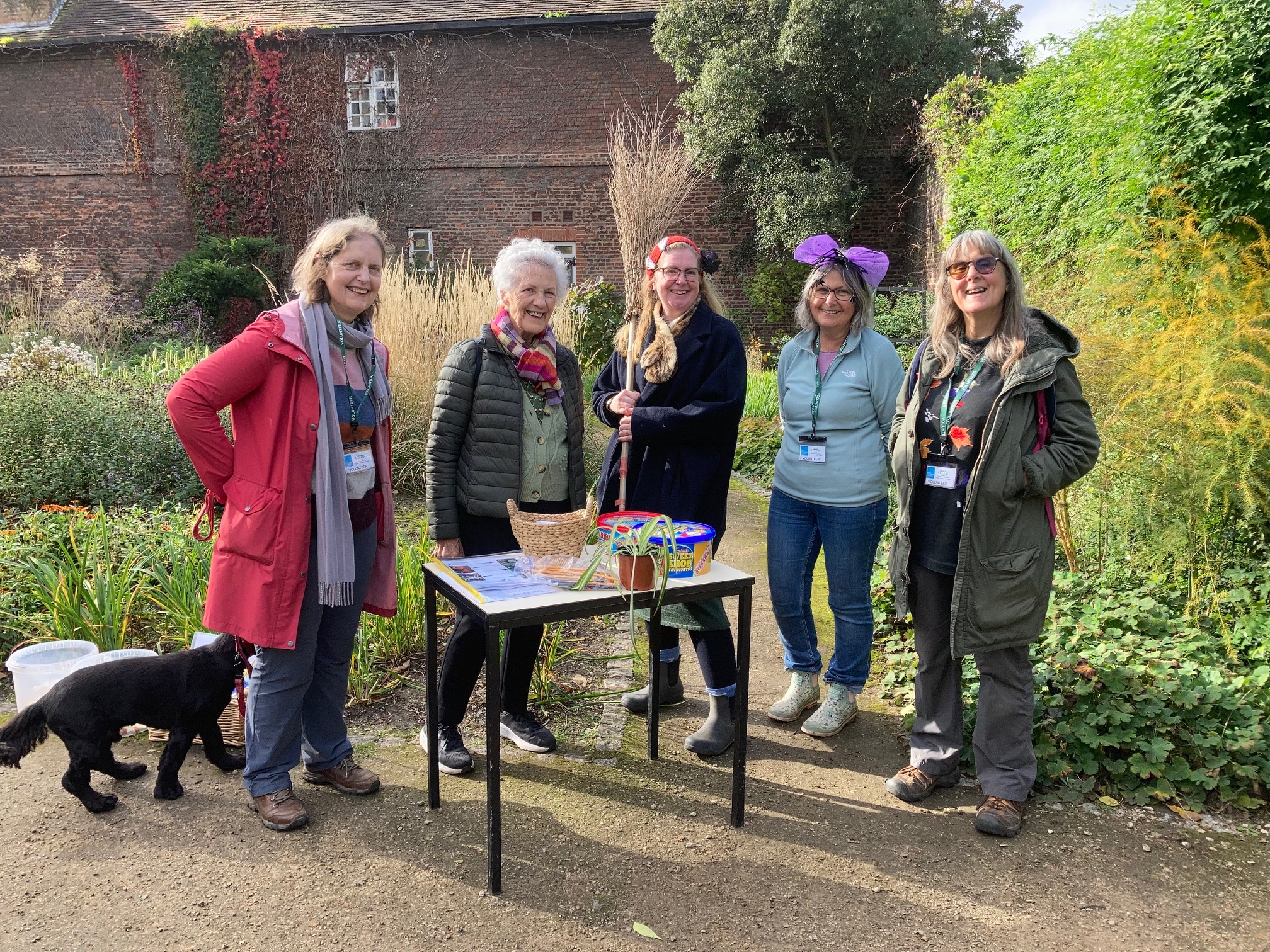
A super-successful day at our CABAHS plant stall at the Horn Fair on 17 October. This annual festival on St Luke’s Day has had a re-boot by the new team at Charlton House and was a very lively event. Our stall made £760, thank you to all who donated plants or helped on the day, these things cannot be done without you all! Lots of commercial and artisan stalls, talks and exhibitions.
CABAHS at the Charlton House Horn Fair, October 2021
10 October 2021: A special opening of Sian’s garden for CABAHS members, a lovely chance to catch up and £251 raised for Greenwich & Bexley Community Hospice.
On a recent visit to Madrid, I called in to the house of Joaquim Sorolla (to my mind, one of the greatest of the Impressionist painters). Like Monet and others, he was one of those artists who loved his garden and, in later life, used it for inspiration and as subject matter. Located in the heart of Madrid, the garden has been created to manage the heat of the city. ‘The garden with its Moorish echoes is the quintessence of the Spanish garden’[1]. It is divided up into three linked but clearly distinguished parts. There is extensive use of aspidistras in huge pots to line balconies and provide focal points around the garden. Roses are grown in pots and situated throughout the garden – the ones I saw in flower were of a cream I associate with ‘Buff Beauty’. And, of course, plenty of pelargoniums in pots, most of which had finished flowering (my visit was in September). If in Madrid, do visit!
Luca de Tena, C. (2021) Museo de Sorolla, Madrid. Ediciones el Viseo.
The Long Border has its Autumn colours on. Orange Tithonia ‘Torch’ and marigold Tagetes ‘Cinnabar’, with Salvia ‘Black & Blue’ stunning in the background.