Professional gardening has long been a man’s world. The title of Fiona Davison’s book comes from a letter written by the retiring Director of Kew Gardens, Joseph Dalton Hooker in 1906. His unambiguous advice to Miss Symonds who fancied a job tending plants was to forget it. Yet women did enter the world of horticulture in the early decades of the twentieth century and Davison follows six of them as they make inroads into this male bastion.
Enjoy a symphony of colour with this extraordinary Tiarella! A charming, shade loving relative of the Heuchera. In spring, slender stems rise above the leaves and hold a mass of pink and white starry flowers, giving a frothy effect – hence the common name the Foam Flower.
This variety has an Award of Garden Merit from the RHS and it copes in the difficult dry shade conditions under the Lime trees in the Old Pond Garden.
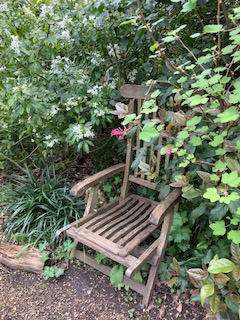
If RHS gold medals could be given to individual gardens, then The Woodlands Farm Cottage Garden deserves that honour. I am, at the moment of writing, sat on one of the many benches enjoying this charming garden.
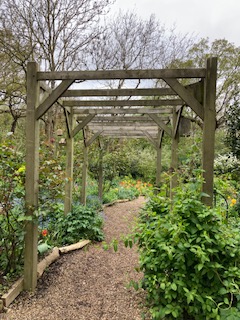
Volunteers started working to create a cottage garden back in 1998 and now, 25 years on I am gazing at their ‘gold-medal’ creation. The garden has everything one would want: wide gravel paths edged with brick or logs meandering around several large informal flowering beds; a rose and clematis-framed timber pergola walkway; glasshouse; summerhouse; raised vegetable and fruit beds; propagation area; pond; a bug hotel; and, very importantly, tables and chairs for family snack times.
A wren has announced its arrival on the beautifully pruned Exochorda and children and mothers are coming in to excitedly explore and admire the garden’s loveliness. From my bench are carefully pruned shrubs arising tall from the spring beds. This allows visitors to clearly view the purple honesty, inky-blue aquilegias, mauve vinca, forget-me-nots, narcissi, tulips, camassias, allium buds, geraniums, hellebores, wallflowers, bergenia, primulas, lamiums and more – all looking their very, early-spring best. Masses of tall cow-parsley are breaking into flower in front of the flowering choisya and viburnums, creating an harmonious effect. And I’ve spotted purple-stemmed cow parsley looking extremely healthy, as well (most envious!)
This cottage garden is sheltered and faces south. It is surrounded by mature trees and many evergreen shrubs so it has its own little micro-climate.
Before I leave, I glance once again at the charming, delicately-pink blossom on the spreading branches of the old apple tree. With a table and chairs set beneath its canopy and spring flowers in the foreground, it is a really lovely vision. And it’s a gold-medal from me! The garden is open to the general public. More information about Woodlands Farm Trust here. Do visit before the spring flowers fade.
Congratulations to all our entrants, spectators and winners at our 46th annual Spring Show! Despite lots of comments like ” I have nothing left, the snails have had everything” it’s clear CABAHS members rise to a challenge as we had 80 entries in total. Monday evening was a great opportunity to show off our collective gardening skills, as well as have another little trip down memory lane about Shows of the past.
The Pipit competition – a definite challenge this year!
Kathy covered the origin of the Spring Shows at last year’s meeting, with the first one held in 1978, and as a result of that research we resurrected two new classes – a Primulas & Auriculas class and a Baking class. They were well received, with 5 and 8 entries respectively.
Mention has to be made of Mandy’s wonderful shortbread shapes – the wheelbarrow filled with chocolate earth was apparently Brownie’s contribution!
1. Prune hardy fuchsias now both in pots and in the ground to promote new growth and to prevent the plants from becoming too woody.
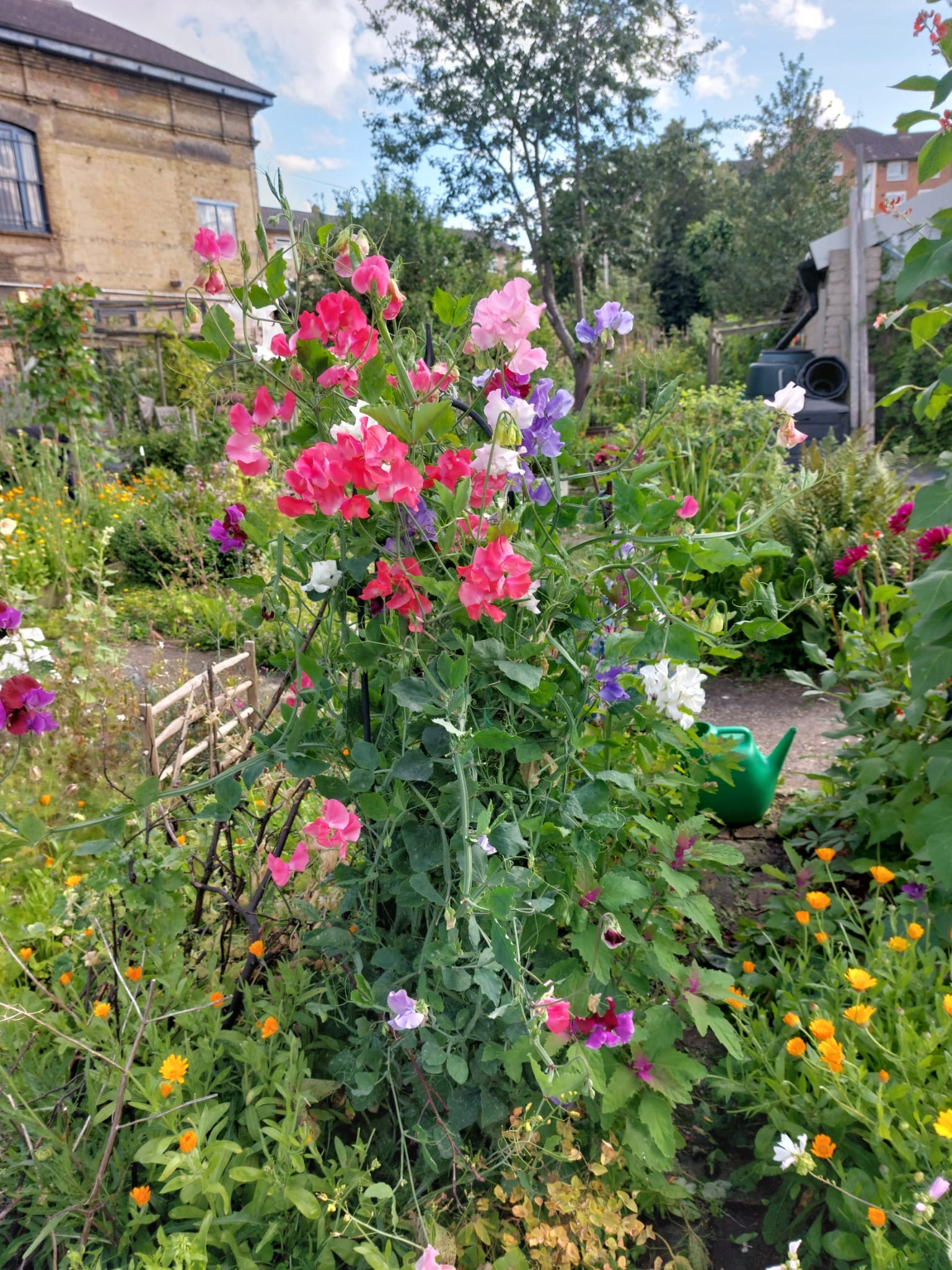
2. Plant out pot grown sweet peas now making sure to pinch out the shoots to promote bushy plants. You can also sow directly in the ground now if you didn’t sow earlier but watch out for slugs munching new seedlings.
3. Someone said the other day that they hadn’t cut back their clematis but I don’t think its too late as the growth on them is phenomenal. It just means they will flower a bit later but then that extends the season.
Pat’s unpruned clematis already at the top of the arch!Pat’s cosmos seedlings – germinated in under a weekPat’s Cosmos flowers
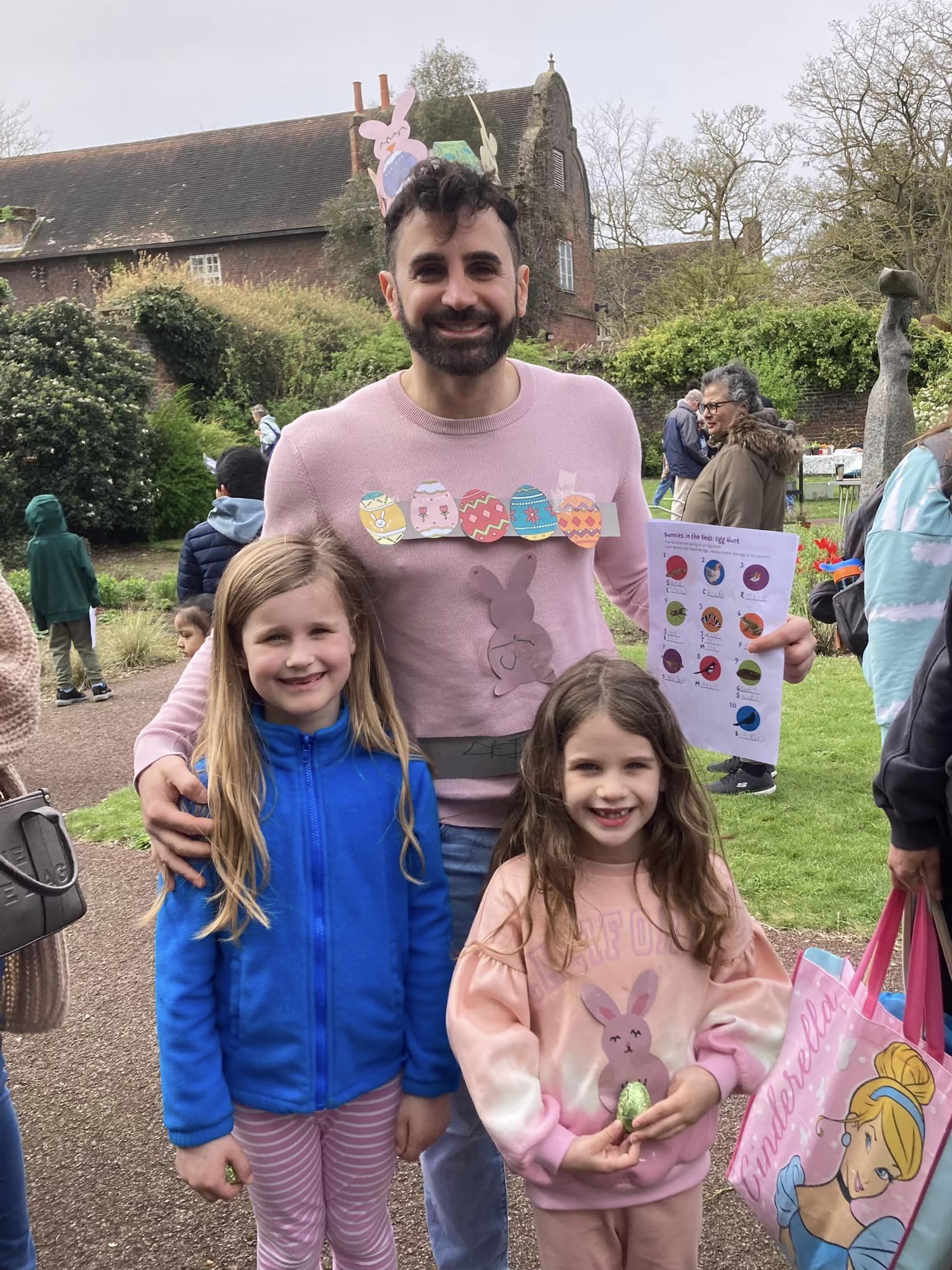
Our “Bunnies in the Beds” Easter Trail took place on Saturday (April 6th) for the fourth year running, it is becoming a fabulous fixture of the Garden Volunteers year. We start thinking up mad ideas in January during tea breaks, then gradually whittle them down to create an exciting but practical trail.
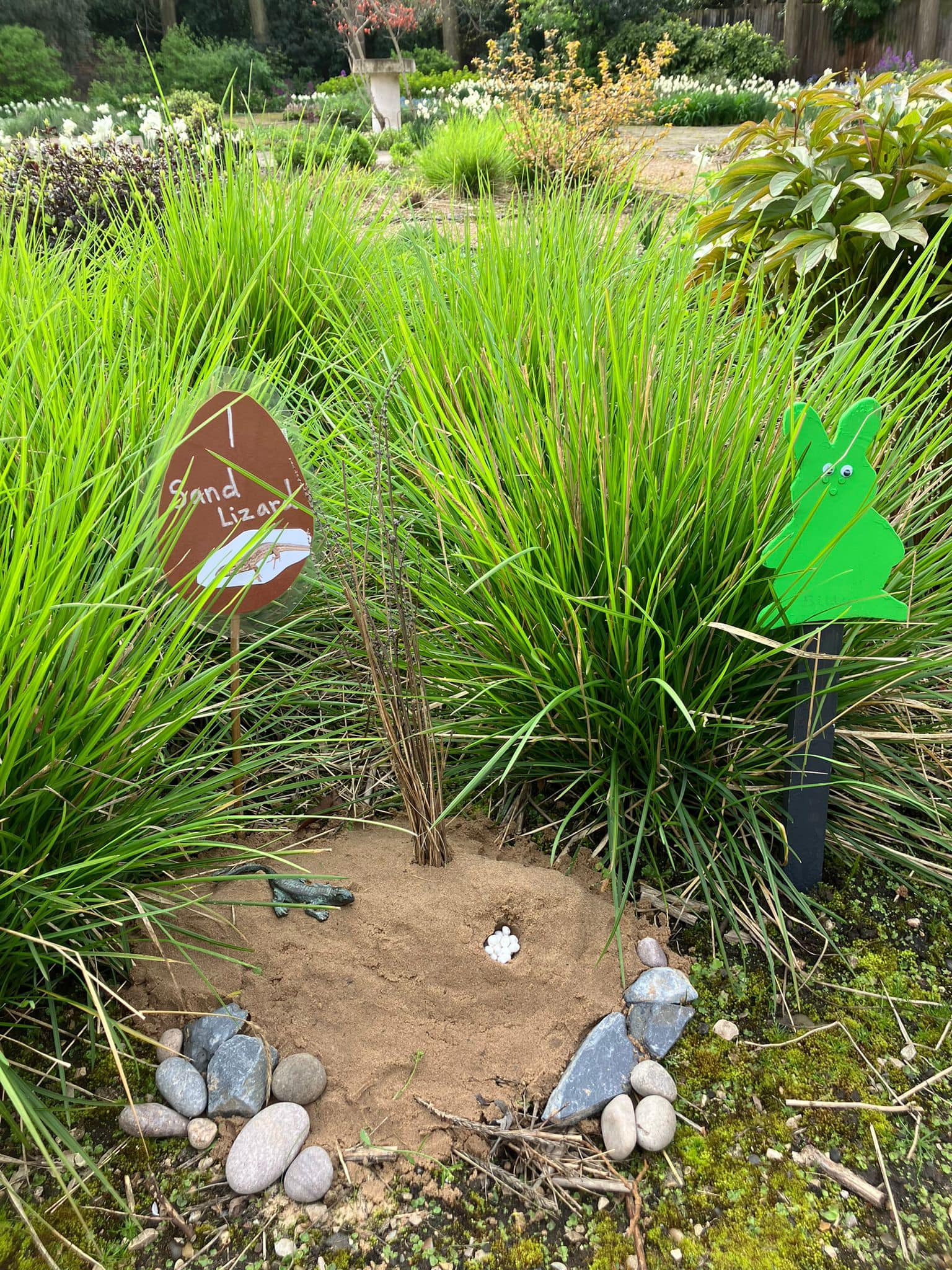
This year, the Bunnies went on an egg hunt with a difference! Having found all the eggs they then had to match them to their parent animal, in order to collect a prize. And by the end of the day, 175 children had achieved their goal. There were birds eggs to find of course, but also frogs, snakes, sand lizard, moths and even a dinosaurs egg!
Also on offer: Potting Up Table with free seeds, courtesy of RHS Britain in Bloom which is celebrating its 60th anniversary this year. We were not expecting this to be so popular and almost ran out of seeds! So many small gardeners-in-the-making came to this event, it was lovely. If you are growing your seeds on, you can keep track how others are doing on social media on @RHS GrassRoots and #RHSBloom60.
The small patio is shielded from the sun, in a south facing garden, by an Acer palmatum ‘Katsura’. The tree caught my eye while on a trip to Kent. Must have one of those I thought. The sapling was bought and is now well mature. Some of the limbs show signs of viral attack, but it soldiers on.
Early to leaf, in February, the leaves are green and red. It produces sap, which attracts the aphids. With the aphids, the small birds make regular visits to eat the goodies. The birds include Blue, Great and Coal Tits, Robin and Goldfinches. The Dunnocks also pay a visit, foraging in the growth below, together with a variety of bees including the distinctive yellow faced variety. Soon after, it will produce a vast amount of blossom, and after that very small sycamore-like seeds. In time and onto autumn, the leaves go from yellow to orange and then fall, covering all the surrounding ground.
We attempted something a bit different at this meeting! Our Chair Stella introduced the evening by asking the audience to imagine we were all sitting relaxing in the CABAHS garden shed surrounded by our gardening friends. She then introduced the “panel” and to start the conversation rolling, asked how they first became interested in gardening.
The four panellists, Ruth, Kathy, Lynda & Pat each had different but similar personal stories, and it was usually a parent or grandparent who first sparked their interest.
The next question was about the tastiest vegetable or fruit we had ever grown.
For Pat this was Sungold tomatoes. Lynda is known among members for growing Goji berry but she chose sweetcorn as the tastiest ever. Ruth thought figs from her allotment were amazing, especially as she had inherited them from the previous holder. For Kathy it was “Mr Green’s” (the previous owner of her garden) summer raspberries, which have been in the same bed for over 35 years.
Now on to the best Show flowers (topical as we have the Spring Show coming up next month). Stella put in her vote for Penstemon ‘Garnet’, certainly a very good do-er in the Walled Gardens at Charlton House.
We hope you enjoy a spring walk around the walled gardens at Charlton House! Look out for:
Forsythia
Forsythia is in the olive family, renowned for its vibrant yellow flowers which appear in spring, long before the leaves unfurl. The one by the Charlton House stables is quite old and we are not sure of the exact variety. We pruned it back hard a year ago and it seems to have loved it!
Cherry laurel (Prunus laurocerasus)
A ‘background’ evergreen plant most of the year, but quite striking when the white candle flowers appear in Spring. Although we call it a laurel, it actually isn’t – it’s in the cherry family! We know that an early resident of Charlton House, Elizabeth Puckering, introduced cherry laurels to the gardens. She was friendly with the diarist John Evelyn, who lived in Deptford at the time, and exchanged cuttings with him in around 1654.
Daffodil (Narcissus ‘Thalia’)
A fragrant and vigorous trumpet daffodil which is now in it’s third year in the walled gardens, so has formed some nice big clumps. It starts off creamy yellow and fades to white, and is sometimes referred to as an orchid daffodil. For fans of BBC Gardener’s World on TV, you might recognise it from Monty Don’s writing garden!
Brunnera has lovely heart-shaped, silvery-veined leaves that look as if frost has touched them. The leaves light up shady areas of the garden. It has long lasting, bright blue flowers that look very much like forget-me-nots, and which provide lots of nectar and pollen for visiting bees.
Wood spurge (Euphorbia amygdaloides var. robbiae)
Wood spurge is in the Euphorbia family, so take care! If the stems are broken, they gush with a thick milky latex substance that can cause blisters on skin. They are handsome perennial plants, shade loving, with zingy lime-green flowers in late Spring and rosettes of glossy dark green leaves. Another name for this plant is ‘Mrs Robb’s Bonnet’ – we would like to see the hat that inspired that name!
Still going strong, winter into spring!
Lenten rose (Helleborus orientalis)
The Lenten Rose is a perennial flowering plant and is part of the Buttercup family, so not a rose at all! Its common name comes from the fact it usually flowers between Ash Wednesday and Easter – the period known as Lent. Hellebores (Lenten roses) can be white,
Primrose (Primula vulgaris)
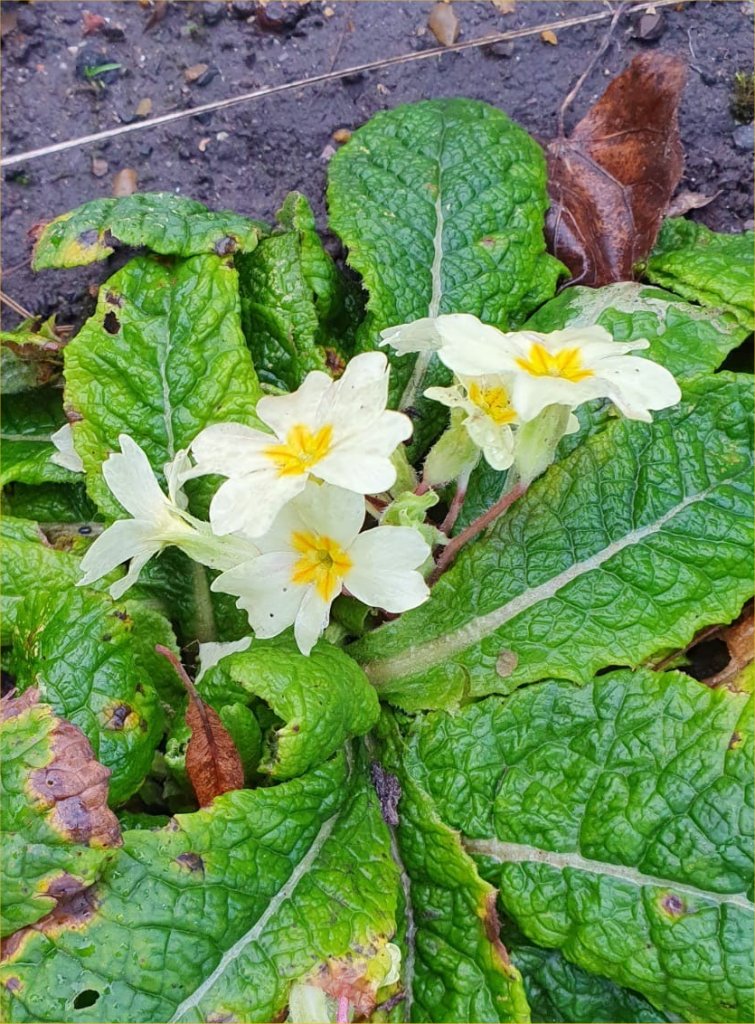
We grow the English or ‘common’ primrose in the walled gardens, which is the natural pale yellow one that gives its name to the colour Primrose. It is often one of the earliest plants to flower in Spring (the Latin word ‘prima’ means first). Early butterflies like the Brimstone benefit from its nectar. Plants will hybridise (cross) very easily with the garden bedding Primulas that come in lots of different bright colours, so seedlings can come up a surprising colour!
1. I sowed my sweet peas early in the month five seeds to a 3 inch pot and then placed them on a light window sill or greenhouse if you have one. They don’t need bottom heat and I don’t soak or nick the seeds but of course you can if you wish. Keep turning the pots so they don’t all lean towards the light.
Sweet Pea seedlingsDreaming of this…
2. Remove browning blooms from camellias to keep the display going especially the white ones which never seem to drop their spent blooms. I just wish I had room for more as they’re such a cheerful sight.













 Charlton and Blackheath Amateur Horticultural Society