We welcomed back Tim Ingram who has a passion for alpines, and is a member of the Alpine Garden Society. He gave us a talk on the evolution of Copton Ash, his garden in Faversham, Kent where he also has a specialist nursery. He also brought with him a selection of alpine and perennial plants for sale. He illustrated his talk with a series of photographs showing the development of his garden over the years and seasons.
Copton Ash fruit plantings Spring 1979Copton Ash getting wild, May 2024
Tim’s garden is a large and mature family-run garden, about one and a half acres in size, which has been in existence for nearly fifty years. He comes from a family of avid gardeners and so was brought up with a keen interest in plants and gardening. His father worked at Brogdale (home of the National Fruit Collection): his mother too a keen gardener: his grandfather was into market gardening. Tim first worked in academic science in London, specialising in plant hormones. He and his wife returned full time to Copton Ash in the late 1980s when they soon started a nursery.
An entertaining and informative evening was had at this year’s Gardeners Question Time. As usual, it enabled members to get advice on their gardening problems, and to air their gardening frustrations. Chaired by Sir Nicolas Bevan, the CABAHS President, the panel also comprised Tom Brown, the Greenwich Park’s Head Gardener, and Pat Kane, a long standing CABAHS member.
Most of the questions were sent in by members beforehand. They covered a broad range of gardening areas and problems: growing hollyhocks; aphid control; tree size; cistus, salvia and sisyrinchium pruning; how to grow dahlias; what killed my rose; problems with apple trees and rambling roses; how to encourage children to get involved in gardening; recommending a fertiliser for yew hedges; the cause of curly cucumbers; dealing with self seeding; and problems with bamboo.
John Anderson has a very distinguished horticultural career. Trained at Kew, he has been head gardener at a range of famous gardens, and his contribution to horticulture was recognised in the award of the RHS Veitch Memorial Medal. In 2016, he became Keeper of Windsor Great Park Gardens, part of the Royal Estate, and managed by the Crown Estate.
It was a particularly interesting and informative talk. The gardens are unusual, situated as they are in a Royal Estate of 8000 acres, and Windsor Castle being a world tourist attraction. Yet the gardens and their management are less well known to the public. John Anderson showed a range of photographs of the gardens, described their history and development over the decades, and the challenges they now present.
The challenges include managing people whether they are tourists, cyclists or picnickers; dealing with vandalism and littering; and protecting its historic landscapes. Also the problems of climate change: evidenced in its Long Walk tree avenue, at over two miles the longest in Britain, where elm and horse chestnut were succumbing to disease, to be replaced by more resistant species such as ginkgo (Maidenhair) trees.
A successful meeting was held in June with a packed audience and we were lucky to be given an engaging and informative talk by Neil Miller, Head Gardener at Hever Castle. In 2002 Neil started as a junior gardener at Hever following 10 years as an Insurance Broker and within 4 years was Head Gardener. Quite an achievement!
Famously Hever Castle was the childhood home of Anne Boleyn, and Henry VIII frequently visited her there. At that time the surrounding land was marsh and bog land. Though there were many changes of ownership in the following centuries, it was not until 1903, when William Waldorf Astor bought the estate, that serious restoration and renovation took place and the design for the gardens was drawn up. Alongside the castle, a Tudor style Village was also built so that invited guests had rooms to stay.
Dave Goulson, Professor of Biological Sciences at the University of Sussex specialising in the ecology and conservation of insects, and author of several books*, gave a talk about the dramatic insect decline worldwide. He outlined some of actions required on a National and International scale to reverse this apocalypse and what we as gardeners can do.
When he was a boy, he started collecting caterpillars (in his lunchbox) and his interest in insects became a life long passion when one of them pupated into a Cinnabar Moth. He explained that insects evolved over 480 million years ago and there are now around one million known species worldwide. They were the first creatures to fly and sing and many have complex inventive ways to camouflage themselves or mimic others. Examples of some ‘weird and wonderful’ insects were shared with us such as the Shield Bug from Thailand whose back very much looks like the face of Elvis.
The horrifying statistics on insect decline were shown, particularly over the last 30 to 40 years. Studies show that the decline is around 75%. He has researched the Shrill Carder Bee which was common across Southern England pre-1960 but by the year 2000 the populations of this bee had greatly decreased and there were only about six populations left. Since 2000, the population which inhabited the Salisbury Levels has become extinct.
Tom Stanier, the Horticultural Team Lead at Greenwich Park, gave a talk about his life as a gardener at the Park and a behind-the-scenes look at working there in these challenging times. He described how he came into gardening, his training and work at the Park and some of the Park infrastructure, policies and projects. It was great to hear from someone with hands-on experience there.
He said he felt a connection with Charlton House as he had been married there in 2018. His interest in gardening really took off in 2017 when he moved into a flat in Lewisham with his partner and began to grow plants on his balcony and indoors. He had a radical rethink of his life in 2018. Having a child particularly refocused his life on his choice of a future career. Having been in retail for ten years, he decided he wanted to work out of doors and do something flexible and tangible. He successfully applied for the 2 year Royal Parks Apprenticeship Scheme which is part practical and part college-based course and chose to work at Greenwich Park as he thought it was more interesting. He completed an RHS Certificate and has since taken over leadership of the Horticultural Team at the Park, working closely with the head gardener.
Audience at January 2024 TalkChair Stella introducing Ruth
Ruth Cornett is a senior director of Heritage and Taxation at Christies and has previously given a talk to CABAHS about her garden at Eltham Palace Gatehouse. This talk focused on flowers in art. She said all gardeners in the way they visually create their gardens are artists, but not all artists are gardeners. Rather than describe the history of flower painting, she focused on how artists used flowers and plants to express themes – how through their paintings they send messages and use symbols and allegories. For example, paintings may comment on a name, be used for propaganda, as a tool for study, to make literary references, be used for educational purposes or to symbolise Christian stories. She illustrated these themes using famous artists from the Renaissance to the present day such as Rubens, Durer, Van Dyke, Murillo and in modern times Ravilious and Hockney.
For example, Ruth pointed out that Botticelli’s Primavera (1478-1502) is an allegory celebrating spring. The Laurel tree in the background of Georgione’s portrait of a new wife, Laura (1506) is a pun on her name and emphasis on her being a strong, loyal determined woman. The portrait of Edward V1 by Scrots (c.1540) is a good example of how paintings were used for propaganda purposes by the powerful. In this picture, the sun shines and looks down on Edward and the plants are growing towards him, whilst the Tudor rose in his hand shows that the Tudor Dynasty is moving forward. Ruth points to Durer’s The Great Piece of Turf (1503) a seemingly unordered collection of wild plants used to represent nature as an example of using paintings for study. Literary references can be seen in Millais’ Ophelia (1851), a character in Shakespeare’s Hamlet, where she is depicted in a naturalistic setting lying dead in a river covered in flowers – a painting which took him several months to create its content and structure. Before photography, paintings and prints were used for educational purposes and Ruth cites the Hortus Elthamensis Seu Plantarum Rariorum by Dillenius (1732) which obtained its plant specimens from the area around Eltham. A Christian story can be seen in Van Dyck’s (1613) table set with bread and wine which were used to represent symbols of Christ and wealth.
Timothy Walker is a botanist with an extensive career in horticulture. He is a former Director of Oxford Botanical Gardens and still lectures at Somerville and Pembroke Colleges as well as being a Fellow of the Linnean Society and winner of four Chelsea gold medals. He came to our attention as the presenter of the BBC 4 television series Botany – a Blooming History. He gave an entertaining and informative talk which was very well received by the audience.
Like all living organisms, plants aim to ensure offspring for the next generation. Timothy described the sexual life of plants as the movement of pollen along the stem from the male anther of a flower to the female stigma to allow fertilisation. He put his discussion within the context of Darwinian theory of the Origin of the Species and Natural Selection and said pollination is less subservient than normally assumed.
He described a variety of stratagems for pollination and ways plants have developed to ensure it happens. Nature abhors inbreeding and, because of genetic problems associated with self pollination, tries to avoid it.
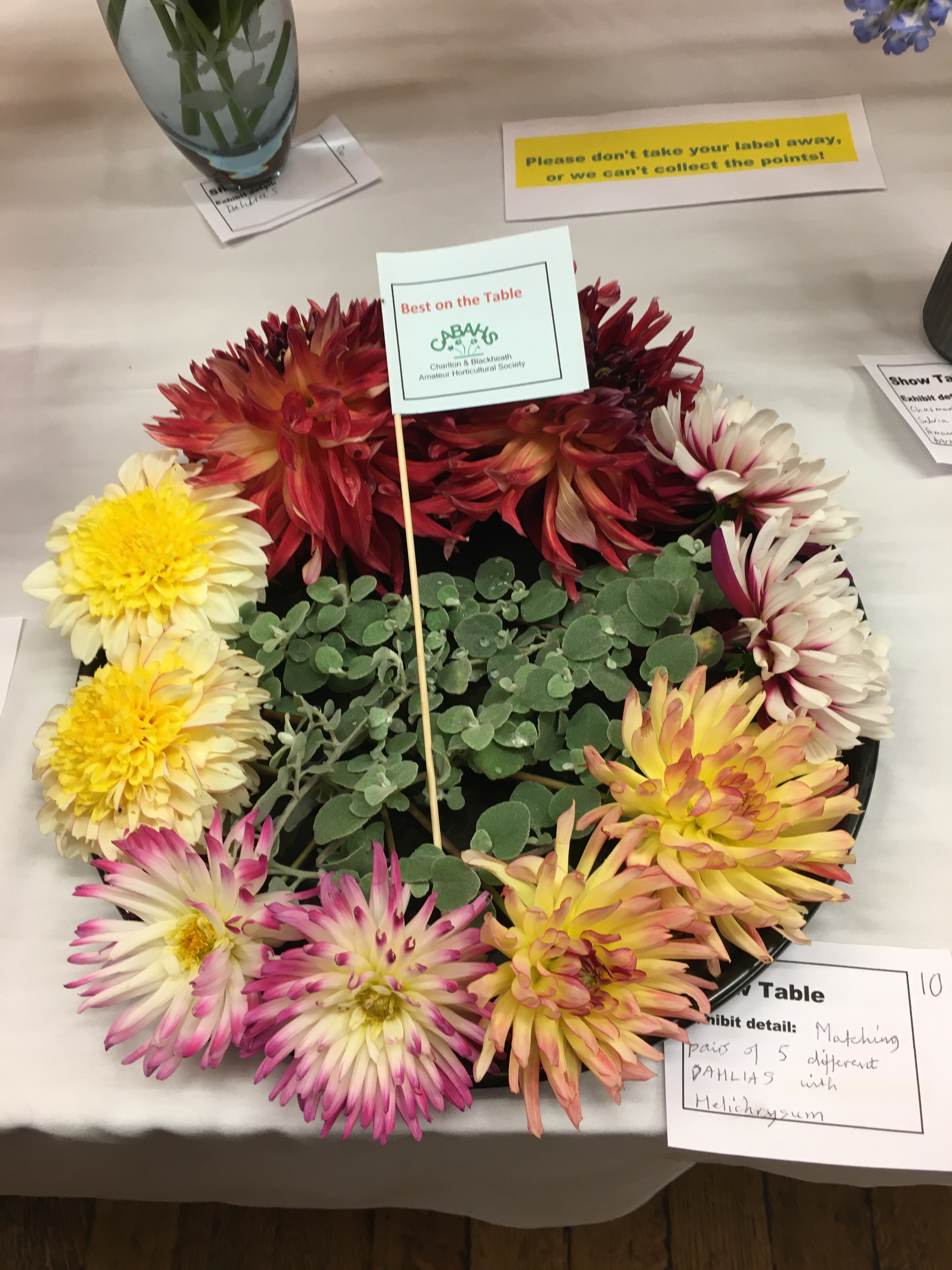
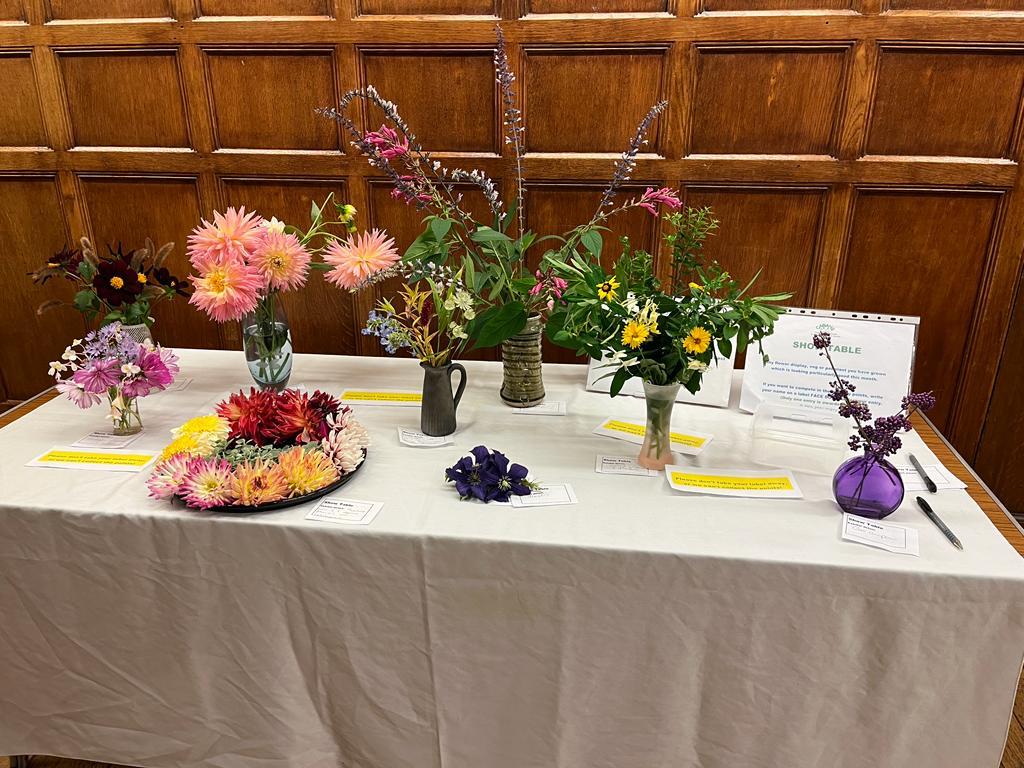
Fifty three people attended our October meeting in the Old Library, enjoying refreshments, the raffle, the plant sale and the Show Table, as well as an interesting talk. The Best on the Show Table was Annie H’s display of Dahlia flowers and Helichrysum.
The talk on the Middle-Sized Garden was a first for CABAHS as it was given by a blogger, Alexandra Campbell who describes herself as a blogger, YouTuber, journalist and author.
For most of her career Alexandra worked as a journalist at journals such as Harpers, Queen and She. But when the introduction of IT led to the drying up of hard print journalism work she embarked on a second career teaching herself blogging and videoing. She now blogs at the Middle-Sized Garden blog which gives advice and tips on gardening. It is one of the top ten gardening blogs in the UK with over a million viewers and covers garden design, middle-sized gardens and expert interviews and tips. She also has five million viewers on her YouTube site.
The panel this year consisted of the CABAHS President, Sir Nicolas Bevan in the chair along with the well known horticulturalist, retired Greenwich Park Manager and teacher, Joe Woodcock and our own knowledgeable CABAHS member, Pat Kane. It was a jolly affair much enjoyed by the members, held in the Old Library at Charlton House because of the possibility of rain.
Before the meeting, some members visited the Old Pond Garden to check on and discuss progress.