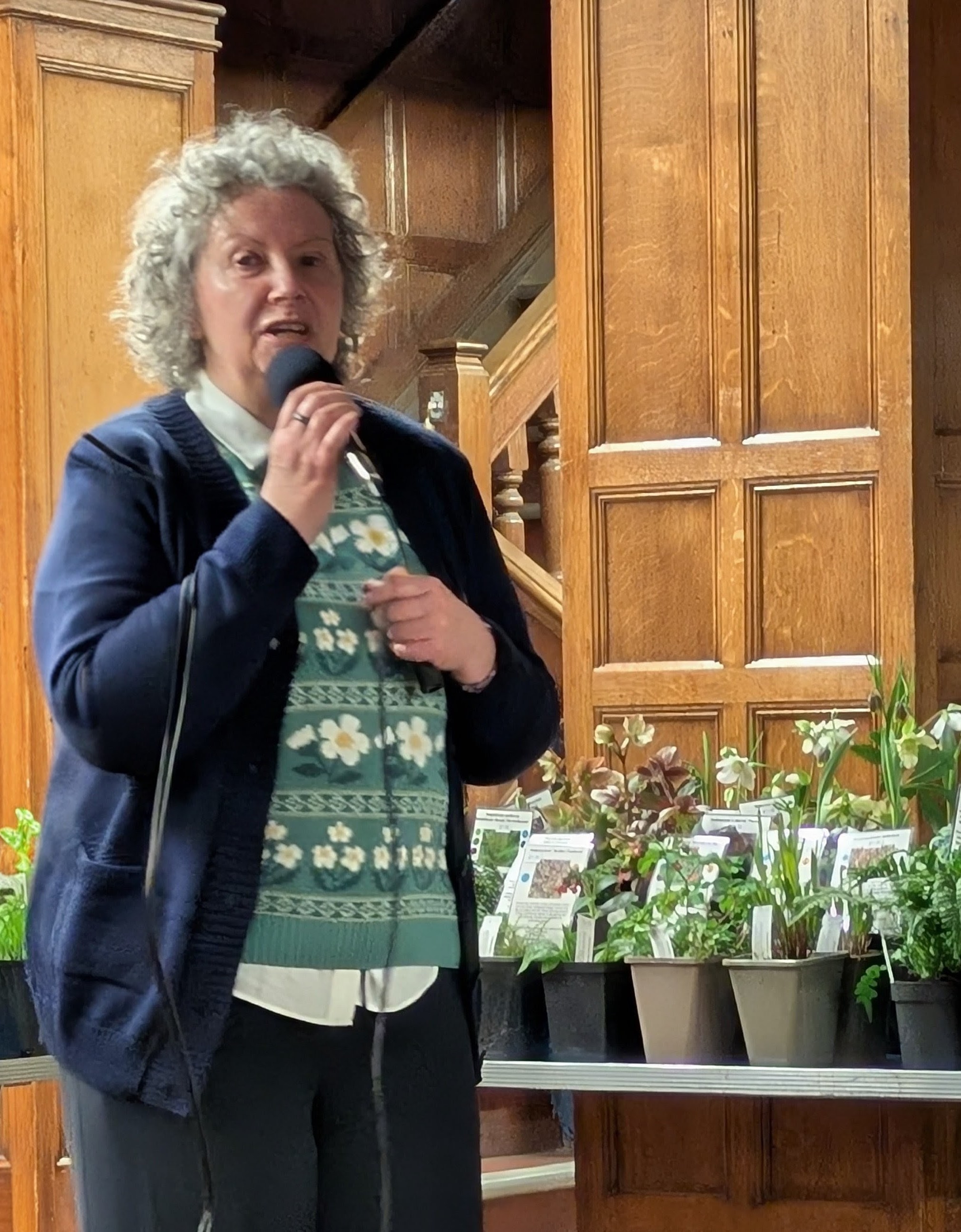
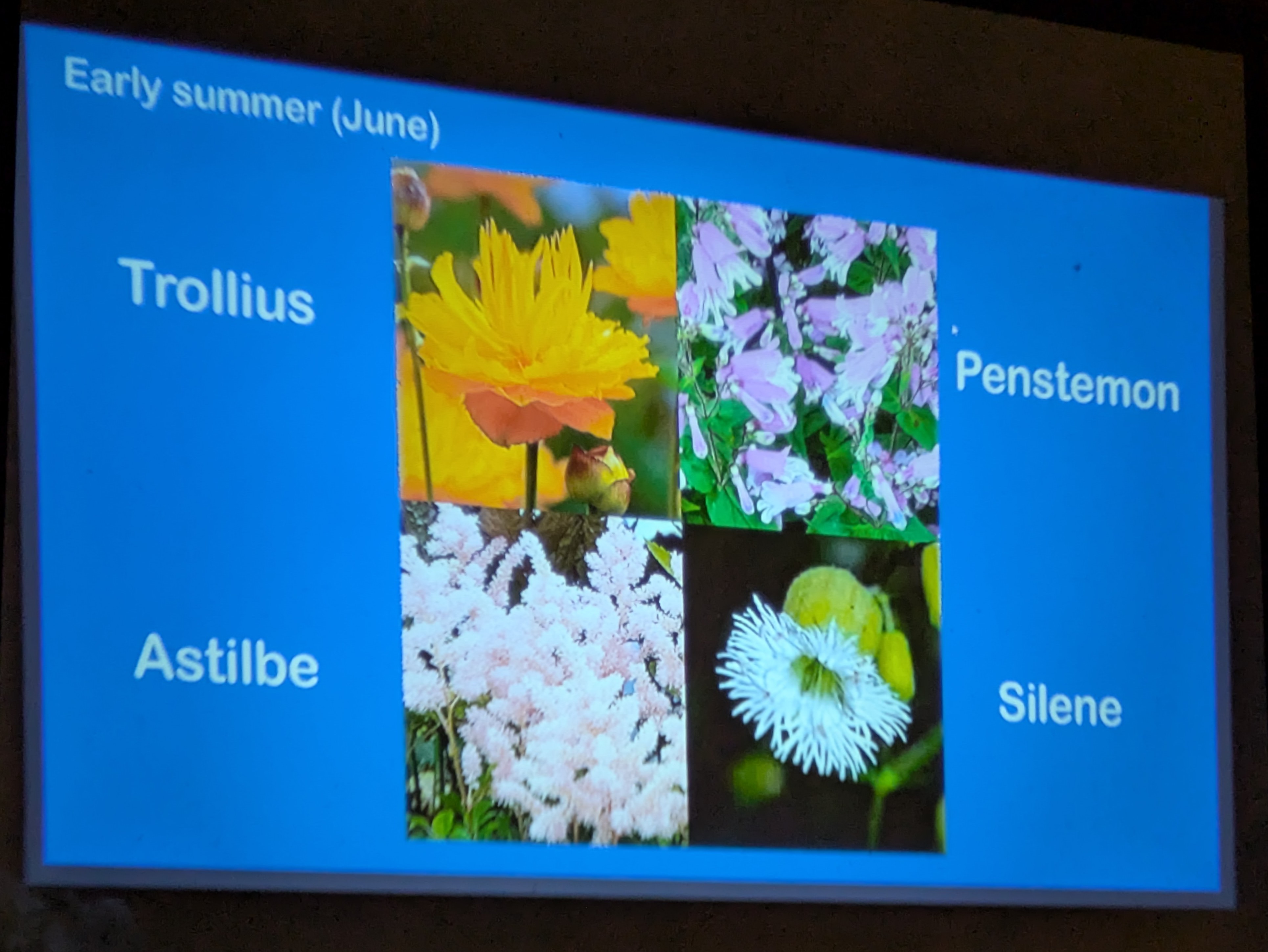
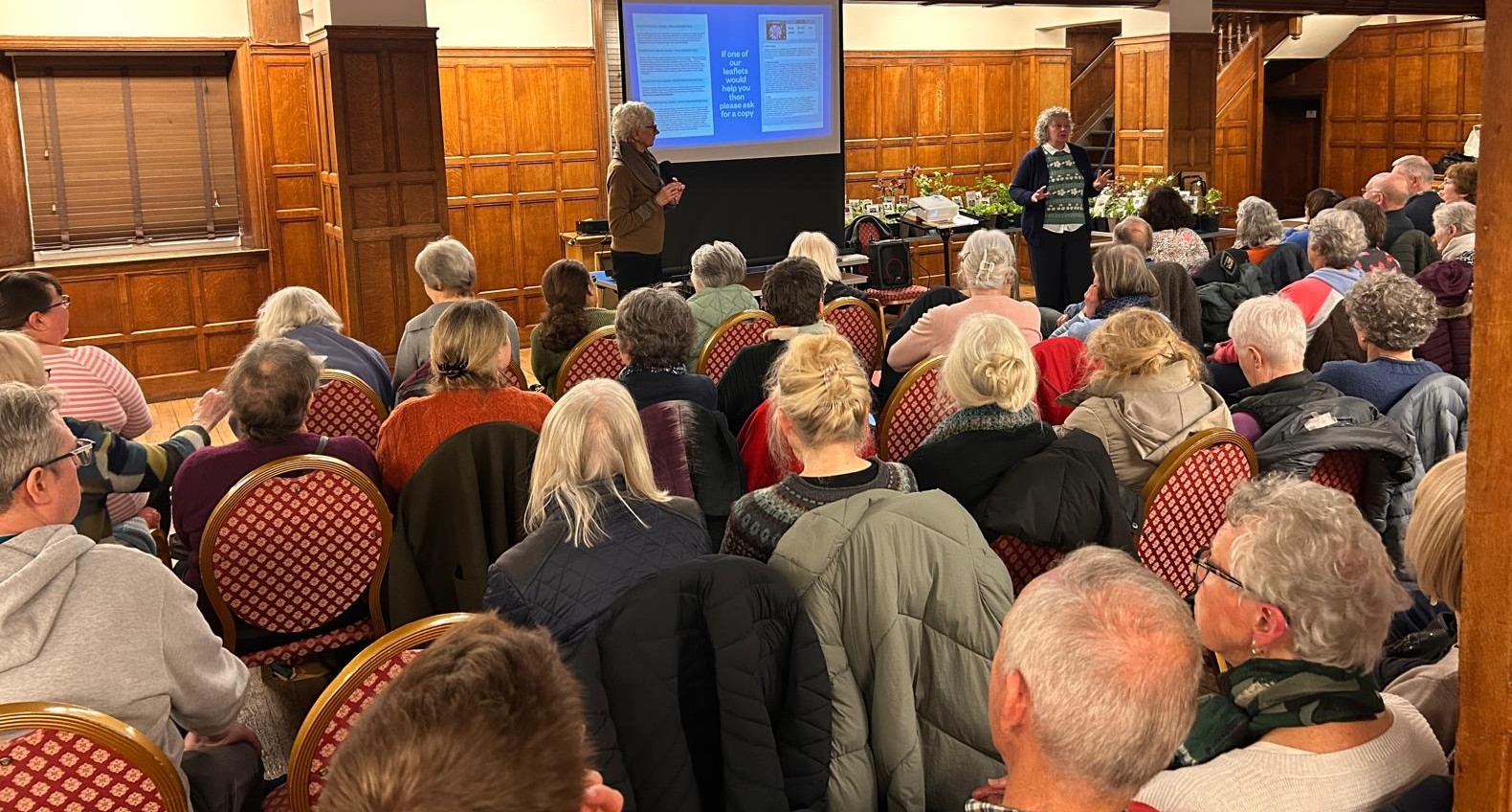
At our meeting on Monday 16 March we welcomed Lynne Moore of Moore and Moore Plants to talk to members about shade loving plants. A specialist in plants for shade for over 30 years, Lynne was clearly passionate about her subject and described herself as a ‘plantaholic’. She noted that from their very first time exhibiting at the Chelsea Flower show, one of the most common complaints she heard from visitors was that ‘nothing grows in the shade’ and this may be why our meeting attracted a large number of attendees. Lynne set out to prove that this is a very mistaken view…
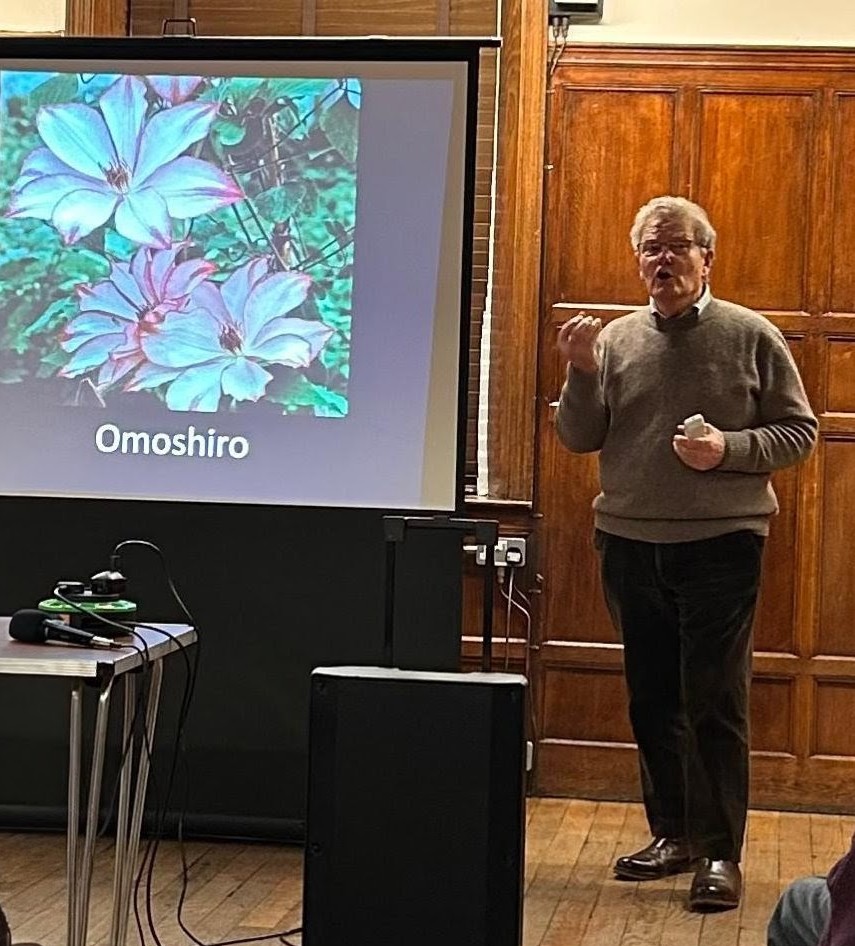
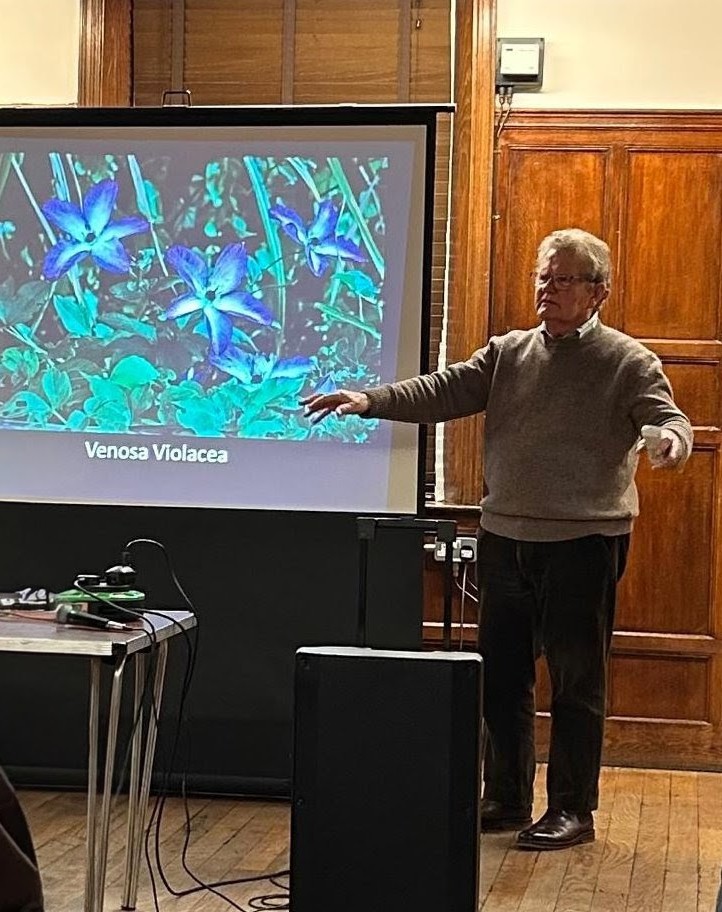
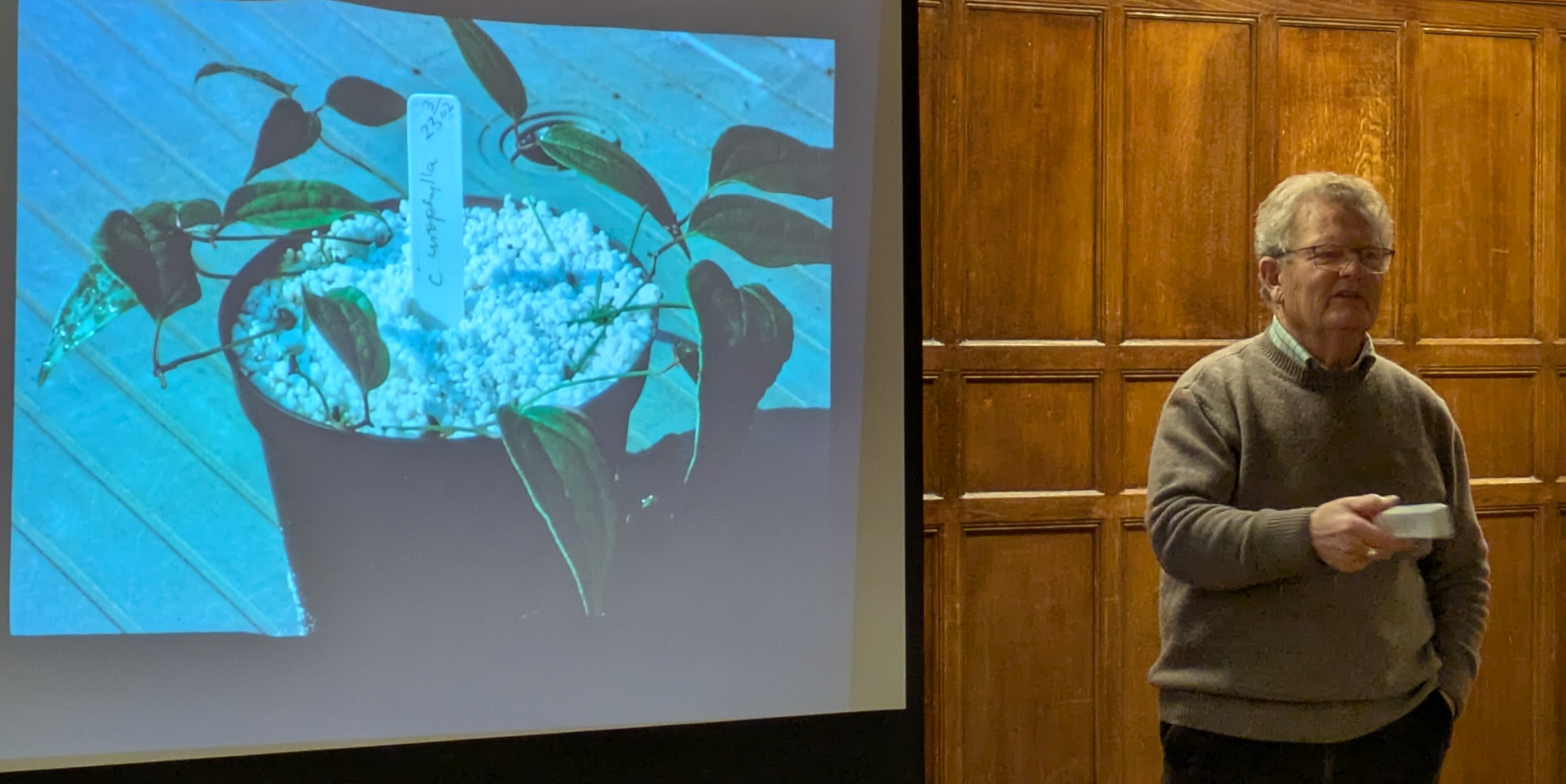
On Monday we welcomed Everett Leeds who gave us an amusing and highly informative talk about the prolific world of Clematis. He has been involved with Clematis for many years through growing, speaking and writing about them. He has been the Chairman of the British Clematis Society four times and is co-author of The Illustrated Encyclopaedia of Clematis . Everett’s enthusiasm for the genus was highlighted when he shared a photo of his former home with the front fence, hedges and trees completely swamped by a 120 foot long and 40 foot high ‘monstrous’ C. Montana. After cutting this completely away, he planted another!
It was a pleasure to welcome back Dr David Marsh, garden historian, academic and former trustee of The Gardens Trust. The intriguing title of his talk was ‘The Great Geranium Robbery’, about an Old Bailey trial in 1795 following the theft of numerous expensive plants…
The scene:
Daniel Grimwood’s Nursery (formerly The Kensington Nursery) in West Kensington.
This month we welcomed Ruth Cornett, one of our own members, who talked to us about Flowers in Art, building on some of the themes she had developed in an earlier presentation.
Ruth demonstrated that, over the years, artists have used flowers in their work to indicate and symbolise a range of meanings, from simple decoration to literary references. Depending on the context, flowers have been used to deliver a hidden message, promote certain ideas, to educate, to convey a Christian story or describe the cycle of life. Ruth’s presentation used one or two paintings to illustrate each of these themes.
Charles II of England being given the first pineapple grown in England by his royal gardener, John Rose Hendrick Danckerts, 1675
Tackling this has been a thorny issue – no pun intended – amongst park users as the Rose Garden was a much-loved feature. Somewhat surprisingly the Rose Garden, as it was when Head Gardener Tom Brown began work on the replanting in 2021, was not one of the heritage areas that fell under the Greenwich Park Revealed project. The garden had first been laid out only in the 1960s with some updates taking place in the 1990s.
Following on from a talk given in October 2024 by Dr Tim Ingram about his family run garden – Copton Ash – he returned for a more detailed presentation about the bulbs grown there. As he was not well that evening, his wife Gillian gallantly stepped up at the last moment to deliver the talk.
A wealth of bulbs have now been planted at Copton Ash, in beds, under trees and also allowed to naturalise in long grass. In particular a circular sunny gravelly bed was highlighted. The planting was at first inspired by the Lime Walk at Sissinghurst Castle which is very much a spring show of narcissus, tulips, primroses, anemones, scillas, violets and erythroniums. Tim has continuously added to and altered the planting in the circular bed so that there is now interest throughout the year.
This is now a regular and popular event in which our panel answer questions sent through in advance from members, some with illustrations or examples sent in plastic bags. The panel this year consisted of our very own CABAHS committee member and all-round plant guru Pat K, our President Sir Nicolas Bevan and horticulturalist and teacher Joe Woodcock. Sir Nicolas invited advice and contributions from the audience too, saying that in a room full of gardeners, the panel did not “have the monopoly on wisdom”. We did our best!
Our esteemed panel: Pat, Nicolas and Joe
Last year we were all overwhelmed by slugs and snails, this year’s scourge is aphids! The first question related to a particularly damaging infestation on Buddleja, which seemed to have caused a virus. Several people, including Joe, have experienced the same this year. He was able to tell us that it is likely to be a specific species, the Melon-cotton aphid, which the RHS are monitoring (you can report cases to the RHS here).
On 19 May we welcomed Dr. Francesca Murray to give a talk on ‘The Gardeners’ Royal Benevolent Institution and its horticultural heroes and heroines’.
Dr. Murray is an author, speaker and researcher on garden history and the horticultural trades, with a special interest in nineteenth century gardeners and nursery owners. Her talk focused on the range of benevolent, mutual aid and charitable societies – as well as the individual characters that founded and used them – that were set up in support of gardeners, florists and associated trades in the years before the welfare state was even considered.
Fiona Davidson is the head of Libraries and Exhibitions at the RHS as well as being an author. Her talk at our March meeting was based on her recent book ‘An Almost Impossible Thing – the radical lives of Britain’s pioneering women gardeners’(previously reviewed by Stella). She described the lives of female gardeners in the late nineteenth and early twentieth century, a reflection of the restricted lives led by women in general during this time. Yet despite this, some pioneers became gardeners and had successful careers in gardening.
Our first meeting of 2025 was very well attended. The speaker and the topic obviously attracted a good audience. The Show Table received a good selection of displays, with Jean’s a worthy winner of Best on the Table.
Our speaker, Fergus Garrett, the highly influential plantsman and horticulturalist, has been Head Gardener at the internationally acclaimed Great Dixter Garden in Northiam, East Sussex since 1993 and is the CEO of the Great Dixter Charitable Trust. He gave an excellent, wide-ranging talk on how to keep our gardens looking vibrant and spectacular all the year round. He explained how to plant for a long flowering season with plants co-existing in one place, but performing at different times. He used photographs of the spectacular gardens at Great Dixter to illustrate his points. He said Great Dixter had the advantage of scale and greenhouses but it is possible to scale down what they do at Great Dixter and use their scheme in our own gardens with minimal labour.
He particularly used the magnificent long border at Great Dixter as an example of how to plan a long flowering season. How to use structural under-planting, interlaying and interplanting with bulbs, self-sowers, perennials, clumps of bedding plants and climbers.


 Charlton and Blackheath Amateur Horticultural Society
