In the bleak midwinter, in amongst the primroses and snowdrops, the New Year brings excitement as the Daphne shrubs come into flower. For one member, several are looking looking extremely handsome and are, at present, the highlights in her garden.
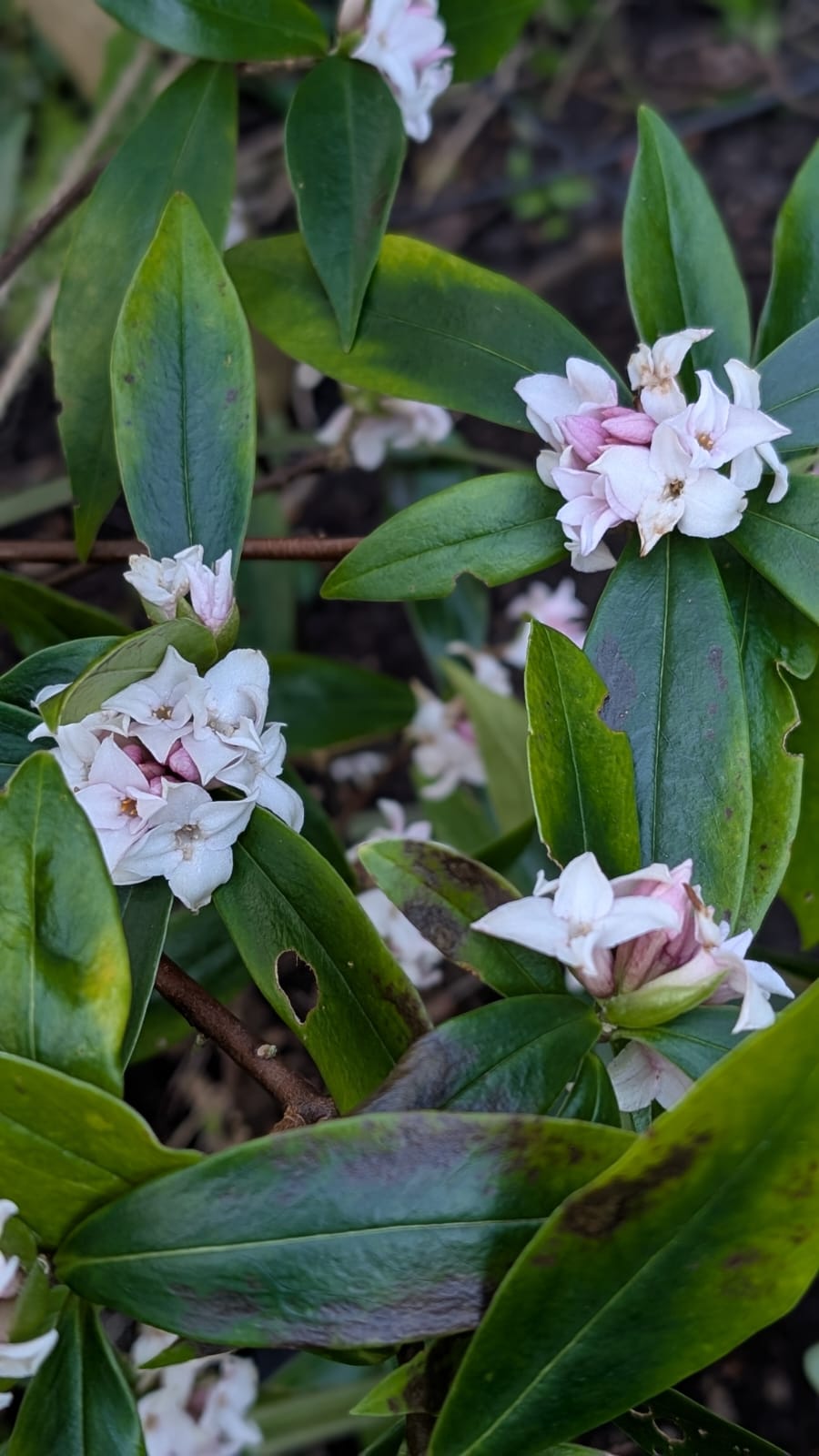
Daphne odora ‘Perfume Princess’ behind Astellia
Daphne odora ‘Perfume Princess’: This evergreen to semi-evergreen variety was bred in New Zealand and is considered the most perfumed of all the Daphnes. Between January and March, this shrub, which is regarded as hardy (although it suffered from the recent heavy frosts) will send out pale-pink blooms amongst its upright, handsome foliage, reaching a height of 1-1.5m over the years. Our CABAHS member says it has “wonderful scent and made a showy plant in just a few years.” I note that there is also a variety Daphne ‘Perfume Princess’ White on the market that would be a bonus to any garden.
One of the joys of walking around the neighbourhood is noticing what’s growing in front gardens and I like to stop and admire the imaginatively designed Xmas wreaths on doors at this time of year, planted window boxes and containers, and see what else is flowering in residents’ borders. And, when at bus stops, I have more time to absorb what’s around me.
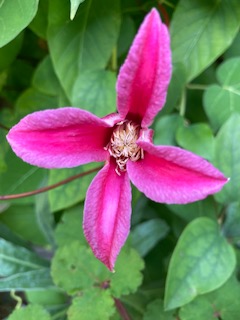
So, at a bus stop a few days ago I noticed Clematis ‘Freckles’ cascading over the wall of CABAHS member Linda W’s garden.
Linda tells me that she bought the clematis six years ago at around this time of the year – with its grey, dank days – “when one needs cheering up and it has not disappointed.” Linda also says that although the vine was slow to establish when planted on the cooler side of the property, it has really taken off. It was planted with a honeysuckle and it flowers profusely in the south/south-west boundary wall. In the summer months it can soak up the sun and in the winter is sheltered by the brick boundary wall.
Although I have written about both these plants in the past, I have chosen them again as ‘Plants of the Month’ because the flower colouring of each is in harmony with one another and both brighten up a garden during the long winter months.
Salvia ‘Black and Blue’ with Westringia in the background (plus orange flower of Pineapple Sage)
Westringia fruticosa (Coastal/Australian Rosemary): This is second plant I have grown of this variety over the years: the first, given to me as a rooted cutting, had a good branch structure and lasted several years in a pot, positioned on a south-facing table; the second was purchased this June from a specialist nursery at the Horniman Plant Fair and, once again, it has an attractive rounded shape, which means they are suitable for growing in pots whilst they are small.
Salvia ‘Amistad’, in less than 20 years, has become a much-loved cultivar throughout the world. and is known as the ‘friendship sage’. It was discovered in a tray of salvias at a plant sale in Argentina in 2005 by Dr Rolando Uria, and he decided to name it ‘Amistad’, meaning ‘friendship’ in Spanish.
There is much to love about this plant, in that its 1.5m high, bushy, rounded habit is ideal for planting schemes, guaranteeing a display of purple flower spires, with highly aromatic foliage, from mid-summer until the frosts in October-November. It’s not 100% hardy, so I have lost it a couple of times over the years but it’s always worth repurchasing. The young growths are adored by slugs and snails, so during wet weather in spring it can be difficult to get going.
I have noticed, however, that in London’s parks, Salvia ‘Amistad’ really thrives and can be seen growing happily and well-established in May, beneath London Planes in much drier soils, where the mature trees are protecting the plants during the winter months. And the drier soils obviously do not attract the slugs during early spring growth.
What a struggle it has been to protect the shoots of these two clematis from sustained attacks by the usual culprits this year! Not only did I use a garlic spray (one clove of garlic simmered in water) but I also liberally (and continually) sprinkled spent coffee grounds around the base of the plants. Although they were saved, I did lose other clematis: scented C ‘Betty Corning’, C ‘Rising Star’ and C ‘Wedding Day’ – all absolutely lovely and such a loss that I will need to repurchase them.
Clematis ‘Princess Diana’ This clematis is definitely one of my ‘top five’. The tulip-shaped flower is an unusual shade of bright pink, with beautifully striped markings both inside and outside of the petals (sepals). This variety (texensis) was introduced by a British breeder to honour the Princess of Wales in 1984 and has deservedly been given the RHS Award of Garden Merit.
As to be expected ‘Princess Diana’ came into flower late – in July, rather than June – and has been flowering continually, with eight flowers and a few buds on the vine at present.
One of the nicest aspects about walking around the streets in our neighbourhoods is being able to view the diverse range of flowering trees, shrubs, perennials and bulbs that enhance front gardens and, in early August, it’s the showiness of Agapanthus that makes one stop in one’s tracks in admiration.
And so, it was an added pleasure to be able to admire the magnificent evergreen Agapanthus praecox “Madeira Blue” and “Madeira White” in my neighbour’s rear garden. Linda tells me she purchased the bulbs in Madeira approximately ten years ago, where these perennials have become naturalised throughout the island.
The plants are extremely tall and vigorous and absolutely stunning, with additional flowering stems this year, having outgrown (and broken) previous terracotta pots. The bulbs have been in the existing plastic pots (sitting on feet) for the past three years, having been divided up – no easy task – and planted into several more containers. They have not been fed for a while and are not given protection in the winter (it’s a sheltered garden) with the flower heads left on until spring.
We might complain about all the rain we have had over the last few months but the plants have just loved, loved, loved it!
So, for the first time ever, I can celebrate, as my Angel’s Fishing Rod (beautiful name) is due to send up at least four flowering stems after many years and I put this down to the extensive rain we have endured this past winter and spring.
At Sissinghurst Gardens recently, I spotted two Dieramas in flower – the maturer pink-flowering specimen in the sheltered Rose garden, in a front-of-border, corner position where two paths meet, and a smaller, delicate-blush-mauve-flowering specimen growing in a south-facing border, situated in front of a tall brick wall – both looking absolutely gorgeous.
June really is the month for roses and when I saw Margaret T’s roses growing on her allotment, I was enchanted by each and every one and I have listed below a few that are in flower now.
Rosa ‘James Galway’
A David Austin climbing rose, introduced in the year 2000 and named after the Irish flautist. Margaret grows this rose as a shrub, so the flowers are at head height and the pink blooms, paler at the edges, have an old rose appearance and fragrance.
Rosa ‘A Whiter Shade of Pale’
What a name! And, what a rose! This gorgeous hybrid tea has blush-pink, very fragrant, repeat-flowering clusters, and glossy dark-green leaves. Considered disease resistant. Introduced in 2006 by rose-breeder, Colin Pearce.
The show gardens at the Chelsea Flower Show each May just zing with the stunning colours of the irises in bloom and they really are one of the main attractions (apart from roses) that are on display. Being ‘show-stoppers’, their impact allows the designers to then infill and arrange around them the more delicate flowers and foliage to an harmonious effect. Visitors admire, with ‘oooh’s and aaah’s’ at the soft, subtle shades and again, of the deeply-rich and vibrant colours of each and every iris grouping.
The name Iris means rainbow and in Greek mythology ‘Goddess of the Rainbow’. The petals and roots of several species, including Iris germanica (bearded) and Iris pallida (Dalmatian/Orris root) are used in the beauty industry, in the manufacture of perfumes, lotions, in food such as spices and even added to gin. Seemingly, the dried root, after 3 years, has the aroma of violets. This industry goes back to the ancient Greeks, Romans and Egyptians and probably long before their time.
I have an Iris pallida flowering in my front garden, low-growing, which is highly fragrant. This was kindly given to me by Penny S some years ago. The flower is fading so unfortunately not worthy of a photograph but it certainly should be grown, as the variegated grey-foliage blends nicely with neighbouring plants. I wouldn’t be without it.
My number-one favourite, though, is Iris ‘Langport Wren’, a Kelways‘ introduction from 1973 and deservedly worthy of the RHS Award of Garden Merit. It was flowering in my front garden until a few days ago when the slugs/snails chomped its head off! The fragrance is reputedly of orange and chocolate – but I wouldn’t know as I haven’t had the chance to find out!!! The first photo below is of this delectable flower, a painterly amalgamation of browns, purples and russets, growing in Margaret T’s garden.
One morning in mid-April – the warmest of the month so far, I had the pleasure of visiting our ex-chairman, Jillian S, to see the display of her stunningly beautiful tree peony flowers. These are well established shrubs with one or two still in bud and the rest nearly finished flowering, apart from the 2-metre species Paeonia delavayi, which is covered in red flowers and buds.
Every gardener should possess at least one tree peony – just to experience their few weeks of fleeting beauty – and, of course, their very handsome and large foliage, which is an added bonus to every garden for many months of the year.
I noticed that Jillian’s tree peonies have or had far more buds than mine, which is about 20 years old. Why is that? Jillian tells me that she has always had a strict policy upon purchasing any plant, including the tree peonies, and that is to immediately repot the plant with one-third multi-purpose and two-thirds of soil from her own garden. Only when the roots have established themselves in the new soil mix does Jillian then plant them in her borders. This method ensures there are fewer plant losses as the roots get the chance to adjust slowly to the change of soil, with the outcome being much stronger and robust root systems and, ultimately, stronger and healthier plants. And, that is the best gardening tip I have ever received!
Jillian tells me that all her peony varieties (Paeonia x suffruticosa) arrived as ‘freebies’ during 2009 and 2011, as special offers advertised in one of our major newspapers. They would arrive in good condition: an 18” stem with two or three branches and a sturdy root system of approximately 9” in length. These would, after potting on, be left for around 9 months to 1-year before being planted into a bed. In springtime, from then on, when the soil is still moist, a mulch of homegrown compost is added around the base of the plants to retain the health of these specimens.
Over the years, Jillian has diligently and systematically recorded in notebooks all of her purchases. And in one of her notebooks she has found her notes on the exact dates the tree peonies arrived: 4th June 2009: Hai Huang Yao (yellow) and Huang Hu Huang Dao Jin (cerise with white splashes). 11th November 2009: Wu Long Peng Sheng (pink/red) and Honxia Hu Hong (pink). 23rd April 2011: Wedding Day.
Peonies prefer morning sun and dappled shade if possible and Jillian’s peonies are perfectly positioned, growing on the north side in the spring garden, some protected by the apple trees. Very little pruning is necessary but I notice that Jillian’s tree peonies are more elegant than my shrub, so a little judicious pruning on my part would not go amiss!