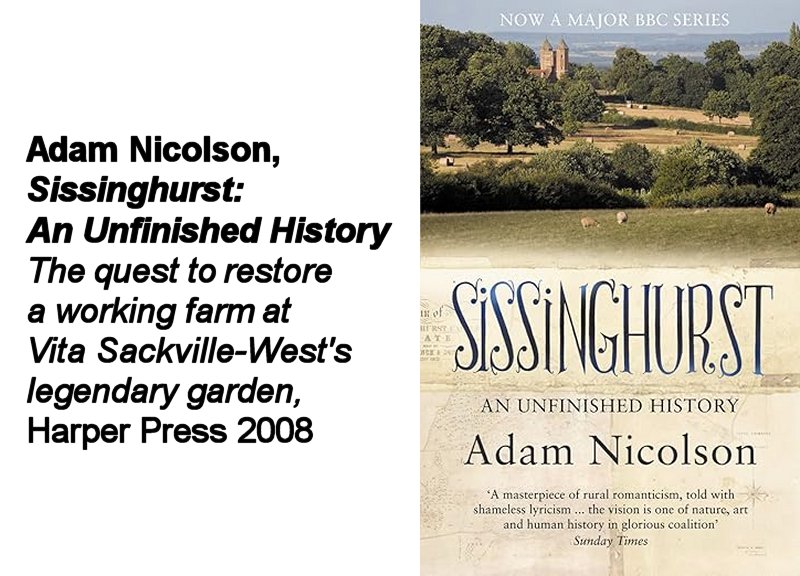
If you are a history buff, this book will engross you from start to finish. Adam Nicolson’s extensive research reveals that a Sissinghurst dwelling was recorded on the site in AD 843. The Kentish inhabitants’ lives of hard work, industry and hardship over the centuries are brought to life by descriptions of everyday life. The expansion of a smaller house into a Manor House in the sixteenth century by a local lad made good, to the sad demise of the dwelling and its appalling conditions during the housing of the French prisoners in the 18th century is vividly told.
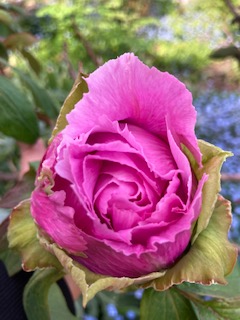
One morning in mid-April – the warmest of the month so far, I had the pleasure of visiting our ex-chairman, Jillian S, to see the display of her stunningly beautiful tree peony flowers. These are well established shrubs with one or two still in bud and the rest nearly finished flowering, apart from the 2-metre species Paeonia delavayi, which is covered in red flowers and buds.
Every gardener should possess at least one tree peony – just to experience their few weeks of fleeting beauty – and, of course, their very handsome and large foliage, which is an added bonus to every garden for many months of the year.
I noticed that Jillian’s tree peonies have or had far more buds than mine, which is about 20 years old. Why is that? Jillian tells me that she has always had a strict policy upon purchasing any plant, including the tree peonies, and that is to immediately repot the plant with one-third multi-purpose and two-thirds of soil from her own garden. Only when the roots have established themselves in the new soil mix does Jillian then plant them in her borders. This method ensures there are fewer plant losses as the roots get the chance to adjust slowly to the change of soil, with the outcome being much stronger and robust root systems and, ultimately, stronger and healthier plants. And, that is the best gardening tip I have ever received!
Jillian tells me that all her peony varieties (Paeonia x suffruticosa) arrived as ‘freebies’ during 2009 and 2011, as special offers advertised in one of our major newspapers. They would arrive in good condition: an 18” stem with two or three branches and a sturdy root system of approximately 9” in length. These would, after potting on, be left for around 9 months to 1-year before being planted into a bed. In springtime, from then on, when the soil is still moist, a mulch of homegrown compost is added around the base of the plants to retain the health of these specimens.
Over the years, Jillian has diligently and systematically recorded in notebooks all of her purchases. And in one of her notebooks she has found her notes on the exact dates the tree peonies arrived: 4th June 2009: Hai Huang Yao (yellow) and Huang Hu Huang Dao Jin (cerise with white splashes). 11th November 2009: Wu Long Peng Sheng (pink/red) and Honxia Hu Hong (pink). 23rd April 2011: Wedding Day.
Peonies prefer morning sun and dappled shade if possible and Jillian’s peonies are perfectly positioned, growing on the north side in the spring garden, some protected by the apple trees. Very little pruning is necessary but I notice that Jillian’s tree peonies are more elegant than my shrub, so a little judicious pruning on my part would not go amiss!
If RHS gold medals could be given to individual gardens, then The Woodlands Farm Cottage Garden deserves that honour. I am, at the moment of writing, sat on one of the many benches enjoying this charming garden.
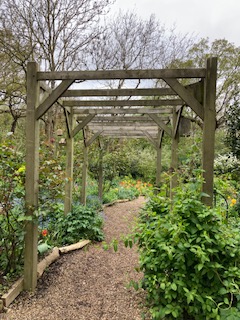
Volunteers started working to create a cottage garden back in 1998 and now, 25 years on I am gazing at their ‘gold-medal’ creation. The garden has everything one would want: wide gravel paths edged with brick or logs meandering around several large informal flowering beds; a rose and clematis-framed timber pergola walkway; glasshouse; summerhouse; raised vegetable and fruit beds; propagation area; pond; a bug hotel; and, very importantly, tables and chairs for family snack times.
A wren has announced its arrival on the beautifully pruned Exochorda and children and mothers are coming in to excitedly explore and admire the garden’s loveliness. From my bench are carefully pruned shrubs arising tall from the spring beds. This allows visitors to clearly view the purple honesty, inky-blue aquilegias, mauve vinca, forget-me-nots, narcissi, tulips, camassias, allium buds, geraniums, hellebores, wallflowers, bergenia, primulas, lamiums and more – all looking their very, early-spring best. Masses of tall cow-parsley are breaking into flower in front of the flowering choisya and viburnums, creating an harmonious effect. And I’ve spotted purple-stemmed cow parsley looking extremely healthy, as well (most envious!)
This cottage garden is sheltered and faces south. It is surrounded by mature trees and many evergreen shrubs so it has its own little micro-climate.
Before I leave, I glance once again at the charming, delicately-pink blossom on the spreading branches of the old apple tree. With a table and chairs set beneath its canopy and spring flowers in the foreground, it is a really lovely vision. And it’s a gold-medal from me! The garden is open to the general public. More information about Woodlands Farm Trust here. Do visit before the spring flowers fade.
1. Prune hardy fuchsias now both in pots and in the ground to promote new growth and to prevent the plants from becoming too woody.
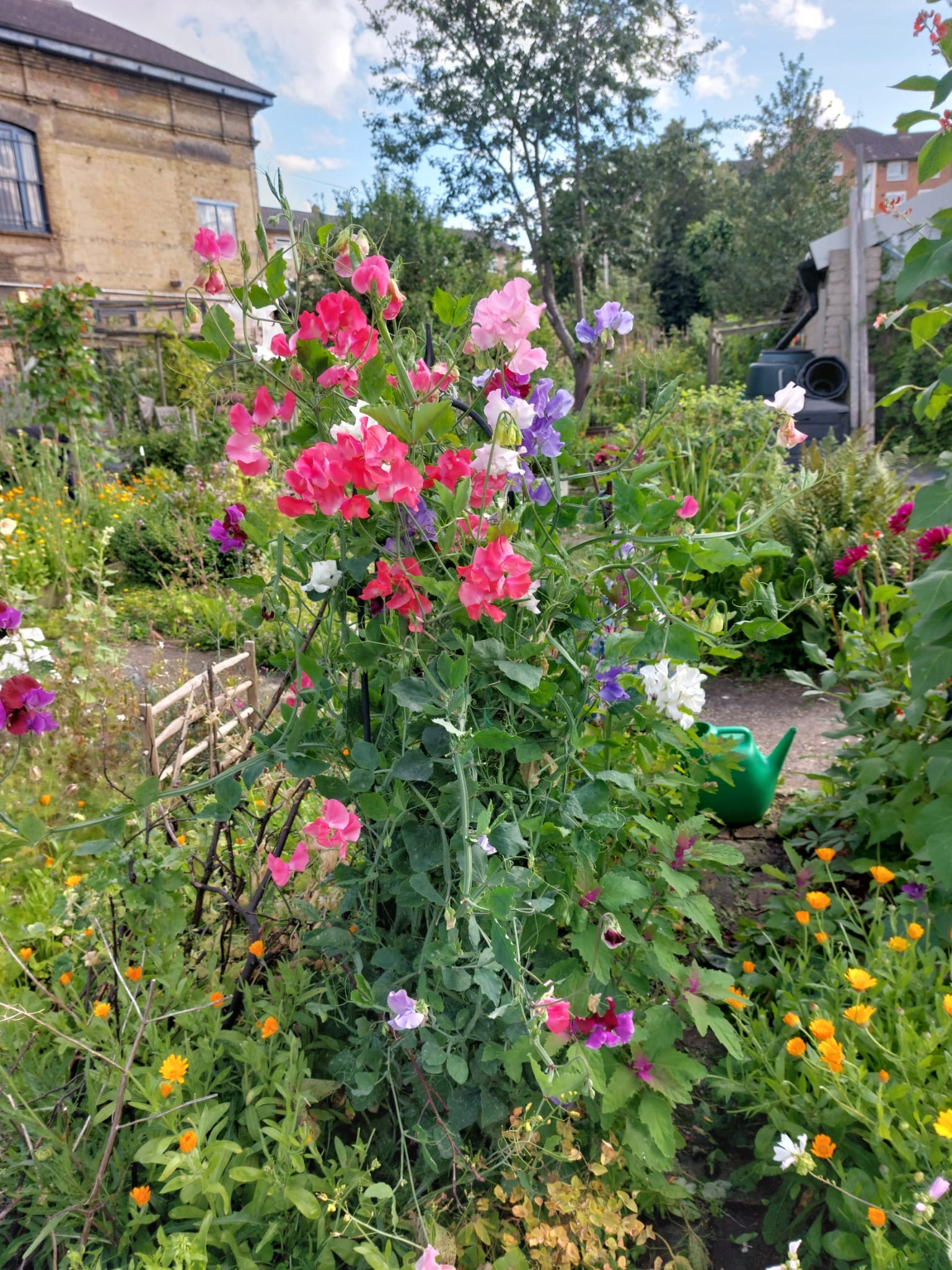
2. Plant out pot grown sweet peas now making sure to pinch out the shoots to promote bushy plants. You can also sow directly in the ground now if you didn’t sow earlier but watch out for slugs munching new seedlings.
3. Someone said the other day that they hadn’t cut back their clematis but I don’t think its too late as the growth on them is phenomenal. It just means they will flower a bit later but then that extends the season.
Pat’s unpruned clematis already at the top of the arch!Pat’s cosmos seedlings – germinated in under a weekPat’s Cosmos flowers
1. I sowed my sweet peas early in the month five seeds to a 3 inch pot and then placed them on a light window sill or greenhouse if you have one. They don’t need bottom heat and I don’t soak or nick the seeds but of course you can if you wish. Keep turning the pots so they don’t all lean towards the light.
Sweet Pea seedlingsDreaming of this…
2. Remove browning blooms from camellias to keep the display going especially the white ones which never seem to drop their spent blooms. I just wish I had room for more as they’re such a cheerful sight.
I have a choice plant in my garden which, amazingly, I have managed to keep alive all these years and it’s all thanks to Margaret T, who kindly gave me an off-shoot such a long time ago.
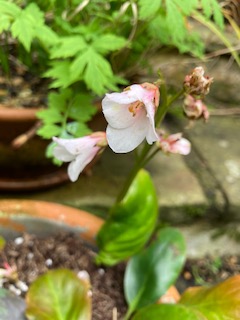
To make sure it was protected, I planted this bergenia in a pot on the shady side of the steps, so that the plant would stand out and not get damaged. It flowers every winter and has been flowering all through February this year and the elegant white, nodding flowers are still hanging on, fading to a shade of blush-pink. The rhizomes have outgrown the pot now so I will be thrilled if I can return the favour and offer Margaret T an off-shoot of this beautiful plant. Plants are difficult to obtain but I understand seed might be available on the market.
The botanists and growers regard this species as the most elegant of all the Bergenias and I can see why, as this compact plant with its rosette of neat, oval, apple-green, shiny leaves enhances the dainty flowers, which are held aloft on elegant, often blush-pink stems.
Seed was first collected from the limestone cliffs in Sichuan in the Himalayan mountains in 1935 and again in 1982 by Roy Lancaster who introduced the species to the UK. Cambridge Botanic Garden website mentions that Bergenia emeiensis can be seen growing in their Alpine House and that they are also trialling the species in their woodland area. The plant used to be regarded as tender but I regard it as a hardy perennial in my small courtyard garden which, like many London gardens, has its own micro-climate. Even so, I do, unfortunately, sometimes lose plants during colder winters but this species has not yet been damaged and so it’s a great treat to be able to admire this handsome specimen from my kitchen window.
The residents of London, SE3 and SE7 are treated to a two-month spectacle every year when the spring bulbs burst open beneath the London Plane trees in their local green space, called Batley Park.
Batley Park consists of a triangular space at the heart of the south-east London shopping centre, known as The Standard, surrounded by the busy, one-way B210 road.
During the winter, the park comes alive with the thousands of purple, mauve and white crocus sprinkled amongst the green sward, followed quickly by swathes and swathes of yellow daffodils, glowing like bright lanterns in the soft sunlight. It’s mother nature’s tapestry and a lovely sight to behold.
The park’s existence is all due to local campaigners, including The Rev John William Marshall, in the late 19th century, unhappy about the appearance of their village green. At that time it was known as Sheepgate Green, and due to their determination the space was transformed. Trees were planted and railings installed and thus renamed Batley Park, after the philanthropist, William Fox Batley, who contributed to the improvements. In 1889 a final touch was added – a Memorial Fountain was included on the south-west corner of the park. If you have not yet seen this year’s spectacle, do visit the park whilst visiting The Standard. At the time of writing I noticed that the daffodil clumps were still producing buds so that means local residents can enjoy this display for a few more weeks.
We are always keen to hear about how member’s gardens are growing or about what you can see from your window but occasionally we receive shorter messages. So here are a few we’ve had recently.
Angela thought members might like to see a photo of her Amaryllis lily. She says “Their sale in supermarkets at Christmas has rapidly become a tradition. Their very decorative, over the top flowers people either hate or love. I love them. They are easy to grow and spectacular. I planted mine after Christmas and it has now produced amazing flowers.”
Viv sent us a photo of the first tulips of the year in her garden with some other pots. Unsurprisingly, she is getting excited about spring…
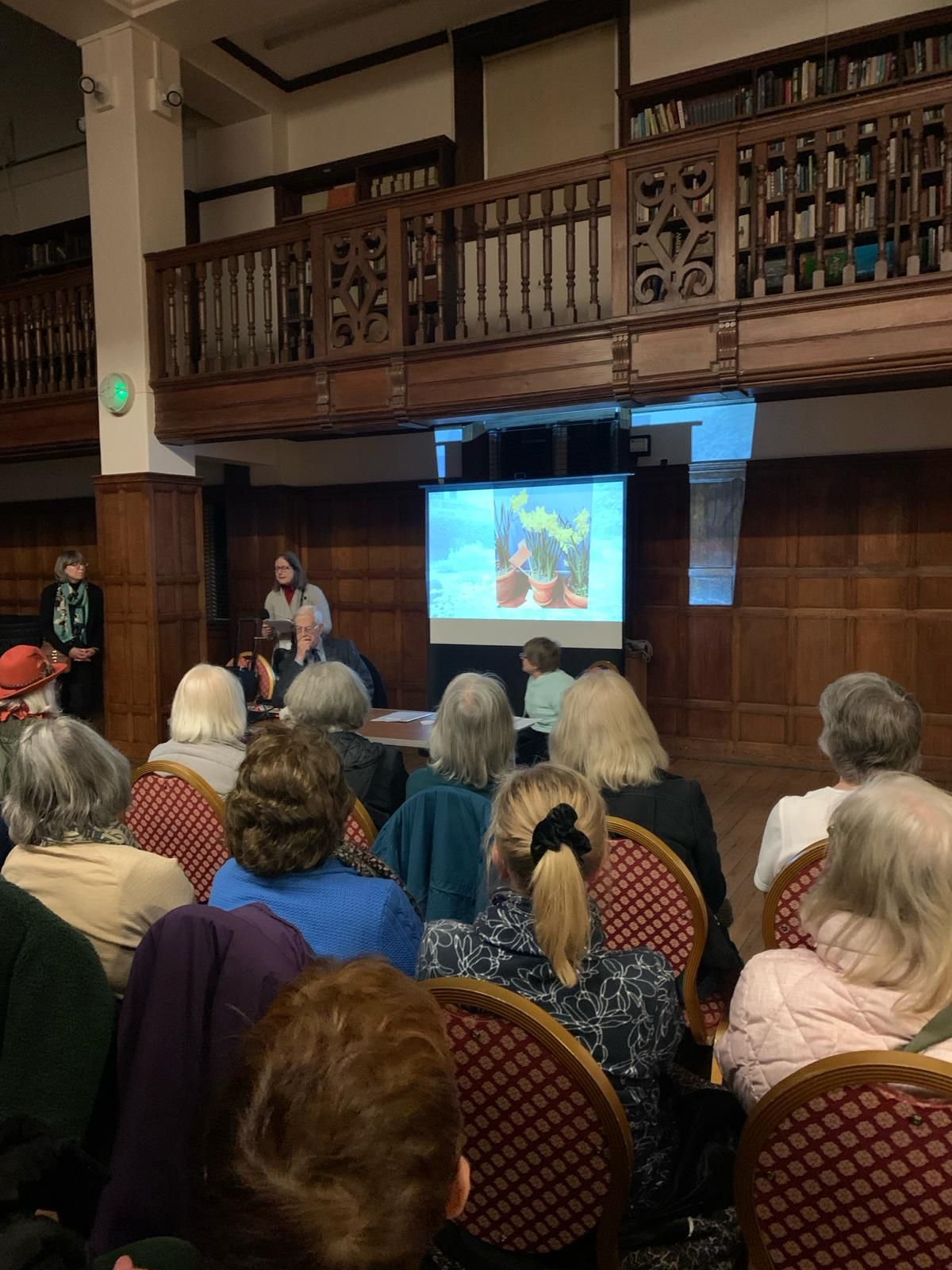
Our February meeting on Monday 19th, comprised our AGM, with the usual election of officers and presentation of the Annual Report, followed by a talk by Tom Stanier, the Horticultural Team Lead at Greenwich Park, about his life as a gardener at the Park and a behind-the-scenes look at working there in these challenging times.
Show Table Winners 2023 The Show Table cup is presented to the member with the most points on the monthly Show Table, over the past year. This year, the Winner was Annie H. Second place went to Terry. And Pat K and Anastasia were Third equal. Well done all.
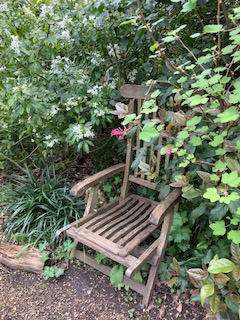
I, too, have a comfy seat looking out on my garden where I spend many happy hours deciding what changes need to be made in my garden (there is always something).
I am currently enjoying watching my pots of bulbs grow and begin to flower. I posted a photo on Facebook of my Harmony irises and my friend in Norfolk (who I think was rather envious) suggested I had a microclimate in my garden. It is very sheltered and faces west so maybe I do.
I have just decided to empty my rather unsightly compost bin and replace it with a smaller, more discreet one. I therefore have a large pile of compost which I am in the process of shovelling around the garden. I am expecting a spectacular display later in the year!
My Clematis Armandii under the tree is budding nicely. I planted it some years ago and was disappointed last year that I had so few flowers on it. That was until I looked out from the upstairs window and discovered that my neighbours were enjoying a beautiful display! It had put all its energy into growing to a lighter spot in the garden next door!
I find this time of year quite difficult garden-wise, especially when the weather is mild, as it is at the moment. I am having to restrain myself from going wild with the secateurs and cutting everything back. I shall wait another month before giving my clematis, roses and salvia a good hair cut. I think it is also time to give the Hibiscus Syriacus Woodbridge a trim as it has grown rather tall and thin.
I hope other people will write about their views, as Kathy suggested.















 Charlton and Blackheath Amateur Horticultural Society